
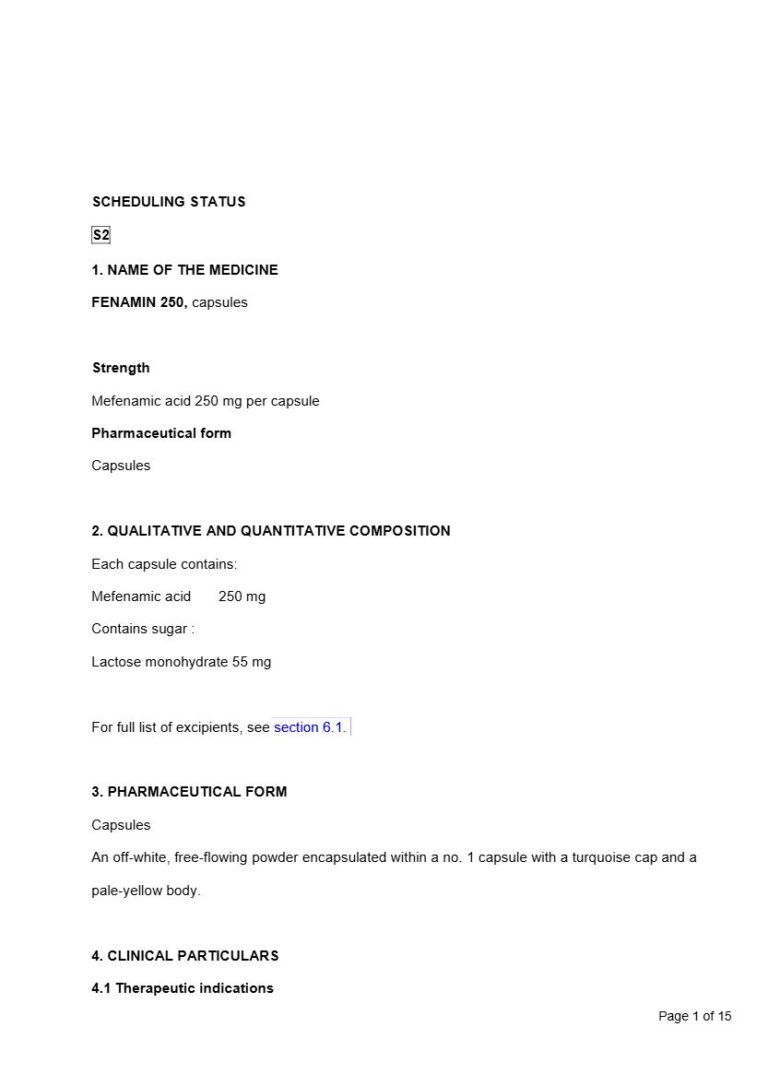
Fenamin 250 250 mg Capsules
PDF Leaflet Revision Date: 24 February 2022
Clinical Summary
Quick overview from the medicine insert
Indication
Treatment of post-traumatic conditions such as pain, swelling, and inflammation.
Dosage (summary)
Adults: 500 mg three times a day; Acute pain: 500 mg initially, then 250 mg every 6 hours. Max 5 days.
Special Populations
- Elderly
- Renal impairment
- Hepatic impairment
Pregnancy & Breastfeeding
Avoid in pregnancy, especially after 20 weeks; not recommended during breastfeeding.
Key Drug Interactions
- Warfarin
- Lithium
- Corticosteroids
- SSRIs
Contraindications
- Hypersensitivity to mefenamic acid
- History of gastrointestinal bleeding
- Active peptic ulcer
- Epilepsy
- Heart failure
Common side effects
- Gastrointestinal disturbances
- Diarrhoea
- Nausea
- Dizziness
- Headache
Counselling Points
- Take with food
- Monitor for gastrointestinal symptoms
- Avoid use in late pregnancy
- Report any unusual symptoms immediately
Serious warnings
- Risk of gastrointestinal bleeding
- Fluid retention
- Potential for cardiovascular events
Important Disclaimer
The Fenamin 250 250 mg Capsules professional information leaflet below is the property of Adcock Ingram and is provided on Medinsert exactly as issued, with no.. alterations or editorial changes. We make every effort to keep content current by updating documents as soon as new versions become available. Medinsert serves as a trusted access point for healthcare professionals, but does not replace official sources or clinical judgement. For more details, please read our full disclaimer. read more>>
 Healthcare Professionals Only
This content is for registered healthcare professionals
Sign in or create a free account to read the full package insert.
Free for HPCSA-registered professionals. Powered by Medinsert.
Clinical Particulars
Section 4 of the official insert — extracted exactly as issued, no alterations
4.1 Therapeutic indications
FENAMIN 250 is indicated for the treatment of post traumatic conditions such as pain, swelling and inflammation, for a maximum period of 5 days.
4.2 Posology and method of administration
Posology
Use the lowest effective dose for the shortest possible duration of treatment. FENAMIN must be taken with meals. FENAMIN 250 should not be given for longer than 5 days.
Adults
Treatment of post-traumatic conditions: Relief of mild to moderate pain: 500 mg three times a day. Acute pain: An initial dosage of 500 mg, thereafter 250 mg every 6 hours.
Paediatric population
No information available.
Method of administration
For oral administration.
4.3 Contraindications
FENAMIN is contraindicated in:
u2022 Hypersensitivity to mefenamic acid and other NSAIDs, with prostaglandin synthetase inhibiting activity or to any of the ingredients of FENAMIN (see section 6.1).
u2022 Because of the possibility of cross-sensitivity among NSAIDs exists, FENAMIN should not be given to patients in whom these medicines induce symptoms of bronchospasm, allergic rhinitis, or urticaria.
u2022 History of gastrointestinal perforation, ulceration or bleeding (PUBs) related to previous NSAIDs, including FENAMIN.
u2022 Patients with an active or a history of recurrent peptic and/or intestinal ulceration /haemorrhage/perforations.
u2022 Chronic inflammation of either the upper or lower gastrointestinal tract such as Inflammatory bowel disease.
u2022 Epilepsy.
u2022 Patients with impaired hepatic or renal functions.
u2022 Heart failure.
u2022 Treatment of pain after coronary artery bypass graft (CABG) surgery.
u2022 Pregnancy and lactation (see section 4.6).
u2022 Avoid use of NSAIDs in women around 30 weeks gestation and later in pregnancy due to the risks of oligohydramnios/ foetal renal dysfunction and premature closure of the foetal ductus arteriosus (see section 4.4 and 4.6).
4.4 Special warnings and precautions for use
Blood counts and liver function should be monitored during long-term therapy with FENAMIN. FENAMIN may enhance the effects of warfarin (see section 4.5).
Elderly:
The elderly have an increased frequency of adverse reactions to NSAIDs such as FENAMIN, especially gastrointestinal perforation, ulceration and bleeding (PUBs) which may be fatal. The risk of gastrointestinal perforation, ulceration and bleeding (PUBs) is higher with increasing doses of FENAMIN, in patients with a history of ulcers, and the elderly. FENAMIN is best avoided in elderly patients with dehydration or pre-existing renal disease. Undesirable effects may be minimised by using the lowest effective dose for the shortest duration necessary to control the condition treated.
Patients on prolonged therapy with FENAMIN should be kept under regular surveillance with particular attention to liver dysfunction, rash, blood dyscrasias or development of diarrhoea. Appearance of any of these symptoms should be regarded as an indication to stop therapy immediately.
Precaution should be taken in patients suffering from dehydration and renal disease, particularly the elderly. FENAMIN and its metabolites may give a false positive reaction to certain urine tests for the presence of bile.
Respiratory disorders:
Caution is required if administered to patients suffering from, or with a previous history of, bronchial asthma since NSAIDs have been reported to precipitate bronchospasm in such patients. Bronchoconstriction may occur with FENAMIN in asthmatic patients with aspirin sensitivity.
Cardiovascular, renal and hepatic impairment:
FENAMIN should be used with caution in patients with impaired renal or liver function. The administration of FENAMIN may cause a dose-dependent reduction in prostaglandin formation and precipitate renal failure. Patients at greatest risk of this reaction are those with impaired renal function, cardiac impairment, liver dysfunction, those taking diuretics and the elderly. Renal function should be monitored in these patients. FENAMIN may enhance the effects of warfarin. Toxicity has also been seen in patients with pre-renal conditions leading to a reduction in renal blood flow or blood volume. Patients at greatest risk are those with impaired renal function, heart failure, liver dysfunction, those taking diuretics, and the elderly. Liver function tests must be carried out regularly to monitor elevation of enzymes and bilirubin.
Cardiovascular and cerebrovascular effects:
Appropriate monitoring and advice are required for patients with a history of hypertension and/or mild to moderate congestive heart failure as fluid retention and oedema have been reported in association with NSAID therapy such as FENAMIN. Use of some NSAIDs such as FENAMIN (particularly at high doses and in long-term treatment) may be associated with a small increased risk of arterial thrombotic events (for example myocardial infarction or stroke). There are insufficient data to exclude such a risk for FENAMIN. Patients with uncontrolled hypertension, congestive heart failure, established ischaemic heart disease, peripheral arterial disease, and/or cerebrovascular disease should only be treated with FENAMIN after careful consideration. Similar consideration should be made before initiating longer-term treatment of patients with risk factors for cardiovascular disease (e.g., hypertension, hyperlipidaemia, diabetes mellitus, smoking). Caution is required in patients with a history of hypertension and/or heart failure as fluid retention and oedema have been reported in association with FENAMIN therapy. In view of the FENAMINu2019s inherent potential to cause fluid retention, heart failure may be precipitated in some compromised patients. As NSAIDs such as FENAMIN can interfere with platelet function, they should be used in caution in patients with intracranial haemorrhage and bleeding diathesis.
Gastrointestinal bleeding, ulceration and perforation:
Gastrointestinal perforation, ulceration or bleeding (PUB) which can be fatal, has been reported with all NSAIDs such as FENAMIN at any time during treatment, with or without warning symptoms or a previous history of serious gastrointestinal events. Smoking and alcohol use are added risk factors. The risk of gastrointestinal perforation, ulceration or bleeding is higher with increasing FENAMIN doses, in patients with a history of ulcer, particularly if complicated with haemorrhage or perforation and in the elderly. FENAMIN should be given with caution to patients with a history of gastrointestinal disease (e.g., ulcerative colitis, Crohnu2019s disease, hiatus hernia, gastro-oesophageal reflux disease, angiodysplasia) as the condition may be exacerbated. If diarrhoea occurs, use of FENAMIN should be discontinued immediately. Combination therapy with protective medicines (e.g., misoprostol or proton pump inhibitors) should be considered for patients at risk of gastrointestinal bleeding such as the elderly, and also for patients requiring concomitant low dose aspirin, or other medicines likely to increase gastrointestinal risk. Patients with a history of gastrointestinal toxicity, particularly the elderly, should report any unusual abdominal symptoms (especially gastrointestinal bleeding) particularly in the initial stages of FENAMIN treatment. Caution should be advised in patients receiving concomitant medicines which could increase the risk of gastrointestinal side effects or bleeding such as corticosteroids, anticoagulants such as warfarin, selective serotonin reuptake inhibitors or anti-platelet medicines such as aspirin. When gastrointestinal perforation, ulceration or bleeding occurs in patients receiving FENAMIN, FENAMIN should be withdrawn. Diarrhoea may occur within 24 hours following usual FENAMIN dosage. When diarrhoea occurs, FENAMIN should be discontinued immediately. Temporary lowering of the white blood cell count has occurred but does not appear to be dose-related. Blood counts should be performed at regular intervals during long-term administration of FENAMIN.
SLE and mixed connective tissue disease:
In patients with systemic lupus erythematosus (SLE) and mixed connective tissue disorders there may be an increased risk of aseptic meningitis.
Skin reactions:
Serious skin reactions, some of them fatal, including exfoliative dermatitis, Stevens-Johnson syndrome, and toxic epidermal necrolysis, have been reported in association with use of NSAIDs such as FENAMIN. Patients appear to be at highest risk of these reactions early in the course of therapy, the onset of the reactions occurring in the majority of cases within the first month of treatment. FENAMIN should be stopped at the first appearance of skin rash, mucosal lesions or any other sign of hypersensitivity.
Cross-sensitivity:
Because of the possibility of cross-sensitivity due to structural relationships which exist among nonsteroidal anti-inflammatory medicines, acute allergic reactions may be more likely to occur in patients who have exhibited allergic reactions to these compounds. Occurrence of rash is a definite reason for stopping FENAMIN because exfoliative dermatitis has been reported on continued use after development of a rash. In dysmenorrhoea and menorrhagia lack of response should alert the medical practitioner to investigate other causes.
Epilepsy:
Caution should be exercised when treating patients suffering from epilepsy.
Poor CYP2C9 metabolisers:
In patients who are known or suspected to be poor CYP2C9 metabolisers based on previous history/experience with other CYP2C9 substrates, FENAMIN should be administered with caution as they may have abnormally high plasma levels due to reduced metabolic clearance.
Foetal Toxicity:
Regular use of NSAIDs during the third trimester of pregnancy, may result in premature closure of the foetal ductus arteriosus in utero, and possibly, in persistent pulmonary hypertension of the new-born. The onset of labour may be delayed and its duration increased (see section 4.6).
4.5 Interactions with other medicines and other forms of interaction
Warfarin: FENAMIN may enhance the effects of warfarin.
Anti-platelet medicines and selective serotonin reuptake inhibitors (SSRIs): Increased risk of gastrointestinal bleeding.
Corticosteroids: increased risk of gastrointestinal perforation, ulceration or bleeding (PUBs)
Lithium: Patients receiving lithium concurrently with non-steroidal anti-inflammatory medicines, including FENAMIN, have produced an elevation of plasma lithium levels and a reduction in renal lithium clearance. Thus, when FENAMIN and lithium are administered concurrently, patients should be observed carefully for signs of lithium toxicity.
NSAIDs: Use of two or more NSAIDs concomitantly could result in an increase in side effects.
4.6 Fertility, pregnancy and lactation
Pregnancy
FENAMIN should not be used during the first two trimesters of pregnancy or labour. Regular use of NSAIDs during the third trimester of pregnancy, may result in premature closure of the foetal ductus arteriosus in utero, and possibly, in persistent pulmonary hypertension of the new-born. The onset of labour may be delayed and its duration increased (see section 4.4). Use of NSAIDs, including FENAMIN, can cause foetal renal dysfunction leading to oligohydramnios and, in some cases, neonatal renal impairment. Because of these risks, the use of FENAMIN dose and duration between 20 and 30 weeks of gestation should be limited and avoided at around 30 weeks of gestation and later in pregnancy.
Breastfeeding
Trace amounts of mefenamic acid may be present in breast milk and transmitted to the breastfeeding infant. Therefore, FENAMIN should not be taken by mothers breastfeeding their infants.
Fertility
The use of FENAMIN may impair female fertility and is not recommended in women attempting to conceive. In women who have difficulties conceiving or who are undergoing investigation of infertility, withdrawal of FENAMIN should be considered.
4.7 Effects on ability to drive and use machines
Undesirable effects such as dizziness, drowsiness, fatigue and visual disturbances are possible after taking NSAIDs such as FENAMIN. If affected, patients should not drive or operate machinery.
4.8 Undesirable effects
a. Summary of the safety profile
The most frequent side effects occurring with FENAMIN are gastrointestinal disturbances.
b. Tabulated summary of adverse reactions
SYSTEM ORGAN CLASS FREQUENCY ADVERSE REACTIONS
Blood and the lymphatic system disorders Less frequent Haemolytic anaemia, decreased haematocrit, leucopoenia, eosinophilia, thrombocytopenia or thrombocytopenic purpura, agranulocytosis, pancytopenia, aplastic anaemia, bone marrow aplasia.
Immune system disorders Less frequent Acute hypersensitivity reactions (urticaria, bronchospasm, anaphylaxis)
Metabolism and nutrition disorders Less frequent Glucose intolerance in diabetic patients, hyponatraemia
Psychiatric disorders Less frequent Nervousness
Nervous system disorders Drowsiness, dizziness, headache, convulsions, insomnia
Eye disorders Frequency unknown Visual disturbances
Ear and labyrinth disorders Less frequent Ear pain
Cardiac disorders Less frequent Palpitations, oedema, hypertension and cardiac failure
Vascular disorders Less frequent Hypotension
Respiratory, thoracic and mediastinal disorders Less frequent Asthma may be precipitated, bronchospasm, dyspnoea
Gastrointestinal disorders Frequent Diarrhoea, nausea with or without vomiting, abdominal pain
Gastrointestinal disorders Less frequent Anorexia, pyrosis, flatulence, enterocolitis, colitis, steatorrhea, cholestatic jaundice, hepatitis, pancreatitis, hepato-renal syndrome, mild hepatic toxicity, constipation, peptic ulceration, perforation with or without gastrointestinal haemorrhage
Gastrointestinal disorders Frequency unknown Dyspepsia, melaena, haematemesis, ulcerative stomatitis, exacerbation of colitis and Crohnu2019s disease, gastritis
Skin and subcutaneous tissue disorders Less frequent Angioedema, oedema of the larynx, Stevens-Johnson syndrome, Lyellu2019s syndrome (toxic epidermal necrolysis), erythema multiforme, perspiration, pruritus, urticaria, skin rash, facial oedema
Skin and subcutaneous tissue disorders Frequency unknown Bullous reactions, including Stevens-Johnson syndrome and toxic epidermal necrolysis
Renal and urinary disorders Less frequent Renal failure, papillary necrosis, acute interstitial nephritis with haematuria, dysuria, proteinuria, allergic glomerulonephritis
Renal and urinary disorders Frequency unknown Nephrotic syndrome, elevations in blood urea
Post marketing experience No information available.
c. Description of selected adverse reactions
Gastrointestinal system disorders: The most commonly observed adverse events are gastrointestinal in nature. Peptic ulcers, perforation, or gastrointestinal bleeding, sometimes fatal. Nausea, vomiting, diarrhoea, flatulence, constipation, dyspepsia, abdominal pain, melaena, haematemesis, ulcerative stomatitis, exacerbation of colitis and Crohnu2019s disease, gastritis.
4.9 Overdose
Refer also section 4.8
Symptoms
Mefenamic acid such as in FENAMIN has a marked tendency to induce tonic-clonic (grand mal) convulsions in overdosage. Dyskinesia, acute renal failure and coma have been reported. Overdose has led to fatalities.
Treatment
Treatment is symptomatic and supportive. Following accidental overdosage, the stomach should be emptied immediately by inducing emesis or by gastric lavage followed by administration of activated charcoal. Vital functions should be monitored and supported. Haemodialysis is of little value since mefenamic acid and its metabolites are firmly bound to plasma proteins.
