
Adco Mefenamic Acid 50mg/ml Suspension
Clinical Summary
Quick overview from the medicine insert
Indication
Management of mild to moderate pain, including dysmenorrhea and pain associated with inflammation.
Dosage (summary)
Children aged 2-7 years: 25 mg (2.5 ml) three times daily. Children aged 7-14 years: 50 mg (5 ml) three times daily. Adults: 500 mg initially, followed by 250 mg every 6 hours as needed.
Onset of Action / Duration
Onset of action is typically within 1 hour, with a duration of effect lasting up to 6 hours.
Special Populations
- Elderly patients may require dose adjustment due to increased risk of adverse effects.
- Patients with renal impairment should use with caution and may require dose adjustment.
Pregnancy & Breastfeeding
Mefenamic acid is contraindicated during the third trimester of pregnancy. Use during lactation should be avoided unless deemed essential by a healthcare provider.
Key Drug Interactions
- May enhance the effects of anticoagulants such as warfarin.
- Concurrent use with other NSAIDs may increase the risk of gastrointestinal adverse effects.
- May reduce the effectiveness of antihypertensive medications.
Contraindications
- Hypersensitivity to mefenamic acid or any component of the formulation.
- Active peptic ulcer disease or history of recurrent ulceration.
- Severe renal or hepatic impairment.
Common side effects
- Gastrointestinal disturbances (nausea, vomiting, diarrhea, constipation).
- Dizziness or headache.
- Rash or other allergic reactions.
Counselling Points
- Take with food or milk to minimize gastrointestinal irritation.
- Do not exceed the recommended dosage.
- Report any signs of gastrointestinal bleeding, such as black stools or vomiting blood.
Serious warnings
- Use with caution in patients with a history of gastrointestinal disease.
- Monitor for signs of renal impairment during prolonged use.
- Discontinue use if severe skin reactions occur.
Important Disclaimer
The Adco Mefenamic Acid 50mg/ml Suspension professional information leaflet below is the property of Adcock Ingram and is provided on Medinsert exactly as issued, with no.. alterations or editorial changes. We make every effort to keep content current by updating documents as soon as new versions become available. Medinsert serves as a trusted access point for healthcare professionals, but does not replace official sources or clinical judgement. For more details, please read our full disclaimer. read more>>
 Healthcare Professionals Only
This content is for registered healthcare professionals
Sign in or create a free account to read the full package insert.
Free for HPCSA-registered professionals. Powered by Medinsert.
Clinical Particulars
Section 4 of the official insert — extracted exactly as issued, no alterations
4.1 Therapeutic indications
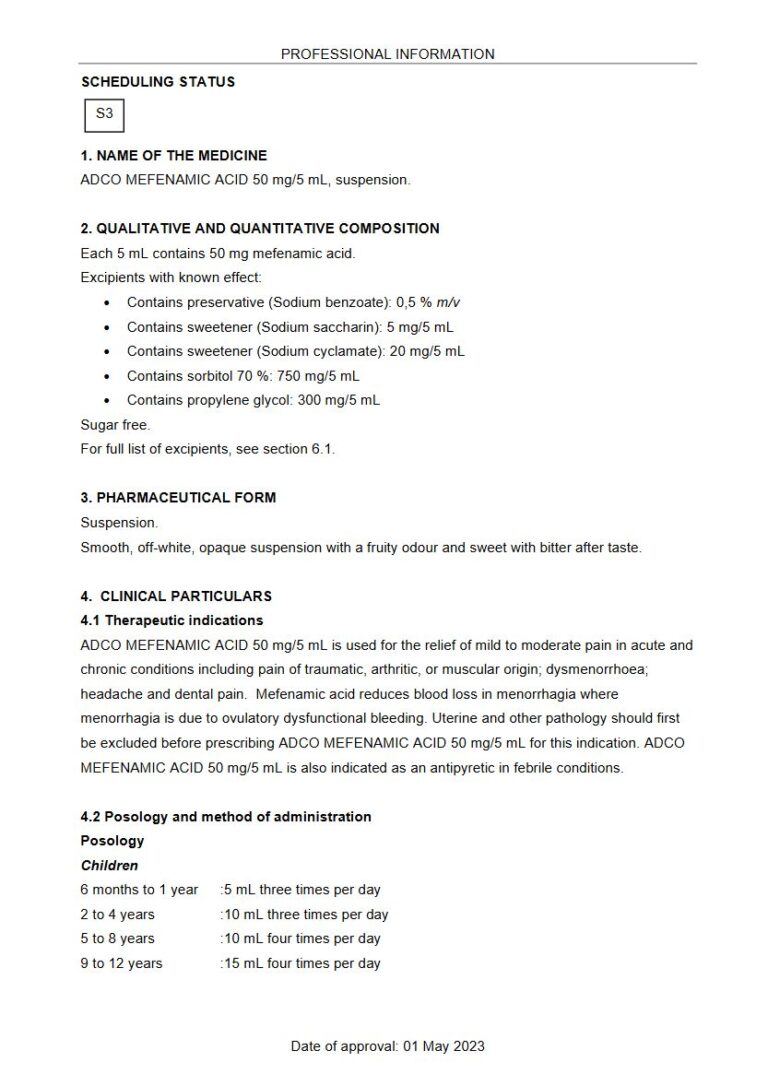
ADCO MEFENAMIC ACID 50 mg/5 mL is used for the relief of mild to moderate pain in acute and chronic conditions including pain of traumatic, arthritic, or muscular origin; dysmenorrhoea; headache and dental pain. Mefenamic acid reduces blood loss in menorrhagia where menorrhagia is due to ovulatory dysfunctional bleeding. Uterine and other pathology should first be excluded before prescribing ADCO MEFENAMIC ACID 50 mg/5 mL for this indication. ADCO MEFENAMIC ACID 50 mg/5 mL is also indicated as an antipyretic in febrile conditions.
4.2 Posology and method of administration
Posology
Children
- 6 months to 1 year: 5 mL three times per day
- 2 to 4 years: 10 mL three times per day
- 5 to 8 years: 10 mL four times per day
- 9 to 12 years: 15 mL four times per day
Gastric irritation may be reduced by taking medication during meals. Mefenamic acid should not be used, continuously, for longer than seven days at a time. Use the lowest effective dose for the shortest possible duration of treatment.
Special populations
No information available.
Paediatric population
Refer to posology in children above.
Method of administration
For oral administration.
4.3 Contraindications
- Hypersensitivity to mefenamic acid or to any of the inactive ingredients (excipients) of ADCO MEFENAMIC ACID 50 mg/5 mL (see section 6.1).
- ADCO MEFENAMIC ACID 50 mg/5 mL is contraindicated in patients who respond to aspirin and aspirin like medicines with sensitivity reactions like bronchoconstriction, skin rashes and urticaria.
- ADCO MEFENAMIC ACID 50 mg/5 mL is contraindicated in patients with a history of gastrointestinal perforation, ulceration or bleeding (PUBs) and/or inflammatory bowel disease, related to previous non-steroidal anti-inflammatory agents (NSAIDs), including ADCO MEFENAMIC ACID 50 mg/5 mL.
- Active or history of recurrent ulcer/haemorrhage/perforations.
- Safety in pregnancy and lactation has not been established.
- Avoid use of NSAIDs in women around 30 weeks gestation and later in pregnancy due to the risks of oligohydramnios/foetal renal dysfunction and premature closure of the foetal ductus arteriosus (see section 4.4 and 4.6).
- Do not use in epileptic patients or in patients with impaired hepatic function.
- ADCO MEFENAMIC ACID 50 mg/5 mL is contraindicated in heart failure.
4.4 Special warnings and precautions for use
ADCO MEFENAMIC ACID 50 mg/5 mL may enhance the effects of the coumarin anticoagulants. Therapy should be discontinued if diarrhoea or skin rash occur. Reported haematological effects include haemolytic anaemia, agranulocytosis, pancytopenia, thrombocytopenia or thrombocytopenia purpura and bone marrow aplasia. Allergic glomerulonephritis has occurred as well as abnormalities of hepatic and renal function. Therefore, blood counts and monitoring of hepatic and renal function are advised during prolonged therapy with mefenamic acid.
Bronchoconstriction may occur in asthmatic patients with aspirin sensitivity. ADCO MEFENAMIC ACID 50 mg/5 mL affects platelet function and it may enhance the effect of anticoagulant therapy. Caution is required in patients with a history of hypertension and/or heart failure as fluid retention and oedema have been reported in association with ADCO MEFENAMIC ACID 50 mg/5 mL therapy. In view of ADCO MEFENAMIC ACID 50 mg/5 mLu2019s inherent potential to cause fluid retention, heart failure may be precipitated in some compromised patients.
Caution is required in patients with significant risk factors for cardiovascular events (e.g. hypertension, hyperlipidaemia, diabetes mellitus, smoking) and should only be treated with diclofenac after careful consideration.
Elderly: The elderly has an increased frequency of adverse reactions to NSAIDs including ADCO MEFENAMIC ACID 50 mg/5 mL especially gastrointestinal perforation, ulceration, and bleeding (PUBs) which may be fatal. The risk of gastrointestinal perforation, ulceration, or bleeding (PUBs) is higher with increasing doses of ADCO MEFENAMIC ACID 50 mg/5 mL in patients with a history of ulcers, and the elderly. When gastrointestinal bleeding or ulceration occurs in patients receiving ADCO MEFENAMIC ACID 50 mg/5 mL treatment with ADCO MEFENAMIC ACID 50 mg/5 mL should be stopped.
ADCO MEFENAMIC ACID 50 mg/5 mL should be given with caution to patients with a history of gastrointestinal disease (e.g., ulcerative colitis, Crohnu2019s disease, hiatus hernia, gastro-oesophageal reflux disease, angiodysplasia) as the condition may be exacerbated.
Serious skin reactions, some of them fatal, including exfoliative dermatitis, Stevens-Johnson syndrome, and toxic epidermal necrolysis have been reported. ADCO MEFENAMIC ACID 50 mg/5 mL should be discontinued at the first appearance of skin rash, mucosal lesions, or any other sign of hypersensitivity.
Foetal Toxicity: Regular use of NSAIDs such as ADCO MEFENAMIC ACID 50 mg/5 mL during the third trimester of pregnancy, may result in premature closure of the foetal ductus arteriosus in utero, and possibly, in persistent pulmonary hypertension of the new-born. The onset of labour may be delayed, and its duration increased. Limit use of NSAIDs, including ADCO MEFENAMIC ACID 50 mg/5 mL, between 20 and 30 weeks of pregnancy due to the risk of oligohydramnios/foetal renal dysfunction. Avoid use of NSAIDs in women around 30 weeks gestation and later in pregnancy due to the risks of oligohydramnios/foetal renal dysfunction and premature closure of the foetal ductus arteriosus. If NSAID treatment is necessary between 20 weeks and 30 weeks gestation, limit ADCO MEFENAMIC ACID 50 mg/5 mL use to the lowest effective dose and shortest duration possible. Consider ultrasound monitoring of amniotic fluid if ADCO MEFENAMIC ACID 50 mg/5 mL treatment extends beyond 48 hours. Discontinue ADCO MEFENAMIC ACID 50 mg/5 mL if oligohydramnios occurs and follow up according to clinical practice (see section 4.3 and 4.6).
Drug Reaction with Eosinophilia and Systemic Symptoms (DRESS): DRESS has been reported in patients taking NSAIDs such as ADCO MEFENAMIC ACID 50 mg/5 ml. Some of these events have been fatal or life-threatening. DRESS typically, although not exclusively, presents with fever, rash, lymphadenopathy, and/or facial swelling. Other clinical manifestations may include hepatitis, nephritis, haematological abnormalities, myocarditis, or myositis. Sometimes symptoms of DRESS may resemble an acute viral infection. Eosinophilia is often present. Because this disorder is variable in its presentation, other organ systems not noted here may be involved. It is important to note that early manifestations of hypersensitivity, such as fever or lymphadenopathy, may be present even though rash is not evident. If such signs or symptoms are present, discontinue ADCO MEFENAMIC ACID 50 mg/5 ml and evaluate the patient immediately.
Sorbitol: ADCO MEFENAMIC ACID 50 mg/5 mL contains sorbitol. Patients with hereditary fructose intolerance (HFI) should not take/be given this medicine. The additive effect of concomitantly administered products containing sorbitol (or fructose) and dietary intake of sorbitol (or fructose) should be taken into account. The content of sorbitol in medicinal products for oral use may affect the bioavailability of other medicinal products for oral use administered concomitantly. Sorbitol may cause gastrointestinal discomfort and mild laxative effect.
Sodium: This medicine contains less than 1 mmol sodium (23 mg) per dosage unit, that is to say essentially u2018sodium-freeu2019.
4.5 Interactions with other medicines and other forms of interaction
Non-Steroidal Anti-inflammatories (NSAIDs): The use of two or more NSAIDs concomitantly could result in an increase in side-effects.
Corticosteroids: Increased risk of gastrointestinal perforation, ulceration, or bleeding (PUBs).
Anti-coagulants: ADCO MEFENAMIC ACID 50 mg/5 mL may enhance the effects of anti-coagulants such as warfarin.
Anti-platelet medicines and selective serotonin reuptake inhibitors (SSRIs): Increased risk of gastrointestinal bleeding.
Paediatric population
No information available.
4.6 Fertility, pregnancy and lactation
Pregnancy: Safety in pregnancy has not been established. Use of NSAIDs, including ADCO MEFENAMIC ACID 50 mg/5 mL, can cause premature closure of the foetal ductus arteriosus and foetal renal dysfunction leading to oligohydramnios and, in some cases, neonatal renal impairment. Because of these risks, the use of ADCO MEFENAMIC ACID 50 mg/5 mL dose and duration between 20 and 30 weeks of gestation should be limited and avoided at around 30 weeks of gestation and later in pregnancy (see section 4.3 and 4.4).
Breastfeeding: Safety in lactation has not been established.
Fertility: No information available.
4.7 Effects on ability to drive and use machines
No information available. Refer to section 4.8.
4.8 Undesirable effects
a. Summary of the safety profile: The most frequently reported side effects are gastrointestinal disturbances and include dyspepsia, upper gastrointestinal discomfort as well as peptic ulceration and gastrointestinal bleeding.
b. Tabulated summary of adverse reactions: Adverse reactions are listed by system organ class.
SYSTEM ORGAN CLASS FREQUENCY ADVERSE REACTIONS
Blood and lymphatic system disorders Frequency unknown Prothrombin concentration may decrease and enhance the effect of anticoagulant therapy, haemolytic anaemia, agranulocytosis, pancytopenia, thrombocytopenia or thrombocytopenia purpura and bone marrow aplasia.
Nervous system disorders Less frequent Headache, drowsiness, dizziness, nervousness.
Eye disorders Less frequent Visual disturbances.
Cardiac disorders Frequency unknown Oedema, hypertension, and cardiac failure.
Respiratory, thoracic and mediastinal disorders Frequency unknown Bronchoconstriction in asthmatic patients with aspirin sensitivity.
Gastrointestinal Disorders 1 Frequent Dyspepsia, upper gastrointestinal discomfort as well as peptic ulceration and gastrointestinal bleeding. Less frequent Diarrhoea.
Skin and subcutaneous tissue disorders Less frequent Drug reaction with Eosinophilia and Systemic Symptoms (DRESS) (see section 4.4). Frequency unknown Skin rash may be a sensitivity reaction and urticaria. Bullous reactions, including Stevens-Johnson syndrome and toxic epidermal necrolysis.
Renal and urinary disorders Frequency unknown Allergic glomerulonephritis.
Post marketing experience No information available.
c. Description of selected adverse reactions: 1 Gastrointestinal system disorders: The most commonly observed adverse events are gastrointestinal in nature. Peptic ulcers, perforation, or gastrointestinal bleeding, sometimes fatal. Nausea, vomiting, diarrhoea, flatulence, constipation, dyspepsia, abdominal pain, melaena, haematemesis, ulcerative stomatitis, exacerbation of colitis and Crohnu2019s disease, gastritis.
Reporting of suspected adverse reactions: Reporting suspected adverse reactions after authorisation of the medicine is important. It allows continued monitoring of the benefit/risk balance of the medicine. Healthcare professionals are asked to report any suspected adverse reactions to SAHPRA via the u201c6.04 Adverse Drug Reaction Reporting Formu201d, found online under SAHPRAu2019s publications: https://www.sahpra.org.za/Publications/Index/8
4.9 Overdose
Mefenamic acid has a marked tendency to induce tonic-clonic (grand mal) convulsions in over dosage. Acute erosion or ulceration of the gastrointestinal mucosa may be a delayed manifestation. Treatment is symptomatic and supportive.
