
Mercaptopurine Equity, 50 mg Tablets.
PDF Leaflet Revision Date: 06 November 2024
Clinical Summary
Quick overview from the medicine insert
Indication
Treatment of acute leukaemia in combination with other medicines.
Dosage (summary)
Adults/children: 2.5 mg/kg/day or 50-75 mg/mu00b2/day, adjusted per individual response.
Special Populations
- Renal impairment
- Hepatic impairment
- Elderly
Pregnancy & Breastfeeding
Avoid in pregnancy; excreted in breast milk, do not breastfeed.
Key Drug Interactions
- Allopurinol (reduce dose to 25%)
- Ribavirin (not advised)
- Methotrexate (adjust dose)
Contraindications
- Hypersensitivity to mercaptopurine
Common side effects
- Bone marrow suppression
- Leukopenia
- Thrombocytopenia
- Nausea
- Vomiting
Counselling Points
- Standardize administration method
- Avoid dairy products
- Monitor for infections
- Use sun protection
Serious warnings
- Myelosuppression
- Hepatotoxicity
- Increased infection risk
- Live vaccines not recommended
Important Disclaimer
The Mercaptopurine Equity, 50 mg Tablets. professional information leaflet below is the property of Equity Pharmaceuticals and is provided on Medinsert exactly as issued, with no.. alterations or editorial changes. We make every effort to keep content current by updating documents as soon as new versions become available. Medinsert serves as a trusted access point for healthcare professionals, but does not replace official sources or clinical judgement. For more details, please read our full disclaimer. read more>>
 Healthcare Professionals Only
This content is for registered healthcare professionals
Sign in or create a free account to read the full package insert.
Free for HPCSA-registered professionals. Powered by Medinsert.
Clinical Particulars
Section 4 of the official insert — extracted exactly as issued, no alterations
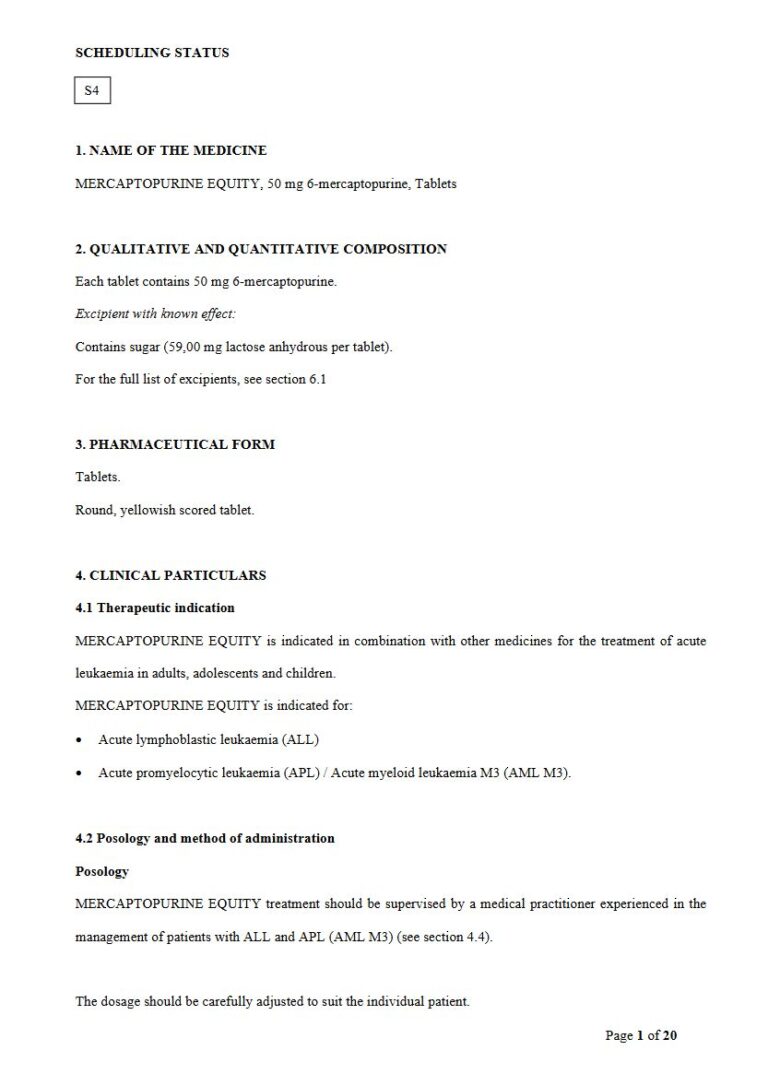
4.1 Therapeutic indication
MERCAPTOPURINE EQUITY is indicated in combination with other medicines for the treatment of acute leukaemia in adults, adolescents and children. MERCAPTOPURINE EQUITY is indicated for:
- Acute lymphoblastic leukaemia (ALL)
- Acute promyelocytic leukaemia (APL) / Acute myeloid leukaemia M3 (AML M3).
4.2 Posology and method of administration
Posology MERCAPTOPURINE EQUITY treatment should be supervised by a medical practitioner experienced in the management of patients with ALL and APL (AML M3) (see section 4.4). The dosage should be carefully adjusted to suit the individual patient.
MERCAPTOPURINE EQUITY may be taken with food or on an empty stomach, but patients should standardise the method of administration. The dose should not be taken with milk or dairy products (see section 4.5). MERCAPTOPURINE EQUITY should be taken at least one hour before or two hours after milk or dairy products (see section 5.1).
Special populations Adults and paediatric population For adults and children the usual dose is 2,5 mg/kg bodyweight per day, or 50 to 75 mg/m2 body surface area per day, but the dose and duration of administration depend on the nature and dosage of other cytotoxic medicines given in conjunction with MERCAPTOPURINE EQUITY. The dosage should be adjusted according to individual response and tolerance. MERCAPTOPURINE EQUITY has been used in various combination therapy schedules for acute leukaemia and the literature and current treatment guidelines should be consulted for details. MERCAPTOPURINE EQUITY should be administered to children with ALL in the evening to lower the risk of relapse. Elderly population No specific studies have been carried out in the elderly. However, it is advisable to monitor renal and hepatic function in these patients and if there is any impairment, consideration should be given to reducing the MERCAPTOPURINE EQUITY dosage. Renal impairment Consideration should be given to reducing the dose in renal impairment. Hepatic impairment Consideration should be given to reducing the dose in hepatic impairment.
4.3 Contraindications
Known hypersensitivity to mercaptopurine or to any of the excipients of MERCAPTOPURINE EQUITY listed in 6.1. In view of the seriousness of the indications there are no other absolute contraindications.
4.4 Special warnings and precautions for use
MERCAPTOPURINE EQUITY IS AN ACTIVE CYTOTOXIC MEDICINE FOR USE ONLY UNDER THE DIRECTION OF CLINICAL PRACTITIONER EXPERIENCED IN THE ADMINISTRATION OF SUCH MEDICINES. Immunisation using a live organism vaccine has the potential to cause infection in immunocompromised hosts. Therefore, immunisations with live organism vaccines are not recommended in patients with ALL or AML. In all cases, patients in remission should not receive live organism vaccines until the patient is deemed to be able to respond to the vaccine. The interval between discontinuation of chemotherapy and restoration of the patient's ability to respond to the vaccine depends on the intensity and type of immunosuppression-causing medications used, the underlying disease, and other factors. Co-administration of ribavirin and MERCAPTOPURINE EQUITY is not advised. Ribavirin may reduce efficacy and increase toxicity of MERCAPTOPURINE EQUITY (see section 4.5).
Safe handling of MERCAPTOPURINE EQUITY Tablets See section 6.6 Instructions for disposal; Safe handling Monitoring: Since MERCAPTOPURINE EQUITY is strongly myelosuppressive full blood counts must be taken daily during remission induction. Patients must be carefully monitored during therapy. Bone marrow suppression Treatment with MERCAPTOPURINE EQUITY causes bone marrow suppression leading to leukopenia and thrombocytopenia and, less frequently, to anaemia. Full blood counts must be taken frequently during remission induction. During maintenance therapy, full blood counts, including platelets, should be regularly monitored and more frequently if high dosage is used or if severe renal and/or hepatic disorder is present. Increased haematological monitoring of the patient is advised when switching between different pharmaceutical formulations of mercaptopurine. The leukocyte and platelet counts continue to fall after treatment is stopped, so at the first sign of an abnormally large fall in the counts, treatment should be interrupted immediately. Bone marrow suppression is reversible if MERCAPTOPURINE EQUITY is withdrawn early enough. During remission induction in acute myelogenous leukaemia, the patient may frequently have to survive a period of relative bone marrow aplasia and it is important that adequate supportive facilities are available. The dosage of MERCAPTOPURINE EQUITY may need to be reduced when this medicine is combined with other medicines whose primary or secondary toxicity is myelosuppression (see section 4.5).
Hepatotoxicity MERCAPTOPURINE EQUITY is hepatotoxic and liver function tests should be monitored weekly during treatment. Gamma glutamyl transferase (GGT) levels in plasma may be particularly predictive of withdrawal due to hepatotoxicity. More frequent monitoring may be advisable in those with pre-existing liver disease or receiving other potentially hepatotoxic therapy. The patient should be instructed to discontinue MERCAPTOPURINE EQUITY immediately if jaundice becomes apparent (see section 4.8).
Tumour lysis syndrome During remission induction when rapid cell lysis is occurring, uric acid levels in blood and urine should be monitored as hyperuricaemia and/or hyperuricosuria may develop, with the risk of uric acid nephropathy. Hydration and urine alkalinisation may minimize potential renal complications.
TPMT Deficiency There are individuals with an inherited deficiency of the enzyme thiopurine methyltransferase (TPMT) who may be unusually sensitive to the myelosuppressive effect of MERCAPTOPURINE EQUITY and prone to developing rapid bone marrow depression following the initiation of treatment with MERCAPTOPURINE EQUITY. This problem could be exacerbated by co-administration with medicines that inhibit TPMT, such as olsalazine, mesalazine or sulfazalazine. Also a possible association between decreased TPMT activity and secondary leukaemias and myelodysplasia has been reported in individuals receiving 6u2013mercaptopurine in combination with other cytotoxics (see section 4.8). Approximately 0,3 % (1:300) of patients have little or no detectable enzyme activity. Approximately 10 % of patients have low or intermediate TPMT activity and 90 % of individuals have normal TPMT activity. There may also be a group of approximately 2 % who have very high TPMT activity. Some laboratories offer testing for TPMT deficiency, although these tests have not been shown to identify all patients at risk of severe toxicity. Therefore, close monitoring of blood counts is still necessary.
Patients with NUDT15 variant Patients with inherited mutated NUDT15 gene are at increased risk for severe 6-mercaptopurine toxicity, such as early leukopenia and alopecia, from conventional doses of thiopurine therapy. They generally require dose reduction, particularly those being NUDT15 variant homozygotes. The frequency of NUDT15 c.415C>T has an ethnic variability of approximately 10 % in East Asians, 4 % in Hispanics, 0,2 % in Europeans and 0 % in Africans. In any case, close monitoring of blood counts is necessary.
4.5 Interaction with other medicines and other forms of interaction
Vaccinations with live organism vaccines are not recommended in immunocompromised individuals (see section 4.4). The administration of MERCAPTOPURINE EQUITY with food may decrease systemic exposure slightly. MERCAPTOPURINE EQUITY may be taken with food or on an empty stomach, but patients should standardise the method of administration to avoid large variability in exposure. The dose should not be taken with milk or dairy products since they contain xanthine oxidase, an enzyme which metabolises MERCAPTOPURINE EQUITY and might therefore lead to reduced plasma concentrations of mercaptopurine.
Effect of concomitant medicines on MERCAPTOPURINE EQUITY Ribavirin Ribavirin inhibits the enzyme, inosine monophosphate dehydrogenase (IMPDH), leading to a lower production of the active 6-thioguanine nucleotides. Severe myelosuppression has been reported following concomitant administration of a pro-drug of 6-mercaptopurine and ribavirin; therefore concomitant administration of ribavirin and MERCAPTOPURINE EQUITY is not advised (see section 4.4 and 5.2).
Myelosuppressive medicines When MERCAPTOPURINE EQUITY is combined with other myelosuppressive medicines caution should be used; dose reductions may be needed based on haematological monitoring (see section 4.4).
Allopurinol/oxipurinol/thiopurinol and other xanthine oxidase inhibitors Xanthine oxidase activity is inhibited by allopurinol, oxipurinol and thiopurinol, which results in reduced conversion of biologically active 6-thioinosinic acid to biologically inactive 6-thiouric acid. When allopurinol, oxipurinol and/or thiopurinol and MERCAPTOPURINE EQUITY are administered concomitantly it is essential that only 25 % of the usual dose of MERCAPTOPURINE EQUITY is given (see section 4.2). Other xanthine oxidase inhibitors, such as febuxostat, may decrease the metabolism of 6-mercaptopurine. Concomitant administration is not recommended as data are insufficient to determine an adequate dose reduction.
Aminosalicylates There is in vitro and in vivo evidence that aminosalicylate derivatives (e.g. olsalazine, mesalazine or sulphasalazine) inhibit the TPMT enzyme. Therefore, lower doses of MERCAPTOPURINE EQUITY may need to be considered when administered concomitantly with aminosalicylate derivatives (see section 4.4).
Methotrexate Methotrexate (20 mg/m2 orally) increased 6-mercaptopurine AUC by approximately 31 % and methotrexate (2 or 5 g/m2 intravenously) increased 6-mercaptopurine AUC by 69 and 93 %, respectively. Therefore, when MERCAPTOPURINE EQUITY is administered concomitantly with high dose methotrexate, the dose should be adjusted to maintain a suitable white blood cell count.
Infliximab Interactions have been observed between azathioprine, a pro-drug of 6-mercaptopurine, and infliximab. Patients receiving ongoing azathioprine experienced transient increases in 6-TGN (6-thioguanine nucleotide, an active metabolite of azathioprine) levels and decreases in the mean leukocyte count in the initial weeks following infliximab infusion, which returned to previous levels after 3 months.
Effect of MERCAPTOPURINE EQUITY on other medicines Anticoagulants Inhibition of the anticoagulant effect of warfarin and acenocoumarol has been reported when co-administered with 6-mercaptopurine as in MERCAPTOPURINE EQUITY; therefore higher doses of the anticoagulant may be needed. It is recommended that coagulation tests are closely monitored when anticoagulants are concurrently administered with MERCAPTOPURINE EQUITY.
4.6 Fertility, pregnancy and lactation
The safety of MERCAPTOPURINE EQUITY in pregnancy and lactation has not been established.
Pregnancy The use of MERCAPTOPURINE EQUITY should be avoided whenever possible during pregnancy, particularly during the first trimester. In any individual case the potential hazard to the foetus must be balanced against the expected benefit to the mother. Abortions and prematurity have been reported after maternal exposure. Multiple congenital abnormalities have been reported following maternal MERCAPTOPURINE EQUITY treatment in combination with other chemotherapy medicines. Substantial transplacental and transamniotic transmission of 6-mercaptopurine as found in MERCAPTOPURINE EQUITY and its metabolites from the mother to the foetus have been shown to occur. Adequate contraceptive precautions should be advised if either partner is receiving MERCAPTOPURINE EQUITY tablets during treatment and for at least three months after receiving the last dose. In utero exposure to thiopurines has not been associated with negative effects on long-term childhood development or susceptibility for infectious disease. Normal offspring with normal Apgar scores directly after birth in most cases, have been born after 6-mercaptopurine therapy administered during pregnancy.
Paternal exposure: Congenital abnormalities and spontaneous abortions have been reported after paternal exposure to MERCAPTOPURINE EQUITY.
Breastfeeding MERCAPTOPURINE EQUITY is excreted into breast milk. Mothers receiving MERCAPTOPURINE EQUITY should not breastfeed.
Fertility The effect of MERCAPTOPURINE EQUITY therapy on human fertility is unknown. Oligospermia has been reported following exposure to 6-mercaptopurine as found in MERCAPTOPURINE EQUITY (see section 4.8).
4.7 Effects on ability to drive and use machines
Patients should not drive, use machinery or perform any tasks that require concentration until they are certain that MERCAPTOPURINE EQUITY does not adversely affect their ability to do so safely.
4.8 Undesirable effects
a. Summary of the safety profile For MERCAPTOPURINE EQUITY there is a lack of modern clinical documentation which can serve as support for accurately determining the frequency of undesirable effects. The frequency categories assigned to the adverse drug reactions below are estimates: for most reactions, suitable data for calculating incidence are not available. Undesirable effects may vary in their incidence depending on the dose received and also when given in combination with other therapeutic medicines. The main side effect of treatment with MERCAPTOPURINE EQUITY is bone marrow suppression leading to leukopenia and thrombocytopenia.
b. Tabulated summary of adverse reactions MedDRA System Organ Class Side Effects Infections and infestations Less frequent Bacterial and viral infections, infections associated with neutropenia Neoplasms benign, malignant and unspecified (including cysts and polyps) Less frequent Neoplasms including lymphoproliferative disorders, skin cancers (melanomas and nonmelanomas), sarcomas (Kaposi's and non-Kaposi's) and uterine cervical cancer in situ (see section 4.4), secondary leukaemia and myelodysplasia (see section 4.4); hepatosplenic T-cell lymphoma in patients with IBD (an unlicensed indication) when used in combination with anti-TNF medicines (see section 4.4.) Blood and lymphatic system disorders Frequent Bone marrow suppression; leukopenia and thrombocytopenia, anaemia Immune system disorders Less frequent Hypersensitivity reactions with the following manifestations have been reported: arthralgia; skin rash; drug fever, hypersensitivity reactions with the following manifestations have been reported: facial oedema Metabolism and nutrition disorders Less frequent Anorexia Frequency unknown Hypoglycaemia# Gastrointestinal disorders Frequent Nausea; vomiting; pancreatitis in the IBD population (an unlicensed indication) Less frequent Oral ulceration; pancreatitis (in the licensed indications), intestinal ulceration, mild diarrhoea and sprue-like symptoms have been reported Hepatobiliary disorders Frequent Biliary stasis; hepatotoxicity Less frequent Hepatic necrosis Skin and subcutaneous tissue disorders Less frequent Alopecia Frequency unknown Photosensitivity Reproductive system and breast disorders Less frequent Transient oligospermia # In the paediatric population
c. Description of selected adverse reactions: Hepatobiliary disorders MERCAPTOPURINE EQUITY is hepatotoxic in animals and man. The histological findings in man have shown hepatic necrosis and biliary stasis. The incidence of hepatotoxicity varies considerably and can occur with any dose but more frequently when the recommended dose of 2,5 mg/kg bodyweight daily or 75 mg/m2 body surface area per day is exceeded. Monitoring of liver function tests may allow early detection of hepatotoxicity. Gamma glutamyl transferase (GGT) levels in plasma may be particularly predictive of withdrawal due to hepatotoxicity. This is usually reversible if MERCAPTOPURINE EQUITY therapy is stopped soon enough but fatal liver damage has occurred.
4.9 Overdose
Symptoms and signs Gastrointestinal effects, including nausea, vomiting and diarrhoea and anorexia may be early symptoms of overdosage having occurred. The principal toxic effect is on the bone marrow, resulting in myelosuppression. Haematological toxicity is likely to be more profound with chronic overdosage than with a single ingestion of 6-mercaptopurine. Liver dysfunction and gastroenteritis may also occur.
The risk of overdosage is also increased when allopurinol is being given concomitantly with MERCAPTOPURINE EQUITY (see section 4.5).
Treatment: As there is no known antidote, blood counts should be closely monitored and general supportive measures, together with appropriate blood transfusion, instituted if necessary. Active measures (such as the use of activated charcoal) may not be effective in the event of MERCAPTOPURINE EQUITY overdose unless the procedure can be undertaken within 60 minutes of ingestion. Further management should be as clinically indicated or as recommended by the national poisons centre, where available.
