
Methotrexate 500 Mg/20 Ml/50 Mg/2 Ml Injection
PDF Leaflet Revision Date: 04 August 2020
Clinical Summary
Quick overview from the medicine insert
Indication
Treatment of various cancers, severe psoriasis, and rheumatoid arthritis.
Dosage (summary)
Varies by condition; e.g., 30 mg/m2 twice weekly for maintenance in leukemia.
Onset of Action / Duration
Onset: 4-6 weeks for leukemia remission.
Special Populations
- Elderly
- Pediatric patients
Pregnancy & Breastfeeding
Contraindicated in pregnancy and lactation; causes embryotoxicity.
Key Drug Interactions
- NSAIDs
- Penicillins
- Proton pump inhibitors
Contraindications
- Hypersensitivity to methotrexate
- Pregnancy
- Severe renal/liver disorders
Common side effects
- Nausea
- Leukopenia
- Stomatitis
- Fatigue
Counselling Points
- Avoid pregnancy during treatment
- Report any signs of infection
- Regular blood tests required
Serious warnings
- Serious toxicity risk
- Monitor for bone marrow and liver toxicity
Important Disclaimer
The Methotrexate 500 Mg/20 Ml/50 Mg/2 Ml Injection professional information leaflet below is the property of Fresenius Kabi South Africa and is provided on Medinsert exactly as issued, with no.. alterations or editorial changes. We make every effort to keep content current by updating documents as soon as new versions become available. Medinsert serves as a trusted access point for healthcare professionals, but does not replace official sources or clinical judgement. For more details, please read our full disclaimer. read more>>
 Healthcare Professionals Only
This content is for registered healthcare professionals
Sign in or create a free account to read the full package insert.
Free for HPCSA-registered professionals. Powered by Medinsert.
Clinical Particulars
Section 4 of the official insert — extracted exactly as issued, no alterations
4.1 Therapeutic indications
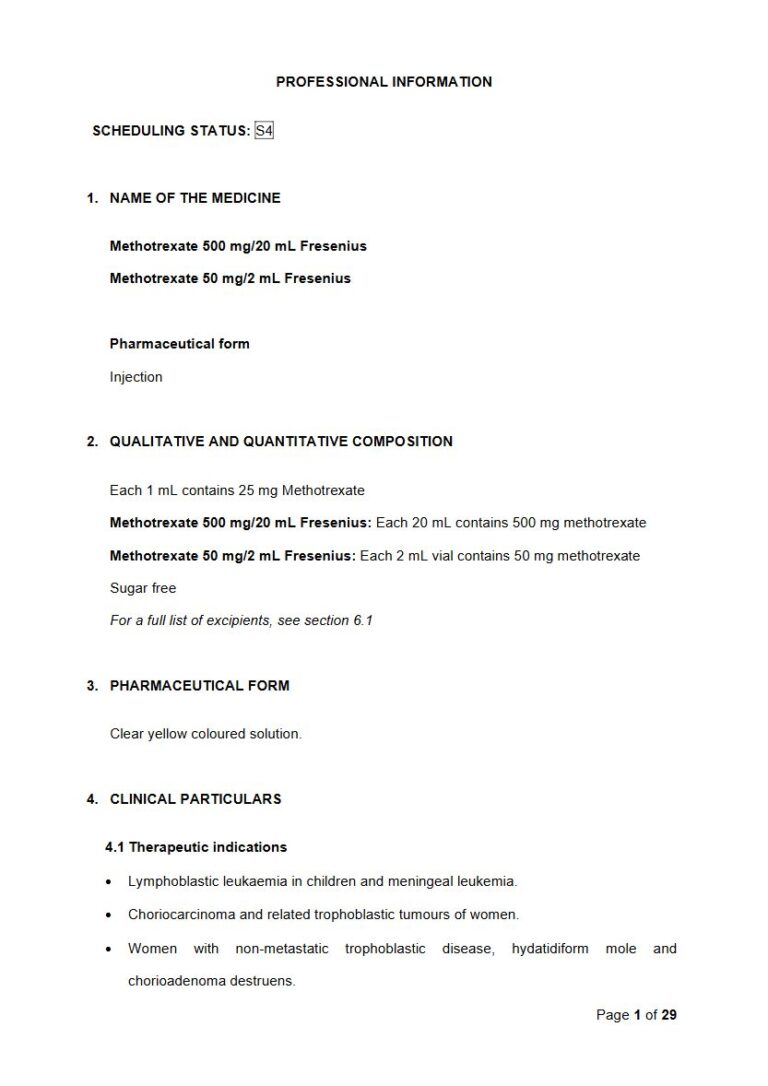
- Lymphoblastic leukaemia in children and meningeal leukemia.
- Choriocarcinoma and related trophoblastic tumours of women.
- Women with non-metastatic trophoblastic disease, hydatidiform mole and chorioadenoma destruens.
- Carcinomas of the breast, tongue, pharynx and testes (in conjunction with chlorambucil and dactinomycin).
- Carcinoma of the lung and osteogenic sarcomas (high dose Methotrexate Fresenius with folinic acid rescue).
- Treatment of severe psoriasis (see section 4.3 and section 4.4).
- Prevention of graft-versus-host reactions that result from marrow transplantation.
- Dermatomyositis, rheumatoid arthritis (not adequately responding to other therapy), Wegneru2019s granulomatosis and pityriasis rubra pilaris.
4.2 Posology and method of administration
Methotrexate Fresenius may be given by mouth, or by injection. The dose of Methotrexate Fresenius, the dosage frequency, the total dose and combination with other cytostatic medicine and/or folinic acid are subject to frequent modification as scientific knowledge improves.
Lymphoblastic leukaemia: When used for induction, Methotrexate Fresenius in doses of 3,3 mg/m2 in combination with prednisone 60 mg/m2 given daily produced remission in 50 % of patients treated, usually within a period of 4 to 6 weeks. Methotrexate Fresenius alone or in combination with other medicines appears to be the medicine of choice for securing maintenance of medicine-induced remissions. When remission is achieved and supportive care has produced general clinical improvement, maintenance therapy is initiated, as follows: Methotrexate Fresenius is administered twice weekly either by mouth or intramuscularly in doses of 30 mg/m2. It can also be given in doses of 2,5 mg/kg intravenously every 14 days. If and when relapse does occur, re-induction of remission can again usually be obtained by repeating the initial induction regime.
Meningeal leukaemia: Some patients with leukaemia are subject to leukaemic invasion of the central nervous system. This may manifest characteristic signs or symptoms or may remain silent and be diagnosed only by examination of the cerebrospinal fluid which contains leukaemic cells in such cases. Therefore, the CSF should be examined in all leukaemic patients. Since passage of Methotrexate Fresenius from blood serum to the cerebrospinal fluid is minimal, for adequate therapy the medicine is administered intrathecally. A common approach is to treat such patients as may actually manifest leukaemic involvement by direct intrathecal instillation of Methotrexate Fresenius.
Intrathecal administration: Administration is at intervals of 2 to 5 days and is usually repeated until the cell count of the cerebrospinal fluid returns to normal. At this point one additional dose is advised. Large doses may cause convulsions. The following dosage regimen is based on age instead of body surface area:
Age (years) Dose (mg)
< 1 6
1 8
2 10
3 or older 12
Similar doses are given prophylactically to patients with lymphoblastic leukaemia, often in association with cranial irradiation. Methotrexate Fresenius in intravenous doses of about 500 mg per m2, followed by folinic acid rescue, may also produce effective concentrations in the CSF.
Choriocarcinoma and similar trophoblastic diseases: Doses of 15 to 30 mg daily by mouth or intramuscularly for 5 days, at intervals of 1 to 2 weeks for 3 to 5 courses. Alternatively, 0,25 to 1 mg per kg body-weight up to a maximum of 60 mg has been given intramuscularly every 48 hours for 4 doses, followed by folinic acid rescue, and repeated at intervals of 7 days. Since hydatidiform mole may precede or be followed by choriocarcinoma, prophylactic chemotherapy with Methotrexate Fresenius has been recommended. Chorioadenoma destruens is considered to be an invasive form of hydatidiform mole. Methotrexate Fresenius administered in these disease states in doses similar to those recommended for choriocarcinoma.
Breast carcinoma: Prolonged cyclic combination chemotherapy with cyclophosphamide, Methotrexate Fresenius and fluorouracil can give good results when used as adjuvant treatment to radical mastectomy in primary breast cancer with positive axillary lymph nodes. Methotrexate Fresenius dosage of 40 mg/m2 intravenously can be given on the first and eighth days. Combination chemotherapy may be necessary in patients with metastases. A range of doses of Methotrexate Fresenius can be used in the management of solid tumours. Very high doses can be given by intravenous infusion, followed by folinic acid, in patients with osteogenic sarcoma and carcinoma of the lung and of the head and neck.
Psoriasis: Methotrexate Fresenius has been given by mouth, intramuscularly, and intravenously in the treatment of psoriasis. Single weekly doses of 10 to 25 mg may be given by mouth or injection. Alternatively, 2,5 mg has been administered by mouth every 12 hours for 3 doses or every 8 hours for 4 doses each week or 2,5 mg may be given daily by mouth for 5 days out of 7.
High-dose therapy: High dose therapy should be used only by qualified specialists in suitable hospital setting.
4.3 Contraindications
- Patients with a known hypersensitivity to methotrexate or any of the excipients should not receive Methotrexate Fresenius.
- Methotrexate Fresenius is contraindicated in pregnancy and in lactation (see section 4.6).
- Methotrexate Fresenius is contraindicated in patients with psoriasis or rheumatoid arthritis with serious renal or liver disorders, bone marrow hypoplasia, leucopenia, thrombocytopenia, anaemia, and alcohol abuse.
- Safety and efficacy in children have not been established other than in cancer chemotherapy.
4.4 Special warnings and precautions for use
- Methotrexate Fresenius should be used only in life threatening neoplastic diseases, or in patients with psoriasis or rheumatoid arthritis with severe, recalcitrant, disabling disease which is not adequately responsive to other forms of therapy.
- Deaths have been reported with the use of methotrexate in the treatment of malignancy, psoriasis, and rheumatoid arthritis.
- Patients should be closely monitored for bone marrow, liver, lung and kidney toxicities.
- Patients should be informed by their physician of the risks involved and be under a physician's care throughout therapy.
- The use of Methotrexate Fresenius high-dose regimens recommended for osteosarcoma requires meticulous care. (see section 4.2) high-dose regimens for other neoplastic diseases are investigational and a therapeutic advantage has not been established.
- Use caution when administering high-dose Methotrexate Fresenius to patients receiving proton pump inhibitor (PPI) therapy. Case reports and published population pharmacokinetic studies suggest that concomitant use of some PPIs, such as omeprazole, esomeprazole, and pantoprazole, with methotrexate (primarily at high dose), may elevate and prolong serum levels of methotrexate and/or its metabolite hydroxymethotrexate, possibly leading to methotrexate toxicities. In two of these cases, delayed methotrexate elimination was observed when high-dose methotrexate was co-administered with PPIs, but was not observed when methotrexate was co-administered with ranitidine. However, no formal medicines interaction studies of methotrexate with ranitidine have been conducted.
4.5 Interaction with other medicines and other forms of interaction
Nonsteroidal anti-inflammatory medicines should not be administered prior to or concomitantly with the high doses of Methotrexate Fresenius, such as used in the treatment of osteosarcoma. Concomitant administration of some NSAIDs with high dose methotrexate therapy has been reported to elevate and prolong serum methotrexate levels, resulting in deaths from severe hematologic and gastrointestinal toxicity.
Caution should be used when NSAIDs and salicylates are administered concomitantly with lower doses of Methotrexate Fresenius. These medicines have been reported to reduce the tubular secretion of methotrexate in an animal model and may enhance its toxicity.
Despite the potential interactions, studies of methotrexate in patients with rheumatoid arthritis has usually included concurrent use of constant dosage regimens of NSAIDs, without apparent problems. It should be appreciated, however, that the doses used in rheumatoid arthritis (7,5 to 15 mg/week) are somewhat lower than those used in psoriasis and that larger doses could lead to unexpected toxicity.
The potential toxicity of Methotrexate Fresenius is increased with simultaneous use of NSAIDS when diuretics are also used. Methotrexate is partially bound to serum albumin, and toxicity may be increased because of displacement by certain medicines, such as salicylates, phenylbutazone, phenytoin, and sulfonamides. Renal tubular transport is also diminished by probenecid; use of Methotrexate Fresenius with this medicine should be carefully monitored.
In the treatment of patients with osteosarcoma, caution must be exercised if high-dose Methotrexate Fresenius is administered in combination with a potentially nephrotoxic chemotherapeutic medicine (e.g., cisplatin).
Methotrexate increases the plasma levels of mercaptopurine. The combination of Methotrexate Fresenius and mercaptopurine may therefore require dose adjustment.
Oral antibiotics such as tetracycline, chloramphenicol, and nonabsorbable broad-spectrum antibiotics, may decrease intestinal absorption of methotrexate or interfere with the enterohepatic circulation by inhibiting bowel flora and suppressing metabolism of the medicine by bacteria.
Penicillins may reduce the renal clearance of methotrexate; increased serum concentrations of methotrexate with concomitant hematologic and gastrointestinal toxicity have been observed with high and low dose Methotrexate Fresenius. Use of Methotrexate Fresenius with penicillins should be carefully monitored.
The potential for increased hepatotoxicity when methotrexate is administered with other hepatotoxic agents has not been evaluated. However, hepatotoxicity has been reported in such cases. Therefore, patients receiving concomitant therapy with Methotrexate Fresenius and other potential hepatotoxins (e.g., azathioprine, retinoids, sulfasalazine) should be closely monitored for possible increased risk of hepatotoxicity.
Methotrexate may decrease the clearance of theophylline; theophylline levels should be monitored when used concurrently with Methotrexate Fresenius.
Vitamin preparations containing folic acid or its derivatives may decrease responses to systemically administered Methotrexate Fresenius. Preliminary animal and human studies have shown that small quantities of intravenously administered. Leucovorin enter the CSF primarily as 5-methyltetrahydrofolate and, in humans, remain 1 to 3 orders of magnitude lower than the usual methotrexate concentrations following intrathecal administration. However, high doses of leucovorin may reduce the efficacy of intrathecally administered Methotrexate Fresenius.
Folate deficiency states may increase methotrexate toxicity. Trimethoprim/sulfamethoxazole has been reported rarely to increase bone marrow suppression in patients receiving methotrexate, probably by decreased tubular secretion and/or an additive antifolate effect.
The use of nitrous oxide anesthesia potentiates the effect of methotrexate on folate-dependent metabolic pathways, resulting in the potential for increased toxicity such as stomatitis, myelosuppression, and neurotoxicity. Avoid concomitant nitrous oxide anesthesia in patients receiving Methotrexate Fresenius.
Administration of methotrexate (primarily at high dose) with proton pump inhibitors such as omeprazole or pantoprazole may elevate and prolong serum levels of methotrexate and its metabolite hydroxymethotrexate as a result of delayed renal elimination of methotrexate (see Sections 4.4 and 5.2).
4.6 Fertility, pregnancy and lactation
Pregnancy Methotrexate Fresenius is contraindicated in pregnant women (see section 4.3) Women of childbearing potential should not be started on methotrexate until pregnancy is excluded and should be fully counseled on the serious risk to the fetus should they become pregnant while undergoing treatment. Pregnancy should be avoided if either partner is receiving Methotrexate Fresenius; during and for a minimum of three months after therapy for male patients, and during and for at least one ovulatory cycle after therapy for female patients.
Breastfeeding Methotrexate Fresenius in breastfed infants, it is contraindicated in lactation (See section 4.3).
Fertility Methotrexate causes embryotoxicity, abortion, and foetal defects in humans. It has also been reported to cause impairment of fertility, oligospermia and menstrual dysfunction in humans, during and for a short period after cessation of therapy. (see section 4.8)
4.7 Effects on ability to drive and use machines
Dizziness blurred vision, transient blindness and fatigue, have been reported in some patients during treatment with Methotrexate Fresenius, and this should be borne in mind when considering a patientu2019s ability to drive or operate machinery. (see section 4.8)
4.8 Undesirable effects
In general, the incidence and severity of acute side effects are related to dose and frequency of administration. The most frequently reported adverse reactions include ulcerative stomatitis, leukopenia, nausea, and abdominal distress. Other frequently reported adverse effects are malaise, undue fatigue, chills and fever, dizziness and decreased resistance to infection. Other adverse reactions that have been observed with methotrexate are listed below by organ system. In the oncology setting, concomitant treatment and the underlying disease make specific attribution of a reaction to methotrexate difficult.
Frequent: Gastrointestinal disorders: gingivitis, pharyngitis, stomatitis, anorexia, nausea, vomiting, diarrhea, hematemesis, melena, gastrointestinal ulceration and bleeding, enteritis, pancreatitis.
Frequent: Blood and lymphatic system disorders: suppressed hematopoiesis, anaemia, aplastic anaemia, pancytopenia, leukopenia, neutropenia, thrombocytopenia, agranulocytosis, eosinophilia, lymphadenopathy and lymphoproliferative disorders (including reversible). Hypogammaglobulinemia has been reported rarely.
Cardiac disorders: pericarditis, pericardial effusion
Vascular disorders: hypotension, thromboembolic events (including arterial thrombosis, cerebral thrombosis, deep vein thrombosis, retinal vein thrombosis, thrombophlebitis, and pulmonary embolus).
Less Frequent: Nervous system disorders: headaches, drowsiness, blurred vision, transient blindness, speech impairment including dysarthria and aphasia, hemiparesis, paresis and convulsions have also occurred following administration of methotrexate. Following low doses, there have been occasional reports of transient subtle cognitive dysfunction, mood alteration or unusual cranial sensations, leukoencephalopathy, or encephalopathy.
Less Frequent: Hepato-biliary disorders: hepatotoxicity, acute hepatitis, chronic fibrosis and cirrhosis, hepatic failure, decrease in serum albumin, liver enzyme elevations.
Infections and Infestations: There have been case reports of sometimes fatal opportunistic infections in patients receiving methotrexate therapy for neoplastic and non-neoplastic diseases. Pneumocystis carinii pneumonia was the most common opportunistic infection. There have also been reports of infections, pneumonia, Cytomegalovirus infection, including cytomegaloviral pneumonia, sepsis, fatal sepsis, nocardiosis; histoplasmosis, cryptococcosis, Herpes zoster, H. simplex hepatitis, and disseminated H. simplex.
Musculoskeletal and connective tissue disorders: stress fracture.
Eye disorders: conjunctivitis, serious visual changes of unknown etiology.
Less Frequent: Respiratory, thoracic and mediastinal disorders: respiratory fibrosis, respiratory failure, alveolitis, interstitial pneumonitis deaths have been reported, and chronic interstitial obstructive pulmonary disease has occasionally occurred.
Less Frequent: Skin and subcutaneous tissue disorders: erythematous rashes, pruritus, urticaria, photosensitivity, pigmentary changes, alopecia, ecchymosis, telangiectasia, acne, furunculosis, erythema multiforme, toxic epidermal necrolysis, Stevens-Johnson syndrome, skin necrosis, skin ulceration and exfoliative dermatitis.
Frequent: Renal and urinary disorders: severe nephropathy or renal failure, azotemia, cystitis, hematuria, proteinuria.
Reproductive system and breast disorders: defective oogenesis or spermatogenesis, transient oligospermia, menstrual dysfunction, vaginal discharge, and gynecomastia; infertility, abortion, foetal death, foetal defects.(see Section 4.6)
Frequency Unknown Other rarer reactions related to or attributed to the use of methotrexate such as nodulosis, vasculitis, arthralgia/myalgia, loss of libido/impotence, diabetes, osteoporosis, sudden death, lymphoma, including reversible lymphomas, tumor lysis syndrome, soft tissue necrosis and osteonecrosis. Anaphylactoid reactions have been reported.
Reporting of suspected adverse reactions Reporting suspected adverse reactions after authorisation of the medicine is important. It allows continued monitoring of the benefit/risk balance of the medicine. Healthcare providers are asked to report any suspected adverse reactions to SAHPRA via the u201c6.04 Adverse Drug Reactions Reporting Formu201d, found online under SAHPRAu2019s publications: https://www.sahpra.org.za/Publications/Index/8 Health care providers are asked to report any suspected adverse drug reactions to the Holder of the Certificate of Registration at the following email address: [email protected] and to the relevant medicineu2019s regulatory authority in the country where the product is marketed.
4.9 Overdose
Folinic acid neutralises the immediate toxic effect of Methotrexate Fresenius on the bone marrow and is given by mouth, intramuscularly, by intravenous bolus injection, or by infusion as calcium folinate. When overdosage is suspected, the dose of calcium folinate should be at least as high as that of Methotrexate Fresenius and should be administered within the first hour; further doses are given as required. When average doses of ABITREXATE have an adverse effect, the equivalent of 12 mg of folinic acid may be given intramuscularly every 6 hours for 4 doses. The majority of a dose is excreted unchanged in the urine within 24 hours. Bound Methotrexate Fresenius may be retained in the body for many months. Treatment is symptomatic and supportive.
