
Advantan Scalp Solution
Clinical Summary
Quick overview from the medicine insert
Indication
Treatment of inflammatory scalp conditions such as psoriasis and seborrheic dermatitis.
Dosage (summary)
Apply a few drops of Advantan Scalp Solution to the affected area of the scalp once daily. Do not exceed the recommended dose.
Onset of Action / Duration
Improvement may be observed within a few days, with maximum effect typically seen after 2 to 4 weeks of treatment.
Special Populations
- Elderly patients
- Patients with hepatic impairment
- Patients with renal impairment
Pregnancy & Breastfeeding
Use during pregnancy and lactation only if the potential benefit justifies the potential risk to the fetus or infant.
Key Drug Interactions
- Caution is advised when used with other topical corticosteroids.
- Potential interactions with systemic corticosteroids.
Contraindications
- Hypersensitivity to methylprednisolone aceponate or any of the excipients.
- Viral infections of the skin (e.g., herpes simplex, varicella).
- Bacterial infections of the skin.
- Fungal infections of the skin.
Common side effects
- Local skin reactions (burning, itching, irritation).
- Atrophy of the skin with prolonged use.
- Systemic absorption may lead to adrenal suppression.
Counselling Points
- Instruct patients to apply the solution only to the affected areas.
- Advise against occlusive dressings unless directed by a healthcare professional.
- Inform patients to report any signs of infection or worsening of the condition.
Serious warnings
- Prolonged use may lead to skin atrophy.
- Use with caution in patients with a history of systemic corticosteroid use.
- Monitor for signs of systemic absorption, especially in children.
Important Disclaimer
The Advantan Scalp Solution professional information leaflet below is the property of Adcock Ingram and is provided on Medinsert exactly as issued, with no.. alterations or editorial changes. We make every effort to keep content current by updating documents as soon as new versions become available. Medinsert serves as a trusted access point for healthcare professionals, but does not replace official sources or clinical judgement. For more details, please read our full disclaimer. read more>>
 Healthcare Professionals Only
This content is for registered healthcare professionals
Sign in or create a free account to read the full package insert.
Free for HPCSA-registered professionals. Powered by Medinsert.
Clinical Particulars
Section 4 of the official insert — extracted exactly as issued, no alterations
4.1 Therapeutic indications
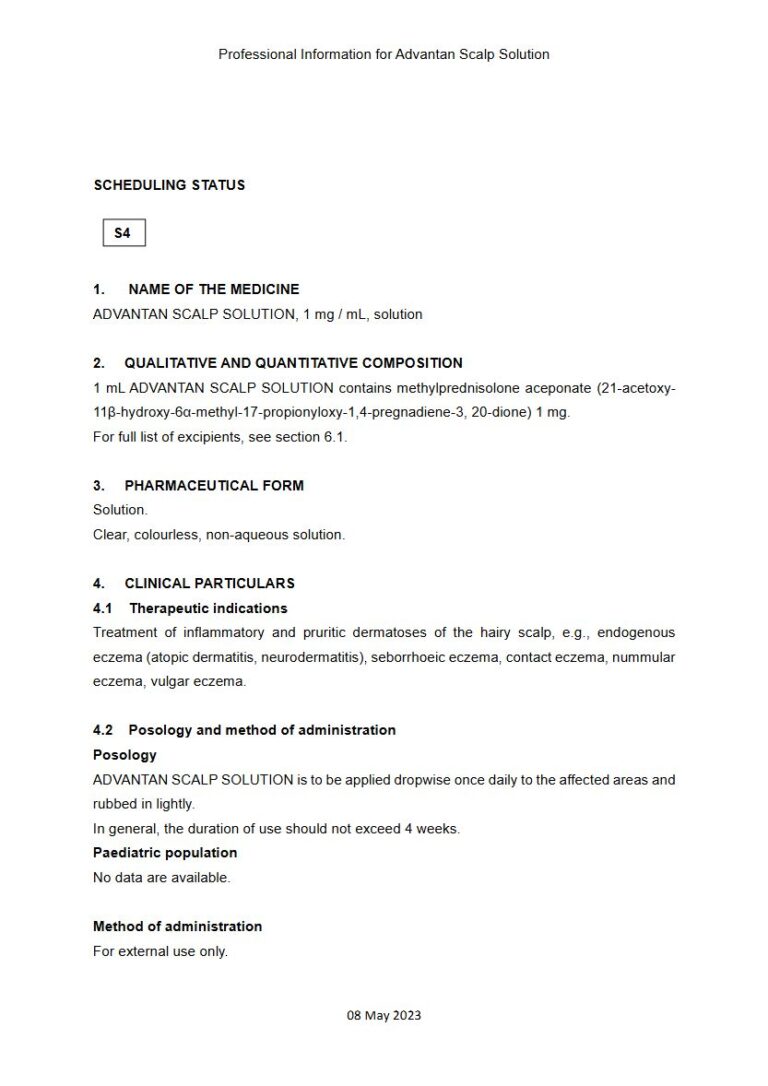
Treatment of inflammatory and pruritic dermatoses of the hairy scalp, e.g., endogenous eczema (atopic dermatitis, neurodermatitis), seborrhoeic eczema, contact eczema, nummular eczema, vulgar eczema.
4.2 Posology and method of administration
Posology
ADVANTAN SCALP SOLUTION is to be applied dropwise once daily to the affected areas and rubbed in lightly. In general, the duration of use should not exceed 4 weeks.
Paediatric population
No data are available.
Method of administration
For external use only.
4.3 Contraindications
ADVANTAN SCALP SOLUTION must not be used in cases of hypersensitivity to the active substance or to any of the excipients listed in section 6.1, presence of tuberculous or syphilitic processes, viral infections (such as herpes zoster or varicella), rosacea, perioral dermatitis, ulcers, acne vulgaris, atrophic dermatitis and vaccination skin reactions in the area to be treated. Skin diseases associated with bacterial or fungal infections (see section 4.4). Corticosteroids have been shown to be teratogenic in animals following dermal application. As these agents are absorbed percutaneously, teratogenicity following topical application cannot be excluded. Therefore, ADVANTAN SCALP SOLUTION should not be used during pregnancy (see section 4.6).
4.4 Special warnings and precautions for use
Long-term continuous treatment with topical corticosteroids should be avoided as far as possible as this may cause atrophic changes in the skin leading to thinning, loss of elasticity, dilatation of superficial blood vessels, telangiectasiae and ecchymoses. These changes are particularly likely to occur on the face and when occlusive dressings are used. Systemic absorption of topically applied corticosteroids may occur, particularly under the following conditions: when large quantities are used, or when application is made to wide areas of the body, or to damaged skin, when potent topical corticosteroids are used, and when the occlusive dressing technique is applied. Depression of the hypothalamic-pituitary-adrenal axis with consequent suppression of the adrenal gland may occur. These effects are most likely to be severe in children. Growth may be retarded and a Cushingoid state may be produced. Benign increased intracranial pressure has been rarely reported. Additional, specific therapy is required in bacterially infected skin diseases and/or in fungus infections. To date, no clinical data are available for the use of ADVANTAN SCALP SOLUTION in children. Local skin infections can be potentiated by topical glucocorticoid use. Care must be taken when using ADVANTAN SCALP SOLUTION to avoid contact with the eyes, open wounds and mucosae. ADVANTAN SCALP SOLUTION is flammable: it should not be applied near open flames.
4.5 Interactions with other medicines and other forms of interaction
None so far known.
Paediatric population
No information available.
4.6 Fertility, pregnancy and lactation
Pregnancy
There are no adequate data on the use of methylprednisolone aceponate in pregnant women. Animal experimental studies with methylprednisolone aceponate have shown embryotoxic and/or teratogenic effects at doses which exceed the therapeutic dose (see section 5.3). A number of epidemiological studies suggest that there could possibly be an increased risk of oral clefts among newborns of women who were treated with systemic glucocorticoids during the first trimester of pregnancy.
In general, the use of topical preparations containing corticoids should be avoided during the first trimester of pregnancy. In particular, treating large areas, prolonged use or occlusive dressings should be avoided during pregnancy and lactation (see section 4.3).
Breastfeeding
In rats, methylprednisolone aceponate showed practically no transfer to the neonates via the milk. But it is not known if methylprednisolone aceponate is secreted in human milk as systemically administered corticosteroids have been reported to appear in human milk. It is not known whether topical administration of ADVANTAN SCALP SOLUTION could result in sufficient systemic absorption of methylprednisolone aceponate to produce detectable quantities in human milk. Therefore, caution should be exercised when ADVANTAN SCALP SOLUTION is administered to a nursing woman.
Fertility
No information about the influence of methylprednisolone aceponate on fertility is available.
4.7 Effects on ability to drive and use machines
ADVANTAN SCALP SOLUTION has no influence on the ability to drive and use machines.
4.8 Undesirable effects
a. Summary of the safety profile
Occasionally, the alcohol content of the ADVANTAN SCALP SOLUTION may lead to local skin irritations such as a mild transient burning sensation. Less frequently, itching, erythema, dry skin, scaling and folliculitis may arise. Frequencies of side effects observed in clinical studies and given in the table below are defined according to the MedDRA frequency convention: very common (u22651/10); common (u22651/100, <1/10); uncommon (u22651/1 000; <1/100), rare (u22651/10 000, <1/1 000); very rare (<1/10 000), not known (cannot be estimated from the available data). The most appropriate MedDRA term was used to describe a certain adverse reaction, its symptoms and related conditions.
b. Tabulated summary of adverse reactions
System organ class
common
uncommon
not known
Eye disorders
Vision blurred (see also section 4.4) **
Skin and subcutaneous tissue disorders
Seborrhoea capitis, hair loss
Acne, telangiectasia, skin atrophy, skin striae, perioral dermatitis, skin discolouration, allergic skin reactions, withdrawal reactions - redness of the skin which may extend to areas beyond the initial affected area, burning or stinging sensation, itch, skin peeling, oozing pustules**
General disorders and administration site reaction
Burning
Pruritus, pain, folliculitis, localised sensation of warmth, dryness, irritation, eczema
Blisters, erythema, hypertrichosis
* Potential undesirable effects not observed in clinical trials. ** See also section 4.4
c. Description of selected adverse reactions
Systemic effects due to absorption may occur when topical preparations containing corticosteroids are applied. Reporting of suspected adverse reactions
Reporting suspected adverse reactions after authorisation of the medicine is important. It allows continued monitoring of the benefit/risk balance of the medicine. Healthcare professionals are asked to report any suspected adverse reactions to SAHPRA via the u201c6.04 Adverse Drug Reaction Reporting Formu201d, found online under SAHPRAu2019s publications: https://www.sahpra.org.za/Publications/Index/8
4.9 Overdose
Please refer to sections 4.4 and 4.8. Treatment should be discontinued if skin atrophy due to overdose of the topical preparation occurs. Symptoms normally resolve within 10 -14 days. Results from acute toxicity studies with methylprednisolone aceponate do not indicate that any risk of acute intoxication is to be expected following a single dermal application of an overdose (application over a large area under conditions favourable to absorption) or inadvertent ingestion. Effects related to isopropyl alcohol, a base component, can occur following inadvertent ingestion of ADVANTAN SCALP SOLUTION. These effects can manifest as symptoms of depression affecting the central nervous system, even from ingesting only a few millilitres of the medicinal product. If any symptoms of overdosage occur, treatment must be discontinued.
