
Rozex Gel 7.5 mg per g GEL
PDF Leaflet Revision Date: 19 April 2022
Clinical Summary
Quick overview from the medicine insert
Indication
Treatment of inflammatory papules, pustules, and erythema of rosacea.
Dosage (summary)
Apply a thin film twice daily to affected areas for 3-4 months.
Pregnancy & Breastfeeding
Not recommended in pregnancy; avoid breastfeeding during treatment.
Key Drug Interactions
- May potentiate anticoagulant effects of warfarin.
- Disulfiram-like reaction with alcohol.
Contraindications
- Hypersensitivity to metronidazole or parabens.
Common side effects
- Watery eyes, transient redness, mild dryness, burning, skin irritation.
Counselling Points
- Apply only to affected areas.
- Avoid excessive sunlight exposure.
- Report any severe irritation or allergic reactions.
Serious warnings
- Avoid contact with eyes and mucous membranes.
- Use with caution in patients with blood dyscrasia.
Important Disclaimer
The Rozex Gel 7.5 mg per g GEL professional information leaflet below is the property of Galderma Laboratories South Africa and is provided on Medinsert exactly as issued, with no.. alterations or editorial changes. We make every effort to keep content current by updating documents as soon as new versions become available. Medinsert serves as a trusted access point for healthcare professionals, but does not replace official sources or clinical judgement. For more details, please read our full disclaimer. read more>>
 Healthcare Professionals Only
This content is for registered healthcare professionals
Sign in or create a free account to read the full package insert.
Free for HPCSA-registered professionals. Powered by Medinsert.
Clinical Particulars
Section 4 of the official insert — extracted exactly as issued, no alterations
4.1 Therapeutic indications
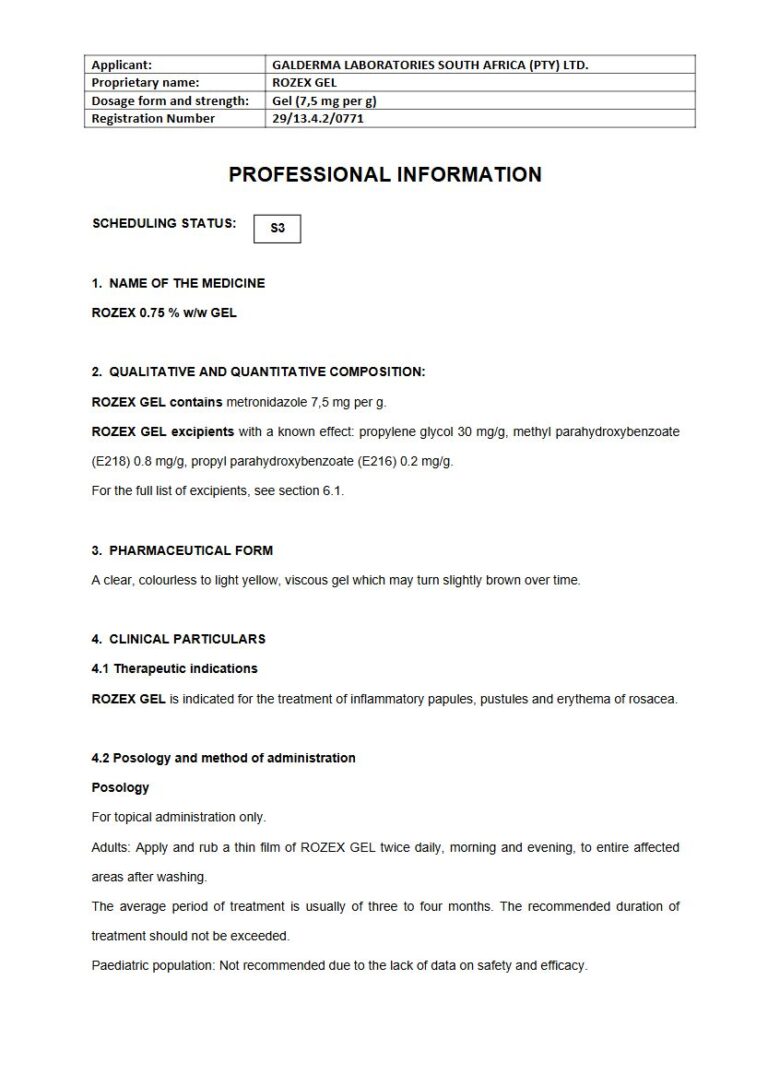
ROZEX GEL is indicated for the treatment of inflammatory papules, pustules and erythema of rosacea.
4.2 Posology and method of administration
Posology
For topical administration only.
Adults: Apply and rub a thin film of ROZEX GEL twice daily, morning and evening, to entire affected areas after washing. The average period of treatment is usually of three to four months. The recommended duration of treatment should not be exceeded.
Paediatric population: Not recommended due to the lack of data on safety and efficacy.
4.3 Contraindications
Hypersensitivity to metronidazole, parabens or any of the excipients listed in section 6.1.
4.4 Special warnings and precautions for use
ROZEX GEL contains:
- Propylene glycol that can be irritating to the skin.
- Methyl parahydroxybenzoate and propyl parahydroxybenzoate which may cause allergic reactions (possibly delayed).
ROZEX GEL has been reported to cause tearing of the eyes, therefore, contact with the eyes and mucous membranes should be avoided. If a reaction suggesting local irritation occurs, patients should be directed to use the medication less frequently, discontinue use temporarily or discontinue use completely and to seek medical advice if necessary.
Metronidazole is a nitroimidazole and should be used with care in patients with evidence of, or history of, blood dyscrasia.
Exposure of metronidazole treated sites to excessive sunlight or artificial sources of ultraviolet irradiation such as sun beds should be avoided.
Unnecessary and prolonged use of this medication should be avoided.
4.5 INTERACTIONS with other medicines and other forms of interaction
Medicine interactions are less likely with topical administration but should be kept in mind when ROZEX GEL is prescribed for patients who are receiving anticoagulant treatment. Oral metronidazole has been reported to potentiate the anticoagulant effect of warfarin and other coumarin anticoagulants resulting in a prolongation of prothrombin time (INR).
Disulfiram-like reaction has been reported in a small number of patients taking oral metronidazole and alcohol concomitantly.
4.6 Fertility, pregnancy and lactation
Pregnancy
Safety and efficacy of ROZEX GEL during pregnancy have not been established. Metronidazole crosses the placental barrier and rapidly enters the foetal circulation. ROZEX GEL should not be used in pregnancy.
Lactation
Mothers on treatment with ROZEX GEL should not breastfeed their infants.
4.7 Effects on ability to drive and the use of machines
ROZEX GEL has no or negligible influence on the ability to drive and use machines.
4.8 Undesirable effects
Because of the minimal absorption of metronidazole and consequently its insignificant plasma concentration after topical administration, the adverse experiences reported with the oral form of the agent have not been reported with ROZEX topical gel. Adverse reactions reported with ROZEX GEL include watery (tearing) eyes if the gel is applied too closely to this area, transient redness and mild dryness, burning and skin irritation.
The following spontaneous adverse experiences have been reported, and within each system organ class, are ranked by frequency, using the following convention:
Very common (u22651/10)
Common (u22651/100 to <1/10)
Uncommon (u2265 1/1 000 to <1/100)
Rare (u22651/10 000 to <1/1 000)
Very rare (<1/10 000), including isolated reports
Unknown (frequency not assessable based on the available data)
4.9 Overdose
In the event of accidental ingestion, treatment should be symptomatic and supportive. In overdose, side effects (see section 4.8) can be precipitated and/or be of increased severity.
