
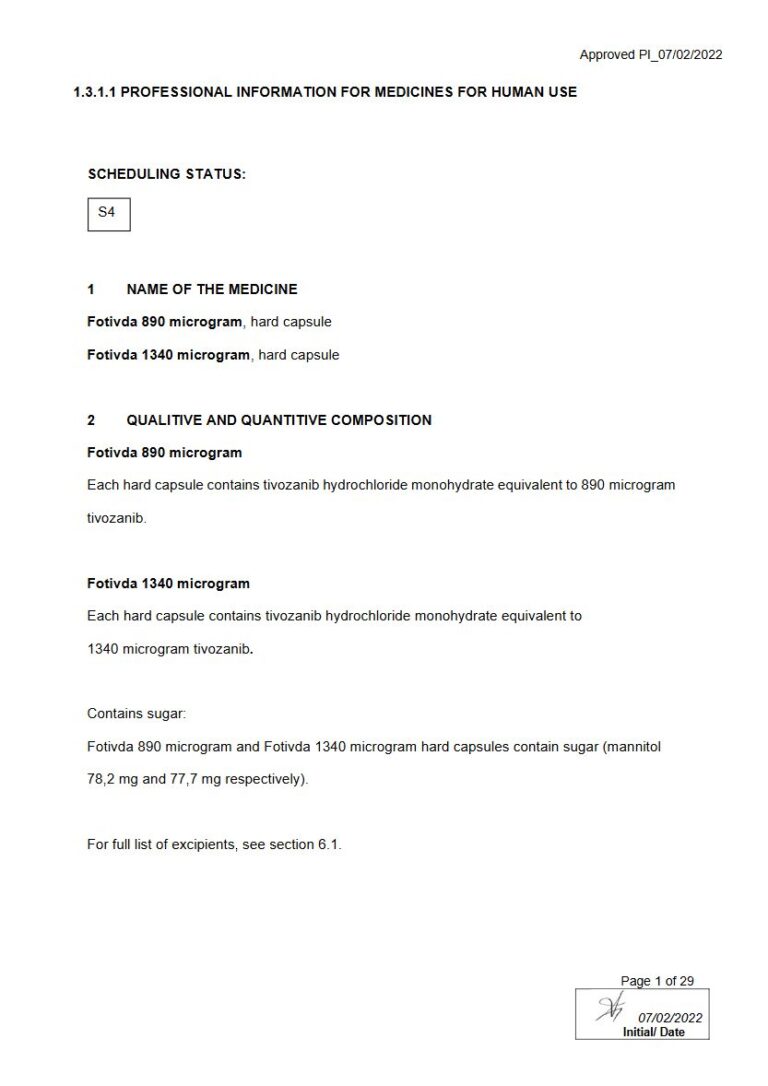
Fotivda 890 Microgram/1340 Microgram/78.2 mg/77.7 mg Capsules
PDF Leaflet Revision Date: 07 February 2022
Clinical Summary
Quick overview from the medicine insert
Indication
First line treatment of advanced renal cell carcinoma.
Dosage (summary)
1340 microgram once daily for 21 days, followed by a 7-day rest.
Special Populations
- Elderly patients
- Renal impairment
- Hepatic impairment
Pregnancy & Breastfeeding
Contraindicated in pregnancy and breastfeeding.
Key Drug Interactions
- St. John's wort
- Strong CYP3A4 inducers
Contraindications
- Hypersensitivity to tivozanib
- Severe hepatic impairment
- Uncontrolled hypertension
- Uncontrolled cardiac failure
Common side effects
- Hypertension
- Dysphonia
- Fatigue
- Diarrhoea
Counselling Points
- Monitor blood pressure regularly
- Avoid pregnancy during treatment
- Do not breastfeed while on Fotivda
Serious warnings
- Hypertension
- Arterial thromboembolic events
- Cardiac failure
- Haemorrhage
Important Disclaimer
The Fotivda 890 Microgram/1340 Microgram/78.2 mg/77.7 mg Capsules professional information leaflet below is the property of Key Oncologics and is provided on Medinsert exactly as issued, with no.. alterations or editorial changes. We make every effort to keep content current by updating documents as soon as new versions become available. Medinsert serves as a trusted access point for healthcare professionals, but does not replace official sources or clinical judgement. For more details, please read our full disclaimer. read more>>
 Healthcare Professionals Only
This content is for registered healthcare professionals
Sign in or create a free account to read the full package insert.
Free for HPCSA-registered professionals. Powered by Medinsert.
Clinical Particulars
Section 4 of the official insert — extracted exactly as issued, no alterations
4.1 Therapeutic indications
Fotivda is indicated for the first line treatment of adult patients with advanced renal cell carcinoma (RCC) and for adult patients who are VEGFR and mTOR pathway inhibitor-nau00efve following disease progression after one prior treatment with cytokine therapy for advanced RCC.
4.2 Posology and method of administration
Posology
Fotivda therapy should be supervised by a medical practitioner experienced in the use of anticancer therapies. The recommended dose of Fotivda is 1340 microgram once daily for 21 days, followed by a 7-day rest period to comprise one complete treatment cycle of 4 weeks. This treatment schedule should be continued until disease progression or unacceptable toxicity. No more than one dose of Fotivda must be taken per day.
Dose modification
The occurrence of undesirable effects may require temporary interruption and/or dose reduction of Fotivda therapy (see Section 4.4). In the pivotal study, the dose was reduced for grade 3 events and interrupted for grade 4 events. When dose reduction is necessary, the Fotivda dose can be reduced to 890 microgram once daily with the normal treatment schedule of 21 days of dosing, followed by a 7-day rest period.
Missed dose
In the case of a missed dose a replacement dose must not be taken to make up for a forgotten dose. The next dose should be taken at the next scheduled time. In the case of vomiting a replacement dose should not be taken; the next dose should be taken at the next scheduled time.
Special populations
Paediatric population
The safety and efficacy of Fotivda in children and adolescents aged below 18 years have not been established. No data are available. There is no relevant use of Fotivda in the paediatric population in the indication advanced renal cell carcinoma.
Elderly patients
No dose adjustment is required in patients 65 years of age or older (see Section 4.4 and 5.1).
Patients with renal impairment
No dose adjustment is required in patients with mild or moderate renal impairment (see Section 5.2). Caution is advised in patients with severe renal impairment due to limited experience and in patients undergoing dialysis as there is no experience of Fotivda in this patient population.
Patients with hepatic impairment
All patients should have liver function tests evaluated, including aminotransferase (ALT), aspartate aminotransferase (AST), bilirubin, and alkaline phosphatase (AP), to determine hepatic function before starting and during treatment with Fotivda. Fotivda should not be used in patients with severe hepatic impairment. Patients with moderate hepatic impairment should only be treated with one Fotivda 1340 microgram capsule every other day as they may be at an increased risk of adverse reactions due to increased exposure with the dose of 1340 microgram every day (see Section 4.4 and 5.1). No dose adjustment is required when administering Fotivda to patients with mild hepatic impairment. Fotivda should be used with caution in patients with mild and moderate hepatic impairment with close monitoring of tolerability.
Method of administration
Fotivda is for oral use. Fotivda may be taken with or without food (see Section 5.2). The capsules must be swallowed whole with a glass of water and must not be opened.
4.3 Contraindications
Hypersensitivity to the active ingredient, tivozanib or to any of the excipients.
Co-administration with herbal preparations containing St. Johnu2019s wort (Hypericum perforatum) (see Interactions).
Pregnancy and lactation.
Severe hepatic impairment (Child Pugh C).
Uncontrolled severe hypertension.
Uncontrolled cardiac failure.
Uncontrolled hypothyroidism.
A history of recent venous thrombotic and/or arterial thrombotic events when other appropriate treatment options are available.
A history of previous posterior reversible encephalopathy syndrome (PRES).
An unresolved / not well controlled bleeding tendency.
4.4 Special warnings and precautions for use
There is evidence that the Progression Free Survival (PFS) of patients with non-clear cell renal cell carcinoma is less than in patients with clear cell renal cell carcinoma. There is evidence that a nephrectomy prior to treatment with Fotivda improved PFS.
Hypertension
In clinical studies with Fotivda, hypertension (including persistent severe hypertension) has occurred (see Section 4.8). In approximately one-third of the patients, hypertension developed within the first 2 months of treatment. Blood pressure should be well controlled prior to initiating Fotivda. During treatment, patients should be monitored for hypertension and treated as needed with anti-hypertensive therapy according to standard medical practice. In the case of persistent hypertension despite use of anti-hypertensive therapy, the Fotivda dose should be reduced, or the treatment interrupted and re-initiated at a lower dose once the blood pressure is controlled, according to clinical judgment (see Section 4.2). Treatment should be discontinued in cases of persistent severe hypertension, posterior reversible encephalopathy syndrome (see below), or other complications of hypertension. Patients receiving anti-hypertensive medicine should still be monitored for hypotension when Fotivda is either interrupted or discontinued (see Section 4.3).
Arterial thromboembolic events
In clinical studies with Fotivda, arterial thromboembolic events (ATEs) have occurred (see Section 4.8). Risk factors for ATE include malignant disease, age > 65 years, hypertension, diabetes mellitus, smoking, hypercholesterolaemia, and prior thromboembolic disease. Fotivda has not been studied in patients who had an ATE within the preceding 6 months of clinical study initiation. Fotivda must be used with caution in patients who are at risk for, or who have a history of these events (such as myocardial infarction, stroke) (see Section 4.3).
Venous thromboembolic events
In clinical studies with Fotivda, venous thromboembolic events (VTEs) have been reported including pulmonary embolism and deep vein thrombosis (see Section 4.8). Risk factors for VTEs include major surgery, multiple trauma, prior VTEs, advanced age, obesity, cardiac or respiratory failure, and prolonged immobility. Fotivda has not been studied in patients who had a VTE within the preceding 6 months of clinical study initiation (see Section 4.3).
Cardiac failure
In clinical studies with Fotivda, as monotherapy for the treatment of patients with RCC, cardiac failure has been reported (see Section 4.8). Signs or symptoms of cardiac failure should be frequently monitored throughout treatment with Fotivda. Management of cardiac failure events may require temporary interruption or permanent discontinuation and/or dose reduction of tivozanib therapy, plus treatment of potential underlying causes of cardiac failure e.g. hypertension (see Section 4.3).
Haemorrhage
In clinical studies with Fotivda, haemorrhagic events have been reported (see Section 4.8). Fotivda must be used with caution in patients who are at risk for, or who have a history of bleeding. If any bleeding requires medical intervention, Fotivda should be temporarily interrupted (see Section 4.3).
Proteinuria
Proteinuria has been reported in clinical studies with Fotivda (see Section 4.8). Monitoring for proteinuria before initiation of, and periodically throughout treatment is recommended. For patients who develop Grade 2 (> 1,0-3,4 g/24 hours) or Grade 3 (u2265 3,5 g/24 hours) proteinuria (National Cancer Institute Common Terminology Criteria for Adverse Events [NCI CTCAE]), the dose of Fotivda has to be reduced or the treatment temporarily interrupted. If the patient develops Grade 4 proteinuria (nephrotic syndrome) Fotivda has to be discontinued. Risk factors for proteinuria include high blood pressure.
Hepatotoxicity
In clinical studies with Fotivda, elevations of ALT, AST, and bilirubin have been reported (see Section 4.8). The majority of AST and ALT elevations were not accompanied with concomitant elevations of bilirubin. AST, ALT, bilirubin, and AP should be monitored before initiation of and periodically throughout treatment with Fotivda because of the potential risk of hepatotoxicity (see Section 4.2). Fotivda should not be used in patients with severe hepatic impairment (see Section 4.3). Patients with moderate hepatic impairment should only be treated with one Fotivda 1340 microgram capsule every other day as they may be at an increased risk of adverse reactions due to increased exposure with the dose of 1340 microgram every day (see Section 5.2). No dose adjustment is required when administering Fotivda to patients with mild hepatic impairment. Fotivda should be used with caution in patients with mild and moderate hepatic impairment with close monitoring of tolerability.
Posterior reversible encephalopathy syndrome
In clinical studies, one case of posterior reversible encephalopathy syndrome (PRES) was confirmed after treatment with Fotivda (see Section 4.8). PRES is a neurological disorder which can present with headache, seizure, lethargy, confusion, blindness and other visual and neurologic disturbances. Mild to severe hypertension may be present. Magnetic Resonance Imaging is necessary to confirm the diagnosis of PRES. Fotivda must be discontinued in patients developing signs or symptoms of PRES. The safety of re-initiating Fotivda therapy in patients previously experiencing PRES is not known and Fotivda should only be used with caution in these patients (see Section 4.3).
Hand foot skin reaction
In clinical studies with Fotivda, hand foot skin reaction (palmar-plantar erythrodysaesthesia) has been reported. Most events in the five renal cell carcinoma monotherapy studies were CTC Grade 1 or 2 (u2265 CTC Grade 3 was observed in < 2 % of patients treated with Fotivda) (see Section 4.8). Management of patients experiencing HFSR may include topical therapies for symptomatic relief with consideration of temporary interruption and/or reduction in treatment dose or, in severe or persistent cases, permanent discontinuation of treatment.
QT interval prolongation
In clinical studies with Fotivda, QT/QTc interval prolongation has been reported (see Section 4.8 and 5.2). QT/QTc interval prolongation may lead to an increased risk for ventricular dysrhythmias. It is recommended that Fotivda be used with caution in patients with a history of QT interval prolongation or other relevant pre-existing cardiac disease and those receiving other medicines known to increase the QT interval. Baseline and periodic monitoring of electrocardiograms and maintenance of electrolytes (e.g. calcium, magnesium, potassium) within the normal range is recommended.
Gastrointestinal perforation/fistula
It is recommended that symptoms of gastrointestinal perforation or fistula should be periodically monitored throughout treatment with Fotivda and that Fotivda should be used with caution in patients at risk for GI perforation or fistula.
Wound healing complications
For precautionary reasons, temporary interruption of Fotivda therapy is recommended in patients undergoing major surgical procedures. The decision to resume Fotivda therapy after surgery should be based on clinical judgment of adequate wound healing.
Hypothyroidism
In clinical studies with Fotivda, hypothyroidism has been reported (see Section 4.8). Hypothyroidism has been observed to occur at any time during treatment with Fotivda, developing as early as within two months of treatment initiation. Risk factors for hypothyroidism include prior history of hypothyroidism and use of anti-thyroid medicines. Thyroid function should be monitored before initiation of, and periodically throughout treatment with Fotivda. Hypothyroidism should be treated according to standard medical practice (see Section 4.3).
Adrenal glands
Adrenal cortical damage has been reported in preclinical studies in rats and monkeys at exposures to tivozanib not much higher than expected therapeutic tivozanib exposure in humans. Although the relevance of this finding in humans is unknown, adrenal cortical function should be monitored if needed and patients should be observed for signs and symptoms of adrenal cortical insufficiency and treated if necessary.
Elderly patients
Dysphonia, diarrhoea, fatigue, weight decreased, appetite decreased, and hypothyroidism occurred more commonly in patients u2265 65 years of age. Healthcare professionals should be aware that elderly patients may be at increased risk of adverse reactions.
Aneurysms and artery dissections
The use of VEGF pathway inhibitors in patients with or without hypertension may promote the formation of aneurysms and/or artery dissections. Before initiating Fotivda, this risk should be carefully considered in patients with risk factors such as hypertension or history of aneurysm.
4.5 Interaction with other medicines and other forms of interaction
Contraindication of concomitant use
Herbal preparations containing St John's wort (Hypericum perforatum) are contraindicated. If a patient is already taking St Johnu2019s wort, this should be stopped before starting Fotivda treatment. The inducing effect of St Johnu2019s wort may persist for at least 2 weeks after cessation of treatment with St Johnu2019s wort (see Section 4.3).
Strong CYP3A4 inducers
In a clinical study in healthy volunteers, co-administration of a single 1340 microgram dose of Fotivda with a strong CYP3A4 inducer at steady-state (rifampin 600 mg once daily) decreased the average half-life of tivozanib from 121 to 54 hours which was associated with a decrease in the single dose AUC 0-u221e of 48 % compared with AUC 0-u221e in the absence of rifampin. Average C max and AUC 0-24hr were not significantly affected (8 % increase and 6 % decrease respectively). The clinical effects of strong CYP3A4 inducers on repeated daily dosing of tivozanib has not been studied but potentially the average time to reach steady-state and the average steady-state serum concentration of tivozanib may be reduced, due to the reduction in half-life. It is recommended that concomitant administration of Fotivda with strong CYP3A4 inducers, if used, should be undertaken with caution.
Moderate CYP3A4 inducers are not expected to have a clinically relevant effect on tivozanib, contained in Fotivda, exposure.
CYP3A4 inhibitors
In a clinical study in healthy volunteers, co-administration of tivozanib with a potent CYP3A4 inhibitor, ketoconazole (400 mg once daily), had no influence on tivozanib serum concentrations (C max or AUC); therefore, tivozanib exposure is unlikely to be altered by CYP3A4 inhibitors.
Medicines for which intestinal absorption is restricted by BCRP
Fotivda inhibits the transporter protein BCRP in vitro, but the clinical relevance of this finding is unknown (see Section 5.2). Caution should be exercised if Fotivda is co-administered with rosuvastatin. Alternatively, a statin not subject to restriction of intestinal absorption by BCRP should be considered. Patients taking an oral BCRP substrate with a clinically relevant efflux interaction in the gut should ensure that a suitable time window (e.g. 2 hours) is applied between administration of Fotivda and the BCRP substrate.
Contraceptives
It is currently unknown whether tivozanib may reduce the effectiveness of hormonal contraceptives, and therefore women using hormonal contraceptives should add a barrier method (see Section 4.6).
4.6 Fertility, pregnancy and lactation
Women of childbearing potential/ Contraception in males and females
Women of childbearing potential should avoid becoming pregnant while on Fotivda. Female partners of male patients taking Fotivda should also avoid pregnancy. Effective methods of contraception should be used by male and female patients and their partners during therapy, and for at least one month after completing therapy. It is currently unknown whether Fotivda may reduce the effectiveness of hormonal contraceptives and therefore women using hormonal contraceptives should add a barrier method.
Pregnancy
Fotivda should not be used during pregnancy or if pregnancy is planned. Studies in animals have shown reproductive toxicity and teratogenicity in rats (see Section 4.3).
Breastfeeding
Because of the potential for tivozanib-mediated adverse reactions in breastfed infants, women should not breastfeed their babies while taking Fotivda (see Section 4.3).
Fertility
Animal studies indicate that male and female fertility may be affected by treatment with Fotivda. Conservation of sperms or ova should be considered before treatment with Fotivda.
4.7 Effects on ability to drive and use machines
Fotivda may have an influence on the ability to drive and use machines. Patients should be advised to be cautious when driving or using machines if they experience asthenia, fatigue, and/or dizziness during treatment with tivozanib (see Section 4.8).
4.8 Undesirable effects
a. Summary of the safety profile
Pooled data of 674 patients with advanced RCC who continued to receive Fotivda as their initial on trial therapy in the five core RCC monotherapy studies have been evaluated in the overall assessment of safety and tolerability of Fotivda. The most important serious adverse reaction is hypertension. The most common adverse reactions of any grade include hypertension (47,6 %), dysphonia (26,9 %), fatigue (25,8 %) and diarrhoea (25,5 %). In the five core RCC monotherapy studies Fotivda was discontinued in a total of 20 patients (3 %) owing to adverse reactions, most commonly due to hypertension (0,4 %), persistent severe hypertension (0,3 %), or acute myocardial infarction (0,3 %). The most frequent adverse reactions leading to Fotivda dose reduction/ interruption were hypertension (4,7 %), diarrhoea (3,1 %), fatigue (1,8 %). In patients receiving Fotivda as initial therapy, there were three adverse reactions with outcome death; one was uncontrolled hypertension in the setting of a suspected overdose (see Section 4.9) and two were reported simply as death.
Tabulated list of adverse reactions
Adverse reactions occurring in patients who continued to receive Fotivda as their initial on trial therapy in the five RCC monotherapy studies were pooled and are listed below by MedDRA body system organ class (SOC) and frequency. Frequencies are defined as follows: very common (u2265 1/10); common (u2265 1/100 to < 1/10); uncommon (u2265 1/1 000 to < 1/100), rare (u2265 1/10 000 to < 1/1 000) and not known (cannot be estimated from available data). Within each SOC, adverse reactions are presented in order of decreasing seriousness.
4.9 Overdose
In overdose, side effects can be precipitated and/or be of increased severity. Blood pressure should be well controlled prior to initiating Fotivda and patients should be monitored for hypertension during treatment (see Section 4.4). In cases of suspected overdose, Fotivda should be discontinued and the patient monitored for hypertension and treated as needed with standard anti-hypertensive therapy. There is no specific treatment or antidote for Fotivda overdose. Treatment should be symptomatic and supportive.
