
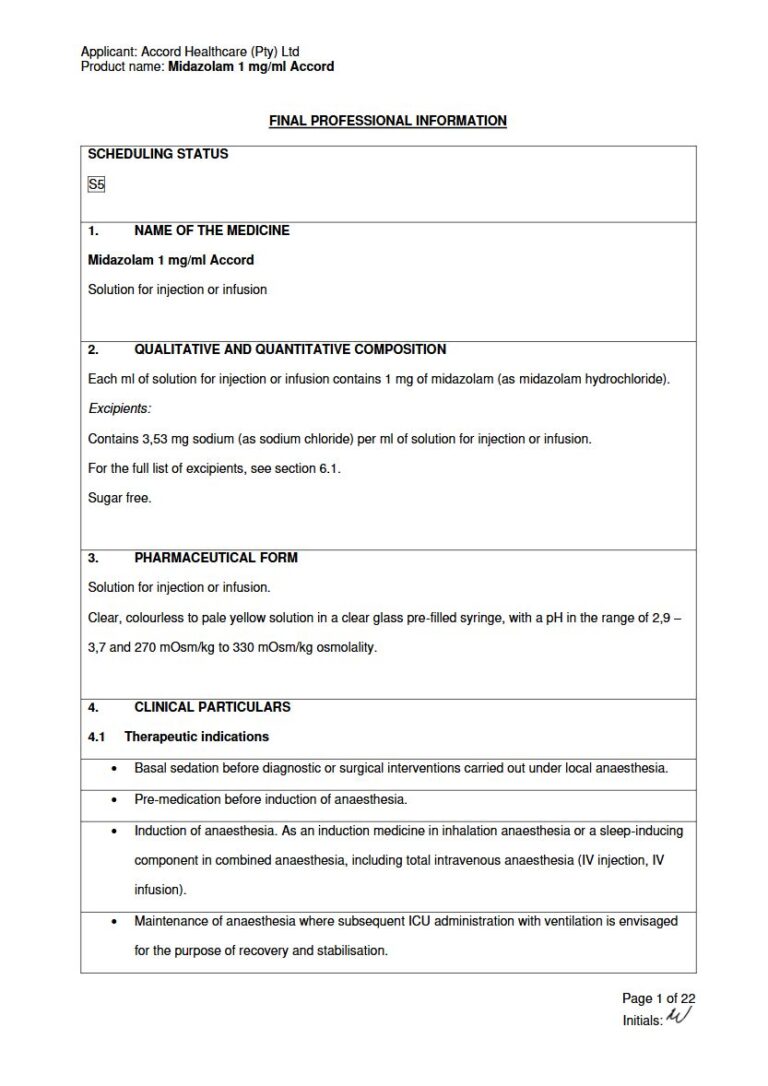
Midazolam 1 Mg/ Ml Accord 1,0 mg SOLUTION FOR INJECTION/ INFUSION
PDF Leaflet Revision Date: 13 September 2022
Clinical Summary
Quick overview from the medicine insert
Indication
Sedation before procedures and induction/maintenance of anesthesia.
Dosage (summary)
Adults <60: 2.5 mg IV; Adults >60: 1-1.5 mg IV.
Onset of Action / Duration
Onset: 2 mins, Duration: 1-2 hours
Special Populations
- Elderly
- Debilitated patients
- Chronic respiratory insufficiency
- Hepatic impairment
- Renal impairment
Pregnancy & Breastfeeding
Not established safe in pregnancy; avoid in breastfeeding.
Key Drug Interactions
- CYP3A4 inhibitors (e.g., ketoconazole)
- CNS depressants (e.g., alcohol, opioids)
Contraindications
- Hypersensitivity to midazolam
- Severe respiratory insufficiency
- Pregnancy
Common side effects
- Drowsiness
- Amnesia
- Respiratory depression
- Hypotension
Counselling Points
- Do not drive or operate machinery post-administration.
- Accompanied discharge recommended.
Serious warnings
- Risk of severe respiratory depression
- Monitor high-risk patients closely
Important Disclaimer
The Midazolam 1 Mg/ Ml Accord 1,0 mg SOLUTION FOR INJECTION/ INFUSION professional information leaflet below is the property of Accord Healthcare and is provided on Medinsert exactly as issued, with no.. alterations or editorial changes. We make every effort to keep content current by updating documents as soon as new versions become available. Medinsert serves as a trusted access point for healthcare professionals, but does not replace official sources or clinical judgement. For more details, please read our full disclaimer. read more>>
 Healthcare Professionals Only
This content is for registered healthcare professionals
Sign in or create a free account to read the full package insert.
Free for HPCSA-registered professionals. Powered by Medinsert.
Clinical Particulars
Section 4 of the official insert — extracted exactly as issued, no alterations
4.1 Therapeutic indications
- Basal sedation before diagnostic or surgical interventions carried out under local anaesthesia.
- Pre-medication before induction of anaesthesia.
- Induction of anaesthesia. As an induction medicine in inhalation anaesthesia or a sleep-inducing component in combined anaesthesia, including total intravenous anaesthesia (IV injection, IV infusion).
- Maintenance of anaesthesia where subsequent ICU administration with ventilation is envisaged for the purpose of recovery and stabilisation.
- Long-term sedation in intensive care units (IV administration as bolus injection or continuous infusion).
4.2 Posology and method of administration
Posology
Midazolam 1 mg/ml Accord is a potent sedative medicine, requiring slow administration and individualised dosing. The dose should be individualised and titrated to the desired state of sedation according to the clinical need, physical status, age and concomitant medication.
In the case of elderly (adults over 60 years) with organic cerebral changes or impaired cardiac and respiratory function, debilitated or chronically ill patients, the dosage should be determined with caution, the special factors relating to each patient being taken into consideration.
Basal sedation
Intravenous basal sedation: Intravenous injections must be given slowly (approximately 1 mg in 30 seconds for sedation). Midazolam 1 mg/ml Accord takes effect in about two minutes after the injection is given.
For basal sedation in diagnostic or surgical interventions carried out under local anaesthesia: In adults below the age of 60 the initial dose is 2,5 mg (0,04 mg/kg) 5-10 minutes before the beginning of the procedure. Further doses of 1 mg may be given as necessary. A total dose greater than 5 mg is not usually necessary to reach the desired endpoint. In adults over 60 years, debilitated or chronically ill patients, the initial dose must be reduced to 1 to 1,5 mg and given 5-10 minutes before the beginning of the procedure. Further doses of 0,5 to 1,0 mg may be given as necessary. Total doses greater than 3,5 mg are not usually necessary.
Pre-medication before an operation
Intramuscular administration: Pre-medication with Midazolam 1 mg/ml Accord given shortly before a procedure produces sedation (induction of sleepiness or drowsiness and relief of apprehension), and pre-operative impairment of memory.
Special populations
Adults below the age of 60 years: 0,07 u2013 0,1 mg/kg body weight IM according to the general condition of the patient. Usual dose is about 5 mg.
Children: Between ages 1 and 15 years: proportionately higher doses are required than in adults in relation to bodyweight. The dose range from 0,08 to 0,20 mg/kg body weight has been shown to be effective and safe. These doses should be administered into a large muscle mass about 30 to 60 minutes before induction of anaesthesia.
In adults over 60 years, debilitated and chronically ill patients: 0,025 u2013 0,05 mg/kg body weight IM. The usual dose is 2 to 3 mg.
Induction and maintenance of anaesthesia
Intravenous injection: Induction: intravenous injections must be given slowly (approximately 2,5 mg in 10 seconds for induction of anaesthesia). The desired level of anaesthesia is reached by stepwise titration. The intravenous induction dose of Midazolam 1 mg/ml Accord should be given slowly in increments. Each increment of not more than 5 mg should be injected over 20 to 30 seconds, allowing 2 minutes between successive increments.
In pre-medicated adults below the age of 60 the dose can range from 10 to 15 mg IV (0,15 to 0,2 mg/kg). A total dose greater than 15 mg is usually not necessary. A sufficiently deep level of sleep is generally achieved after 2-3 minutes. In non-pre-medicated adults below the age of 60, the dose may be higher (0,3 to 0,35 mg/kg body weight), but a total dose greater than 20 mg is usually not necessary. In adults over 60 years of age, debilitated and chronically ill patients, lower doses will be required.
Maintenance: Intravenous continuous infusion: The maintenance dose usually ranges from 0,03 to 0,1 mg/kg/hr when used in combination with narcotics or ketamine. In high-risk surgical patients, adults over 60 years, debilitated and chronically ill patients, lower maintenance doses will be required.
Sedation in intensive care units (ICU)
Intravenous sedation in ICU: The desired level of sedation is reached by stepwise titration of Midazolam 1 mg/ml Accord, followed by either continuous infusion, or intermittent bolus. For sedation in ICU, the dosage should be individualised and Midazolam 1 mg/ml Accord titrated to the desired state of sedation according to the clinical need, physical status, age and concomitant medication. The intravenous loading dose should be given slowly in increments. Each increment of 1 to 2,5 mg should be injected over 20 to 30 seconds, allowing 2 minutes between successive increments. The intravenous loading dose can range from 0,03 to 0,3 mg/kg, but a total dose greater than 15 mg is usually not necessary. The loading dose should be reduced or omitted in hypovolaemic, vasoconstricted or hypothermic patients. The maintenance dose ranges from 0,03 to 0,2 mg/kg/hr. In hypovolaemic, vasoconstricted or hypothermic patients, the maintenance dose should be reduced, at times to as low as 25 % of the usual dose. The level of sedation should be assessed regularly if permitted by the patient's condition.
Method of administration
Midazolam 1 mg/ml Accord is indicated for parenteral use only.
4.3 Contraindications
- Hypersensitivity to midazolam, benzodiazepines or to any of the excipients of Midazolam 1 mg/ml Accord listed in section 6.1.
- Conscious sedation in patients with severe respiratory insufficiency or acute respiratory depression.
- Safety in pregnancy has not been established. Midazolam has been shown to cross the placenta and to enter foetal circulation.
- Midazolam passes into breast milk and should not be administered to breast feeding mothers.
4.4 Special warnings and precautions for use
Midazolam 1 mg/ml Accord should be administered only by experienced healthcare professionals in a setting fully equipped for the monitoring and support of respiratory and cardiovascular function and by persons specifically trained in the recognition and management of expected adverse events including respiratory and cardiac resuscitation. Severe cardiorespiratory adverse events have been reported. These have included respiratory depression, apnoea, respiratory arrest and/or cardiac arrest. Such life-threatening incidents are more likely to occur when the injection is given too rapidly or when a high dosage is administered (see section 4.8).
Special caution is required for the indication of conscious sedation in patients with impaired respiratory function. When Midazolam 1 mg/ml Accord is used for premedication, adequate observation of the patient after administration is mandatory as interindividual sensitivity varies and symptoms of overdose may occur.
Special caution should be exercised when administering Midazolam 1 mg/ml Accord to high-risk patients:
- adults over 60 years of age
- chronically ill or debilitated patients.
- patients with chronic respiratory insufficiency
- patients with chronic renal failure, impaired hepatic function or with impaired cardiac function
- paediatric patients especially those with cardiovascular instability.
Special care must be taken when benzodiazepines are used during labour and delivery, as high single doses may produce respiratory depression, irregularities in the foetal heart rate and hypotonia, poor sucking and hypothermia in the neonate. These high-risk patients require lower dosages (see section 4.2) and should be continuously monitored for early signs of alterations of vital functions.
Due to CNS depressant and/or muscle-relaxant properties, particular care should be taken when administering Midazolam 1 mg/ml Accord to a patient with myasthenia gravis.
Tolerance
Some loss of efficacy has been reported when Midazolam 1 mg/ml Accord was used as long-term sedation in intensive care units (ICU).
Dependence
When Midazolam 1 mg/ml Accord is used in long-term sedation in ICU, it should be borne in mind that physical dependence on midazolam may develop. The risk of dependence increases with dose and duration of treatment; it is also greater in patients with a medical history of alcohol and/or medicine abuse (see section 4.8).
Withdrawal symptoms
During prolonged treatment with Midazolam 1 mg/ml Accord in ICU, physical dependence may develop. Therefore, abrupt termination of the treatment will be accompanied by withdrawal symptoms. The following symptoms may occur: headaches, muscle pain, anxiety, tension, restlessness, confusion, irritability, rebound insomnia, mood changes, hallucinations and convulsions. Since the risk of withdrawal symptoms is greater after abrupt discontinuation of treatment, it is recommended to decrease doses gradually.
Amnesia
Midazolam causes anterograde amnesia (frequently this effect is very desirable in situations such as before and during surgical and diagnostic procedures), the duration of which is directly related to the administered dose. Prolonged amnesia can present problems in outpatients, who are scheduled for discharge following intervention. After receiving midazolam parenterally, patients should be discharged from hospital or consulting room only if accompanied by an attendant.
Paradoxical reactions
Paradoxical reactions such as agitation, involuntary movements (including tonic/clonic convulsions and muscle tremor), hyperactivity, hostility, rage reaction, aggressiveness, paroxysmal excitement and assault, have been reported to occur with midazolam. These reactions may occur with high doses and/or when the injection is given rapidly. The highest incidence to such reactions has been reported among children and the elderly.
Altered elimination of midazolam
Midazolam elimination may be altered in patients receiving compounds that inhibit or induce CYP3A4 and the dose of Midazolam 1 mg/ml Accord may need to be adjusted accordingly (see section 4.5). Midazolam elimination may also be delayed in patients with liver dysfunction and low cardiac output (see section 5.2).
Paediatric patients
Adverse haemodynamic events have been reported in paediatric patients with cardiovascular instability; rapid intravenous administration should be avoided in this population.
Concomitant use of alcohol/CNS depressants
The concomitant use of midazolam with alcohol or/and CNS depressants should be avoided. Such concomitant use has the potential to increase the clinical effects of Midazolam 1 mg/ml Accord possibly including severe sedation or clinically relevant respiratory depression (see section 4.5).
Risk from concomitant use of opioids
Concomitant use of Midazolam 1 mg/ml Accord and opioids may result in sedation, respiratory depression, coma and death. Because of these risks, concomitant prescribing of sedative medicines such as benzodiazepines or related medicines such as Midazolam 1 mg/ml Accord with opioids should be reserved for patients for whom alternative treatment options are not possible. If a decision is made to prescribe Midazolam 1 mg/ml Accord concomitantly with opioids, the lowest effective dose should be used, and the duration of treatment should be as short as possible (see also general dose recommendation in section 4.2). The patients should be followed closely for signs and symptoms of respiratory depression and sedation. In this respect, it is strongly recommended to inform patients and their caregivers (where applicable) to be aware of these symptoms (see section 4.5).
Medical history of alcohol or medicine abuse
Midazolam 1 mg/ml Accord should be avoided in patients with a medical history of alcohol or drug abuse.
Discharging criteria
After parenteral administration of Midazolam 1 mg/ml Accord, patients should not be discharged from hospital or consulting rooms for at least four hours or only when recommended by the treating doctor and if accompanied by an attendant. It is recommended that the patient is accompanied by a responsible person when returning home after discharge.
Information about excipients
Midazolam 1 mg/ml Accord contains less than 1 mmol sodium (23 mg) per dose i.e. essentially u2018sodium freeu2019.
4.5 Interactions with other medicines
Pharmacokinetic Interactions
Midazolam is metabolised by CYP3A4. Inhibitors and inducers of CYP3A have the potential to respectively increase and decrease the plasma concentrations and, subsequently, the effects of midazolam thus requiring dose adjustments accordingly.
Pharmacokinetic interactions with CYP3A4 inhibitors or inducers are more pronounced for oral as compared to IV midazolam, in particular since CYP3A4 also exists in the upper gastro-intestinal tract. This is because for the oral route both systemic clearance and availability will be altered while for the parenteral route only the change in the systemic clearance becomes effective. After a single dose of IV midazolam, the consequence on the maximal clinical effect due to CYP3A4 inhibition will be minor while the duration of effect may be prolonged. However, after prolonged dosing of midazolam, both the magnitude and duration of effect will be increased in the presence of CYP3A4 inhibition.
There are no available studies on CYP3A4 modulation on the pharmacokinetics of midazolam after rectal and intramuscular administration. It is expected that these interactions will be less pronounced for the rectal than for the oral route because the gastro-intestinal tract is by-passed whereas after IM administration the effects of CYP3A4 modulation should not substantially differ from those seen with IV midazolam.
It is therefore recommended to carefully monitor the clinical effects and vital signs during the use of midazolam, taking into account that they may be stronger and last longer after co-administration of a CYP3A4 inhibitor, be it given only once. Administration of high doses or long-term infusions of midazolam to patients receiving strong CYP3A4 inhibitors, e.g. during intensive care, may result in long-lasting hypnotic effects, delayed recovery and respiratory depression, thus requiring dose adjustments.
With respect to induction, it should be considered that the inducing process needs several days to reach its maximum effect and also several days to dissipate. Contrary to a treatment of several days with an inducer, a short term-treatment is expected to result in less apparent medicine interactions with midazolam. However, for strong inducers a relevant induction even after short-term treatment cannot be excluded.
Midazolam is not known to change the pharmacokinetics of other medicines.
Medicines that inhibit CYP3A
- Azole antifungals
- Ketoconazole increased the plasma concentrations of intravenous midazolam by 5-fold while the terminal half-life increased by about 3-fold. If parenteral midazolam is co-administered with the strong CYP3A inhibitor ketoconazole, it should be done in an intensive care unit (ICU) or similar setting which ensures close clinical monitoring and appropriate medical management in case of respiratory depression and/or prolonged sedation. Staggered dosing and dosage adjustment should be considered, especially if more than a single IV dose of midazolam is administered. The same recommendation may apply also for other azole antifungals (see further), since increased sedative effects of IV midazolam, although lesser, are reported.
- Voriconazole increased the exposure of intravenous midazolam by 3-fold whereas its elimination half-life increased by about 3-fold.
- Fluconazole and itraconazole both increased the plasma concentrations of intravenous midazolam by 2 u2013 3-fold associated with an increase in terminal half-life by 2,4-fold for itraconazole and 1,5-fold for fluconazole, respectively.
- Posaconazole increased the plasma concentrations of intravenous midazolam by about 2-fold.
- It should be kept in mind that if midazolam is given orally, its exposure will drastically be higher than the above-mentioned ones, notably with ketoconazole, itraconazole, voriconazole. Midazolam 1 mg/ml Accord is not indicated for oral administration.
- Macrolide antibiotics
- Erythromycin resulted in an increase in the plasma concentrations of intravenous midazolam by about 1,6 u2013 2-fold associated with an increase of the terminal half-life of midazolam by 1,5 u2013 1,8- fold.
- Clarithromycin increased the plasma concentrations of midazolam by up to 2,5-fold associated with an increase in terminal half-life by 1,5 u2013 2-fold.
- HIV Protease inhibitors
- Saquinavir and other HIV protease inhibitors: Co-administration with protease inhibitors may cause a large increase in the concentration of midazolam. Upon co-administration with ritonavir-booster lopinavir, the plasma concentrations of intravenous midazolam increased by 5,4-fold, associated with a similar increase in terminal half-life. If parenteral midazolam is co administered with HIV protease inhibitors, treatment setting should follow the description in the above section for azole antifungals, ketoconazole.
- Calcium-channel blockers
- Diltiazem: A single dose of diltiazem increased the plasma concentrations of intravenous midazolam by about 25 % and the terminal half-life was prolonged by 43 %.
- Various medicines/herbs
- Atorvastatin showed a 1,4-fold increase in plasma concentrations of IV midazolam compared to control group.
4.6 Fertility, pregnancy and lactation
Insufficient data are available on midazolam to assess its safety during pregnancy. Animal studies do not indicate a teratogenic effect, but fetotoxicity was observed as with other benzodiazepines. No data on exposed pregnancies are available for the first two trimesters of pregnancy.
The administration of high doses of midazolam in the last trimester of pregnancy, during labour or when used as an induction medicine of anaesthesia for caesarean section has been reported to produce maternal or foetal adverse effects (inhalation risk in mother, irregularities in the foetal heart rate, hypotonia, poor sucking, hypothermia and respiratory depression in the neonate). (see section 4.4)
Moreover, infants born from mothers who received benzodiazepines chronically during the latter stage of pregnancy may have developed physical dependence and may be at some risk of developing withdrawal symptoms in the postnatal period. The risk for neonates should be considered in case of administration of midazolam for any surgery near the term.
Midazolam passes in low quantities into breast milk. Nursing mothers should be advised to discontinue breastfeeding for 24 hours following administration of midazolam. (see section 4.3)
4.7 Effects on ability to drive and use machines
Midazolam 1 mg/ml Accord has a major influence on the ability to drive and use machines. Sedation, amnesia, impaired attention and impaired muscular function may adversely affect the ability to drive or use machines. Prior to receiving midazolam, the patient should be warned not to drive a vehicle or operate a machine until completely recovered. The prescribing doctor should decide when these activities may be resumed. It is recommended that the patient is accompanied when returning home after discharge.
4.8 Undesirable effects
The following undesirable effects have been reported to occur when Midazolam 1 mg/ml Accord is injected:
Immune System Disorders
Frequency not known Hypersensitivity, angioedema, anaphylactic shock
Psychiatric Disorders
Less frequent Depressed mood, affective disorder, confusional state, disorientation
Frequency not known Euphoric mood, hallucinations, agitation*, hostility*, rage*, aggressiveness*, excitement*, physical drug dependence and withdrawal syndrome, abuse
Nervous System Disorders
Frequent Drowsiness
Less frequent Ataxia
Frequency not known Involuntary movements (including tonic/clonic movements and muscle tremor)*, hyperactivity*.
Sedation (prolonged and postoperative), alertness decreased, somnolence, headache, dizziness, anterograde amnesia**, the duration of which is directly related to the administered dose. Convulsions have been reported in premature infants and neonates. Medicine withdrawal convulsions.
Cardiac Disorders
Frequency not known Cardiac arrest, bradycardia
Vascular Disorders
Frequency not known Hypotension, vasodilation, thrombophlebitis, thrombosis
Respiratory, thoracic and mediastinal Disorders
Frequency not known Respiratory depression, apnoea, respiratory arrest, dyspnoea, laryngospasm, hiccups
Gastrointestinal Disorders
Frequency not known Nausea, vomiting, constipation, dry mouth
Skin and Subcutaneous Tissue Disorders
Frequency not known Rash, urticaria, pruritis
General Disorders and Administration Site Conditions
Less frequent Lethargy
Frequency not known Fatigue, injection site erythema, injection site pain
Injury, Poisoning and Procedural Complications
Frequency not known Falls, fractures***
Social Circumstances
Frequency not known Assault*
* Paradoxical medicine reactions have been reported, particularly among children and the elderly (see section 4.4)
** Anterograde amnesia may still be present at the end of the procedure and in few cases prolonged amnesia has been reported (see section 4.4).
*** There have been reports of falls and fractures in benzodiazepine users. The risk of falls and fractures is increased in those taking concomitant sedatives (including alcoholic beverages) and in the elderly.
Dependence
Use of midazolam - even in therapeutic doses - may lead to the development of physical dependence. After prolonged IV administration, discontinuation, especially abrupt discontinuation of the product, may be accompanied by withdrawal symptoms including withdrawal convulsions (see section 4.4). Cases of abuse have been reported. Severe cardiorespiratory adverse events have occurred. Life-threatening incidents are more likely to occur in adults over 60 years of age and those with pre-existing respiratory insufficiency or impaired cardiac function, particularly when the injection is given too rapidly or when a high dosage is administered (see section 4.4).
4.9 Overdose
Symptoms
Midazolam 1 mg/ml Accord commonly causes drowsiness, ataxia, dysarthria and nystagmus. Overdose of Midazolam 1 mg/ml Accord may lead to areflexia, apnoea, hypotension, cardiorespiratory depression and coma. If coma occurs, it usually lasts a few hours but it may be more protracted and cyclical, particularly in elderly patients. Benzodiazepine respiratory depressant effects are more serious in patients with respiratory disease.
Treatment
Monitor the patientu2019s vital signs and institute supportive measures as indicated by the patientu2019s clinical state. In particular, patients may require symptomatic treatment for cardiorespiratory effects or central nervous system effects. If taken orally further absorption should be prevented using an appropriate method e.g. treatment within 1-2 hours with activated charcoal. If activated charcoal is used airway protection is imperative for drowsy patients. In case of mixed ingestion gastric lavage may be considered, however not as a routine measure. If CNS depression is severe consider the use of flumazenil, a benzodiazepine antagonist. This should only be administered under closely monitored conditions. It has a short half-life (about an hour), therefore patients administered flumazenil will require monitoring after its effects have worn off. Flumazenil is to be used with extreme caution in the presence of medicines that reduce seizure threshold (e.g. tricyclic antidepressants). Refer to the prescribing information for flumazenil, for further information on the correct use of this medicines.
