
Mediprist 200 mg Tablets
PDF Leaflet Revision Date: 30 September 2024
Clinical Summary
Quick overview from the medicine insert
Indication
Medical termination of intra-uterine pregnancy and cervical dilation.
Dosage (summary)
200 mg as a single dose for up to 63 days gestation; 600 mg for later terminations.
Onset of Action / Duration
Onset: 24 hours, Duration: 36-48 hours
Special Populations
- Renal failure
- Hepatic failure
- Malnutrition
Pregnancy & Breastfeeding
Contraindicated in pregnancy; avoid during breastfeeding.
Key Drug Interactions
- CYP3A4 inducers
- CYP3A4 inhibitors
Contraindications
- Hypersensitivity to mifepristone
- Chronic adrenal failure
- Ectopic pregnancy
- Unremoved IUD
Common side effects
- Nausea
- Vomiting
- Dizziness
- Vaginal bleeding
Counselling Points
- Follow-up visit mandatory
- Inform about potential heavy bleeding
- Avoid pregnancy until next cycle
Serious warnings
- Severe cutaneous adverse reactions
- Risk of incomplete abortion
Important Disclaimer
The Mediprist 200 mg Tablets professional information leaflet below is the property of Adcock Ingram and is provided on Medinsert exactly as issued, with no.. alterations or editorial changes. We make every effort to keep content current by updating documents as soon as new versions become available. Medinsert serves as a trusted access point for healthcare professionals, but does not replace official sources or clinical judgement. For more details, please read our full disclaimer. read more>>
 Healthcare Professionals Only
This content is for registered healthcare professionals
Sign in or create a free account to read the full package insert.
Free for HPCSA-registered professionals. Powered by Medinsert.
Clinical Particulars
Section 4 of the official insert — extracted exactly as issued, no alterations
4.1 Therapeutic indications
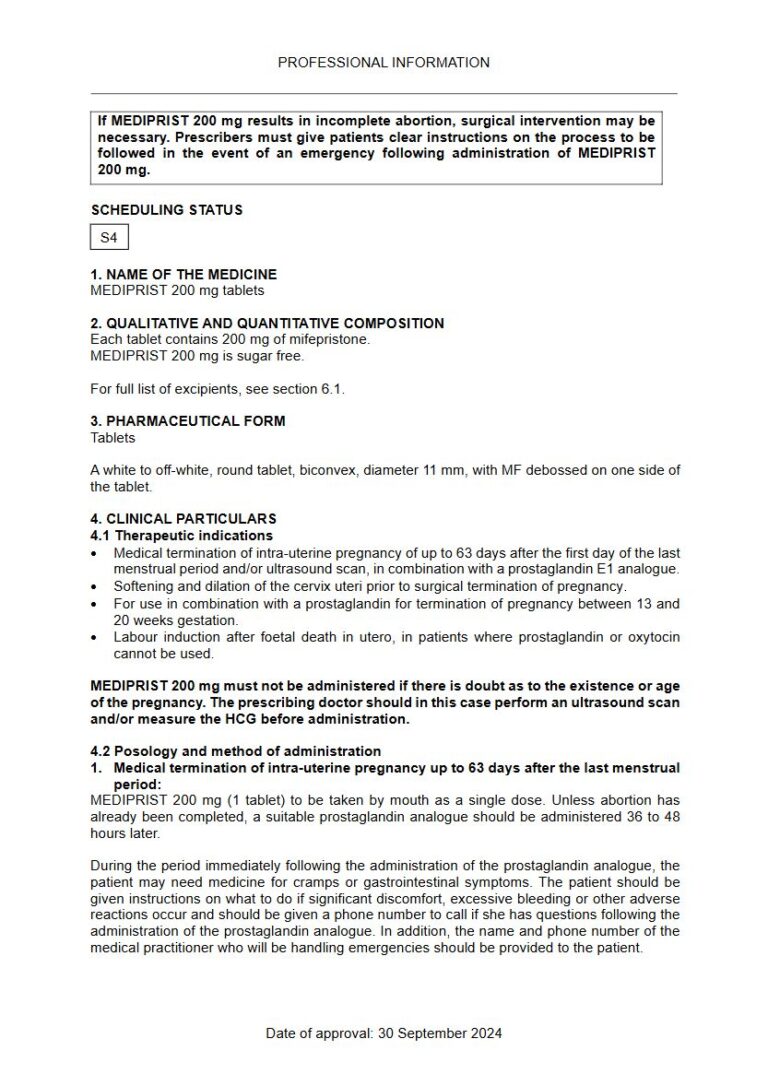
- Medical termination of intra-uterine pregnancy of up to 63 days after the first day of the last menstrual period and/or ultrasound scan, in combination with a prostaglandin E1 analogue.
- Softening and dilation of the cervix uteri prior to surgical termination of pregnancy.
- For use in combination with a prostaglandin for termination of pregnancy between 13 and 20 weeks gestation.
- Labour induction after foetal death in utero, in patients where prostaglandin or oxytocin cannot be used.
4.2 Posology and method of administration
- Medical termination of intra-uterine pregnancy up to 63 days after the last menstrual period: MEDIPRIST 200 mg (1 tablet) to be taken by mouth as a single dose. Unless abortion has already been completed, a suitable prostaglandin analogue should be administered 36 to 48 hours later. During the period immediately following the administration of the prostaglandin analogue, the patient may need medicine for cramps or gastrointestinal symptoms. The patient should be given instructions on what to do if significant discomfort, excessive bleeding or other adverse reactions occur and should be given a phone number to call if she has questions following the administration of the prostaglandin analogue. In addition, the name and phone number of the medical practitioner who will be handling emergencies should be provided to the patient.
- Softening and dilation of the cervix uteri prior to surgical pregnancy termination during the first trimester. MEDIPRIST 200 mg (1 tablet) to be taken by mouth 36 to 48 hours before (but not beyond) the surgical termination of pregnancy. Softening and dilation has been shown to be detectable from 24 hours after administration and increases to a maximum approximately 36 to 48 hours after administration. Surgery should be performed no later than 48 hours after administration of MEDIPRIST 200 mg, since when the elapsed time between MEDIPRIST 200 mg administration and surgery is more than 48 hours the risk of bleeding and abortion to surgery, particularly with pregnancies of earlier gestations (less than 9 weeks), is increased.
- For use in combination with a prostaglandin analogue for termination of pregnancy between 13 and 20 weeks gestation: 600 mg of mifepristone (3 x MEDIPRIST 200 mg tablets) is taken by mouth as a single dose followed 36 to 48 hours later by a prostaglandin analogue. The prostaglandin analogue is to be repeated as many times as necessary. If abortion does not occur within 48 hours after the first prostaglandin analogue administration, an alternative procedure of uterine emptying should be followed. It is not necessary to perform a dilation and curettage procedure if it is clear that a complete abortion has occurred.
- Labour induction after foetal death in utero in patients where prostaglandin or oxytocin cannot be used: 600 mg of mifepristone (3 x MEDIPRIST 200 mg tablets) taken by mouth in a single dose for two consecutive days. Labour should be induced by the usual methods if it has not started within 72 hours following the first administration. The dosage is independent of body weight. Dose adjustment to a higher dose (600 mg) is needed with concomitant treatment with CYP3A4 inducers (see section 4.5).
4.3 Contraindications
- known hypersensitivity to mifepristone or to any of the excipients of MEDIPRIST 200 mg listed in section 6.1.
- chronic adrenal failure
- asthmatics (severe asthma uncontrolled by corticosteroid therapy) and other patients with chronic obstructive airways disease
- inherited porphyria
- suspected ectopic pregnancy
- pregnancy not confirmed by an ultrasound or biological test
- pregnancy beyond 63 days of amenorrhoea
- pregnancy of 84 days of amenorrhoea and beyond (for softening and dilation of the cervix prior to surgical termination of pregnancy)
- contraindication to the prostaglandin analogue selected
- long-term corticosteroid therapy
- haemorrhagic disorders and treatment with anticoagulants
- unremoved intra-uterine contraceptive device.
4.4 Special warnings and precautions for use
Severe cutaneous adverse reactions, including toxic epidermal necrolysis and acute generalised exanthematous pustulosis, have been reported in association with mifepristone (see section 4.8). In patients who experience severe cutaneous adverse reactions, re-treatment with mifepristone is not recommended.
The pharmacokinetics, safety and tolerability of MEDIPRIST 200 mg were investigated in women with moderate hepatic impairment versus healthy women participants with normal hepatic function. Statistical analyses of total AUC u221e and C max for the mifepristone, N-demethylated metabolite, hydroxylated metabolite and di-demethylated metabolite showed a decrease in both overall peak and exposure in patients with moderate hepatic impairment compared to healthy-matched participants. In conclusion, the clinical consequences of 200 mg mifepristone administration in patients with moderate hepatic impairment are unknown.
MEDIPRIST 200 mg is not recommended in patients with:
- Renal failure
- Hepatic failure
- Malnutrition
Medical termination of developing intra-uterine pregnancy: This method requires the involvement of the woman who should be informed of the requirements of the method which are:
- The necessity to combine treatment with prostaglandin to be administered at a second visit.
- The need for a follow up visit (3rd visit) within 14 to 21 days after intake of MEDIPRIST 200 mg in order to check for complete expulsion.
- The possible risk of failure (see section 5) of the method which may require termination by another method.
In the case of a pregnancy occurring with an intra-uterine device in situ, this device must be removed before administration of MEDIPRIST 200 mg. The expulsion may take place before prostaglandin administration (in about 3 % of cases). This does not preclude the control visit in order to check for the complete expulsion and the uterine vacuity. The risks related to the method must be taken into account and explained to the patient:
- Failures: The risk of failure, which occurs in up to 11.7 % of the cases, makes the control visit mandatory in order to check that the expulsion is completed.
In cases of non-complete expulsion, a surgical revision may be necessary. The efficacy of the method decreases with parity and consequently increasing of age of the woman.
Bleeding: Bleeding is an almost constant part of the procedure, whatever the prostaglandin use, and at any pregnancy term although it is usually more abundant when pregnancy age increases. It can occur after MEDIPRIST 200 mg alone. The patient must be informed of the occurrence of prolonged vaginal bleeding (an average of 10 to 16 days after MEDIPRIST 200 mg intake) which may be heavy. Bleeding occurs in almost all cases and is not in any way proof of complete expulsion and for this reason a follow-up visit is absolutely necessary, to confirm termination of pregnancy. The patient should be informed not to travel far away from the prescribing centre as long as complete expulsion has not been recorded. She will receive precise instructions as to whom she should contact and where to go, in the event of any problems emerging, particularly in the case of very heavy vaginal bleeding. It should be noted that in pregnancies of 8 to 9 weeks gestation, blood loss may be heavier than that seen at earlier gestations. A follow-up visit must take place within a period of 10 to 14 days after administration of MEDIPRIST 200 mg to verify by the appropriate means (clinical examination, ultrasound scan, and beta-hCG measurement) that expulsion has been completed and that vaginal bleeding has stopped. In case of persistent bleeding (even light) beyond the control visit, its disappearance should be checked within a few days. If an ongoing pregnancy is suspected, a further ultrasound scan may be required to evaluate its viability. Persistence of vaginal bleeding at this point could signify incomplete abortion, or an unnoticed extra-uterine pregnancy, and appropriate treatment should be considered. Patients must be informed that in the event of the failure or interruption of the method, the pregnancy is liable to continue to develop. The foetus may be exposed to a risk of malformation. It is essential that termination of pregnancy by another method be undertaken at a follow-up visit in the event of such failure. Since heavy bleeding requiring haemostatic curettage occurs in up to 5 % of the cases during the medical method of pregnancy termination, special care should be given to patients with haemostatic disorders with hypocoagulability, or with anaemia. The decision to use the medical or the surgical method should be decided with specialised medical practitioners according to the type of haemostatic disorder and the level of anaemia.
Infection: Cases of fatal toxic shock caused by Clostridium sordellii endometritis presenting with or without fever or other obvious symptoms of infection, have been reported after medical abortion with the use of 200 mg mifepristone, as in MEDIPRIST 200 mg followed by non-authorised vaginal administration of misoprostol tablets for oral use. Clinicians should be aware of this potentially fatal complication.
In all instances: The use of MEDIPRIST 200 mg requires rhesus determination and hence the prevention of rhesus allo-immunisation as well as other general measures taken usually during any termination of pregnancy. Patients must be informed that subsequent pregnancy may occur between embryo expulsion and the resumption of menses. To avoid potential exposure of a subsequent pregnancy to MEDIPRIST 200 mg, it is recommended that conception be avoided during the next menstrual cycle. Reliable contraceptive precautions should therefore commence as early as possible after MEDIPRIST 200 mg administration. In case of suspected acute adrenal failure, dexamethasone administration is recommended. 1 mg of dexamethasone antagonises a dose of 400 mg of MEDIPRIST 200 mg. Due to the antiglucocorticoid activity of MEDIPRIST 200 mg, the efficacy of long-term corticosteroid therapy, including inhaled corticosteroids in asthmatic patients, may be decreased during the 3 to 4 days following intake of MEDIPRIST 200 mg. Therapy should be adjusted. A decrease of the efficacy of the method can theoretically occur due to the antiprostaglandin properties of non-steroidal anti-inflammatory drugs (NSAIDs) including aspirin (acetyl salicylic acid). Limited evidence suggests that co-administration of NSAIDs on the day of prostaglandin administration does not adversely influence the effects of MEDIPRIST 200 mg or the prostaglandin on cervical ripening or uterine contractility and does not reduce the clinical efficacy of medical termination of pregnancy. MEDIPRIST 200 mg should also be used with caution in the following patients:
- Smokers over 35 years of age, especially when used in combination with a prostaglandin analogue.
- Patients with cardiovascular disease or risk factors
- Patients with prosthetic heart valves - those patients who have had one previous episode of infective endocarditis should receive chemoprophylaxis.
- Multiparous women and women with a history of caesarean section - The risk of uterine rupture may be increased in such patients.
4.5 Interaction with other medicines and other forms of interaction
Pharmacodynamic interaction: A decrease of the efficacy of the method can theoretically occur due to the antiprostaglandin properties of non-steroidal anti-inflammatory drugs (NSAIDs) including aspirin (acetyl salicylic acid). Some evidence suggests that co-administration of NSAIDs on the day of prostaglandin administration does not adversely influence the effects of mifepristone or the prostaglandin on cervical ripening or uterine contractility and does not reduce the clinical efficacy of medical termination of pregnancy.
Pharmacokinetic interactions: Effect of other medicines on mifepristone: Concomitant administration of mifepristone with CYP3A4 inhibitor itraconazole increased mifepristone AUC by 2.6-fold and its metabolites 22-hydroxy mifepristone and N-demethyl mifepristone exposure by 5.1-fold and 1.5-fold, respectively. C max was increased by 1.5-fold for mifepristone and 1.8-fold for 22 hydroxy mifepristone and decreased to 0.7-fold for N-demethyl mifepristone. Increased exposure is expected when mifepristone is given concomitantly with a strong CYP3A4 inhibitor (C max increases 1.5-fold). However, this is most likely not clinically relevant. No dose adjustment is needed when mifepristone is given concomitantly with a CYP3A4 inhibitor (e.g., itraconazole, ketoconazole, erythromycin or grapefruit juice).
Concomitant administration of mifepristone as contained in with CYP3A4 inducer rifampicin was shown to decrease mifepristone AUC by 6.3-fold and its metabolites 22-hydroxy mifepristone and N-demethyl mifepristone by 20-fold and 5.9-fold, respectively. Therefore, reduced efficacy can be expected when mifepristone is given concomitantly with a CYP3A4 inducer (e.g., rifampicin, dexamethasone, St. Johnu2019s Wort and certain anticonvulsants such as phenytoin, phenobarbital, carbamazepine). Therefore, in case of a patient treated with strong or moderate CYP3A4 inducer, it is advised to administer a single oral dose of 600 mg (i.e. 3 tablets of 200 mg each), followed 36 to 48 hours later by the administration of the prostaglandin analogue gemeprost 1 mg per vagina.
Effect of mifepristone on other medicines: In vitro and in vivo data indicates that mifepristone is an inhibitor of CYP3A4. Co-administration of mifepristone may lead to an increase in serum levels of medicines that are metabolised by CYP3A4. Due to the slow elimination of mifepristone from the body, such interaction may be observed for a prolonged period after its administration. Therefore, caution should be exercised when mifepristone is administered with medicines that are CYP3A4 substrates and have narrow therapeutic range, including some medicines used during general anaesthesia.
4.6 Fertility, pregnancy and lactation
Pregnancy: MEDIPRIST 200 mg is indicated for the termination of pregnancy and has no other use during pregnancy.
- The patient should be informed that due to the risk of failure of the medical method of pregnancy termination and the unknown risk to the foetus, the control visit is mandatory (See section 4.4).
- Should a failure of the method be diagnosed at the control visit (viable ongoing pregnancy), and should the patient still agree, pregnancy termination should be completed by another method.
- Should the patient wish to continue with her pregnancy, the available data is too limited to justify a systematic termination of an exposed pregnancy. In that event, a careful ultra-sonographic monitoring of the pregnancy will be established, with a special attention to the limbs.
Breastfeeding: It is unknown whether MEDIPRIST 200 mg is excreted in the mother's breast milk. Consequently, MEDIPRIST 200 mg use should be avoided during breastfeeding.
Fertility: Pregnancies may occur between embryo expulsion and the resumption of menses. To avoid potential exposure of a subsequent pregnancy to MEDIPRIST 200 mg, it is recommended that conception be avoided during the next menstrual cycle. Reliable contraceptive precautions should therefore commence as early as possible after MEDIPRIST 200 mg administration.
4.7 Effects on ability to drive and use machines
MEDIPRIST 200 mg may make you dizzy. Do not drive or operate machinery until you know how MEDIPRIST 200 mg affects you.
4.8 Undesirable effects
The adverse events reported with MEDIPRIST 200 mg, classified according to frequency and system organ class, are summarised below in tabular format:
| System Organ Class | Frequent | Less frequent | Not known (cannot be estimated from the available data) |
|---|---|---|---|
| Infections and infestations | Infection following abortion, suspected or confirmed infections (pelvic inflammatory disease) | Toxic shock syndrome | |
| Neoplasms benign and malignant (including cysts and polyps) | Elevated alpha-feto protein, elevated carcinoembryo-genic antigen | ||
| Blood and lymphatic system disorders | Thrombotic thrombocytopenic purpura, thrombocytopenia, induced systemic lupus erythematous | ||
| Psychiatric disorders | Mania | ||
| Nervous system disorders | Headache, dizziness | Epilepsy, neurogenic tinnitus | |
| Eye disorders | Ophthalmoplegia | ||
| Cardiac disorders | Myocardial infarction, induced Adams-Stokes syndrome | ||
| Vascular disorders | Hot flush, superficial thrombophlebitis, hypotension | ||
| Respiratory, thoracic and mediastinal disorders | Bronchospasm, induced bronchial asthma | ||
| Gastrointestinal disorders | Nausea, vomiting, diarrhoea, gastric discomfort, abdominal pain, cramping (can be light or moderate) | Gastric bleeding | |
| Hepato-biliary disorders | Abnormal liver function tests, hepatic failure, hepatorenal failure | ||
| Skin and subcutaneous tissue disorders | Skin rash / pruritus, urticarial reaction, toxic epidermal necrolysis, erythema nodosum, angioedema* | Acute generalised exanthematous pustulosis | |
| Musculoskeletal and connective tissue disorders | Limb spasm | ||
| Renal and urinary disorders | Renal failure | ||
| Pregnancy, puerperium and perinatal conditions | Uterine contractions or cramping (10 to 45 %) in the hours following prostaglandin intake. Heavy bleeding occurs in about 5 % of the cases and may require haemostatic curettage in up to 1.4 % of the cases. | Hydatiform mole, ectopic pregnancy, amniotic band syndrome, gestational trophoblastic tumour, uteroplacental apoplexy | |
| Reproductive system and breast disorders | Vaginal bleeding, uterine spasm, prolonged post-abortion bleeding, spotting, severe haemorrhage, endometritis, breast tenderness, heavy bleeding | Haemorrhagic shock, salpingitis, bilateral adnexal mass, intrauterine adhesion, ovarian cyst rupture, breast abscess, haematosalpynx, uterine rupture | |
| General disorders and administration site conditions | Fatigue, chill / fever, fainting | Anaphylaxis, periorbital oedema, malaise, vagal symptoms |
Bleeding is an almost constant part of the procedure, whatever the prostaglandin use, and at any pregnancy term although it is usually more abundant when pregnancy age increases. It can occur after mifepristone alone. When heavy, it often reflects incomplete abortion leading to a surgical procedure in approximately 5 percent of the cases. It can necessitate a blood transfusion in 0.5 to 1 percent of the cases.
Reporting of suspected adverse reactions: Reporting suspected adverse reactions after authorisation of the medicine is important. It allows continued monitoring of the benefit/risk balance of the medicine. Health care providers are asked to report any suspected adverse reactions to SAHPRA via the u201c6.04 Adverse Drug Reactions Reporting Formu201d, found online under SAHPRAu2019s publications: https://www.sahpra.org.za/Publications/Index/8. Reporting can also be done directly to Adcock Ingram Limited at: Adcock Ingram Limited : E-mail : [email protected] Tel : 011 635 0134
4.9 Overdose
In the event of massive ingestion signs of adrenal failure might occur. Signs of acute intoxication may require specialist treatment including the administration of dexamethasone. Treatment is supportive and symptomatic.
