
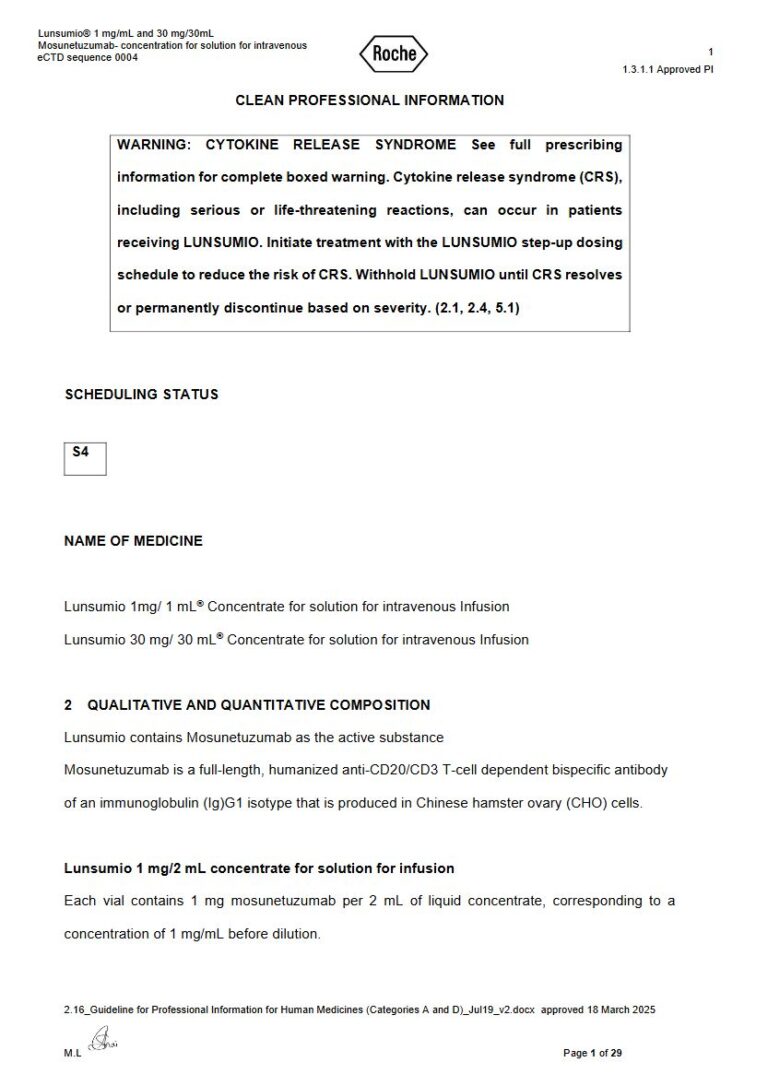
Lunsumio 1 Mg/1 Ml/30 Mg/30 Ml Solution
PDF Leaflet Revision Date: 18 March 2025
Clinical Summary
Quick overview from the medicine insert
Indication
Treatment of adult patients with relapsed or refractory follicular lymphoma who have received at least two prior systemic therapies.
Dosage (summary)
Cycle 1: Day 1 - 1 mg, Day 8 - 2 mg, Day 15 - 60 mg; Cycle 2: Day 1 - 60 mg; Cycle 3+: Day 1 - 30 mg.
Special Populations
- Geriatric patients
- Renal impairment
- Hepatic impairment
Pregnancy & Breastfeeding
Avoid during pregnancy unless benefits outweigh risks; discontinue breastfeeding during therapy.
Key Drug Interactions
- CYP3A substrates
Contraindications
- Hypersensitivity to mosunetuzumab or excipients
Common side effects
- Neutropenia
- Anemia
- Thrombocytopenia
- Diarrhea
- Pyrexia
- Cytokine release syndrome
Counselling Points
- Premedicate with corticosteroids, antihistamines, and antipyretics
- Monitor for signs of CRS
- Seek immediate medical attention for CRS symptoms
Serious warnings
- Cytokine release syndrome
- Serious infections
- Tumor flare
- Tumor lysis syndrome
Important Disclaimer
The Lunsumio 1 Mg/1 Ml/30 Mg/30 Ml Solution professional information leaflet below is the property of Roche Products and is provided on Medinsert exactly as issued, with no.. alterations or editorial changes. We make every effort to keep content current by updating documents as soon as new versions become available. Medinsert serves as a trusted access point for healthcare professionals, but does not replace official sources or clinical judgement. For more details, please read our full disclaimer. read more>>
 Healthcare Professionals Only
This content is for registered healthcare professionals
Sign in or create a free account to read the full package insert.
Free for HPCSA-registered professionals. Powered by Medinsert.
Clinical Particulars
Section 4 of the official insert — extracted exactly as issued, no alterations
4.1 Therapeutic indication
Lunsumio as monotherapy is indicated for the treatment of adult patients with relapsed or refractory follicular lymphoma (FL) who have received at least two prior systemic therapies.
4.2 Posology and method of administration
General
Substitution by any other biological medicinal product requires the consent of the prescribing physician. Lunsumio must only be administered as an intravenous infusion under the supervision of a qualified physician with appropriate medical support to manage severe reactions such as cytokine release syndrome. (see Section 4.4 Special precautions and warnings). Do not administer as an IV push or bolus.
Prophylaxis and premedication
Lunsumio should be administered to well-hydrated patients. Table 1 provides details on recommended premedication for cytokine release syndrome and infusion related reactions.
Table 1: Premedication to be administered to patients prior to Lunsumio Infusion
Patients requiring premedication
Premedication
Dosage
Administration
Cycles 1 and 2: all patients
Cycles 3+: patients who experienced any grade CRS with previous dose
Corticosteroid
Dexamethasone 20 mg IV or methylprednisolone 80 mg IV
Complete at least 1 hour prior to infusion
Anti-histamine
Diphenhydramine hydrochloride 50 - 100 mg or equivalent oral or IV anti-histamine
At least 30 minutes prior to infusion
Anti-pyretic
Oral acetaminophen or paracetamol (500 - 1000 mg)
At least 30 minutes prior to infusion
The recommended dose of Lunsumio for each 21-day cycle is detailed in Table 2.
Table 2: Dose of Lunsumio for patients with Follicular Lymphoma
Day of Treatment
Dose of Lunsumio
Rate of infusion
Cycle 1 Day 1
1 mg
Infusions of Lunsumio in Cycle 1 should be Administered over a minimum of 4 hours.
Day 8
2 mg
Day 15
60 mg
Cycle 2 Day 1
60 mg
If the infusions were well-tolerated in Cycle 1, subsequent infusions of Lunsumio may be administered over 2 hours.
Cycle 3+ Day 1
30 mg
Duration of treatment
Lunsumio should be administered for 8 cycles unless a patient experiences unacceptable toxicity or disease progression. For patients who achieve a complete response, no further treatment beyond 8 cycles is required. For patients who achieve a partial response or have stable disease in response to treatment with Lunsumio after 8 cycles, an additional 9 cycles of treatment (17 cycles total) should be administered, unless a patient experiences unacceptable toxicity or disease progression.
Delayed or missed dose
If any dose in cycle 1 is delayed for >7 days, the previous tolerated dose should be repeated prior to resuming the planned treatment schedule. If a dose interruption occurs between cycles 1 and 2 that results in a treatment-free interval of u22656 weeks, administer Lunsumio at 1 mg on Day 1, 2 mg on Day 8, then resume the planned cycle 2 treatment of 60 mg on Day 15. If a dose interruption occurs that results in a treatment-free interval of u22656 weeks between any cycles in cycle 3 onwards, administer Lunsumio at 1 mg on Day 1, 2 mg on Day 8, then resume the planned treatment schedule of 30 mg on Day 15.
Dose Modifications
Identify cytokine release syndrome (CRS) based on clinical presentation (see section 4.4 Warnings and Precautions). Evaluate for and treat other causes of fever, hypoxia, and hypotension, such as infections/sepsis. Infusion related reactions (IRR) may be clinically indistinguishable from manifestations of CRS. If CRS or IRR is suspected, manage according to the recommendations in Table 3.
Table 3: CRS Grading1 and Management
CRS Grade
Current Infusion of Lunsumio
Management of CRS2
Next Scheduled Infusion of Lunsumio
Grade 1
Fever u226538u00baC
Interrupt infusion and treat symptoms. Treat symptoms. If CRS event lasts > 48 hours after symptomatic management. Ensure symptoms are resolved for 72 hours. Consider more frequent Monitoring. Re-start infusion at the same infusion rate when symptoms resolve. If symptoms recur with re-administration, discontinue current infusion. Resume treatment at the next scheduled infusion.
Grade 2
Fever u226538u00baC and/or hypotension not requiring vasopressors and/or hypoxia requiring low-flow oxygen3 by nasal cannula or blow-by
Interrupt infusion and treat symptoms. Re-start infusion at 50% rate when symptoms resolve. If symptoms recur with re-administration, discontinue current infusion. Resume treatment at the next scheduled infusion. Treat symptoms. If no clinical improvement is observed after symptomatic management, consider dexamethasone4 and/or tocilizumab5. If there is no improvement within 24 hours or rapid progression of CRS, manage per Grade 3. Ensure symptoms are resolved for 72 hours. Consider maximizing premedication as appropriate.7 Consider infusing the next dose at 50% rate, with more frequent monitoring.
Grade 3
Fever u226538u00baC and/or hypotension requiring a vasopressor (with or without vasopressin) and/or hypoxia requiring high flow oxygen6
Discontinue current infusion and treat symptoms. Do not resume the current infusion. Resume treatment at the next scheduled infusion. Treat symptoms. Administer tocilizumab5 and dexamethasone4. If there is no improvement or rapid progression of CRS, consider alternative anti-cytokine therapy and methylprednisolone 1000 mg/day IV. Ensure symptoms are resolved for 72 hours. Hospitalize for the next infusion. Maximize premedication as appropriate.7 Administer the next infusion at 50% rate by nasal cannula, face mask, non-rebreather mask, or Venturi mask
Grade 4
Fever u226538u00baC and/or hypotension requiring multiple vasopressors (excluding vasopressin) and/or hypoxia requiring oxygen by positive pressure (e.g., CPAP, BiPAP, intubation and mechanical ventilation)
Discontinue current infusion and treat symptoms. Do not resume the current treatment. Treat symptoms. Administer tocilizumab5 and dexamethasone4. If there is no improvement or rapid progression of CRS, consider alternative anti-cytokine therapy and methylprednisolone 1000 mg/day IV. Permanently discontinue treatment.
1 ASTCT = American Society for Transplant and Cellular Therapy. 2 If CRS is refractory to management, consider other causes including hemophagocytic lymphohistiocytosis. 3 Low-flow oxygen is defined as oxygen delivered at <6 L/minute. 4 Dexamethasone should be administered at 10 mg IV every 6 hours (or equivalent). 5 Tocilizumab should be administered at a dose of 8 mg/kg IV (8 mg/kg for participants at a weight of u226530 kg only; 12mg/kg for participants at a weight of <30 kg; doses exceeding 800 mg per infusion are not recommended); repeat every 8 hours as necessary (up to a maximum of 4 doses). 6 High-flow oxygen is defined as oxygen delivered at u22656 L/minute. 7 Refer to Table 1 for additional information.
Dose modifications for other clinically significant adverse reactions
Patients who experience grade 3 or 4 reactions should have treatment temporarily withheld until symptoms are resolved.
Pediatric Use
The safety and efficacy of Lunsumio in children below 18 years of age have not been established.
Geriatric Use
No dose adjustment of Lunsumio is required in patients u2265 65 years of age (see section 5.2 Pharmacokinetic properties).
Renal impairment
No dose adjustment is required in patients with mild or moderate renal impairment. A recommended dose has not been determined for patients with CrCl <30 mL/min (see section 5.2 Pharmacokinetic properties).
Hepatic impairment
No dose adjustment of Lunsumio is required for patients with mild hepatic impairment [total bilirubin greater than upper limit of normal (ULN) and u2264 1.5x ULN or aspartate transaminase greater than ULN]. (see section 5.2 Pharmacokinetic properties). A recommended dose has not been determined for Lunsumio in patients with moderate or severe hepatic impairment.
4.3 Contraindications
Lunsumio is contraindicated in patients with a known hypersensitivity to mosunetuzumab or any of the excipients.
4.4 Special warnings and precautions for use
General
In order to improve traceability of biological medicinal products, the trade name and the batch number of the administered product should be clearly recorded (or stated) in the patient file.
Sugar
Lunsumio contains D sucrose. Patients with the rare hereditary conditions of galactose intolerance lactase deficiency, glucose-galactose malabsorption intolerance should not take Lunsumio. Lunsumio contains D sucrose which may have an effect on the glycaemic control of patients with diabetes mellitus.
Cytokine Release Syndrome (CRS)
CRS, including life-threatening reactions, have occurred in patients receiving Lunsumio. Signs and symptoms included pyrexia, chills, hypotension, tachycardia, hypoxia, and headache. Infusion related reactions may be clinically indistinguishable from manifestations of CRS. CRS events occurred predominantly in cycle 1 and were mainly associated with Day 1 and Day 15 dose administrations. Premedicate patients with corticosteroids, antipyretics and antihistamines at least through cycle 2. Ensure adequate hydration prior to the administration of Lunsumio. Monitor patients for signs or symptoms of CRS. Counsel patient to seek immediate medical attention should signs or symptoms of CRS occur at any time. Institute treatment with supportive care, tocilizumab and/or corticosteroids as indicated (see section 4.2 Psology and method of administration).
Serious infections
Serious infections such as pneumonia, bacteremia, and sepsis or septic shock have occurred in patients receiving Lunsumio some of which were life-threatening or fatal events. Febrile neutropenia was observed in patients after receiving Lunsumio infusion. Lunsumio should not be administered in the presence of active infections. Caution should be exercised when considering the use of Lunsumio in patients with a history of recurring or chronic infections (e.g., chronic, active Epstein-Barr Virus), with underlying conditions that may predispose to infections or who have had significant prior immunosuppressive treatment. Administer prophylactic antibacterial, antiviral and/or antifungal medications, as appropriate. Monitor patients for signs and symptoms of infection before and after Lunsumio administration and treat appropriately. In the event of febrile neutropenia, evaluate for infection and manage with antibiotics, fluids and other supportive care.
Tumor flare
Tumor flare has been reported in patients treated with Lunsumio. Manifestations included new or worsening pleural effusions, localized pain and swelling at the sites of lymphoma lesions and tumor inflammation. Consistent with the mechanism of action of Lunsumio tumor flare is likely due to the influx of T-cells into tumor sites following Lunsumio administration. There are no specific risk factors for tumor flare that have been identified, however, there is a heightened risk of compromise and morbidity due to mass effect secondary to tumor flare in patients with bulky tumors located in close proximity to airways and/or a vital organ. Monitoring and evaluation for tumor flare at critical anatomical sites is recommended in patients treated with Lunsumio.
Tumor lysis syndrome (TLS)
TLS has been reported in patients receiving Lunsumio. Ensure adequate hydration prior to the administration of Lunsumio. Administer prophylactic anti-hyperuricemic therapy (e.g allopurinol, rasburicase), as appropriate. Monitor patients for signs or symptoms of TLS, especially patients with high tumor burden or rapidly proliferative tumors, and patients with reduced renal function. Monitor blood chemistries and manage abnormalities promptly.
Drug Abuse and Dependence
Lunsumio does not have the potential for abuse and dependence.
4.5 Interaction with other medicines and other forms of interaction
No dedicated pharmacokinetic drug-drug interaction studies have been conducted with mosunetuzumab. Physiologically based pharmacokinetics modeling and simulations based on IL-6 and cytochrome P450 (CYP) 3A interaction indicated a low risk of cytokine-mediated drug-drug interaction potential for mosunetuzumab. No dose adjustment for Lunsumio is recommended with co-administration of Lunsumio with small molecule drugs which are CYP3A substrates. Upon initiation of Lunsumio in patients who are receiving concomitant drugs that are sensitive CYP3A substrates with a narrow therapeutic index, monitor for effect or drug concentration or dose adjust the CYP3A substrate accordingly, if warranted.
4.6 Fertility, pregnancy and lactation
Contraception
Women of childbearing potential should use contraception while receiving Lunsumio and for at least 3 months after the last infusion of Lunsumio (see section 5.2 Pharmacokinetic Properties, Elimination).
Pregnancy
Lunsumio should be avoided during pregnancy unless the potential benefit to the mother outweighs the potential risk to the fetus. There are no adequate and well-controlled data from studies in pregnant women; however transient peripheral B-cell depletion and lymphocytopenia have been reported in infants born to mothers exposed to other anti-CD20 antibodies during pregnancy. (see section 5.3 Non clinical safety data)
Labor and Delivery
The safe use of Lunsumio during labor and delivery has not been established.
Breastfeeding
It is unknown whether Lunsumio is excreted in human breast milk or has any effect on the breastfed child and on milk production. Because human IgG is excreted in human milk, and the potential for mosunetuzumab absorption leading to B-cell depletion is unknown, women should be advised to discontinue breastfeeding during Lunsumio therapy.
Pediatric Use
The safety and efficacy of Lunsumio in children and adolescents (<18 years of age) has not been studied.
Geriatric Use
Among the 214 patients treated with Lunsumio92 (43%) were 65 years of age or older. No clinically important differences in safety or effectiveness of Lunsumio were observed between these patients and younger patients.
Renal Impairment
The safety and efficacy of Lunsumio in patients with renal impairment has not been formally studied. Patients with mild and moderate renal impairment were included in clinical trials. Lunsumio is a monoclonal antibody and cleared via catabolism (rather than renal excretion), and a change in dose is not expected to be required for patients with renal impairment (see section 5.2 Pharmacokinetics properties).
Hepatic Impairment
The safety and efficacy of Lunsumio in patients with hepatic impairment has not been formally studied. Patients with mild hepatic impairment were included in clinical trials. Lunsumio is a monoclonal antibody and cleared via catabolism (rather than hepatic metabolism), and a change in dose is not expected to be required for patients with hepatic impairment (see section 5.2 Pharmacokinetic properties).
4.7 Effects on ability to drive and use machines
Lunsumio may have a minor influence on the ability to drive and use machines. Patients who experience events that impair consciousness should be evaluated and advised not to drive and refrain from operating heavy or potentially dangerous machinery until events are resolved.
4.8 Undesirable effects
Clinical Trials
The adverse drug reactions (ADRs) described in this section were identified from the clinical studies in patients treated at the recommended dose (n=214). The median number of cycles was 8, 37% received 8 cycles, and 15% received more than 8 cycles up to 17 cycles. Table 4 summarizes the adverse drug reactions (ADRs) that have been reported in association with the use of Lunsumio.
MedDRA PT Frequency category
Blood and lymphatic system disorders
Neutropenia 1 Very common
Anemia Very common
Thrombocytopenia 2 Very common
Febrile neutropenia common
Gastrointestinal disorders
Diarrhea Very common
General disorders and administration site conditions
Pyrexia Very common
Immune system disorders
Cytokine release syndrome 3 Very common
Infections and infestations
Upper respiratory tract infection common
Urinary tract infection common
Pneumonia common
Investigations
Alanine aminotransferase, increased Very common
Aspartate aminotransferase increased common
Metabolism and nutrition disorders
Hypophosphatemia Very common
Hypokalemia Very common
Hypomagnesemia Very common
Tumor lysis syndrome Uncommon
Neoplasms benign, malignant and unspecified (including cysts and polyps)
Tumor flare common
Nervous system disorders
Headache Very common
Skin and subcutaneous tissue disorders
Rash Very common
Pruritus Very common
Dry skin Very common
1 Neutropenia includes neutropenia and neutrophil count decreased
2 Thrombocytopenia includes thrombocytopenia and platelet count decreased
3 By American Society for Transplant and Cellular Therapy
Additional information for selected adverse drug reactions
The data below reflect information for significant adverse reactions for Lunsumio. Cytokine release syndrome
Cytokine release syndrome (ASTCT grading system) of any grade occurred in 39% (84/214) of patients, with grade 2 occurring in 15%, grade 3 occurring in 2.3%, and grade 4 occurring in 0.5% of patients treated with Lunsumio. The one patient with the grade 4 event was a patient with FL in the leukemic phase and also experienced concurrent TLS. No patients had a fatal CRS event. CRS of any grade occurred in 15% of patients after the Cycle 1, Day 1 dose; 5% after the Cycle 1, Day 8 dose; 33% after the Cycle 1, Day 15 dose, 5% occurring in patients after the Cycle 2 and 2% in Cycles 3 and beyond. The median time to CRS onset from the start of administration in Cycle 1 Day 1 was 5 hours (range: 1 - 73 hours), Cycle 1 Day 8 was 28 hours (range: 5 - 81 hours), Cycle 1 Day 15 was 26 hours (range: 0.1 - 391 hours), and Cycle 2 Day 1 was 46 hours (range: 12 - 82 hours). CRS resolved in all patients, and the median duration of CRS events was 3 days (range 1 - 29 days).
Of the 84 patients that experienced CRS, the most common signs and symptoms of CRS included pyrexia (96%), hypotension (36%), chills (33%), tachycardia (24%), hypoxia (23%) and headache (16%). Sixteen percent (34/214) of patients received tocilizumab and/or a corticosteroid, 10% (21/214) received tocilizumab, 10% (22/214) received corticosteroids, and 4% (9/214) received both tocilizumab and corticosteroids. In patients experiencing Grade 2 CRS, 48% (16/33) of patients were treated with symptomatic management without corticosteroids or tocilizumab, 33% (11/33) received corticosteroids, 30% (10/33) received tocilizumab, and 12% (4/33) received both corticosteroids and tocilizumab. Patients with grade 3 (n=5) or grade 4 (n=1) CRS received tocilizumab, corticosteroids, vasopressors and/or oxygen supplementation. Hospitalizations due to CRS occurred in 20% (43/214) of patients and the median duration of hospitalization was 5 days (range 0 - 28 days).
Neutropenia
Neutropenia of any grade occurred in 28% (59/214), including 24% Grade 3 - 4 events. The median time to onset of first neutropenia/neutrophil count decreased events was 46 days (range: 1 - 280 days), with median duration of 8 days (range: 1 - 314 days). Of the 59 patients who had neutropenia/neutrophil count decreased events 70% (41/59) received treatment G-CSF to treat the events.
Serious Infections
Serious infections of any grade occurred in 16% (35/214) of patients. Four (1.9%) patients experienced serious infections concurrently with Grade 3 - 4 neutropenia. The median time to onset of first serious infection was 40 days (range: 1 - 261 days), with median duration of 12 days (range: 2 - 174 days). Grade 5 events occurred in 0.9% (2/214) patients, which included pneumonia and sepsis.
Tumor Flare
Tumor flare (including pleural effusion and tumor inflammation) occurred in 4% (9/214) of patients, which included 1.9% grade 2 and 2.3% grade 3 events. The median time to onset was 13 days (range 5 - 84 days), and median duration was 10 days (range 1 - 77 days).
Tumor Lysis Syndrome
TLS occurred in 0.9% (2/214) of patients, concurrent with CRS. One patient with follicular lymphoma was in the leukemic phase who experienced Grade 4 TLS. TLS onset was on days 2 and 24, and resolved within 3 and 6 days, respectively.
Post marketing Experience
Not applicable
Reporting of suspected adverse reactions
Reporting suspected adverse reactions after authorisation of the medicine is important. It allows continued monitoring of the benefit/risk balance of the medicine. Healthcare professionals are asked to report any suspected adverse reactions to SAHPRA via the u201c6.04 Adverse Drug Reaction Report Formu201d, found online under SAHPRAu2019s publications: https://www.sahpra.org.za/Publications/Index/8
4.9 Overdose
Not applicable
