
Bactroban Nasal Ointment
Clinical Summary
Quick overview from the medicine insert
Indication
Topical treatment of nasal carriage of Staphylococcus aureus, including methicillin-resistant strains (MRSA).
Dosage (summary)
Apply a small amount (approximately 1/2 of the ointment tube) to the anterior nares of each nostril twice daily for 5 days.
Onset of Action / Duration
Effects may be observed within 48 hours of initiation of therapy.
Special Populations
- Elderly patients
- Patients with renal impairment
- Patients with hepatic impairment
Pregnancy & Breastfeeding
Mupirocin is classified as Category B3. Use during pregnancy only if clearly needed. Caution is advised when used during lactation.
Key Drug Interactions
- No significant drug interactions have been reported with mupirocin. However, caution should be exercised when used with other topical agents.
Contraindications
- Hypersensitivity to mupirocin or any of the excipients in the formulation.
Common side effects
- Local irritation
- Burning sensation
- Itching
- Erythema
- Dryness at the application site
Counselling Points
- Instruct patients to apply the ointment only in the nostrils and avoid contact with eyes.
- Advise patients to wash hands before and after application.
- Inform patients to complete the full course of treatment even if symptoms improve.
Serious warnings
- Prolonged use may lead to the development of drug-resistant bacteria.
- Not for systemic use; avoid application to broken skin or mucous membranes.
Important Disclaimer
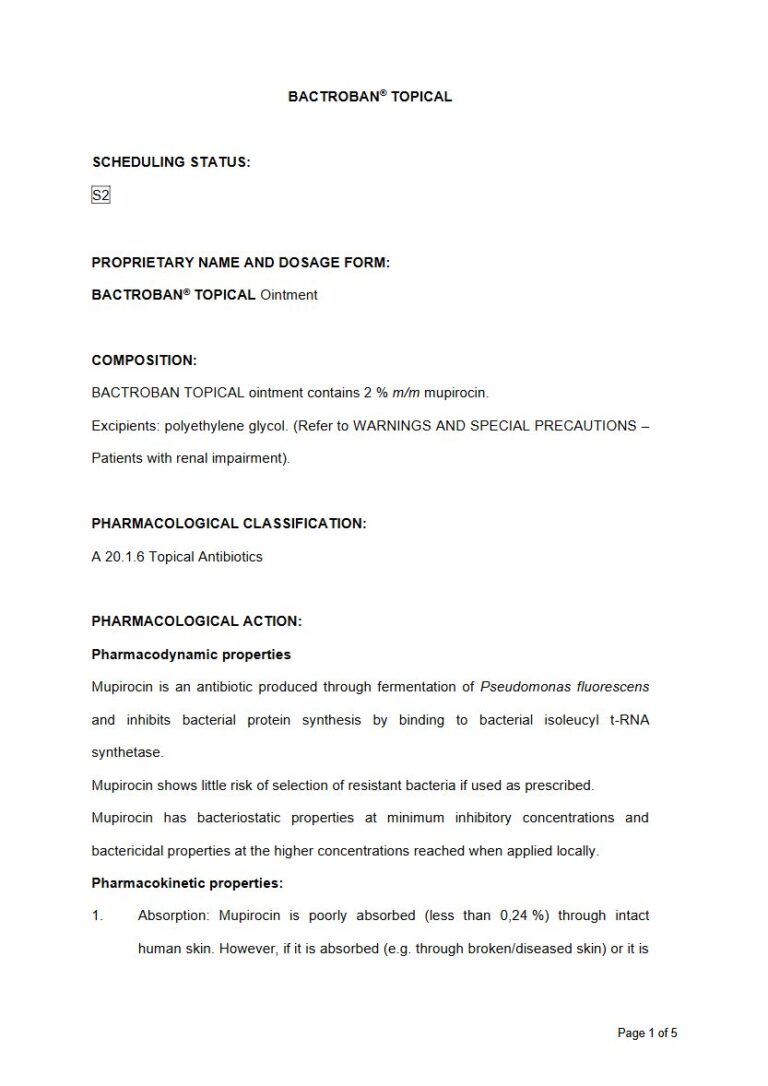
The Bactroban Nasal Ointment professional information leaflet below is the property of Glaxosmithkline South Africa and is provided on Medinsert exactly as issued, with no.. alterations or editorial changes. We make every effort to keep content current by updating documents as soon as new versions become available. Medinsert serves as a trusted access point for healthcare professionals, but does not replace official sources or clinical judgement. For more details, please read our full disclaimer. read more>>
 Healthcare Professionals Only
This content is for registered healthcare professionals
Sign in or create a free account to read the full package insert.
Free for HPCSA-registered professionals. Powered by Medinsert.
Clinical Particulars
Section 4 of the official insert — extracted exactly as issued, no alterations
4.1 Therapeutic indications
BACTROBAN TOPICAL ointment is indicated for the topical treatment of primary and secondary bacterial skin infections caused by Staphylococcus aureus and other susceptible organisms. Primary skin infections: Impetigo, folliculitis, furunculosis and ecthyma. Secondary infections: Infected dermatoses e.g., infected eczema. Infected traumatic lesions e.g., abrasions, insect bites, minor (not requiring hospitalisation) wounds and burns. Prophylaxis: Mupirocin may be used to avoid bacterial contamination of small wounds, incisions and other clean lesions, and to prevent infection of abrasions and small cuts and wounds.
4.2 Posology and method of administration
Adults, children, elderly: 2-3 times a day for up to 10 days, depending on the response. Hepatic impairment: As above. Renal impairment: See WARNINGS AND SPECIAL PRECAUTIONS.
Method of Administration: A small quantity of BACTROBAN ointment should be applied to cover the affected area. The treated area may be covered by a dressing. Any product remaining at the end of treatment should be discarded. Do not mix with other preparations as there is a risk of dilution, resulting in a reduction in the antibacterial activity and potential loss of stability of the mupirocin in the ointment.
4.3 Contraindications
BACTROBAN TOPICAL ointment is not indicated for the treatment of skin lesions infected with Pseudomonas aeruginosa. BACTROBAN TOPICAL ointment should not be given to patients with a history of hypersensitivity to any of its constituents.
4.4 Special warnings and precautions for use
This mupirocin ointment formulation is not suitable for:
- ophthalmic use
- intranasal use
- use in conjunction with cannulae
- at the site of central venous cannulation
Avoid contact with eyes. If contaminated, the eyes should be thoroughly irrigated with water until the ointment residues have been removed. Patients with renal impairment: No restrictions, unless the condition being treated could lead to absorption of polyethylene glycol and there is evidence of moderate to severe renal impairment. Polyethylene glycol can be absorbed from open wounds, burns and damaged skin and is excreted by the kidneys. BACTROBAN TOPICAL ointment should not be used in conditions where absorption of large quantities of polyethylene glycol is possible, especially if there is evidence of moderate or severe renal impairment. The excretion of polyethylene glycol may be impaired and could lead to nephrotoxicity and severe metabolic disturbances. In the rare event of a possible sensitisation reaction or severe local irritation occurring with the use of BACTROBAN TOPICAL ointment, treatment should be discontinued, the product should be rinsed off and appropriate alternative therapy for the infection instituted. Prolonged or irregular use may result in overgrowth of non-susceptible strains of S. aureus and other organisms.
4.6 Fertility, pregnancy and lactation
The safety in pregnancy and lactation has not been established.
4.8 Undesirable effects
Side effects are listed below by system organ class and frequency. Frequencies are defined as: very common (u22651/10), common (u22651/100, <1/10), uncommon (u2265 1/1 000, < 1/100), rare (u22651/10 000, <1/1 000), very rare (<1/10 000), including isolated reports. Common and uncommon side effects were determined from pooled safety data from a clinical trial population of 1 573 treated patients encompassing 12 clinical studies. Very rare side effects were primarily determined from post-marketing experience data and therefore refer to reporting rate rather than true frequency.
Immune system disorders: Very rare: Systemic allergic reactions have been reported with BACTROBAN TOPICAL.
Skin and subcutaneous tissue disorders: Common: Burning localised to the area of application. Uncommon: Itching, erythema, stinging and dryness localised to the area of application. Cutaneous sensitisation reactions to mupirocin or the ointment base.
4.9 Overdose
See SIDE EFFECTS.
