
Cellcept Oral / Cellcept Iv 250 mg/1.5 g/1 g Tablets
PDF Leaflet Revision Date: 23 March 2023
Clinical Summary
Quick overview from the medicine insert
Indication
Prophylaxis of organ rejection in transplant patients.
Dosage (summary)
Adults: 1 g orally or IV twice daily; max 2 g/day for renal; 1.5 g for cardiac.
Special Populations
- Renal impairment
- Hepatic impairment
- Elderly
Pregnancy & Breastfeeding
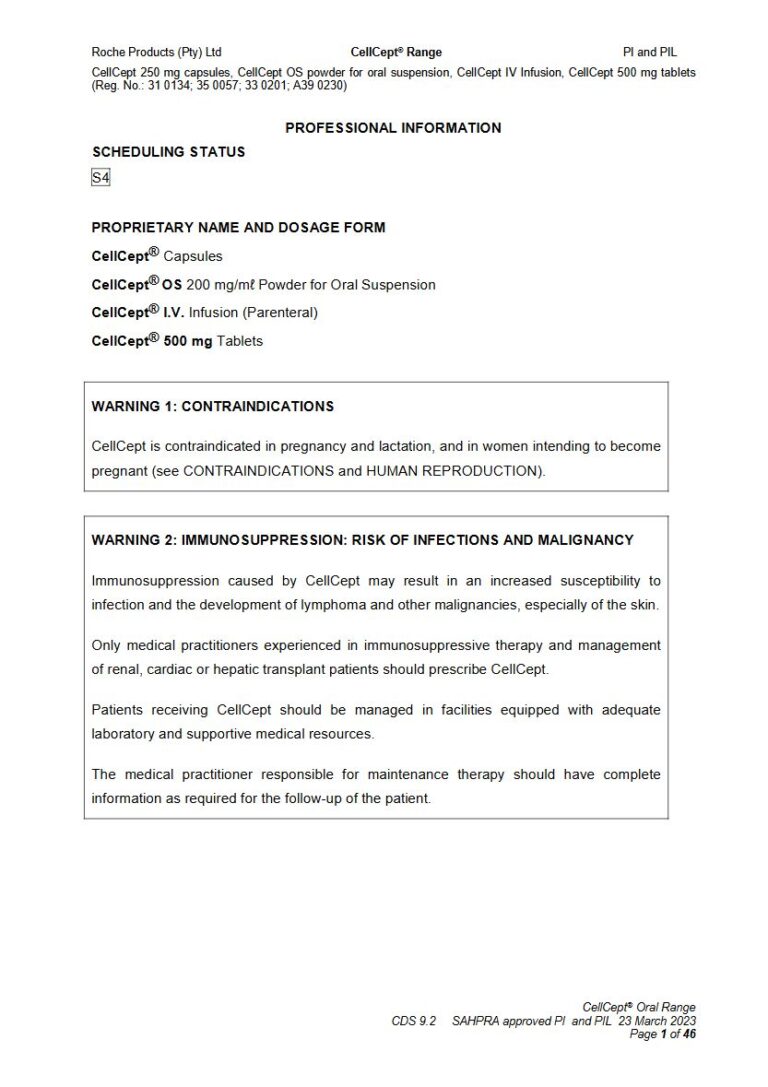
Contraindicated in pregnancy and lactation; teratogenic effects reported.
Key Drug Interactions
- Acyclovir
- Antacids
- Cholestyramine
- Ciclosporin A
Contraindications
- Pregnancy
- Lactation
- Hypersensitivity
- Contraceptive non-compliance
Common side effects
- Diarrhoea
- Leucopenia
- Sepsis
- Vomiting
Counselling Points
- Use effective contraception
- Report signs of infection
- Avoid live vaccines
Serious warnings
- Increased risk of infections and malignancies
- Teratogenic effects
- Neutropenia monitoring required
Important Disclaimer
The Cellcept Oral / Cellcept Iv 250 mg/1.5 g/1 g Tablets professional information leaflet below is the property of Roche and is provided on Medinsert exactly as issued, with no.. alterations or editorial changes. We make every effort to keep content current by updating documents as soon as new versions become available. Medinsert serves as a trusted access point for healthcare professionals, but does not replace official sources or clinical judgement. For more details, please read our full disclaimer. read more>>
 Healthcare Professionals Only
This content is for registered healthcare professionals
Sign in or create a free account to read the full package insert.
Free for HPCSA-registered professionals. Powered by Medinsert.
Clinical Particulars
Section 4 of the official insert — extracted exactly as issued, no alterations
4.1 Therapeutic indications
CellCept is indicated for the prophylaxis of organ rejection in patients receiving allogeneic renal, hepatic or cardiac transplants. CellCept I.V. is indicated when oral formulations cannot be used. It should preferably not be used for longer than 5 days. CellCept should be used concomitantly with ciclosporin and corticosteroids.
4.2 Posology and method of administration
Adults: The recommended dose is 1,0 g, administered orally or intravenously (over NO LESS THAN 2 HOURS) twice a day (daily dose of 2 g) is recommended for renal transplant patients. Although a dose of 1,5 g, administered twice daily (daily dose of 3 g), was used in clinical trials and was shown to be safe and effective, no efficacy advantage could be established for renal transplant patients. Patients receiving 2 g per day of CellCept, demonstrated an overall better safety profile than patients receiving 3 g/day.
Children aged 3 months to 18 years: The recommended dose of CellCept OS powder for oral suspension is 600 mg/mu00b2 administered twice daily (up to a maximum of 2 g daily). Patients with a body surface area of 1,25 to 1,5 mu00b2 may be prescribed CellCept capsules at a dose of 750 mg twice daily (1,5 g daily dose). Patients with a body surface area > 1,5 mu00b2 may be prescribed CellCept tablets at a dose of 1 g twice daily (2 g daily dose).
Standard dosage for prophylaxis of cardiac rejection: Adults: A dose of 1,5 g administered orally or intravenously (over NO LESS THAN 2 HOURS), twice a day (daily dose of 3 g), is recommended for use in cardiac transplant patients. Children: No data are available for paediatric cardiac transplant patients.
Standard dosage for prophylaxis of hepatic rejection: Adults: A dose of 1 g administered intravenously (over NO LESS THAN 2 HOURS) twice a day (daily dose of 2 g), or 1,5 g administered orally, twice a day (daily dose of 3 g), is recommended for use in hepatic transplant patients. Children: No data are available for paediatric hepatic transplant patients.
Standard dosage for treatment of first or refractory renal rejection: Adults: a dose of 1,5 g administered orally or intravenously (over NO LESS THAN 2 HOURS) twice a day (daily dose of 3 g) is recommended for management of first or refractory rejection. Children: no data are available for treatment of first or refractory renal rejection in paediatric renal transplant patients.
4.3 Contraindications
- Allergic reactions to CellCept have been observed. Therefore, CellCept is contraindicated in patients with a hypersensitivity to mycophenolate mofetil or mycophenolic acid or any of the excipients of CellCept.
- CellCept I.V. is contraindicated in patients who are allergic to polysorbates (Tween).
- Pregnancy and breastfeeding (see HUMAN REPRODUCTION).
- Women of childbearing potential not using highly effective methods of contraception.
- CellCept is an IMPDH (inosine monophosphate dehydrogenase) inhibitor; and it should be avoided in patients with rare hereditary deficiency of hypoxanthine - guanine phosphoribosyl - transferase (HGPRT) such as Lesch - Nyhan and Kelley - Seegmillar syndrome.
- CellCept oral suspension contains aspartame, a source of phenylalanine and should not be given to patients with phenylketonuria.
4.4 Special warnings and precautions for use
CAUTION: CELLCEPT I.V. SOLUTION SHOULD NEVER BE ADMINISTERED BY RAPID OR BOLUS INTRAVENOUS INJECTION. Patients receiving CellCept as part of an immuno-suppressive regimen are at an increased risk of developing lymphomas and other malignancies, particularly of the skin. The risk appears to be related to the intensity and duration of immuno-suppression rather than to the use of any specific agent (see BOXED WARNING). Exposure to sunlight and UV light should be limited by wearing protective clothing and using sunscreen with a high protection factor.
Disorders of immuno-suppression: Serious life-threatening infections such as meningitis and infectious endocarditis have been reported and there is evidence of a higher frequency of certain types of infections such as tuberculosis and atypical mycobacterial infection. Oversuppression of the immune system can increase susceptibility to infection, including opportunistic infections, fatal infections and sepsis. Such infections include latent viral reactivation, such as by polyomaviruses: Progressive Multifocal Leukoencephalopathy (PML) associated with the Polyomavirus JC, sometimes fatal, have been reported in CellCept-treated patients. Medical practitioners should consider PML in the differential diagnosis in patients reporting neurological symptoms while using CellCept and consultation with a neurologist should be considered as clinically indicated.
BK virus - associated nephropathy has been observed during the use of CellCept in patients post renal transplant. This infection can be associated with serious outcomes, sometimes leading to renal graft loss. Patient monitoring may help detect patients at risk for BK virus - associated nephropathy.
Cases of pure red cell aplasia (PRCA) have been reported in patients treated with CellCept in combination with other immunosuppressive agents. The mechanism for mycophenolate mofetil induced - PRCA is unknown. In some cases PRCA was found to be reversible with dose reduction or cessation of CellCept therapy. In transplant patients, however, reduced immunosuppression may place the graft at risk.
Patients receiving CellCept should be monitored for neutropenia. The development of neutropenia may be related to CellCept itself, concomitant medications, viral infections, or some combination of these causes. Patients on CellCept should have complete blood counts, weekly during the first month, twice monthly for the second and third months of treatment, then monthly through the first year.
Patients receiving CellCept should be instructed to immediately report any evidence of infection, unexpected bruising, bleeding, or any other manifestation consistent with bone marrow depression. Patients should be advised that during treatment with CellCept, vaccinations may be less effective and the use of live attenuated vaccines should be avoided. Influenza vaccination with killed virus may be of value.
Because CellCept has been associated with an increased incidence of digestive system adverse events, including infrequent cases of gastrointestinal tract ulceration, haemorrhage and perforation, CellCept should be administered with caution in patients with active serious digestive system disease.
Administration of doses greater than 1 g twice a day to renal transplant patients with severe chronic renal impairment should be avoided and these patients should be carefully observed. No data is available for cardiac transplant patients with severe chronic renal impairment.
In patients with delayed renal graft function post-transplant, mean MPA AUC 0 - 12 was comparable, but MPAG AUC 0 - 12 was 2 - 3 fold higher, compared to that seen in post-transplant patients without delayed renal graft function. No dose adjustment is recommended for these patients, however, they should be carefully observed (see PHARMACOLOGICAL ACTION u2013 Pharmacokinetic properties).
It is recommended that CellCept not be administered concomitantly with azathioprine because both have the potential to cause bone marrow suppression and such concomitant administration has not been studied. The risk: benefit relationship of mycophenolate mofetil in combination with tacrolimus has not been established (see INTERACTIONS).
4.5 Interactions with other medicines
Acyclovir: Higher MPAG and acyclovir plasma AUCu2019s were observed when mycophenolate mofetil was administered with acyclovir, compared to the administration of each medicine alone.
Antacids and proton pump inhibitors (PPIs): Decreased mycophenolic acid (MPA) exposure has been observed when antacids, such as magnesium and aluminium hydroxides in combination with PPIs, including lansoprazole and pantoprazole, the exposure to CellCept was 25 - 30 % decreased. These data support extrapolation of this finding to all antacids.
Cholestyramine: Following single dose administration of 1,5 g of mycophenolate mofetil to normal healthy subjects, pre-treated with 4 g of cholestyramine three times daily for 4 days, there was a 40 % reduction in the AUC of MPA.
Ciclosporin A: Ciclosporin A (CsA) pharmacokinetics were unaffected by mycophenolate mofetil. However, in renal transplant patients concomitant administration of CellCept and CsA resulted in reduced MPA exposures by 30 - 50 % compared with patients receiving the combination of sirolimus and similar doses of CellCept.
Ganciclovir: Based on the results of a single dose administration study of recommended doses of oral mycophenolate and IV ganciclovir, and the known effects of renal impairment on the pharmacokinetics of MMF and ganciclovir, it is anticipated that co-administration of these agents (which compete for mechanism of renal tubular secretion) will result in increases in MPAG and ganciclovir concentration. No substantial alteration of MPA pharmacokinetics is anticipated and MMF dose adjustment is not required. In patients with renal impairment in which MMF and ganciclovir are co-administered, patients should be carefully monitored.
Oral contraceptives: The pharmacokinetics of oral contraceptives were unaffected by co-administration of CellCept. A study of co-administration of CellCept (1 g twice a day) and combined oral contraceptives containing ethinylestradiol (0,02 u2013 0,04 mg) and levonorgestrel (0,05 u2013 0,2 mg), desogestrel (0,15 mg) or gestodene (0,05 u2013 0,10 mg) conducted in 18 women with psoriasis over 3 menstrual cycles showed no clinically relevant influence of CellCept on serum levels of progesterone, LH and FSH, thus indicating no influence of CellCept on the ovulation-suppressing action of the oral contraceptives.
Rifampicin: After correction for dose a 70 % decrease in MPA exposure (AUC 0 - 12h) has been observed with concomitant rifampicin administration in a single heart-lung transplant patient. It is therefore recommended to monitor MPA exposure levels and to adjust CellCept doses accordingly to maintain clinical efficacy when the medicines are administered concomitantly.
Trimethoprim/sulphamethoxazole, norfloxacin and metronidazole: No effect on the systemic exposure of MPA was observed when CellCept was concomitantly administered with any antibiotic separately. In contrast, the combination of norfloxacin and metronidazole reduced the MPA AUC 0 - 48 by 30 % following a single dose of CellCept.
Ciprofloxacin and amoxicillin plus clavulanic acid: Reductions in pre-dose (trough) MPA concentrations of 54 % have been reported in renal transplant recipients in the first 7 days immediately following commencement of oral ciprofloxacin or amoxicillin plus clavulanic acid. Effects tended to diminish with continued antibiotic use and cease after discontinuation. The change in predose level may not accurately represent changes in overall MPA exposure therefore clinical relevance of these observations is unclear.
Tacrolimus: Exposure to tacrolimus concomitantly administered with CellCept had no effect on the AUC or C max of MPA in liver transplant recipients. A similar finding was observed in a recent study in kidney transplant recipients. In renal transplant patients it was shown that the tacrolimus concentration did not appear to be altered by CellCept (see WARNINGS AND SPECIAL PRECAUTIONS). However, in hepatic transplant patients there was an increase of approximately 20 % in tacrolimus AUC when multiple doses of CellCept (1,5 g b.i.d.) were administered to patients taking tacrolimus.
Other interactions: Medicines known to undergo renal tubular secretion e.g. probenecid, may compete with MPAG and thereby raise plasma concentrations of MPAG, or the other compound undergoing tubular secretion. Concomitant administration of sevelamer and CellCept in adults and paediatric patients decreased the MPA C max and AUC 0 - 12 by 30 % and 25 % respectively. The data suggests that sevelamer and other calcium free phosphate binders preferentially should be given 2 hours after CellCept intake to minimise the impact on the absorption of MPA.
Live vaccines: Live vaccines should not be given to patients with an impaired immune response. The antibody response to other vaccines may be diminished (see WARNINGS AND SPECIAL PRECAUTIONS).
4.6 Fertility, pregnancy and lactation
CellCept is contraindicated in pregnancy and lactation (see CONTRAINDICATIONS). CellCept is teratogenic and mutagenic. Congenital abnormalities and spontaneous abortions have been reported with the use of CellCept during pregnancy. The following malformations were frequently reported:
- facial malformations such as cleft lip, cleft palate, micrognathia and hypertelorism of the orbits
- abnormalities of the ear (e.g. abnormally formed or absent external/middle ear) and eye (e.g. coloboma, microphthalmos)
- malformations of the fingers (e.g. polydactyly, syndactyly, brachydactyly)
- cardiac abnormalities such as atrial and ventricular septal defects
- oesophageal malformations (e.g. oesophageal atresia)
- nervous system malformations (such as spina bifida)
4.7 Effects on ability to drive and use machines
CellCept may affect the patientu2019s ability to drive and use machines. Patients should be advised to first take note of how they are affected by CellCept before attempting to drive or operate machines (see SIDE EFFECTS).
4.8 Undesirable effects
Experience from clinical trials: The principle adverse reactions associated with the administration of CellCept include diarrhoea, leucopenia, sepsis and vomiting and there is evidence of a higher frequency of certain types of infections. See WARNINGS AND SPECIAL PRECAUTIONS.
Adverse Events Reported in u2265 10 % and in 3 u2013 < 10 % of Patients Treated with CellCept in Clinical Trials in Adults when Used in Combination with Ciclosporin and Corticosteroids
| Body System | Adverse Events Reported in Renal Transplant Patients (n = 991) | Adverse Events Reported in Cardiac Transplant Patients (n = 289) | Adverse Events Reported in Hepatic Transplant Patients (n = 277) |
|---|---|---|---|
| Body as a whole | u2265 10 % asthenia, fever, headache, infection, pain (includes abdominal, back, and chest), oedema, sepsis | asthenia, fever, chills, headache, infection, pain (includes abdominal, back, and chest), oedema, sepsis | ascites, asthenia, chills, enlarged abdomen, fever, headache, hernia, infection, pain (includes abdominal, back and chest), oedema, peritonitis, sepsis |
| Body as a whole | 3 u2013 < 10 % cysts (including lymphocele and hydrocele), enlarged abdomen, facial oedema, flu syndrome, haemorrhage, hernia, malaise, pelvic pain | cellulitis, cysts (including lymphocele and hydrocele), enlarged abdomen, facial oedema, flu syndrome, haemorrhage, hernia, malaise, neck pain, pallor, pelvic pain | abscess, cellulitis, cyst (including lymphocele and hydrocele), flu syndrome, haemorrhage, malaise, neck pain |
| Blood and lymphatic | u2265 10 % anaemia (including hypochromic anaemia), leucocytosis, leucopenia, thrombocytopenia | anaemia (including hypochromic anaemia), ecchymosis, leucocytosis, leucopenia, thrombocytopenia | anaemia (including hypochromic anaemia), leucocytosis, leucopenia, thrombocytopenia |
| Blood and lymphatic | 3 u2013 < 10 % ecchymosis, petechia, prothrombin time increased | ecchymosis, pancytopenia, prothrombin time increased | abnormal kidney function (decrease in renal function, elevated serum creatinine), oliguria, urinary tract infection |
4.9 Overdose
In cases of overdose, side effects would be exacerbated and exaggerated (see SIDE EFFECTS). Reports of overdose with mycophenolate mofetil have been received from clinical trials and during post-marketing experience. Overdose of mycophenolate mofetil may result in over-suppression of the immune system and could increase susceptibility to infections and bone marrow suppression (see WARNINGS AND SPECIAL PRECAUTIONS). If neutropenia develops, dosing with CellCept should be interrupted or the dose reduced. MPA cannot be removed by haemodialysis. However, at high MPAG plasma concentrations (> 100 mg/mu2113) small amounts of MPAG are removed. By increasing excretion of the medicine, MPA can be removed by bile acid sequestrants, such as cholestyramine.
