
Naloxone Hcl Fresenius 0,4 mg/1 ml/0,02 mg Solution
PDF Leaflet Revision Date: 24 January 2023
Clinical Summary
Quick overview from the medicine insert
Indication
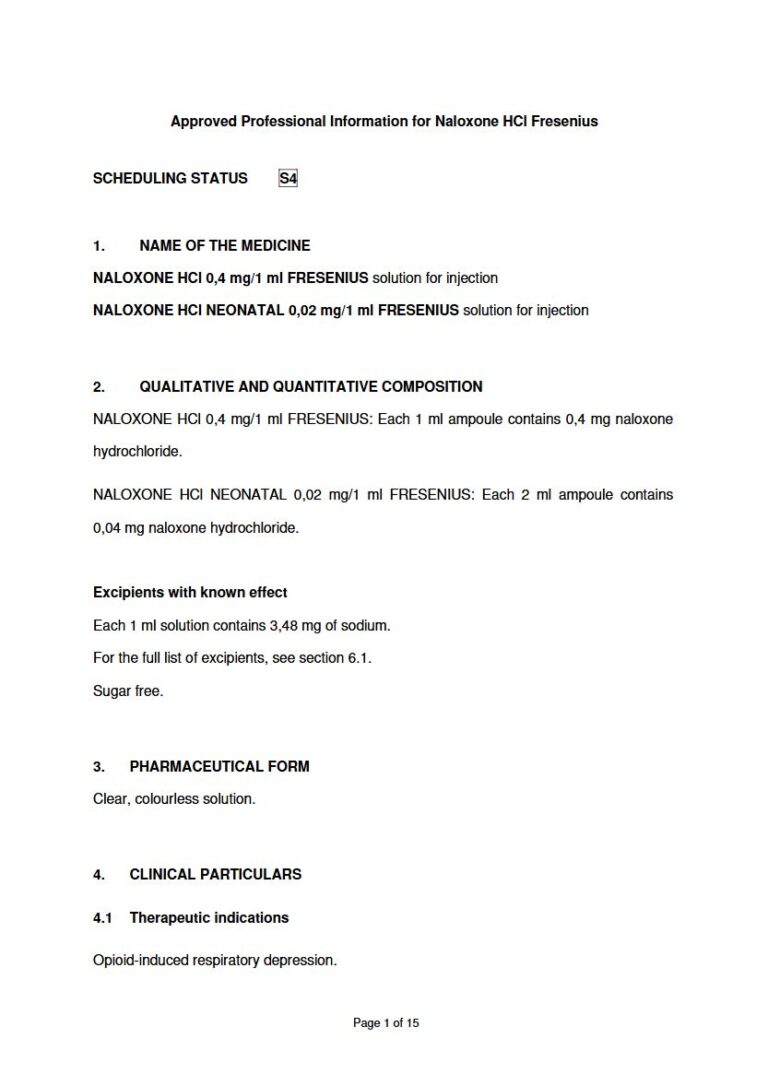
Opioid-induced respiratory depression.
Dosage (summary)
Adults: 0.4 to 2 mg IV, repeat as needed. Neonates: 0.01 mg/kg IM/IV/SQ.
Onset of Action / Duration
Onset: 2 mins, Duration: 1-4 hours
Special Populations
- Hepatic impairment
- Renal impairment
Pregnancy & Breastfeeding
Caution in pregnancy; safety not established. Caution in breastfeeding.
Key Drug Interactions
- Opioids
- Buprenorphine
- Clonidine
Contraindications
- Hypersensitivity to naloxone
Common side effects
- Dizziness
- Nausea
- Tachycardia
- Hypotension
Counselling Points
- Monitor for opioid effects returning
- Avoid driving for 24 hours after administration
Serious warnings
- Risk of acute withdrawal syndrome
- Cardiovascular effects in pre-existing conditions
Important Disclaimer
The Naloxone Hcl Fresenius 0,4 mg/1 ml/0,02 mg Solution professional information leaflet below is the property of Fresenius Kabi Manufacturing Sa and is provided on Medinsert exactly as issued, with no.. alterations or editorial changes. We make every effort to keep content current by updating documents as soon as new versions become available. Medinsert serves as a trusted access point for healthcare professionals, but does not replace official sources or clinical judgement. For more details, please read our full disclaimer. read more>>
 Healthcare Professionals Only
This content is for registered healthcare professionals
Sign in or create a free account to read the full package insert.
Free for HPCSA-registered professionals. Powered by Medinsert.
Clinical Particulars
Section 4 of the official insert — extracted exactly as issued, no alterations
4.1 Therapeutic indications
Opioid-induced respiratory depression.
Neonatal respiratory depression secondary to the administration of opioids to the mother.
4.2 Posology and method of administration
Posology
(i) Adults: Opioid toxicity: 0,4 to 2 mg intravenously, repeated, if necessary, at two-to-three-minute intervals, as needed. If no response has been observed after a total dose of 10 mg, then the diagnosis of overdosage with medicines other than opioids should be considered. Post-operative opioid depression: 0,1 to 0,2 mg intravenously at intervals of at least 2 minutes to obtain an optimum respiratory response while maintaining adequate analgesia.
(ii) Paediatrics: Neonates u2013 Opioid-induced depression: (resulting from the administration of opioid analgesics to the mother during labour) 0,01 mg/kg body mass of the infant by intramuscular, intravenous or subcutaneous injection, repeated at two-to-three-minute intervals if necessary. Alternatively, a single intramuscular dose of 0,06 mg/kg body mass may be given at birth for a more prolonged action. Children u2013 Opioid toxicity: 0,01 mg/kg body mass intravenously, followed, if necessary, by a larger dose of 0,1 mg/kg body mass. All patients receiving NALOXONE HCl FRESENIUS should be closely observed as the duration of action of some opioids exceeds that of naloxone hydrochloride and repeated doses may be required.
Method of administration
NALOXONE HCl FRESENIUS may be administered subcutaneously, intramuscularly, or intravenously. In emergency situations intravenous administration is recommended. Suitable diluents for intravenous administration are sterile solutions containing sodium chloride or dextrose.
4.3 Contraindications
Hypersensitivity to naloxone hydrochloride or any of the excipients of NALOXONE HCl FRESENIUS listed in section 6.1.
4.4 Special warnings and precautions for use
NALOXONE HCl FRESENIUS should be administered cautiously to persons including newborns of mothers who are known or suspected to be physically dependent on opioids. In such cases an abrupt and complete reversal of opioid effects may precipitate an acute withdrawal syndrome. The signs and symptoms of opioid withdrawal in patients physically dependent on opioids may include, but are not limited to, the following: body aches, diarrhoea, tachycardia, fever, runny nose, sneezing, piloerection, sweating, yawning, nausea and vomiting, nervousness, restlessness or irritability, shivering or trembling, abdominal cramps, weakness, and increased blood pressure. In the neonate, opioid withdrawal may also include convulsions, excessive crying and hyperactive reflexes.
Patients who respond satisfactorily to NALOXONE HCl FRESENIUS must be closely monitored and repeated doses of NALOXONE HCl FRESENIUS should be administered as necessary, since the duration of action of some opioids may exceed that of NALOXONE HCl FRESENIUS. Large doses of NALOXONE HCl FRESENIUS in post-operative patients may result in a clear reversal in analgesia, excitement and an elevation in blood pressure. A reversal of opioid effects achieved too rapidly may induce nausea, vomiting, sweating or tachycardia.
NALOXONE HCl FRESENIUS is not effective against respiratory depression due to non-opioid medicines. Reversal of buprenorphine-induced respiratory depression may be incomplete. If an incomplete response occurs, respiration should be mechanically assisted. In addition to NALOXONE HCl FRESENIUS, other resuscitative measures, such as maintenance of a free airway, artificial ventilation, cardiac massage, and vasopressor medicines should be available and employed when necessary to counteract acute opioid poisoning. Abrupt post-operative reversal of opioid depression may result in nausea, vomiting, sweating, tremulousness, tachycardia, increased blood pressure, seizures, ventricular tachycardia and fibrillation, pulmonary oedema and cardiac arrest which may result in death. Several instances of hypotension, hypertension, ventricular tachycardia and fibrillation, pulmonary oedema and cardiac arrest have been reported in post-operative patients following administration of naloxone hydrochloride, as in NALOXONE HCl FRESENIUS. Coma and encephalopathy have been reported as sequelae of these events. These have occurred in post-operative patients most of whom had pre-existing cardiovascular disorders or received other medicines which may have similar adverse cardiovascular effects. Although a direct cause and effect relationship has not been established, NALOXONE HCl FRESENIUS should be used with caution in patients with pre-existing cardiac disease or patients who have received medicines with potential adverse cardiovascular effects, such as hypotension, ventricular tachycardia or fibrillation and pulmonary oedema. It has been suggested that the pathogenesis of pulmonary oedema associated with the use of NALOXONE HCl FRESENIUS is similar to neurogenic pulmonary oedema, i.e., a centrally mediated massive catecholamine response, leading to a dramatic shift of blood volume into the pulmonary vascular bed, resulting in increased hydrostatic pressures. NALOXONE HCl FRESENIUS should also be used with caution in patients with pre-existing pulmonary disease, since sudden exacerbation of underlying pulmonary disease may occur.
Use in hepatic impairment
The safety and effectiveness of NALOXONE HCl FRESENIUS in patients with liver disease have not been established. Caution should be exercised when NALOXONE HCl FRESENIUS is administered to patients with hepatic disease.
Use in renal impairment
The safety and effectiveness of NALOXONE HCl FRESENIUS in patients with renal insufficiency/failure have not been established. Caution should be exercised when NALOXONE HCl FRESENIUS is administered to this patient population.
4.5 Interaction with other medicines and other forms of interaction
The effect of NALOXONE HCl FRESENIUS is based on the interaction with opioids and opioid agonists, reversing effects of opioids; rapid reversal may precipitate acute withdrawal syndrome in opioid dependence. At the usual NALOXONE HCl FRESENIUS dose, there is no interaction with barbiturates and tranquillisers. Data on the interaction with alcohol are not uniform. In patients with multiple intoxication with opioids and sedatives or alcohol, the result of NALOXONE HCl FRESENIUS administration may be delayed, dependent on the cause of intoxication. Complete analgesia can be restored following administration of NALOXONE HCl FRESENIUS to patients that had buprenorphine as analgesic. It is assumed that this effect is caused by the arched form of the dose-response curve of buprenorphine with decreasing analgesia at (too) high doses. However, reversal of respiratory depression caused by buprenorphine is limited. Serious hypertension has been reported following administration of naloxone hydrochloride, as in NALOXONE HCl FRESENIUS, to patients in a coma caused by clonidine-overdosing. NALOXONE HCl FRESENIUS reverses the analgesic and other effects of opioid agonist/antagonists such as pentazocine, so may precipitate withdrawal symptoms if used concurrently with these medicines in physically dependent patients. NALOXONE HCl FRESENIUS reverses the analgesic and other effects of opioid agonist analgesics and may precipitate withdrawal symptoms if used concurrently with these medicines in physically dependent patients, including patients receiving methadone to treat opioid dependence. When NALOXONE HCl FRESENIUS is used post-operatively to reverse the central depressive effects of opioid agonists used as anaesthesia adjuncts, the dose of NALOXONE HCl FRESENIUS must be carefully titrated to achieve the desired effect without interfering with control of post-operative pain or causing other adverse effects.
4.6 Pregnancy and lactation
Pregnancy
Safety in pregnancy has not been established. Caution should be taken when administering it to neonates of mothers who are physically dependent on opioids as a withdrawal syndrome may be precipitated.
Breastfeeding
Safety during lactation has not been established. It is not known whether NALOXONE HCl FRESENIUS is excreted in human milk. Because many medicines are excreted in human milk, caution should be exercised when NALOXONE HCl FRESENIUS is administered to a nursing woman.
4.7 Effects on ability to drive and use machines
NALOXONE HCl FRESENIUS may cause dizziness (see section 4.8). Patients who have received NALOXONE HCl FRESENIUS to reverse the effects of opioids should be warned not to drive a vehicle or operate machinery or to engage in other activities demanding physical or mental exertion for at least 24 hours, since the effect of the opioids may return.
4.8 Undesirable effects
Immune system disorders: Less frequent: Allergic reactions (urticaria, rhinitis, dyspnoea, Quinckeu2019s oedema), anaphylactic shock.
Nervous system disorders: Frequent: Dizziness, headache. Less frequent: Tremor, seizures, sweating, tension.
Cardiac disorders: Frequent: Tachycardia. Less frequent: Dysrhythmias, bradycardia.
Vascular disorders: Frequent: Hypotension, hypertension.
Respiratory, thoracic and mediastinal disorders: Less frequent: Pulmonary oedema.
Gastrointestinal disorders: Frequent: Nausea, vomiting. Less frequent: Diarrhoea, dry mouth.
Skin and subcutaneous tissue disorders: Less frequent: Erythema multiforme.
General disorders and administration site conditions: Frequent: Post-operative pain. Less frequent: Hyperventilation, irritation of vessel wall (after IV administration).
Post-operative. The following adverse events have been associated with the use of NALOXONE HCl FRESENIUS in post-operative patients: hypotension, ventricular tachycardia or fibrillation, dyspnoea, pulmonary oedema and cardiac arrest. Death, coma, and encephalopathy have been reported as sequelae of these events. Adverse cardiovascular effects have occurred most frequently in post-operative patients with a pre-existing cardiovascular disease or in those receiving other medicines that produce similar adverse cardiovascular effects. Excessive doses of NALOXONE HCl FRESENIUS in post-operative patients may result in significant reversal of analgesia and may cause agitation (see sections 4.2 and 4.4).
Nausea and vomiting have been reported in post-operative patients who have received doses higher than recommended. However, a causal relationship has not been established, and the symptoms may be signs of too rapid antagonisation of the opioid effect. Higher than recommended dosage in post-operative use can lead to the return of pain. A fast reversal of opioid effect can induce hyperventilation.
Opioid depression. Abrupt reversal of opioid depression may result in nausea, vomiting, sweating, tachycardia, increased blood pressure, tremulousness, seizures, ventricular tachycardia and fibrillation, pulmonary oedema and cardiac arrest, which may result in death (see section 4.4).
Opioid dependence (see section 4.4). Agitation and paraesthesias have been reported less frequently with the use of NALOXONE HCl FRESENIUS.
Drug abuse and dependence. NALOXONE HCl FRESENIUS is an opioid antagonist.
4.9 Overdose
See section 4.8. Treatment is symptomatic and supportive.
