
Nicardipine Equity 10 mg Solution for Injection
PDF Leaflet Revision Date: 18 September 2023
Clinical Summary
Quick overview from the medicine insert
Indication
Acute life-threatening hypertension.
Dosage (summary)
Initial: 3-5 mg/h; max: 15 mg/h; maintenance: 2-4 mg/h.
Onset of Action / Duration
Onset: 5-15 mins, Duration: varies.
Special Populations
- Hepatic impairment
- Renal impairment
Pregnancy & Breastfeeding
Use in pregnancy not established; contraindicated in breastfeeding.
Key Drug Interactions
- Beta-blockers
- Dantrolene
- Magnesium
- CYP3A inducers/inhibitors
Contraindications
- Hypersensitivity
- Mitral/aortic stenosis
- Unstable angina
- Recent myocardial infarction
Common side effects
- Headache
- Dizziness
- Peripheral oedema
- Palpitations
- Flushing
Counselling Points
- Monitor blood pressure continuously
- Infusion only via electronic pump
- Avoid breastfeeding during treatment
Serious warnings
- Severe hypotension
- Caution in cardiac failure
- Risk of maternal hypotension in pregnancy
Important Disclaimer
The Nicardipine Equity 10 mg Solution for Injection professional information leaflet below is the property of Equity Pharmaceuticals and is provided on Medinsert exactly as issued, with no.. alterations or editorial changes. We make every effort to keep content current by updating documents as soon as new versions become available. Medinsert serves as a trusted access point for healthcare professionals, but does not replace official sources or clinical judgement. For more details, please read our full disclaimer. read more>>
 Healthcare Professionals Only
This content is for registered healthcare professionals
Sign in or create a free account to read the full package insert.
Free for HPCSA-registered professionals. Powered by Medinsert.
Clinical Particulars
Section 4 of the official insert — extracted exactly as issued, no alterations
4.1 Therapeutic indications
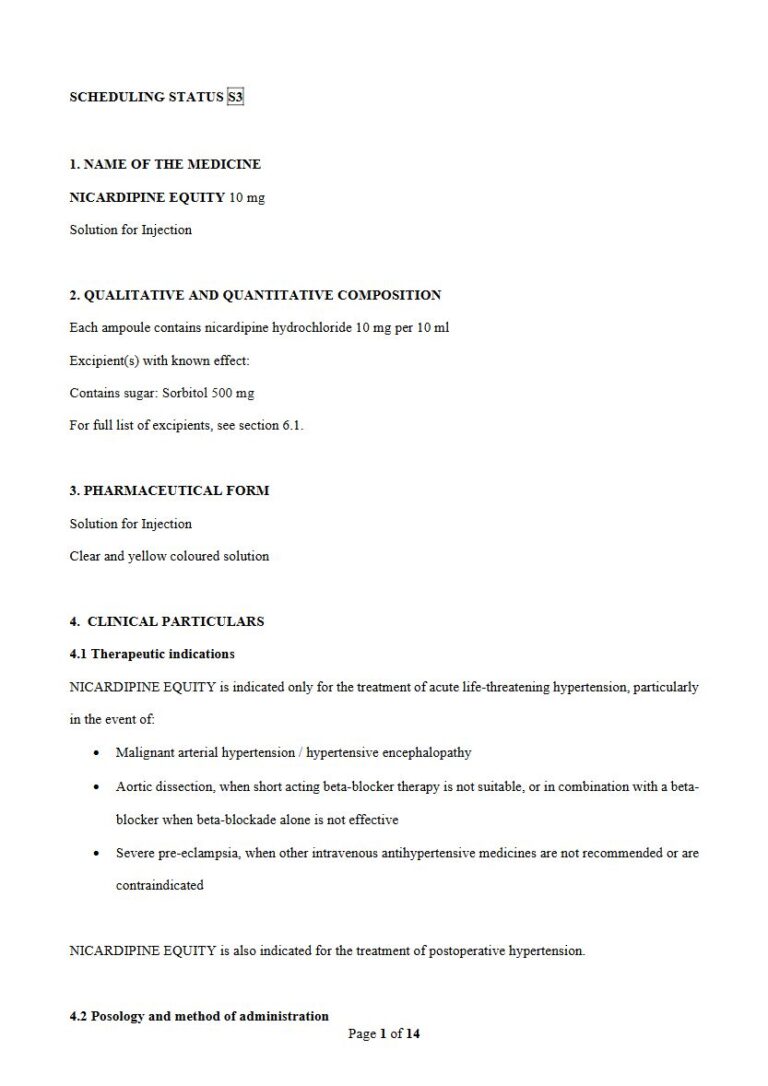
NICARDIPINE EQUITY is indicated only for the treatment of acute life-threatening hypertension, particularly in the event of:
- Malignant arterial hypertension / hypertensive encephalopathy
- Aortic dissection, when short acting beta-blocker therapy is not suitable, or in combination with a beta-blocker when beta-blockade alone is not effective
- Severe pre-eclampsia, when other intravenous antihypertensive medicines are not recommended or are contraindicated
NICARDIPINE EQUITY is also indicated for the treatment of postoperative hypertension.
4.2 Posology and method of administration
Posology
NICARDIPINE EQUITY should only be administered by medical practitioners experienced in haemodynamic management and only be used in intensive care, high care and interoperative settings. Blood pressure and heart rate must be continuously monitored.
The speed of administration must be accurately controlled using an electronic syringe driver or a volumetric pump. Blood pressure and heart rate must be monitored at least every 5 minutes during the infusion, and then until vital signs are stable, but at least for 12 hours after the end of the administration of NICARDIPINE EQUITY.
The antihypertensive effect will depend on the administered dose. The dosage regimen to achieve the desired blood pressure can vary depending on the targeted blood pressure, the response of the patient, and the age or status of the patient.
Unless given by a central venous line, dilute to a concentration of 0,1 u2013 0,2 mg/ml before use (see section 6.2 for details of compatible solutions).
Adults
Initial dose: Treatment should start with the continuous administration of NICARDIPINE EQUITY at a rate of 3-5 mg/h for 15 minutes. Rates can be increased by increments of 0,5 or 1 mg every 15 minutes. The infusion rate should not exceed 15 mg/h.
Maintenance dose: When the target pressure is reached, the dose should be reduced progressively, usually to between 2 and 4 mg/h, to maintain the therapeutic efficacy.
Transition to an oral antihypertensive medicine: Discontinue NICARDIPINE EQUITY or titrate downward while appropriate oral therapy is established. When an oral antihypertensive medicine is being instituted, consider the lag time of onset of the oral medicineu2019s effect. Continue blood pressure monitoring until desired effect is achieved.
Geriatrics
The safety and efficacy in patients over 65 years has not been established.
Paediatric population
The safety and efficacy in low birth weight infants, new-borns, nursing infants, infants and children has not been established.
Pregnancy (Severe Pre-eclampsia)
The safety and efficacy have not been established. A syndrome of high blood pressure, fluid accumulation in the tissues and protein in the urine that becomes apparent in the second half of pregnancy. Pre-eclampsia is primarily a placental disorder with damage to the inner lining of placental blood vessels.
Hepatic impairment
NICARDIPINE EQUITY should be used with caution in these patients. Since NICARDIPINE EQUITY is metabolised in the liver, lower dose regimen in patients with impaired liver function.
Renal Impairment
Lower dose regimen in patients with renal impairments.
Method of administration
NICARDIPINE EQUITY should be administered by continuous intravenous infusion only.
4.3 Contraindications
- Hypersensitivity to the active substance(s) or to any of the excipients listed in section 6.1
- Mitral valve stenosis and severe aortic stenosis including aortic valve stenosis
- Compensatory hypertension, i.e., in case of an arteriovenous shunt or aortic coarctation
- Unstable angina
- Within 8 days after myocardial infarction
- Patients with rare hereditary problems of fructose intolerance should not receive this medicine.
4.4 Special warnings and precautions for use
Rapid pharmacologic reductions in blood pressure may produce severe systemic hypotension including diminished organ perfusion and reflex tachycardia. If either occurs with NICARDIPINE EQUITY consider decreasing the dose by half or stopping the infusion.
Bolus administration or intravenous administration not controlled is contraindicated. Infusion must be administered only through electronic syringe driver of a volumetric pump is not recommended and can increase the risk of serious hypotension.
Moderate to severe Cardiac failure
NICARDIPINE EQUITY should be used with extreme caution in patients with congestive heart failure or pulmonary oedema, particularly when these patients are receiving concomitant beta-blockers, as worsening of cardiac insufficiency may occur.
Ischaemic cardiovascular disease
NICARDIPINE EQUITY is contraindicated in unstable angina and immediately following myocardial infarction (refer to section 4.3). NICARDIPINE EQUITY should be used with caution in patients with suspected coronary ischemia. Occasionally, patients have developed an increased frequency, duration or severity of angina upon starting or increasing NICARDIPINE EQUITY dosage, or during the course of treatment.
Pregnancy
There is a risk of severe maternal hypotension and potentially fatal foetal hypoxia. Concomitant use of NICARDIPINE EQUITY with magnesium sulphate is contraindicated.
Patients with history of hepatic dysfunction or impaired hepatic function.
Rare cases of abnormal hepatic function possibly associated with the use of NICARDIPINE EQUITY have been reported. Potential risk groups are patients with a history of hepatic dysfunction or those with impaired hepatic function at the initiation of treatment with NICARDIPINE EQUITY.
Patients with portal hypertension
The worsening portal vein hypertension and portal-systemic collateral blood flow index in cirrhotic patients have been reported with NICARDIPINE EQUITY.
Patients with pre-existing elevated intracranial pressure
Intracranial pressure must be monitored, to allow calculation of the cerebral perfusion pressure.
Patients with stroke
NICARDIPINE EQUITY should not be used with a recent history of stroke.
Combination with beta-blockers
Caution should be exercised when using NICARDIPINE EQUITY in combination with a beta-blocker in patients with decreased cardiac function. In such case, the dosage of the beta-blocker should be individualised to the clinical situation (refer to section 4.5).
Injection site reactions
Infusion site reactions can occur, particularly with prolonged duration of administration and in peripheral veins. It is advised to change the infusion site in case of any suspicion of infusion site irritation. The use of a central venous line or of a greater dilution of the solution could reduce the risk of occurrence of infusion site reaction.
Paediatric population
The safety and efficacy of NICARDIPINE EQUITY has not been established.
Excipient warnings
This product contains sorbitol. Patients with rare hereditary problem of fructose intolerance should not be given NICARDIPINE EQUITY (see section 4.3).
4.5 Interactions with other medicines and other forms of interaction
Enhancement of negative inotropic effect
NICARDIPINE EQUITY may enhance the negative inotropic effect of beta-blockers and may cause heart failure in patients with latent or uncontrolled heart failure (refer to section 4.4).
Dantrolene
The combination of a calcium channel inhibitor such as NICARDIPINE EQUITY and dantrolene is therefore potentially dangerous and is contraindicated.
Magnesium
Concomitant use of NICARDIPINE EQUITY with magnesium is contraindicated.
CYP3A inducers and inhibitors
NICARDIPINE EQUITY is metabolised by cytochrome P450 3A4. Co-administration of CYP3A4 enzyme-inducing medicines (e.g. carbamazepine, phenobarbital, phenytoin, fosphenytoin, primidone and rifampicin) may cause a decrease in the plasma concentrations of NICARDIPINE EQUITY. Co-administration of CYP3A4 enzyme-inhibiting medicines (e.g., cimetidine, itraconazole and grapefruit juice) may cause an increase in the plasma concentration of NICARDIPINE EQUITY. Co-administration of NICARDIPINE EQUITY with itraconazole has shown an increased risk of adverse events, in particular oedema due to a decreased metabolism of the calcium channel blocker in the liver.
Cyclosporine, tacrolimus and sirolimus
Concomitant administration of NICARDIPINE EQUITY and cyclosporin, tacrolimus or sirolimus may result in elevated plasma ciclosporin/tacrolimus levels. Blood levels should be monitored and dosage of immunosuppressant and/or NICARDIPINE EQUITY should be reduced, if required.
Digoxin
NICARDIPINE EQUITY has been reported to increase the plasma levels of digoxin. Digoxin levels should be monitored when concomitant therapy with NICARDIPINE EQUITY is initiated.
Potential additive antihypertensive effect
Concomitant medications which could potentiate the antihypertensive effect of NICARDIPINE EQUITY include baclofen, alpha-blockers, tricyclic antidepressants, neuroleptics, opioids and amifostine.
Decrease of antihypertensive effect
NICARDIPINE EQUITY in combination with intravenous corticosteroids and tetracosactide (except for hydrocortisone used as replacement therapy in Addisonu2019s disease) may cause a decrease in the antihypertensive effect.
Inhalational anaesthetics
The co-administration of NICARDIPINE EQUITY with inhalational anaesthetics could induce a potential additive or synergistic hypotensive effect, as well as an inhibition by anaesthetics of the baroreflex heart rate increase associated with peripheral vasodilators.
Competitive neuromuscular blockers
Nicardipine may enhance neuromuscular block possibly by acting at the post-junctional region. Neuromuscular block infusion dose requirements could be reduced by the concurrent use of NICARDIPINE EQUITY. Reversal of neuromuscular block by neostigmine appears not to be affected by NICARDIPINE EQUITY infusion. No additional monitoring is required.
4.6 Fertility, pregnancy and lactation
Pregnancy
Limited pharmacokinetic data have shown that NICARDIPINE EQUITY does not accumulate and has a low placental transfer. In clinical practice the use of NICARDIPINE EQUITY during the first two trimesters in a limited number of pregnancies has not revealed any malformities or particular foetotoxic effect to date. The use of NICARDIPINE EQUITY for severe pre-eclampsia during the third trimester of pregnancy could produce a tocolytic effect.
Breastfeeding
NICARDIPINE EQUITY and its metabolites are excreted in human milk. Mother on treatment with NICARDIPINE EQUITY must not breastfeed their babies.
Fertility
No data on male and female fertility is available.
4.7 Effects on ability to drive and use machines
NICARDIPINE EQUITY has no or negligible influence on the ability to drive and use machines.
4.8 Undesirable effects
a. Summary of the safety profile
Most undesirable effects are the consequence of the vasodilator effects of NICARDIPINE EQUITY. The most frequent side effects are headache, dizziness, peripheral oedema, palpitations and flushing.
b. Tabulated summary of adverse reactions
Adverse reactions listed below are classified according to MedDRA System Organ Class (SOC). Frequency categories are defined according to the following convention: Very common (u2265 1/10); common (u2265 1/100 to < 1/10); uncommon (u2265 1/1 000 to < 1/100); rare (u2265 1/10 000 to < 1/1 000); very rare (< 1/10 000) and not known (cannot be estimated from the available data).
System Organ Class Very common Common Not known
Blood and the lymphatic system disorders Thrombocytopenia
Metabolism and nutrition disorders Hypophosphatemia
Psychiatric disorders Lethargy, mood disturbances
Nervous system disorders Headache Dizziness Migraine, confusion, hypertonia
Eye disorders Visual disturbances, eye pain, conjunctivitis
Ear and labyrinth disorders Tinnitus
Cardiac disorders Lower limb oedema, palpitations, hypotension, tachycardia Atrioventricular block, angina pectoris, ST segment depression, inverted T wave
Vascular disorders Orthostatic hypotension Deep-vein thrombophlebitis, excessive fall in blood pressure which leads to cerebral or myocardial ischaemia or transient blindness
Respiratory, thoracic and mediastinal disorders Pulmonary oedema *, respiratory disorder
Gastrointestinal disorders Nausea, vomiting Paralytic ileus, constipation, dyspepsia
Hepato-biliary disorders Hepatic enzyme increased (liver function abnormalities)
Skin and subcutaneous tissue disorders Flushing Erythema, gingival hyperplasia, rash, pruritus
Musculoskeletal, connective tissue and bone disorders Myalgia, tremor
Renal and urinary disorders Micturition disorders including increased frequency
Reproductive system and breast disorders Gynecomastia, impotence
General disorders and administrative site conditions Phlebitis, fever
*cases have been also reported when used as tocolytic during pregnancy
4.9 Overdose
Symptoms
Overdose with NICARDIPINE EQUITY can potentially result in marked hypotension, bradycardia, palpitations, flushing, drowsiness, collapse, peripheral oedema, confusion, slurred speech and hyperglycaemia. Based on reports in laboratory animals, overdosage also resulted in reversible hepatic function abnormalities, sporadic focal hepatic necrosis and progressive atrioventricular conduction block.
Management
In case of an overdose, it is recommended to use routine measures including monitoring of cardiac and respiratory function. In addition to general supportive measures, intravenous calcium preparations and vasopressors are clinically indicated for patients exhibiting the effects of calcium entry blockade. Major hypotension can be treated by intravenous infusion of any plasma volume expander and supine position with the legs elevated. NICARDIPINE EQUITY is not dialysable.
