
Arem 5mg Tablets
Clinical Summary
Quick overview from the medicine insert
Indication
Management of insomnia and as a premedication for surgical procedures.
Dosage (summary)
The usual adult dose is 5 mg to 10 mg taken orally at bedtime.
Onset of Action / Duration
Effects typically begin within 30 minutes and can last for several hours.
Special Populations
- Elderly patients
- Patients with hepatic impairment
- Patients with renal impairment
Pregnancy & Breastfeeding
Nitrazepam is contraindicated during pregnancy and lactation due to potential risks to the fetus and infant.
Key Drug Interactions
- CNS depressants (e.g., alcohol, opioids) may enhance sedative effects.
- Antidepressants may increase the risk of sedation.
- Cimetidine may increase nitrazepam levels.
Contraindications
- Hypersensitivity to nitrazepam or any component of the formulation.
- Severe respiratory insufficiency.
- Sleep apnea syndrome.
Common side effects
- Drowsiness
- Dizziness
- Confusion
- Ataxia
- Paradoxical reactions (e.g., agitation, aggression)
Counselling Points
- Avoid alcohol while taking this medication.
- Do not drive or operate machinery until you know how this medication affects you.
- Take the medication exactly as prescribed and do not exceed the recommended dose.
Serious warnings
- Risk of dependence and withdrawal symptoms with prolonged use.
- Use with caution in patients with a history of substance abuse.
- May impair cognitive function and coordination.
Important Disclaimer
The Arem 5mg Tablets professional information leaflet below is the property of Adcock Ingram and is provided on Medinsert exactly as issued, with no.. alterations or editorial changes. We make every effort to keep content current by updating documents as soon as new versions become available. Medinsert serves as a trusted access point for healthcare professionals, but does not replace official sources or clinical judgement. For more details, please read our full disclaimer. read more>>
 Healthcare Professionals Only
This content is for registered healthcare professionals
Sign in or create a free account to read the full package insert.
Free for HPCSA-registered professionals. Powered by Medinsert.
Clinical Particulars
Section 4 of the official insert — extracted exactly as issued, no alterations
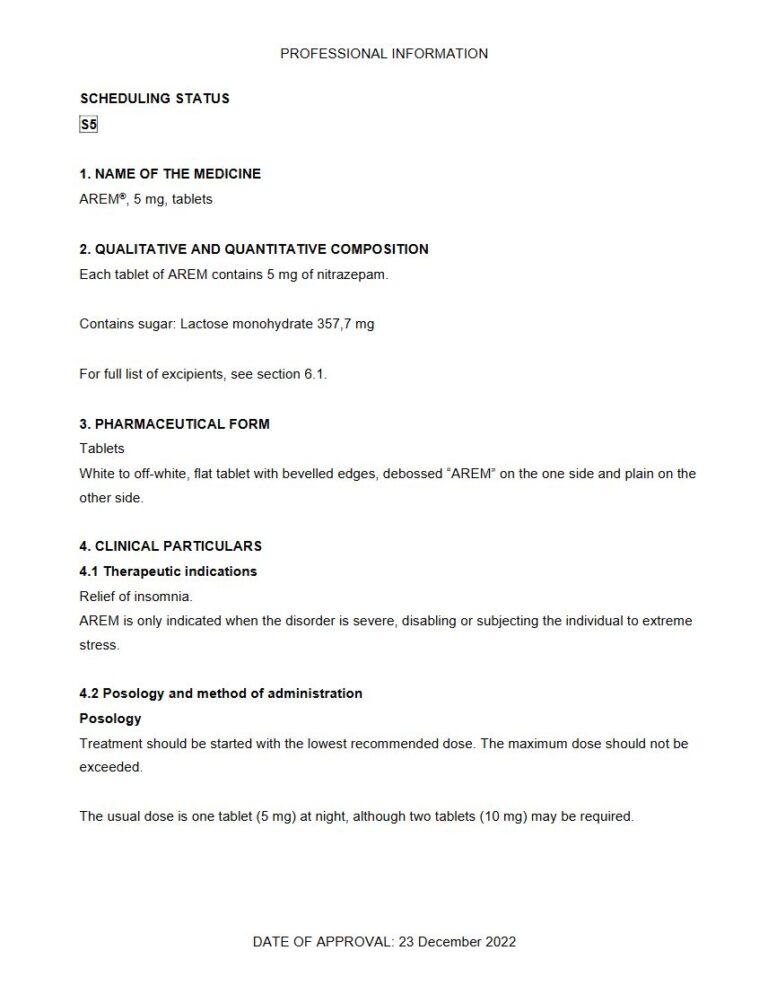
4.1 Therapeutic indications
Relief of insomnia. AREM is only indicated when the disorder is severe, disabling or subjecting the individual to extreme stress.
4.2 Posology and method of administration
Posology Treatment should be started with the lowest recommended dose. The maximum dose should not be exceeded. The usual dose is one tablet (5 mg) at night, although two tablets (10 mg) may be required. Treatment should be as short as possible. Generally the duration of treatment varies from a few days to two weeks, with a maximum of four weeks, including the tapering off process. In certain cases extension beyond the maximum treatment period may be necessary, if so, it should not take place without re-evaluation of the patientu2019s status.
Special populations Elderly Elderly or debilitated patients should not be given more than half of the normal adult dose.
Method of administration For oral administration.
4.3 Contraindications
- Psychotic patients.
- Chronic obstructive lung disease states.
- Patients with a known hypersensitivity towards nitrazepam or other benzodiazepines or to any of the excipients listed in section 6.1.
- Pregnancy (given during labour it crosses the placenta and may cause the floppy-infant syndrome characterised by central respiratory depression, hypothermia and poor sucking).
- Lactating mothers.
- Patients suffering from depression and suicidal tendencies.
- Acute porphyria.
- AREM should not be used in patients with pre-existing central nervous system depression or coma, acute pulmonary insufficiency, or sleep apnoea.
4.4 Special warnings and precautions for use
Particular caution should be exercised in:
- The elderly and debilitated - who are at a particular risk of oversedation, respiratory depression, sleep disturbances and ataxia (see section 4.2);
- patients suffering from impairment of renal or hepatic function or from hypoalbuminaemia;
- patients receiving barbiturates or other central nervous system depressants since there is an additive risk of central nervous depression when these medicines are taken together;
- patients with myasthenia gravis on account of pre-existing muscle weakness;
- patients with organic brain changes particularly arteriosclerosis;
- patients with acute closed-angle glaucoma;
- patients with gout.
Monitoring of cardiorespiratory function is recommended when benzodiazepines are used for conscious sedation. AREM is not recommended for the primary treatment of psychotic illness or chronic psychosis or obsessional states. AREM should not be used alone to treat depression or anxiety with depression (suicide may be precipitated in such patients) (see section 4.3). AREM should be used with extreme caution in patients with a history of alcohol or drug abuse, patients should be cautioned regarding the additive effect of alcohol. Concomitant use of nitrazepam (e.g., AREM) and opioids may result in sedation, respiratory depression, coma and death. Because of these risks, concomitant prescribing of sedative medicines such as benzodiazepines or related medicines such as AREM with opioids should be reserved for patients for whom alternative treatment options are not possible. If a decision is made to prescribe AREM concomitantly with opioids, the lowest effective dose should be used, and the duration of treatment should be as short as possible (see also general dose recommendation in section 4.2). The patients should be followed closely for signs and symptoms of respiratory depression and sedation. It is strongly recommended to inform patients and their caregivers (where applicable) to be aware of these symptoms (see section 4.5). If the patient is awoken during the period of maximum medicine activity, recall may be impaired.
Dependence There is a potential for abuse and the development of physical and psychological dependence, especially with prolonged use and high doses. The risk of dependence is also greater in patients with a history of alcohol or drug abuse or in patients with marked personality disorders. Regular monitoring in such patients is essential; routine repeat prescriptions should be avoided and treatment should be withdrawn gradually. Once physical dependence has developed, abrupt termination of treatment will be accompanied by withdrawal symptoms. These may consist of headaches, muscle pain, extreme anxiety, tension, restlessness, confusion, mood changes, rebound insomnia, irritability, sweating and diarrhoea. When benzodiazepines with a long duration of action are being used it is important to warn against changing to a benzodiazepine with a short duration of action (e.g. AREM), as withdrawal symptoms may develop. In severe cases the following symptoms may occur: derealisation, depersonalisation, hyperacusis, numbness and tingling of extremities, hypersensitivity to light, noise and physical contact, hallucinations or epileptic seizures. In some instances, withdrawal following excessive dosages may produce confusional states and psychotic manifestations and convulsions. Abuse of the benzodiazepines (e.g., AREM) has been reported. Some loss of efficacy to the hypnotic effects of short-acting benzodiazepines may develop after repeated use for a few weeks. Abnormal psychological reactions to benzodiazepines (e.g.AREM) have been reported. Rare behavioural effects include paradoxical aggressive outbursts, excitement, confusion, restlessness, agitation, irritability, delusion, rages, nightmares, hallucinations, psychoses, inappropriate behaviour and the uncovering of depression with suicidal tendencies. Extreme caution should therefore be used in prescribing benzodiazepines (e.g. AREM) to patients with personality disorders. If any of these reactions occur, use of the medicine should be discontinued. These reactions may be quite severe and are more likely to occur in the elderly.
Rebound effects A transient syndrome whereby the symptoms that led to treatment with AREM recur in an enhanced form may occur on withdrawal of treatment. It may be accompanied by other reactions including mood changes, anxiety and restlessness. Since the risk of withdrawal phenomena/rebound phenomena is greater after abrupt discontinuation of treatment, it is recommended that the dosage is decreased gradually.
Duration of treatment The duration of treatment should be as short as possible (see section 4.2), but should not exceed 4 weeks for insomnia, including a tapering off process. Extension beyond these periods should not take place without re-evaluation of the situation. It may be useful to inform the patient when treatment is started that it will be of limited duration and to explain precisely how the dosage will be progressively decreased. Moreover it is important that the patient should be aware of the possibility of rebound phenomena, thereby minimising anxiety over such symptoms, should they occur while AREM is being discontinued. Benzodiazepines (e.g. AREM) may induce anterograde amnesia. The condition usually occurs 1 to 2 hours after ingesting the product and may last up to several hours. Therefore, to reduce the risk, patients should ensure that they will be able to have an uninterrupted sleep of 7 to 8 hours. Due to the myorelaxant effect there is a risk of falls and consequently of hip fractures particularly for elderly patients when they get up at night.
Excipients Patients with the rare hereditary problems of galactose intolerance e.g. total lactase deficiency, glucose-galactose malabsorption should not take AREM.
4.5 Interaction with other medicines and other forms of interaction
The effects of AREM (enhanced sedation or respiratory and cardiovascular depression) may be enhanced by neuroleptics, tranquillisers, alcohol, antidepressants, medicines to treat colds, medicines for seizure, antihistamines, muscle relaxants, antipsychotics, general anaesthetics, other hypnotics or sedatives, opioid analgesics or other medicines that have central depressant properties or that interfere with their metabolism. The concomitant use of sedative medicines such as benzodiazepines or related medicines such as nitrazepam (e.g., AREM) with opioids increases the risk of sedation, respiratory depression, coma and death because of additive CNS depressant effect. The dosage and duration of concomitant use should be limited (see section 4.4). When nitrazepam (e.g., AREM) is used in conjunction with anti-epileptic medicines, side-effects and toxicity may be more evident, particularly with hydantoins or barbiturates or combinations including them. This requires extra care in adjusting dosage in the initial stages of treatment. Known inhibitors of hepatic enzymes, particularly cytochrome P450 have been shown to reduce the clearance of benzodiazepines and may potentiate their action and known inducers of hepatic enzymes, e.g. rifampicin, may increase the clearance of benzodiazepines (e.g. AREM). Enhances sedative effect with moxonidine. Baclofen and tizanidine (enhanced sedative effect). Cimetidine has also been reported to inhibit the metabolism of AREM.
4.6 Fertility, pregnancy and lactation
Pregnancy AREM is contraindicated in pregnancy (see section 4.3) u2212 Pregnancy (given during labour it crosses the placenta and may cause the floppy-infant syndrome characterised by central respiratory depression, hypothermia and poor sucking).
Breastfeeding AREM is contraindicated in lactating mothers (see section 4.3)
Fertility Data on the effect of AREM on fertility is not available.
4.7 Effects on ability to drive and use machines
AREM may, particularly at the initiation of therapy, lead to drowsiness or impaired concentration which may be aggravated by the simultaneous intake of alcohol or other central nervous system depressants. Patients should not drive, climb dangerous heights or operate dangerous machinery where loss of attention might be hazardous.
4.8 Undesirable effects
a) Summary of the safety profile Common adverse effects include drowsiness during the day, numbed emotions, reduced alertness, confusion, fatigue, headache, dizziness, muscle weakness, ataxia and double vision. These phenomena are dose related and occur predominantly at the start of therapy, they usually disappear with repeated administration. The elderly and debilitated patients and in patients receiving high doses are particularly sensitive to the effects of centrally-depressant medicines.
b) Tabulated list of adverse reactions MedDRA System Organ Class Description Blood and the lymphatic system disorders Less frequent Blood dyscrasias Immune system disorders Less frequent Hypersensitivity reactions (anaphylaxia and angiooedema) Psychiatric disorders Less frequent Sleeping disorders, including insomnia, psychiatric and paradoxical reactions (4), muscular cramps, libido fluctuations Unknown frequency Dependence and abuse of benzo-diazepines, amnesia (2), depression (3), withdrawal symptoms (1) Nervous system disorders Frequent Dizziness, ataxia, drowsiness, headache, lightheadedness Less frequent Tremor Unknown frequency Dysarthria, hypothermia and tingling and numbness of the hands Eye disorders Less frequent Visual disturbances, blurred vision Ear and labyrinth disorders Less frequent Vertigo Vascular disorders Less frequent Hypotension Respiratory, thoracic and mediastinal disorders Less frequent Respiratory depression Gastrointestinal disorders Less frequent Nausea, gastrointestinal upsets, changes in salivation Hepato-biliary disorders Less frequent Jaundice Skin and subcutaneous tissue disorders Less frequent Rash, pruritis and other allergic skin reactions, Stevens-Johnson syndrome Renal and urinary disorders Less frequent Urinary retention/incontinence (1) Use (even at therapeutic doses) may lead to the development of physical and psychological dependence: discontinuation of the therapy may result in withdrawal or rebound phenomena, a transient syndrome whereby the symptoms that led to treatment with benzodiazepine or benzodiazepine-like medicine recur in an enhanced form. It may be accompanied by other reactions including mood changes, anxiety, convulsions and restlessness. Since the risk of withdrawal phenomena/rebound phenomena is greater after abrupt discontinuation of treatment, it is recommended that the dosage be decreased gradually. (2) Anterograde amnesia may occur during the use of therapeutic doses since the risk is increased at higher doses. Amnesia may be combined with behavioural problems. (3) Pre-existing depression may be revealed during the use of benzodiazepines (e.g AREM). (4) Reactions such as restlessness, excitation, irritability, aggressiveness, delusions, rage, nightmares, hallucinations, psychoses, inappropriate behaviour and other behavioural side effects may occur during benzodiazepine treatment. They can be very serious with AREM. These side effects are observed more frequently in elderly patients. The benzodiazepines have a moderate potential for abuse.
Reporting of suspected adverse reactions Reporting suspected adverse reactions after authorization of the medicine is important. It allows continued monitoring of the benefit/risk balance of the medicine. Health care providers are asked to report any suspected adverse reactions to SAHPRA via the u201c6.04 Adverse Drug Reactions Reporting Formu201d, found online under SAHPRAu2019s publications: https://www .sahpra.org.za/Publications/Index/8. Reporting can also be done directly to Adcock Ingram Limited at: Adcock Ingram Limited : E-mail : [email protected] Tel : 011 635 0134
4.9 Overdose
Symptoms: Overdosage of benzodiazepines (e.g., AREM) is usually manifested by degrees of central nervous system depression ranging from drowsiness to coma. In mild cases, symptoms include drowsiness, mental confusion, dysarthria and lethargy; in more serious cases, the symptoms include ataxia, hypotonia, hypotension, respiratory depression, rarely coma and very rarely death.
Management: Activated charcoal should be given to reduce absorption. Treatment is symptomatic and supportive although the specific benzodiazepine antagonist, flumazenil, may be indicated in emergencies. Flumazenil may also be useful in the diagnosis of benzodiazepine overdosage. The benzodiazepine antagonist flumazenil is not indicated in patients with epilepsy who have been treated with benzodiazepines. Antagonism of the benzodiazepine effect in such patients may trigger seizures. If excitation occurs, barbiturates should not be used.
