
Zoczen Capsules
PDF Leaflet Revision Date: 01 February 2022
Clinical Summary
Quick overview from the medicine insert
Indication
Treatment and prevention of uncomplicated lower urinary tract infections.
Dosage (summary)
50 mg to 100 mg four times daily with meals; 50 mg to 100 mg daily for prevention.
Special Populations
- Elderly
- Renal impairment
- Hepatic impairment
Pregnancy & Breastfeeding
Safe in pregnancy except at term; contraindicated in breastfeeding if infant has G6PD deficiency.
Key Drug Interactions
- Probenecid
- Sulfinpyrazone
- Magnesium trisilicate
- Quinolones
Contraindications
- G6PD deficiency
- Anuria
- Oliguria
- Renal impairment (eGFR < 45 mL/min)
- Pregnant women at term
Common side effects
- Nausea
- Dizziness
- Peripheral neuropathy
- Pulmonary reactions
Counselling Points
- Take with food to minimize gastric upset
- Report signs of peripheral neuropathy
- Urine may turn brown
Serious warnings
- Prolonged use not recommended
- Risk of pulmonary toxicity
- Monitor for hemolytic anemia
Important Disclaimer
The Zoczen Capsules professional information leaflet below is the property of Aurogen Sa and is provided on Medinsert exactly as issued, with no.. alterations or editorial changes. We make every effort to keep content current by updating documents as soon as new versions become available. Medinsert serves as a trusted access point for healthcare professionals, but does not replace official sources or clinical judgement. For more details, please read our full disclaimer. read more>>
 Healthcare Professionals Only
This content is for registered healthcare professionals
Sign in or create a free account to read the full package insert.
Free for HPCSA-registered professionals. Powered by Medinsert.
Clinical Particulars
Section 4 of the official insert — extracted exactly as issued, no alterations
4.1. Therapeutic indications
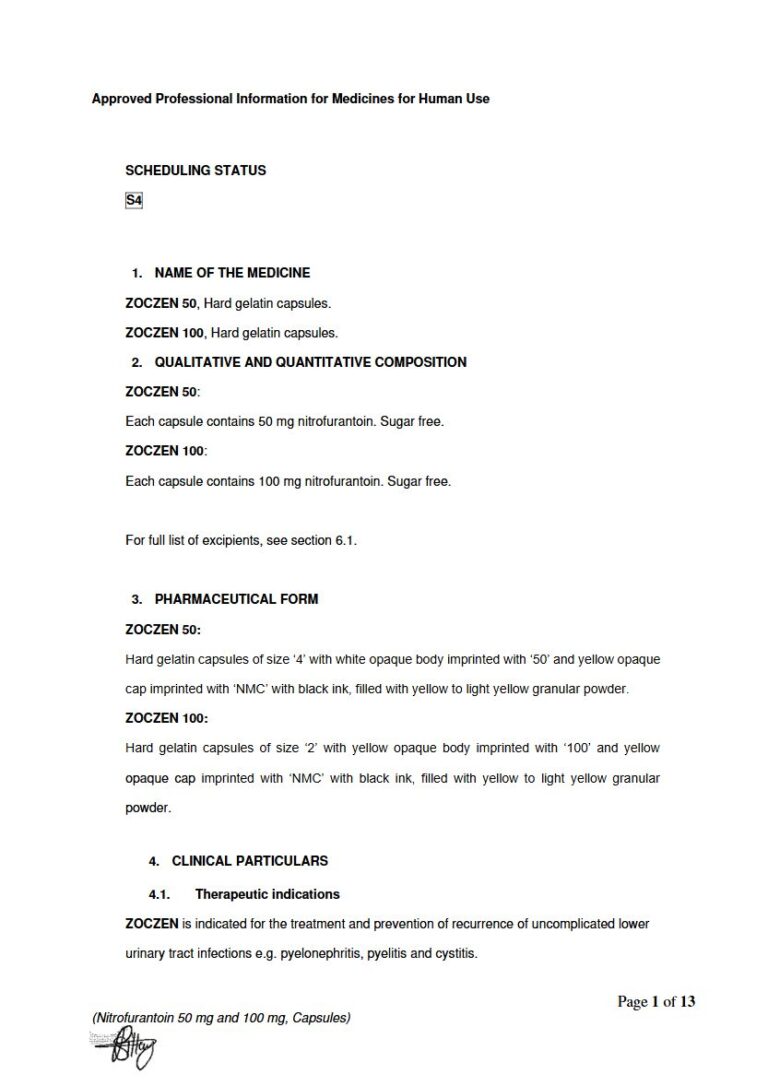
ZOCZEN is indicated for the treatment and prevention of recurrence of uncomplicated lower urinary tract infections e.g. pyelonephritis, pyelitis and cystitis.
It is not indicated for the treatment of associated renal, cortical or perinephric abscesses.
4.2. Posology and method of administration
Adults
Acute urinary tract infections: 50 mg to 100 mg four times a day, with meals and at bedtime.
To prevent recurrences: 50 mg to 100 mg per day ZOCZEN may be given with food or milk to further minimise gastric upset. Therapy should be discontinued for at least one week and for at least 3 days after sterility of the urine is obtained. Continued infection indicates need for re-evaluation. Nitrofurantoin is highly soluble in urine, to which it may impart a brown colour.
SPECIAL POPULATION
Paediatric patients: Acute urinary tract infections: Should be calculated on the basis of 5 to 7 mg/kg of body mass per 24 hours to be given in divided doses four times a day (contraindicated for children under one month) To prevent recurrences: 1 mg/kg/day for long-term therapy.
Method of administration ZOCZEN is administered orally.
4.3. Contraindications
ZOCZEN is contraindicated:
- In patients with known sensitivity to nitrofurantoin microcrystals and any of the excipients of ZOCZEN.
- In patients with a deficiency of glucose 6-phosphate dehydrogenase or nursing mothers of infants with this deficiency.
- Anuria, oliguria and renal impairment are contraindications to therapy with ZOCZEN. Treatment of this type of patient carries an increased risk of toxicity because of impaired excretion of nitrofurantoin.
- Pregnant women at term, as well as infants under one month of age, because of the possibility of haemolytic anaemia due to immature enzyme systems (glutathione instability).
- Acute porphyria
- Patients suffering from renal impairment with an eGFR of less than 45 mL/min.
4.4. Special warnings and precautions for use
Prolonged use of ZOCZEN is not recommended. A course of therapy should not exceed 14 days and repeated courses should be separated by rest periods. Patients with a history of asthma may experience acute asthmatic attacks. Elderly patients and patients undergoing prolonged therapy should be monitored for changes in pulmonary function. Cases of haemolytic anaemia of the primaquine sensitivity type have been induced by ZOCZEN. The haemolysis appears to be linked to a glucose-6-phosphate dehydrogenase deficiency in the red blood cells of the affected patients. Any sign of haemolysis is an indication to discontinue ZOCZEN. Pseudomonas is the organism most commonly implicated in super infections in patients treated with ZOCZEN. During ZOCZEN treatments there are lung and liver complications that can be life-threatening (see section 4.8). The treatment should be stopped immediately and the necessary measures should be taken. Acute, subacute and chronic pulmonary reactions have been observed in patients treated with ZOCZEN. If these reactions occur, ZOCZEN must be discontinued immediately.
Chronic pulmonary reactions (including pulmonary fibrosis and diffuse interstitial pneumonitis) can develop insidiously, and can often occur in elderly patients. Close monitoring of the pulmonary conditions of patients receiving long-term therapy is indicated (especially in the elderly).
Patients with hepatic impairment Patients should be closely monitored for signs of hepatitis (especially in the long term use). Existing conditions can mask pulmonary and hepatic side effects, there is caution provided when ZOCZEN is used in patients with pulmonary diseases, disturbed hepatic function, neurological disorders and allergic diathesis.
Precautions
Patients should be warned to report early signs of peripheral neuropathy. If peripheral neuropathy occurs the treatment should be discontinued. Care is required in patients with predisposing pulmonary, hepatic, neurological or allergic disorders and in those with conditions (such as anaemia, diabetes mellitus, electrolyte imbalance, debility or vitamin B deficiency) which may predispose to peripheral neuropathy.
Hepatotoxicity
Hepatic reactions, including hepatitis, autoimmune hepatitis, cholestatic jaundice, chronic active hepatitis and hepatic necrosis, can occur. Fatalities have been reported. The onset of chronic active hepatitis may be insidious, and patients should be monitored periodically for changes in biochemical tests that would indicate liver injury. If hepatitis occurs, ZOCZEN should be withdrawn immediately and appropriate measures should be taken.
Urine can be coloured yellow or brown after taking ZOCZEN. Patients who taking ZOCZEN can test false positive for urine glucose (if tested for urine reducing substances). ZOCZEN is not effective for the treatment of parenchymal infections of unilateral non-functioning kidney. A surgical cause for infection should be excluded in recurrent or severe cases.
4.5. Interaction with other medicines and other forms of interaction
- Probenecid or sulphinpyrazone may reduce the excretion of ZOCZEN and should not be given concomitantly.
- Magnesium trisilicate may reduce the absorption of ZOCZEN.
- ZOCZEN may cause false positive reactions in urine tests for glucose using copper reduction methods.
- Antagonism between nitrofurantoin and nalidixic acid, and nitrofurantoin and oxolinic acid has been demonstrated in vitro.
- ZOCZEN should not be given concomitantly with quinolones.
The effect of other medicines on nitrofurantoin:
- Food or medicines that delays gastric emptying increase the bioavailability of ZOCZEN.
- Carbonic anhydrase inhibitors and alkalising medicines can reduce the antibacterial activity of ZOCZEN.
- Magnesium trisilicate, co-administered with ZOCZEN, reduces the absorption of ZOCZEN.
- There may be an antagonism between quinolones and ZOCZEN: simultaneous administration is not recommended.
- Probenecid and sulfinpyrazone can reduce the renal clearance of ZOCZEN.
The effect of nitrofurantoin on other medicines / laboratory tests:
- Typhoid fever vaccine (oral): antibacterial medicines make the oral typhoid fever vaccine ineffective.
- Nitrofurantoin can affect certain laboratory tests. False positive results or incorrect high reading can occur with urinary glucose tests based on the reduction of copper sulphate, such as Benedict's reagent and Clinitest (Ames). However, there is no interference with the Clinistix test.
4.6. Fertility, pregnancy and lactation
Pregnancy
Data in pregnant women indicate no teratogenicity or fetal/ neonatal toxicity. Animal studies do not show reproductive toxicity as clinically relevant doses. Therefore, ZOCZEN can be used during pregnancy, except in pregnant women at term, as well as infants under one month of age, because of the possibility of haemolytic anaemia due to immature enzyme systems (glutathione instability).
Breastfeeding
ZOCZEN is excreted in breast milk. ZOCZEN can be used during breastfeeding, but it is contraindicated in those patients with a deficiency of glucose 6-phosphate dehydrogenase or nursing mothers of infants with this deficiency.
Fertility
In men, at supra-therapeutic doses, a temporary stoppage in spermatogenesis and reduced sperm counts. Clinical doses are not associated with male infertility. No reduced fertility was observed in animal studies. In rats, at high doses observed a temporary stoppage in spermatogenesis.
4.7. Effects on ability to drive and use machines
ZOCZEN can cause dizziness and drowsiness. Patient should be advised not to drive or operate machines until the symptoms disappear.
4.8. Undesirable effects
A tabulated list of undesirable effects is outlined below:
a. Tabulated list of adverse reactions
Reported adverse reactions for nitrofurantoin are listed below according to organ systems.
System organ class Frequency Infections and infestations Superinfections by fungi or resistant organisms such as Pseudomonas. However, these are limited to the genitourinary tract. Frequency unknown Blood and Lymphatic system disorders Aplastic anemia Frequent Agranulocytosis, leucopenia, granulocytopenia, haemolytic anemia, thrombocytopenia, glucose -6- phosphate dehydrogenase deficiency anemia, megaloblastic anemia and eosinophilia. Frequency unknown Immune system disorders Allergic skin reactions, Angioneurotic oedema and anaphylaxis. Frequency unknown Psychiatric disorders Depression, euphoria, confusion, psychotic reactions. Frequency unknown Nervous system disorders Peripheral neuropathy including optic neuritis (sensory as well as motor involvement), nystagmus, vertigo, dizziness, headache and drowsiness. Benign intracranial hypertension. Frequency unknown Cardiac disorders Collapse and cyanosis. Frequent Respiratory, thoracic and mediastinal disorders Acute pulmonary reactions, Subacute pulmonary reactions*, Chronic pulmonary reactions, Cough, Dyspnoea, Pulmonary fibrosis; possible association with lupus-erythematous-like syndrome. Frequency unknown Gastrointestinal disorders Sialadenitis, Pancreatitis, Nausea, Anorexia, Emesis, Abdominal pain and Diarrhoea. Frequency unknown Hepatobiliary disorders Cholestatic jaundice, Chronic active hepatitis (fatalities have been reported), Hepatic necrosis, autoimmune hepatitis. Frequency unknown Skin and subcutaneous tissue disorders Transient alopecia Exfoliative dermatitis and erythema multiforme (including Stevens-Johnson Syndrome), maculopapular, erythematous or eczematous eruptions, urticaria, rash, and pruritus. Lupus-like syndrome associated with pulmonary reaction. Medicine Rash With Eosinophilia And Systemic Symptoms (DRESS syndrome), cutaneous vasculitis. Frequency unknown Renal and urinary disorders Yellow or brown discoloration of urine, interstitial nephritis. Frequency unknown General disorders and administration site conditions Asthenia, fever, chills, fever and arthralgia. Frequency unknown Investigations False positive urinary glucose test results Frequency unknown
Acute pulmonary reactions usually occur within the first week of treatment and are reversible with cessation of therapy. Acute pulmonary reactions are commonly manifested by fever, chills, cough, chest pain, dyspnoea, pulmonary infiltration with consolidation or pleural effusion on chest x-ray, and eosinophilia. In subacute pulmonary reactions, fever and eosinophilia occur less often than in the acute form. Chronic pulmonary reactions occur rarely in patients who have received continuous therapy for six months or longer and are more common in elderly patients. Changes in ECG have occurred, associated with pulmonary reactions.
Reporting of suspected adverse reactions Reporting suspected adverse reactions after authorisation of the medicinal product is important. It allows continued monitoring of the benefit/risk balance of the medicinal product. Healthcare professionals are asked to report any suspected adverse reactions to SAHPRA via The u20186.04 Adverse Drug Reactions Reporting Formu2019. Found under SAHPRAu2019s publications: https://www/sahpra.org.za/Publications/Index/8.
4.9. Overdose
Symptoms and signs of overdose include gastric irritation, nausea and vomiting. Treatment is symptomatic and supportive (see section 4.7).
