
Ocrevusa 300 mg Concentrate solution for infusion
PDF Leaflet Revision Date: 27 August 2021
Clinical Summary
Quick overview from the medicine insert
Indication
Treatment of relapsing and primary progressive multiple sclerosis.
Dosage (summary)
Initial: 600 mg IV (2 infusions of 300 mg, 2 weeks apart); Subsequent: 600 mg IV every 6 months.
Special Populations
- Elderly
- Renal impairment
- Hepatic impairment
Pregnancy & Breastfeeding
Contraindicated in pregnancy and lactation; use contraception during treatment and for 6 months after.
Key Drug Interactions
- Live vaccines contraindicated
- Immunosuppressants may increase infection risk
Contraindications
- Hypersensitivity to ocrelizumab
- Active hepatitis B or C
- Active infections
- Live attenuated vaccines
Common side effects
- Infusion-related reactions
- Upper respiratory tract infections
- Nasopharyngitis
Counselling Points
- Premedicate with steroids and antihistamines
- Monitor for IRRs post-infusion
- Avoid live vaccines
Serious warnings
- Risk of PML
- Hepatitis B reactivation
- Monitor for infusion-related reactions
Important Disclaimer
The Ocrevusa 300 mg Concentrate solution for infusion professional information leaflet below is the property of Roche Products and is provided on Medinsert exactly as issued, with no.. alterations or editorial changes. We make every effort to keep content current by updating documents as soon as new versions become available. Medinsert serves as a trusted access point for healthcare professionals, but does not replace official sources or clinical judgement. For more details, please read our full disclaimer. read more>>
 Healthcare Professionals Only
This content is for registered healthcare professionals
Sign in or create a free account to read the full package insert.
Free for HPCSA-registered professionals. Powered by Medinsert.
Clinical Particulars
Section 4 of the official insert — extracted exactly as issued, no alterations
4.1 Therapeutic Indications
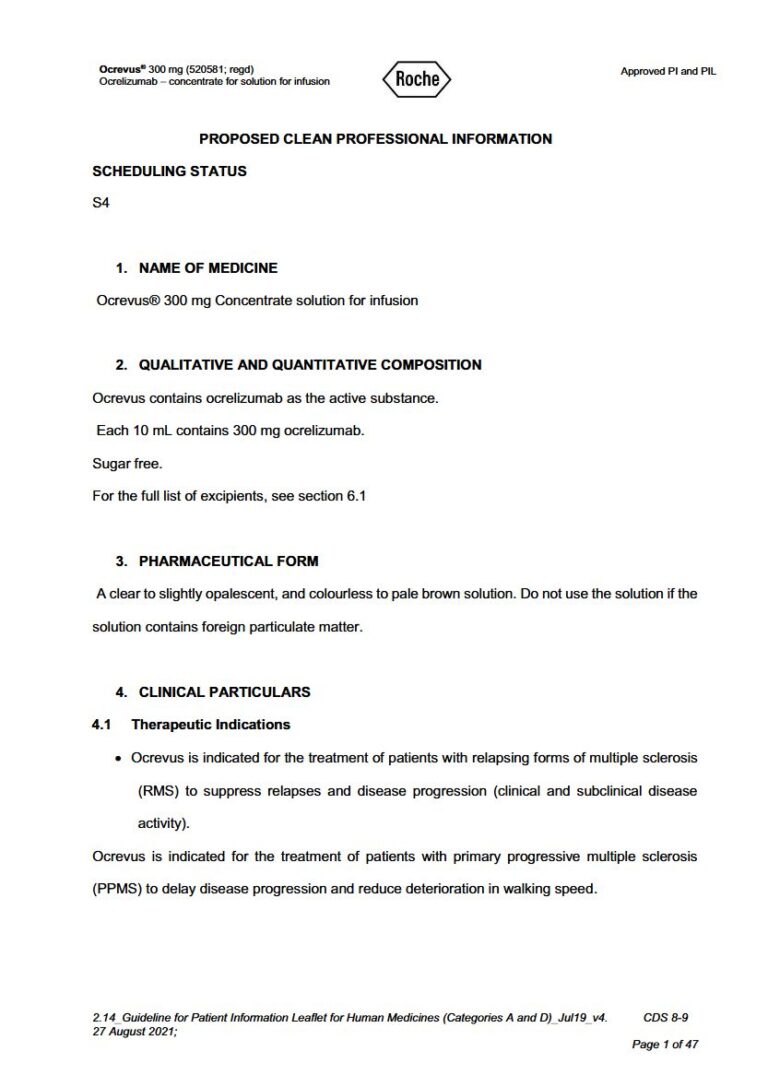
u00b7 Ocrevus is indicated for the treatment of patients with relapsing forms of multiple sclerosis (RMS) to suppress relapses and disease progression (clinical and subclinical disease activity). Ocrevus is indicated for the treatment of patients with primary progressive multiple sclerosis (PPMS) to delay disease progression and reduce deterioration in walking speed.
4.2 Posology and method of administration
General
Substitution by any other biological medicine approved for the indication requires the consent of the prescribing medical practitioner.
Premedication for infusion-related reactions
Premedicate with 100 mg IV methylprednisolone (or an equivalent) approximately 30 minutes prior to each Ocrevus infusion (see section 4.4) and with an antihistamine (e.g. diphenhydramine) approximately 30 - 60 minutes before each infusion of Ocrevus to reduce the frequency and severity of infusion-related reactions. The addition of an antipyretic (e.g. paracetamol) may also be considered approximately 30 - 60 minutes before each infusion of Ocrevus.
Administration of Ocrevus
Ocrevus is administered as an IV infusion through a dedicated line under the close supervision of an experienced healthcare professional with access to appropriate medical support to manage severe reactions such as serious IRRs. Ocrevus infusions should not be administered as an intravenous push or bolus. Use isotonic 0,9 % sodium chloride solution as the infusion vehicle. In the event an IV infusion cannot be completed the same day, the remaining liquid in the infusion bag must be discarded (see section 6.6, Special Instructions for Use, Handling and Disposal). Observe the patient for at least one hour after the completion of the infusion (see section 4.4, Infusion-Related Reactions).
Initial Dose
Ocrevus is administered by IV infusion as a 600 mg dose every 6 months. The initial 600 mg dose is administered as two separate IV infusions; first as a 300 mg infusion, followed 2 weeks later by a second 300 mg infusion.
Subsequent Doses
Subsequent doses of Ocrevus thereafter are administered as a single 600 mg IV infusion every 6 months (see Table 1). A minimum interval of 5 months should be maintained between each dose of Ocrevus. If patients did not experience a serious infusion-related reaction (IRR) with any previous Ocrevus infusion, a shorter (2-hour) infusion can be administered for subsequent doses (see Table 1, Option 2) ( see section 4.8 Undesirable Effects).
Delayed or Missed Doses
If a planned infusion of Ocrevus is missed, it should be administered as soon as possible; do not wait until the next planned dose. The treatment interval for Ocrevus should be maintained between doses.
Infusion Adjustments during Treatment:
No dose reductions of Ocrevus are recommended. In case of infusion-related reactions (IRRs) during any infusion, see the following adjustments. Additional information on IRRs can be found in section 4.4, Infusion-Related Reactions.
Life-threatening IRRs
Immediately stop Ocrevus if there are signs of a life-threatening or disabling infusion-related reaction during an infusion, such as acute hypersensitivity or acute respiratory distress syndrome. The patient should receive appropriate supportive treatment. Permanently discontinue Ocrevus in these patients.
Severe IRRs
If a patient experiences a severe infusion-related reaction or a complex of flushing, fever, and throat pain symptoms, the infusion should be interrupted immediately and the patient should receive symptomatic treatment. The infusion should be restarted only after all symptoms have resolved. The initial infusion rate at restart should be half of the infusion rate at the time of onset of the reaction.
Mild to Moderate IRRs
If a patient experiences a mild to moderate infusion-related reaction (e.g. headache), the infusion rate should be reduced to half the rate at the onset of the event. This reduced rate should be maintained for at least 30 minutes. If tolerated, the infusion rate may then be increased according to the patientu2019s initial infusion schedule. See section 4.4, Infusion-Related Reactions for full description of symptoms associated with IRRs.
Special Dosage Instructions
Paediatrics
The safety and efficacy of Ocrevus in children and adolescents (< 18 years) has not been studied.
Elderly/Geriatrics
The safety and efficacy of Ocrevus in patients u2265 65 years of age has not been studied.
Renal Impairment
The safety and efficacy of Ocrevus in patients with renal impairment has not been formally studied. Patients with mild renal impairment were included in clinical trials. Ocrevus is a monoclonal antibody and cleared via catabolism (rather than renal excretion), and a change in dose is not expected to be required for patients with renal impairment (see section 5.2 , Pharmacokinetics in Special Populations, Renal Impairment).
Hepatic Impairment
The safety and efficacy of Ocrevus in patients with hepatic impairment has not been formally studied. Patients with mild hepatic impairment were included in clinical trials. Ocrevus is a monoclonal antibody and cleared via catabolism (rather than hepatic metabolism), and a change in dose is not expected to be required for patients with hepatic impairment (see section 5.2, Pharmacokinetics in Special Populations, Hepatic Impairment).
4.3 Contraindications
u00b7 Patients with known hypersensitivity to ocrelizumab or to any of the excipients in Ocrevus.
u00b7 The occurrence of a life threatening infusion reaction to Ocrevus.
u00b7 Active hepatitis B virus infection or Active hepatitis C virus infection.
u00b7 Active infection (irrespective of pathogen), including active tuberculosis, at the time of a planned infusion.
u00b7 Patients receiving Ocrevus must not receive live attenuated vaccines.
u00b7 Women of childbearing potential should use contraception while receiving Ocrevus and for 6 months after the last infusion of Ocrevus (see section 4.6).
4.4 Special warnings and precautions for use
Safety and efficacy in patients with HIV has not been established.
General
In order to improve traceability of biological medicines, the trade name and the batch number of the administered product should be clearly recorded (or stated) in the patient file.
Infusion-Related Reactions (IRRs)
Ocrevus is associated with IRRs, which may be related to cytokine release and/or other chemical mediators. Symptoms of IRRs may occur during any infusion, but have been more frequently reported during the first infusion. IRRs can occur within 24 hours of the infusion. These reactions may present as pruritus, rash, urticaria, erythema, throat irritation, oropharyngeal pain, dyspnoea, pharyngeal or laryngeal oedema, flushing, hypotension, pyrexia, fatigue, headache, dizziness, nausea, tachycardia, and anaphylaxis (see section 4.8).
Patients treated with Ocrevus should be observed for at least one hour after the completion of the infusion for any symptom of IRR. Medical practitioners should alert patients that IRRs can occur within 24 hours of infusion. A hypersensitivity reaction could also occur (acute allergic reaction to Ocrevus). IRRs may be clinically indistinguishable from type 1 (IgE-mediated) acute hypersensitivity reactions (see Hypersensitivity Reactions). For premedication to reduce the frequency and severity of IRRs see section 4.2.
Managing infusion-related reactions:
For patients experiencing life-threatening, severe or mild to moderate IRR symptoms see section 4.2, Infusion adjustments during treatment. Patients who experience severe pulmonary symptoms, such as bronchospasm or asthma exacerbation, must have their infusion interrupted immediately and permanently (see section 4.3). After administering symptomatic treatment, monitor the patient until the pulmonary symptoms have resolved because initial improvement of clinical symptoms could be followed by deterioration. Hypotension, as a symptom of IRR, may occur during Ocrevus infusions. Therefore, withholding of antihypertensive treatments should be considered for 12 hours prior to and throughout each Ocrevus infusion.
Patients with a history of congestive heart failure (New York Heart Association III & IV) were not studied.
Immunogenicity
Out of 1 311 patients treated with Ocrevus, 12 (~1 %) tested positive for treatment-emergent anti-drug antibodies (ADAs), of which 2 patients tested positive for neutralising antibodies. The impact of treatment-emergent ADAs on safety and efficacy cannot be assessed given the low incidence of ADA associated with Ocrevus.
Hypersensitivity Reactions
Hypersensitivity may be difficult to distinguish from IRRs in terms of symptoms. A hypersensitivity reaction may present during any infusion, although typically would not present during the first infusion. For subsequent infusions, more severe symptoms than previously experienced, or new severe symptoms, should prompt consideration of a potential hypersensitivity reaction. If a hypersensitivity reaction is suspected during infusion, the infusion must be stopped immediately and permanently. Patients with known IgE-mediated hypersensitivity to Ocrevus must not be treated (see section 4.3).
Infections
Delay Ocrevus administration in patients with an active infection until the infection is resolved.
Progressive multifocal leukoencephalopathy (PML)
John Cunningham (JC) virus infection resulting in PML has been observed in patients treated with anti-CD20 antibodies and other MS therapies and associated with risk factors (e.g. patient population, polytherapy with immunosuppressants). However, a risk of PML cannot be ruled out. Medical practitioners should be vigilant for early signs and symptoms of PML, which can include any new onset, or worsening of neurological signs or symptoms as these can be similar to an MS relapse. If PML is suspected, withhold dosing with Ocrevus. Evaluation of PML, including magnetic resonance scan (MRI) preferably with contrast (compared with pre-treatment MRI), confirmatory cerebrospinal fluid (CSF) testing for JC Viral DNA and repeat neurological assessments, should be considered. If PML is confirmed, discontinue treatment permanently.
Hepatitis B reactivation
Hepatitis B virus (HBV) reactivation, in some cases resulting in fulminant hepatitis, hepatic failure and death, has been reported in patients treated with anti-CD20 antibodies. HBV screening should be performed in all patients before initiation of treatment with Ocrevus as per local guidelines. Patients with active Hepatitis B virus (HBV), (i.e. an active infection confirmed by positive results for Hepatitis B surface antigen (HBsAg) and anti-HB testing) should not be treated with Ocrevus (see section 4.3). Patients with positive serology (i.e. negative for HBsAg and positive for HB core antibody [HBcAb+]; carriers of HBV [positive for surface antigen, HBsAg+]) should consult liver disease experts before start of treatment and should be monitored and managed following local medical standards to prevent hepatitis B reactivation.
Treatment with immunosuppressants before, during or after Ocrevus
When initiating Ocrevus after an immunosuppressive therapy or initiating an immunosuppressive therapy after Ocrevus, the potential for overlapping pharmacodynamic effects should be taken into consideration (see section 5.1). Exercise caution when prescribing Ocrevus taking into consideration the pharmacodynamics of other disease modifying MS therapies. Ocrevus has not been studied in combination with other disease modifying MS therapies.
Vaccinations
The safety of immunisation with live or live-attenuated viral vaccines, following Ocrevus therapy has not been studied and vaccination with live-attenuated or live vaccines is contraindicated during treatment and until B-cell repletion (see section 4.3 and section 5.1). After treatment with Ocrevus over 2 years, the proportion of patients with positive antibody titres against S. pneumoniae, mumps, rubella, varicella were generally similar to the proportions at baseline. In a randomised open-label study, RMS patients treated with Ocrevus were able to mount humoral responses, albeit decreased, to tetanus toxoid, 23-valent pneumococcal polysaccharide, keyhole limpet haemocyanin neoantigen, and seasonal influenza vaccines. It is still recommended to vaccinate patients treated with Ocrevus with seasonal influenza vaccines that are inactivated. Medical practitioners should review the immunisation status of patients before starting treatment with Ocrevus. Patients who require vaccination should complete their immunisations at least 6 weeks prior to initiation of Ocrevus.
Exposure in utero to Ocrevus and vaccination of neonates and infants with live or live-attenuated vaccines
Due to the potential depletion of B-cells in neonates and infants of mothers who have been exposed to Ocrevus during pregnancy, it is recommended that vaccination with live or live-attenuated vaccines should be delayed until B-cell levels have recovered; therefore, measuring CD19-positive B-cell level, in neonates and infants, prior to vaccination is recommended. It is recommended that all vaccinations other than live or live-attenuated should follow the local immunisation schedule and measurement of vaccine-induced response titres should be considered to check whether individuals can mount a protective immune response because the efficacy of the vaccination may be decreased.
4.5 Interaction with other medicines and other forms of interaction
No formal interaction studies have been performed, as no interactions are expected via the CYP and other metabolising enzymes or transporters.
4.6 Fertility, pregnancy and lactation
Ocrevus is contraindicated in pregnancy and lactation.
Pregnancy
Ocrevus is a humanised monoclonal antibody of an immunoglobulin G1 subtype and immunoglobulins are known to cross the placental barrier. Ocrevus should not be used during pregnancy (see section 4.3). Peripheral B-cell depletion and lymphocytopenia have been reported in infants born to mothers exposed to anti-CD20 antibodies during pregnancy. Postponing vaccination with live or live-attenuated vaccines should be considered for neonates and infants born to mothers who have been exposed to Ocrevus in utero. B-cell levels in neonates and infants following maternal exposure to Ocrevus have not been studied in clinical trials and the potential duration of B-cell depletion in neonates and infants is unknown (see section 2.4 Warnings and Precautions).
Contraception
Women of childbearing potential should use contraception while receiving Ocrevus and for 6 months after the last infusion of Ocrevus (see section 5.2, Pharmacokinetic properties, Elimination).
Breastfeeding/Lactation
Human IgG is excreted in human milk, therefore women should not breastfeed their infants during Ocrevus therapy.
4.7 Interference with daily activities
Infusion related reactions may occur up to 24 hours post infusion and may impair a patientsu2019 ability to drive or to use machines.
4.8 Undesirable effects
a. Summary of the safety profile:
The safety of Ocrevus has been evaluated in 1 311 patients across MS clinical studies, which includes 825 patients in active-controlled RMS clinical trials and 486 patients in a placebo-controlled PPMS study. Table 2 summarises the adverse drug reactions (ADRs) that have been reported in association with the use of Ocrevus in clinical trials. The most frequently reported ADRs were IRRs and respiratory tract infections.
Relapsing forms of MS
The ADRs were identified based on data from two active-controlled studies to evaluate the efficacy and safety of Ocrevus in 825 adults with relapsing forms of MS (RMS). The controlled period of the study was 96 weeks (4 doses of Ocrevus).
Primary Progressive MS
The ADRs were identified based on data from a single study with 486 adult patients, to evaluate the efficacy and safety of Ocrevus in primary progressive MS (PPMS). Frequencies are defined as very common (u2265 1/10), common (u2265 1/100 to < 1/10), uncommon (u2265 1/1,000 to < 1/100), rare (u2265 1/10,000 to < 1/1,000) and very rare (< 1/10,000). Adverse reactions are presented in order of decreasing frequency.
b. Tabulated list of adverse reactions
Table 2: Summary of ADRs associated with Ocrevus (in RMS or PPMS) with an incidence of u2265 2 % and higher than the comparator.
c. Description of selected adverse events
Infusion-related reactions
Across the RMS and PPMS trials, symptoms associated with IRRs included, but were not limited to: pruritus, rash, urticaria, erythema, flushing, hypotension, pyrexia, fatigue, headache, dizziness, throat irritation, oropharyngeal pain, dyspnoea, pharyngeal or laryngeal oedema, nausea, tachycardia. None of the IRRs were fatal. In RMS clinical trials, IRRs were the most common adverse event in patients treated with Ocrevus 600 mg with an overall incidence of 34,3 %. The incidence of IRRs was highest during Dose 1, infusion 1 (27,5 %) and decreased over time to <10 % at Dose 4. The majority of IRRs in both treatment groups were mild to moderate. In the (PPMS) clinical trial, the incidence of IRRs was highest during Dose 1, infusion 1 (27,4 %) and decreased with subsequent Doses to <10 % at Dose 4. A greater proportion of patients experienced IRRs with the first infusion of each dose compared with the second infusion of that dose. The majority of IRRs were mild to moderate.
Alternative Shorter Infusion of Subsequent Doses
In the Shorter Infusion Substudy, designed to characterise the safety profile of shorter (2-hour) Ocrevus infusions in patients with RRMS, the incidence, intensity, and types of symptoms of IRRs were consistent with those of infusions administered over 3,5 hours.
Infection
In the RMS and PPMS clinical trials, respiratory tract infections and herpes infections were reported with Ocrevus. Respiratory Tract Infections: The infections were predominately of upper respiratory tract infections (including nasopharyngitis) and bronchitis (see Table 2). Herpes: In clinical trials, herpes infections were reported which included herpes zoster (2,1 %), herpes simplex, (0,7 %) and oral herpes (3,0 %), genital herpes (0,1 %), herpes virus infection (0,1 %).
Serious Infections from Clinical Trials in Autoimmune Conditions Other than MS
Ocrevus in combination with concomitant immunosuppressive medications (e.g. chronic steroids, non-biologic and biologic disease-modifying anti-rheumatic drugs [DMARDS], mycophenolate mofetil, cyclophosphamide, azathioprine) has been studied in other autoimmune conditions. The majority of available data is from studies in patients with rheumatoid arthritis (RA), where an imbalance in serious infections was observed, including, but not limited to, atypical pneumonia and pneumocystis jiroveci pneumonia, varicella pneumonia, tuberculosis, histoplasmosis in the Ocrevus-immunosuppressant group. Some of these infections were fatal.
Risk factors for serious infections in these trials included other comorbidities, chronic use of immunosuppressants/steroids, and patients from Asia.
Laboratory Abnormalities
Immunoglobulins
Treatment with Ocrevus resulted in a decrease in total immunoglobulins over the controlled period of the studies, mainly driven by reduction in IgM, with no apparent association with serious infections. In the active-controlled (RMS) studies, the proportion of patients, at baseline, reporting IgG, IgA and IgM < lower limit of normal (LLN) in the Ocrevus treatment arm was 0,5 %, 1,5 % and 0,1 % respectively. Following treatment, the proportion of Ocrevus-treated patients reporting IgG, IgA and IgM < LLN at 96 weeks was 1,5 %, 2,4 % and 16,5 % respectively. In the placebo-controlled (PPMS) study, the proportion of patients, at baseline, reporting IgG, IgA and IgM < LLN in the Ocrevus treatment arm was 0,0 %, 0,2 % and 0,2 % respectively. Following treatment, the proportion of Ocrevus-treated patients reporting IgG, IgA and IgM < LLN at 120 weeks was 1,1 %, 0,5 % and 15,5 % respectively.
Neutrophils
In the active-controlled (RMS) treatment period, decreased neutrophils were observed in 14,7 % of Ocrevus patients. In the placebo-controlled (PPMS) clinical trial, the proportion of Ocrevus patients presenting decreased neutrophils was (12,9 %). The majority of the decreased neutrophils were transient (only observed once for a given patient treated with Ocrevus) and were Grade 1 and 2 in severity. Overall, approximately 1 % of the patients in the Ocrevus group had Grade 3 or 4 neutropenia.
4.9 Overdose
There is no specific antidote in the event of an overdose; interrupt the infusion immediately and observe the patient for infusion-related reactions (see section 4.4 , Infusion-Related Reactions). Treatment is palliative and supportive.
