
Lynparza 150 mg, 100 mg FC tablets
PDF Leaflet Revision Date: 29 February 2024
Clinical Summary
Quick overview from the medicine insert
Indication
Maintenance treatment for specific cancers with BRCA mutations.
Dosage (summary)
300 mg (2 x 150 mg tablets) twice daily.
Special Populations
- Elderly (>65 years)
- Renal impairment
- Hepatic impairment
Pregnancy & Breastfeeding
Contraindicated during pregnancy and breastfeeding; use effective contraception.
Key Drug Interactions
- Strong or moderate CYP3A inhibitors
- Strong or moderate CYP3A inducers
Contraindications
- Hypersensitivity
- Severe renal impairment (CrCl < 30 ml/min)
- Severe hepatic impairment (Child-Pugh class C)
- Pregnancy and lactation
Common side effects
- Anaemia
- Neutropenia
- Fatigue
- Nausea
- Vomiting
Counselling Points
- Monitor for haematological toxicity.
- Avoid pregnancy during treatment.
- Take with or without food.
Serious warnings
- Haematological toxicity
- Myelodysplastic Syndrome/Acute Myeloid Leukaemia
- Pneumonitis
Important Disclaimer
The Lynparza 150 mg, 100 mg FC tablets professional information leaflet below is the property of Astrazeneca Pharmaceuticals and is provided on Medinsert exactly as issued, with no.. alterations or editorial changes. We make every effort to keep content current by updating documents as soon as new versions become available. Medinsert serves as a trusted access point for healthcare professionals, but does not replace official sources or clinical judgement. For more details, please read our full disclaimer. read more>>
 Healthcare Professionals Only
This content is for registered healthcare professionals
Sign in or create a free account to read the full package insert.
Free for HPCSA-registered professionals. Powered by Medinsert.
Clinical Particulars
Section 4 of the official insert — extracted exactly as issued, no alterations
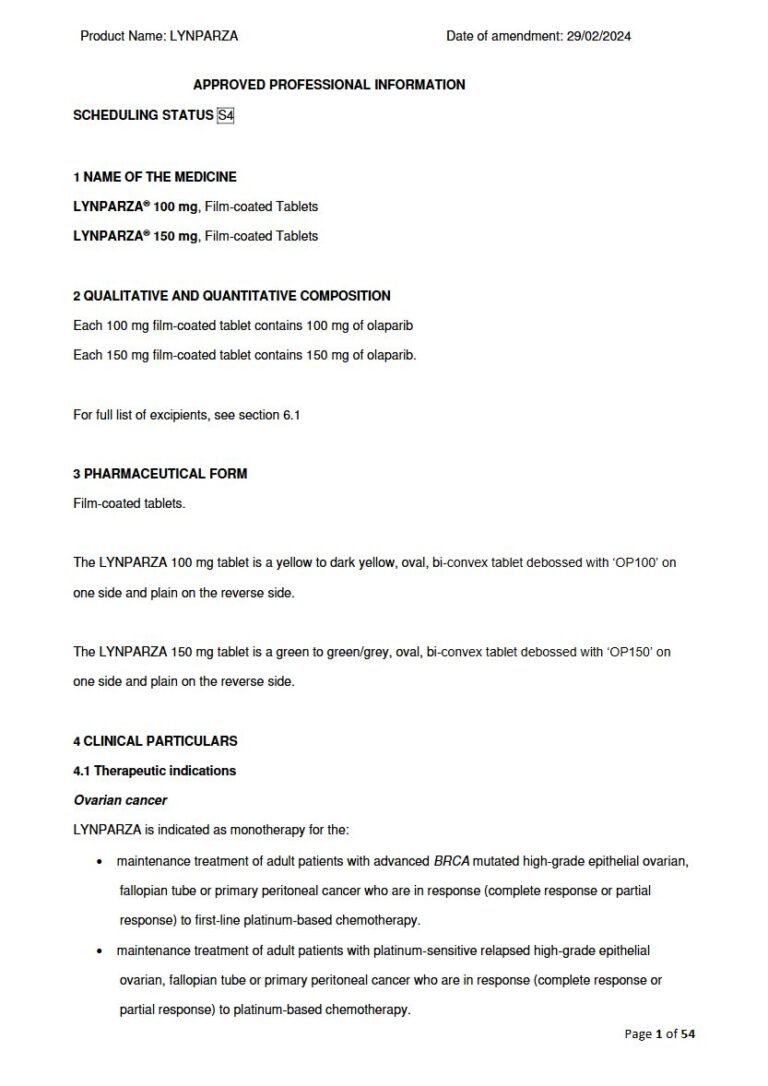
4.1 Therapeutic indications
Ovarian cancer
LYNPARZA is indicated as monotherapy for the:
- maintenance treatment of adult patients with advanced BRCA mutated high-grade epithelial ovarian, fallopian tube or primary peritoneal cancer who are in response (complete response or partial response) to first-line platinum-based chemotherapy.
- maintenance treatment of adult patients with platinum-sensitive relapsed high-grade epithelial ovarian, fallopian tube or primary peritoneal cancer who are in response (complete response or partial response) to platinum-based chemotherapy.
LYNPARZA in combination with bevacizumab is indicated for the:
- maintenance treatment of adult patients with advanced high-grade epithelial ovarian, fallopian tube or primary peritoneal cancer who are in response (complete response or partial response) to first-line platinum-based chemotherapy with bevacizumab.
Breast cancer
LYNPARZA is indicated as monotherapy for the:
- treatment of adult patients with germline BRCA -mutated HER2-negative metastatic breast cancer who have previously been treated with chemotherapy. These patients could have received chemotherapy in the neoadjuvant, adjuvant or metastatic setting.
Adenocarcinoma of the pancreas
LYNPARZA is indicated as monotherapy for the:
- maintenance treatment of adult patients with germline BRCA -mutated metastatic adenocarcinoma of the pancreas whose disease has not progressed on first-line platinum-based chemotherapy.
Prostate cancer
LYNPARZA is indicated as monotherapy for the:
- treatment of adult patients with metastatic castration-resistant prostate cancer and homologous recombination repair gene mutations (germline and/or somatic) who have progressed following a prior new hormonal agent.
4.2 Posology and method of administration
Treatment with LYNPARZA should be initiated and supervised by a medical practitioner experienced in the use of anticancer medicines.
Detection of BRCA and other HRR gene mutations: Gene mutation status should be determined by an experienced laboratory using a validated test method.
Patient selection
Monotherapy maintenance treatment of advanced BRCA-mutated ovarian cancer:
Patients must have confirmation of a breast cancer susceptibility gene (BRCA) mutation (identified by either germline or tumour testing) before LYNPARZA treatment is initiated.
Metastatic HER2-negative breast cancer:
Patients must have confirmation of a BRCA mutation (identified by germline testing) before LYNPARZA treatment is initiated.
Maintenance following first-line treatment of metastatic gBRCA-mutated metastatic adenocarcinoma of the pancreas:
Patients must have confirmation of a BRCA mutation (identified by germline testing) before LYNPARZA treatment is initiated.
HRR-gene mutated metastatic castration-resistant prostate cancer (mCRPC):
Patients must have confirmation of a homologous recombination repair (HRR) gene mutation (using either tumour DNA from a tissue sample, ctDNA obtained from a plasma sample or germline DNA obtained from a blood or another non-tumour sample) before LYNPARZA treatment is initiated. HRR genetic status should be determined by an experienced laboratory using a validated test method.
Posology
LYNPARZA is available as 100 mg and 150 mg tablets. The recommended dose of LYNPARZA is 300 mg (two 150 mg tablets) taken twice daily, equivalent to a total daily dose of 600 mg. The 100 mg tablet is available for dose reduction.
Duration of treatment
Monotherapy maintenance treatment of advanced BRCA-mutated ovarian cancer:
Patients can continue treatment for 2 years or until radiological disease progression. Patients with a complete response (no radiological evidence of disease) at 2 years should stop treatment. Patients with evidence of disease at 2 years, who in the opinion of the treating medical practitioner can derive further benefit from continuous treatment, can be treated beyond 2 years.
Platinum-sensitive relapsed ovarian cancer:
It is recommended that treatment be continued until progression of the underlying disease or unacceptable toxicity.
Maintenance treatment of advanced ovarian cancer in combination with bevacizumab:
Patients can continue treatment with LYNPARZA for 2 years or until radiological disease progression, unacceptable toxicity. Patients with a complete response (no radiological evidence of disease) at 2 years should stop treatment. Patients with evidence of disease at 2 years, who in the opinion of the treating medical practitioner can derive further benefit from continuous LYNPARZA treatment, can be treated beyond 2 years. When LYNPARZA is used in combination with bevacizumab, refer to the Prescribing Information for bevacizumab for recommended dosing information (see section 5.1).
Metastatic HER2-negative breast cancer:
It is recommended that treatment be continued until progression of the underlying disease or unacceptable toxicity.
Maintenance following first-line treatment of metastatic adenocarcinoma of the pancreas:
It is recommended that treatment be continued until progression of the underlying disease or unacceptable toxicity.
HRR-gene mutated metastatic castration-resistant prostate cancer:
It is recommended that treatment be continued until progression of the underlying disease or unacceptable toxicity.
Missing dose
If a patient misses a dose of LYNPARZA, the patient should take their next normal dose at its scheduled time.
Dose adjustments
For adverse events
Treatment may be interrupted to manage adverse events such as nausea, vomiting, diarrhoea and anaemia and dose reduction can be considered (see section 4.8). The recommended dose reduction is to 250 mg (one 150 mg tablet and one 100 mg tablet) twice daily (equivalent to a total daily dose of 500 mg). If a further dose reduction is required, then reduction to 200 mg (two 100 mg tablets) twice daily (equivalent to a total daily dose of 400 mg) is recommended.
For co-administration with CYP3A inhibitors
Concomitant use of strong or moderate CYP3A inhibitors is not recommended and alternative medicines should be considered. If a strong CYP3A inhibitor must be co-administered, the recommended LYNPARZA dose reduction is to 100 mg (one 100 mg tablet) taken twice daily (equivalent to a total daily dose of 200 mg). If a moderate CYP3A inhibitor must be co-administered, the recommended LYNPARZA dose reduction is to 150 mg (one 150 mg tablet) taken twice daily (equivalent to a total daily dose of 300 mg) (see sections 4.4 and 4.5).
Special patient populations
Children or adolescents: LYNPARZA is not indicated for use in paediatric patients, as safety and efficacy of LYNPARZA in children and adolescents have not been established.
Elderly (>65 years): No adjustment in starting dose is required for elderly patients. There are limited clinical data in patients aged 75 years and over.
Renal impairment: For patients with moderate renal impairment (creatinine clearance 31 u2013 50 ml/min) the recommended dose of LYNPARZA is 200 mg (two 100 mg tablets) twice daily (equivalent to a total daily dose of 400 mg). LYNPARZA is not recommended for patients with severe renal impairment or end-stage renal disease (creatinine clearance u226430 ml/min), as safety and pharmacokinetics have not been studied in these patients. LYNPARZA can be administered to patients with mild renal impairment (creatinine clearance 51 u2013 80 ml/min) with no dose adjustment (see section 5.2).
Hepatic impairment: LYNPARZA can be administered to patients with mild or moderate hepatic impairment (Child-Pugh classification A or B) with no dose adjustment (see section 5.2). LYNPARZA is not recommended for use in patients with severe hepatic impairment (Child-Pugh classification C), as safety and pharmacokinetics have not been studied in these patients.
Method of administration
For oral use. LYNPARZA tablets should be swallowed whole and not chewed, crushed, dissolved or divided.
LYNPARZA tablets can be taken with or without food.
4.3 Contraindications
- Hypersensitivity to the active substance or to any of the excipients of LYNPARZA listed in section 6.1.
- Severe renal impairment CrCl < 30 ml/min (see section 4.2).
- Severe hepatic impairment (Child-Pugh class C) (see section 4.2).
- Pregnancy and lactation and for 1 month after the last dose (see section 4.6).
4.4 Special warnings and precautions for use
Haematological toxicity
Haematological toxicity has been reported in patients treated with LYNPARZA, including clinical diagnoses and/or laboratory findings of (CTCAE grade 1 or 2) anaemia, neutropenia, thrombocytopenia and lymphopenia. Patients should not start treatment with LYNPARZA until they have recovered from haematological toxicity caused by previous anti-cancer therapy (haemoglobin, platelet and neutrophil levels should be u2264CTCAE grade 1). Baseline testing, followed by monthly monitoring, of complete blood counts is recommended for the first 12 months of treatment and periodically after this time to monitor for clinically significant changes in any parameter during treatment (see section 4.8). If a patient develops severe haematological toxicity or blood transfusion dependence, treatment with LYNPARZA should be interrupted and appropriate haematological testing should be initiated. If the blood parameters remain clinically abnormal after 4 weeks of LYNPARZA dose interruption, bone marrow analysis and/or blood cytogenetic analysis are recommended.
Myelodysplastic Syndrome/Acute Myeloid Leukaemia (MDS/AML)
The incidence of MDS/AML in patients treated in clinical trials with LYNPARZA monotherapy, including long-term survival follow up, was <1,5 %, with higher incidence in patients with BRCA m platinum-sensitive relapsed ovarian cancer who had received at least two prior lines of platinum chemotherapy and were followed up for 5 years (see section 4.8). The majority of events had a fatal outcome. The duration of therapy with LYNPARZA in patients who developed MDS/AML varied from 4 years. All patients had potential contributing factors for the development of MDS/AML, having received previous chemotherapy with platinum medicines. Many had also received other DNA damaging treatments. The majority of reports were in germline BRCA mutation (gBRCAm) carriers and some of the patients had a history of more than one primary malignancy or of bone marrow dysplasia. If MDS and/or AML are confirmed while on treatment with LYNPARZA, it is recommended that LYNPARZA should be discontinued and the patient be treated appropriately.
Pneumonitis
Pneumonitis has been reported in <1,0 % patients treated with LYNPARZA monotherapy in clinical studies. Reports of pneumonitis had no consistent clinical pattern and were confounded by a number of predisposing factors (cancer and/or metastases in lungs, underlying pulmonary disease, smoking history, and/or previous chemotherapy and radiotherapy). When LYNPARZA was used in clinical studies in combination with other therapies there have been events with a fatal outcome. If patients present with new or worsening respiratory symptoms such as dyspnoea, cough and fever, or an abnormal chest radiologic finding is observed, LYNPARZA treatment should be interrupted and prompt investigation initiated. If pneumonitis is confirmed, LYNPARZA treatment should be discontinued and the patient treated appropriately.
Embryofoetal toxicity
Based on its mechanism of action (PARP inhibition), LYNPARZA could cause foetal harm when administered to a pregnant woman. Nonclinical studies in rats have shown that LYNPARZA causes adverse effects on embryofoetal survival and induces major foetal malformations at exposures below those expected at the recommended human dose of 300 mg twice daily. LYNPARZA should not be taken during pregnancy. If the patient becomes pregnant while taking LYNPARZA, the patient should be apprised of the potential hazard to a foetus.
Pregnancy/contraception
LYNPARZA should not be used during pregnancy. Women of childbearing potential must use two forms of reliable contraception before starting LYNPARZA treatment, during therapy and for 6 months after receiving the last dose of LYNPARZA (see section 4.6). Two highly effective and complementary forms of contraception are recommended (see section 4.6). Male patients and their female partners of childbearing potential should be advised that they must use effective contraception during LYNPARZA treatment and for 3 months after receiving the last dose of LYNPARZA (see section 4.6).
Breastfeeding
Breastfeeding mothers should not breastfeed during treatment with LYNPARZA and for one month after receiving the last dose of LYNPARZA (see section 4.6).
4.5 Interactions with other medicines
Co-administration of LYNPARZA with strong or moderate CYP3A inhibitors is not recommended (see section 4.5). If a strong or moderate CYP3A inhibitor must be co-administered, the dose of LYNPARZA should be reduced (see section 4.2).
Co-administration of LYNPARZA with strong or moderate CYP3A inducers is not recommended. In the event that a patient already receiving LYNPARZA requires treatment with a strong or moderate CYP3A inducer, the prescriber should be aware that the efficacy of LYNPARZA may be substantially reduced (see section 4.5).
4.6 Fertility, pregnancy and lactation
Woman of childbearing potential/contraception in Males and Females
Women of childbearing potential must use two forms of effective contraception before starting LYNPARZA treatment during therapy and for 6 months after receiving the last dose of LYNPARZA (see section 4.4). A pregnancy test should be performed on all women of childbearing potential prior to treatment, and pregnancy tests should be performed at regular intervals during treatment and at 6 months after receiving the last dose.
It is not known whether LYNPARZA or its metabolites are found in seminal fluid. Male patients must use a condom during therapy and for 3 months after receiving the last dose of LYNPARZA when having sexual intercourse with a pregnant woman or with a woman of childbearing potential. Female partners of male patients must also use effective contraception if they are of childbearing potential (see section 4.4). Male patients should not donate sperm during therapy and for 3 months after receiving the last dose of LYNPARZA.
Pregnancy
LYNPARZA is contraindicated during pregnancy due to the teratogenic and genotoxic potential of LYNPARZA (see section 4.3 and 4.4). Female partners of male patients taking LYNPARZA should also avoid pregnancy. No studies have been conducted in pregnant women (see section 5.3). If a female patient or a female partner of a male patient receiving LYNPARZA becomes pregnant, she should be apprised of the potential hazard to the foetus or potential risk of loss of the pregnancy (see section 4.4).
Breastfeeding
Mothers must not breastfeed their infants while taking LYNPARZA, nor for one month after the last dose (see section 4.3 and 4.4).
Fertility
There are no clinical data on human fertility. In animal studies, no effect on conception was observed but there were adverse effects on embryofoetal survival (see section 5.3).
4.7 Effects on ability to drive and use machines
During treatment with LYNPARZA, asthenia, fatigue, and dizziness have been reported and those patients who experience these symptoms should observe caution when driving or using machines.
4.8 Undesirable effects
b. Tabulated summary of adverse reactions
The safety profile is based on pooled data from 3077 patients with solid tumours treated with LYNPARZA monotherapy and 535 patients treated with LYNPARZA in combination with bevacizumab in clinical trials at the recommended dose. When LYNPARZA is used in combination with bevacizumab the safety profile is generally consistent with that of the individual therapies. The following adverse reactions have been identified in completed clinical trials with patients receiving LYNPARZA monotherapy where patient exposure is known. Adverse Drug Reactions are organised by MedDRA System Organ Class (SOC) and then by MedDRA preferred term in Table 1. Within each SOC, preferred terms are arranged by decreasing frequency and then by decreasing seriousness. Frequencies of occurrence of adverse reactions are defined as: very common (u22651/10); common (u22651/100 to <1/10); uncommon (u22651/1 000 to <1/100); rare (u22651/10 000 to <1/1 000); and very rare (<1/10 000) including isolated reports.
Table 1 Adverse drug reactions reported in clinical trials with LYNPARZA monotherapy
MedDRA SOC MedDRA Term CIOMS descriptor/ Frequency of Overall Frequency (All CTCAE grades) CTCAE grade 3 and above Neoplasms benign, malignant and unspecified (including cysts and polyps) Myelodysplastic syndrome/Acute myeloid leukaemia a Uncommon Uncommon Blood and lymphatic system disorders Anaemia a Very common Very common Neutropenia a Very common Common Leukopenia a Very common Common Thrombocytopenia a Very common Common Lymphopenia a Common Uncommon Immune system disorders Hypersensitivity a Uncommon Rare Angioedema * Uncommon - Metabolism and nutrition disorders Decreased appetite Very common Uncommon Nervous system disorders Dizziness Very common Uncommon Headache Very common Uncommon Dysgeusia a Very common - Respiratory, thoracic and mediastinal disorders Cough a Very common Uncommon Dyspnoea a Very common Common Gastrointestinal disorders Vomiting Very common Common Diarrhoea Very common Common Nausea Very common Common Dyspepsia Very common Rare Stomatitis Common Uncommon Upper abdominal pain Common Uncommon Skin and subcutaneous tissue disorders Rash a Common Uncommon Dermatitis a Uncommon - Erythema nodosum Rare - General disorders Fatigue (including asthenia) Very common Common Investigations Blood creatinine increased Common Rare Mean cell volume increased Uncommon - a MDS/AML includes preferred terms (PTs) of acute myeloid leukaemia, myelodysplastic syndrome and myeloid leukaemia. Anaemia includes PTs of anaemia, anaemia macrocytic, erythropenia, haematocrit decreased, haemoglobin decreased, normocytic anaemia and red blood cell count decreased. Neutropenia includes PTs of febrile neutropenia, neutropenia, neutropenic infection, neutropenic sepsis and neutrophil count decreased. Leukopenia includes PTs of leukopenia and white blood cell count decreased. Thrombocytopenia includes PTs of platelet count decreased and thrombocytopenia. Lymphopenia includes PTs of lymphocyte count decreased and lymphopenia. Hypersensitivity includes PTs of drug hypersensitivity and hypersensitivity. Cough includes PTs of cough and productive cough. Dyspnoea includes PTs of dyspnoea and dyspnoea exertional. Dysgeusia includes PTs of dysgeusia and taste disorder. Stomatitis includes PTs of aphthous ulcer, mouth ulceration and stomatitis. Rash includes PTs of erythema, exfoliative rash, rash, rash erythematous, rash macular, rash maculo-papular, rash papular and rash pruritic. Dermatitis includes PTs of dermatitis and dermatitis allergic. *As observed in post-marketing setting.
c. Description of selected adverse reactions
Myelodysplastic syndrome/Acute myeloid leukaemia
In clinical studies, across all indications, MDS/AML occurred uncommonly in patients on treatment and during the 30-day safety follow up, and <1,5 % at any time after starting LYNPARZA, including cases actively solicited during the long term follow up for overall survival. In patients with BRCA m platinum-sensitive relapsed ovarian cancer who had received at least two prior lines of platinum chemotherapy and received study treatment until disease progression (SOLO2 study, with LYNPARZA treatment u2265 2 years in 45 % of patients), the incidence of MDS/AML was 8 % in patients receiving LYNPARZA and 4 % in patients receiving placebo at a follow-up of 5 years. In the LYNPARZA arm, 9 out of 16 MDS/AML cases occurred after discontinuation of LYNPARZA during the survival follow-up. The incidence of MDS/AML was observed in the context of extended overall survival in the LYNPARZA arm and late onset of MDS/AML. The risk of MDS/AML remains < 1,5 % at 5 year follow up in the first-line setting when LYNPARZA maintenance treatment is given after one line of platinum chemotherapy for a duration of 2 years.
Haematological toxicity
Anaemia was the most common CTCAE grade u22653 adverse reaction reported in clinical studies with first onset generally reported in the first 3 months of treatment. An exposure-response relationship between LYNPARZA and decreases in haemoglobin has been demonstrated. In clinical studies with LYNPARZA monotherapy the incidence of CTCAE grade u22652 shifts (decreases) from baseline in haemoglobin was 23 %, absolute neutrophils 19 %, platelets 6 %, lymphocytes 29 % and leucocytes 20 % (all % approximate). The incidence of elevations in mean corpuscular volume from low or normal at baseline to above the upper limit of normal was approximately 58 %. Levels appeared to return to normal after treatment discontinuation and did not appear to have any clinical consequences. Baseline testing, followed by monthly monitoring, of complete blood counts is recommended for the first 12 months of treatment, and periodically after this time, to monitor for clinically significant changes in any parameter during treatment which may require dose interruption or reduction and/or further treatment (see sections 4.2 and 4.4).
Other laboratory findings
In clinical studies with LYNPARZA monotherapy the incidence of CTCAE grade u22652 shifts (elevations) from baseline in blood creatinine was approximately 11 %. Data from a double-blind placebo-controlled study showed median increase up to 23 % from baseline remaining consistent over time and returning to baseline after treatment discontinuation. 90 % of patients had creatinine values of CTCAE grade 0 at baseline and 10 % were CTCAE grade 1 at baseline.
Nausea and vomiting
Nausea was generally reported very early, with first onset within the first month of LYNPARZA treatment in the majority of patients. Vomiting was reported early, with first onset within the first two months of LYNPARZA treatment in the majority of patients. Both nausea and vomiting were reported to be intermittent for the majority of patients.
d. Paediatric population
No studies have been conducted in paediatric patients.
Reporting of suspected adverse reactions
Reporting suspected adverse reactions after authorisation of the medicine is important. It allows continued monitoring of the benefit/risk balance of the medicine. Health care providers are asked to report any suspected adverse reactions to SAHPRA via the u201c6.04 Adverse Drug Reaction Reporting Formu201d, found online under SAHPRAu2019s publications: https://www.sahpra.org.za/Publications/Index/8
4.9 Overdose
Symptoms of overdose are expected to be an exacerbation of the adverse events. There is no specific treatment in the event of LYNPARZA overdose. In the event of an overdose, the medical practitioner should follow general supportive measures and should treat the patient symptomatically.
