
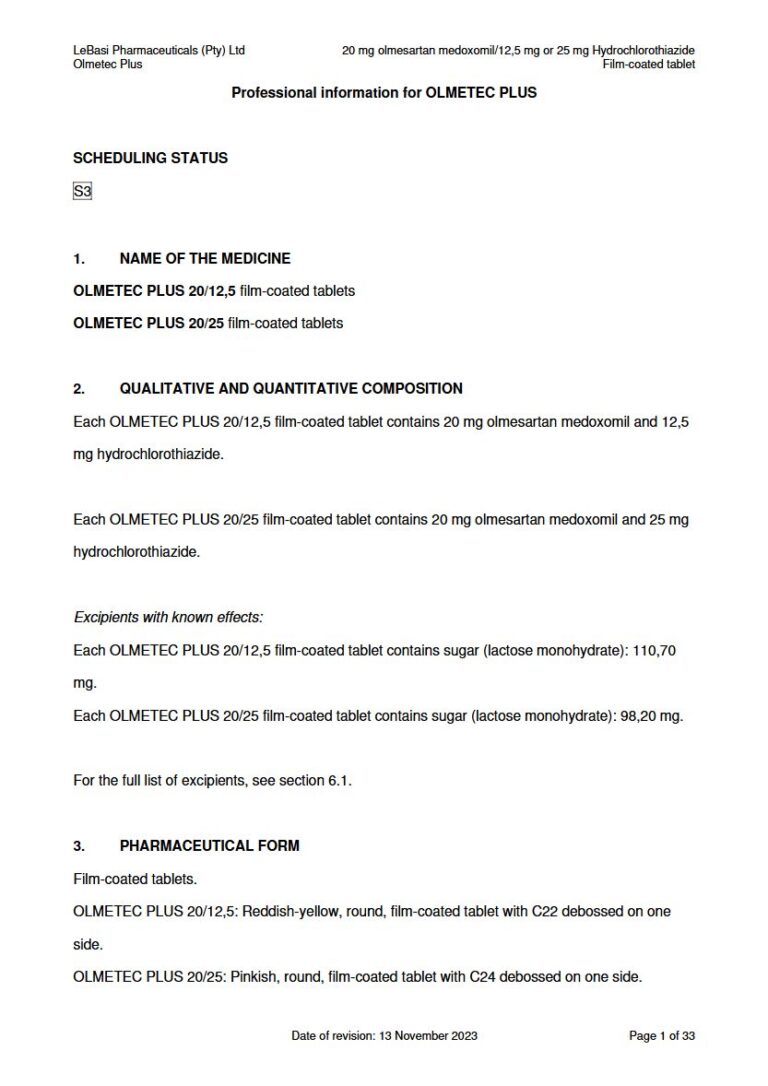
Olmetec Plus 20 mg, 12,5 mg or 25 mg FC tablet
PDF Leaflet Revision Date: 13 November 2023
Clinical Summary
Quick overview from the medicine insert
Indication
Treatment of essential hypertension.
Dosage (summary)
Adults: 1 tablet daily; max 20/25 mg.
Onset of Action / Duration
Onset: 2 hours, Duration: 6-12 hours
Special Populations
- Elderly
- Renal impairment
- Hepatic impairment
Pregnancy & Breastfeeding
Contraindicated in pregnancy and lactation.
Key Drug Interactions
- Lithium
- NSAIDs
- Potassium-sparing diuretics
Contraindications
- Hypersensitivity
- Severe renal impairment
- Severe hepatic impairment
- Pregnancy
- Bilateral renal artery stenosis
Common side effects
- Headache
- Dizziness
- Fatigue
Counselling Points
- Monitor blood pressure regularly.
- Avoid potassium supplements.
- Report any skin lesions.
Serious warnings
- Risk of hypotension in volume-depleted patients
- Dual blockade of RAAS contraindicated
Important Disclaimer
The Olmetec Plus 20 mg, 12,5 mg or 25 mg FC tablet professional information leaflet below is the property of Lebasi Pharmaceuticals and is provided on Medinsert exactly as issued, with no.. alterations or editorial changes. We make every effort to keep content current by updating documents as soon as new versions become available. Medinsert serves as a trusted access point for healthcare professionals, but does not replace official sources or clinical judgement. For more details, please read our full disclaimer. read more>>
 Healthcare Professionals Only
This content is for registered healthcare professionals
Sign in or create a free account to read the full package insert.
Free for HPCSA-registered professionals. Powered by Medinsert.
Clinical Particulars
Section 4 of the official insert — extracted exactly as issued, no alterations
4.1 Therapeutic indications
Treatment of essential hypertension. OLMETEC PLUS is indicated in adult patients whose blood pressure is not adequately controlled on olmesartan medoxomil alone.
4.2 Posology and method of administration
Posology
Adults
OLMETEC PLUS is administered once daily, with or without food. A maximum daily dose of OLMETEC PLUS 20/25 should not be exceeded. OLMETEC PLUS 20/12,5 may be administered in patients whose blood pressure is not adequately controlled by optimal monotherapy of OLMETEC 20 mg alone. OLMETEC PLUS 20/25 may be administered in patients whose blood pressure is not adequately controlled by OLMETEC PLUS 20/12,5.
Special populations
Elderly
In elderly patients the same dosage of the combination is recommended as for adults.
Renal impairment
When OLMETEC PLUS is used in patients with mild to moderate renal impairment (creatinine clearance of 30 to 60 mL/min), periodic monitoring of renal function is advised. OLMETEC PLUS is contraindicated in patients with severe renal impairment (creatinine clearance < 30 mL/min) (see section 4.3).
Hepatic impairment
OLMETEC PLUS should be used with caution in patients with mild to moderate hepatic impairment (see sections 4.4, 5.2). In patients with moderate hepatic impairment, an initial dose of 10 mg olmesartan medoxomil once daily is recommended and the maximum dose should not exceed 20 mg once daily. Close monitoring of blood pressure and renal function is advised in hepatically-impaired patients who are receiving diuretics and/or other antihypertensive medicines. OLMETEC PLUS should not be used in patients with severe hepatic impairment (see sections 4.3 and 5.2), cholestasis and biliary obstruction (see section 4.3).
Children and adolescents
The safety and efficacy of olmesartan medoxomil have not been established in children and adolescents up to 18 years of age. Treatment of children up to 18 years is not recommended.
Method of administration
The tablet should be swallowed with a sufficient amount of fluid (e.g. one glass of water). The tablet should not be chewed and should be taken at the same time each day.
4.3 Contraindications
- Hypersensitivity to the active substances or to other sulfonamide-derived substances (since hydrochlorothiazide is a sulfonamide-derived medicine), or to any of the ingredients of OLMETEC PLUS (listed in section 6.1).
- Pregnancy and lactation (see sections 4.4 and 4.6).
- Hereditary or idiopathic angioedema.
- A history of angioedema related to previous therapy with ACE inhibitors or angiotensin receptor blockers (ARBs): These patients must never again be given these medicines.
- Hypertrophic obstructive cardiomyopathy (HOCM).
- Bilateral renal artery stenosis.
- Renal artery stenosis in patients with a single kidney (see section 4.4).
- Aortic stenosis (see section 4.4).
- Concomitant therapy with potassium sparing diuretics such as spironolactone, triamterene, amiloride (see section 4.5).
- Porphyria.
- The concomitant use of OLMETEC PLUS with aliskiren-containing products is contraindicated (see sections 4.4 and 4.5).
- Lithium therapy: Concomitant administration with OLMETEC PLUS may lead to toxic blood concentrations of lithium (see section 4.5).
- Severe renal impairment (creatinine clearance < 30 mL/min) (see section 4.4).
- Refractory hypokalaemia, hypercalcaemia, hyponatraemia and symptomatic hyperuricaemia.
- Severe hepatic impairment, cholestasis and biliary obstructive disorders (see section 4.4).
- Patients with a history of previous and/or current basal cell carcinomas and/or squamous cell carcinomas of the skin and lip.
4.4 Special warnings and precautions for use
Should a woman become pregnant while receiving OLMETEC PLUS, the treatment should be stopped promptly and switched to a different class of antihypertensive medicine (see sections 4.3 and 4.6).
Dual blockade of the renin-angiotensin-aldosterone system (RAAS)
There is evidence that the concomitant use of ACE-inhibitors, angiotensin II receptor blockers (ARBs) or aliskiren may increase the risk of hypotension, hyperkalaemia and decreases renal function (including acute renal failure). Dual blockade of RAAS through the combined use of OLMETEC PLUS and aliskiren is therefore contraindicated (see section 4.3). OLMETEC PLUS should not be used concomitantly with aliskiren (see section 4.3).
ACE-inhibitors and angiotensin II receptor blockers should not be used concomitantly in patients with diabetic nephropathy.
Intravascular volume depletion
Symptomatic hypotension, especially after the first dose, may occur in patients who are volume and/or sodium depleted by vigorous diuretic therapy, dietary salt restriction, and diarrhoea or vomiting. Volume and/or sodium depletion should therefore be corrected before the administration of OLMETEC PLUS (see section 4.3).
Other conditions with stimulation of the renin-angiotensin-aldosterone system
In patients whose vascular tone and renal function depend predominantly on the activity of the renin-angiotensin-aldosterone system, (e.g. patients with severe congestive heart failure or underlying renal disease, including renal artery stenosis), treatment with other medicines that affect this system has been associated with acute hypotension, uraemia, oliguria or acute renal failure (see section 4.3).
Renovascular hypertension
There is an increased risk of severe hypotension and renal insufficiency when patients with bilateral renal artery stenosis or stenosis of the artery to a single functioning kidney are treated with OLMETEC PLUS (see section 4.3).
Renal impairment and kidney transplantation
OLMETEC PLUS should not be used in patients with severe renal impairment (creatinine clearance 30 mL/min; < 60 mL/min). However, in such patients OLMETEC PLUS should be administered with caution and periodic monitoring of serum potassium, creatinine and uric acid levels is recommended. Thiazide diuretic-associated uraemia (or another kidney disease e.g. azotaemia) may occur in patients with impaired renal function. If progressive renal impairment becomes evident, careful reappraisal of therapy is necessary, with consideration given to discontinuing diuretic therapy. There is no experience of the administration of OLMETEC PLUS in patients with recent kidney transplantation.
Hepatic impairment
There is currently no experience of olmesartan medoxomil in patients with severe hepatic impairment. Furthermore, minor alterations of fluid and electrolyte balance during thiazide therapy may precipitate hepatic coma in patients with impaired hepatic function or progressive liver disease. Therefore, care should be taken in patients with mild to moderate hepatic impairment (see section 4.2). Use of OLMETEC PLUS in patients with severe hepatic impairment, cholestasis and biliary obstruction is contraindicated (see sections 4.3 and 5.2).
Mitral valve stenosis
As with other vasodilators, special caution is indicated in patients suffering from mitral stenosis.
Primary aldosteronism
Patients with primary aldosteronism generally will not respond to anti-hypertensive medicines acting through inhibition of the renin-angiotensin system. Therefore, the use of OLMETEC PLUS is not recommended in such patients.
Metabolic and endocrine effects
Thiazide therapy such as in OLMETEC PLUS may impair glucose tolerance. In diabetic patients dosage adjustments of insulin or oral hypoglycaemic medicines may be required. Latent diabetes mellitus may become manifest during thiazide therapy. Increases in cholesterol and triglyceride levels are undesirable effects known to be associated with thiazide diuretic therapy such as in OLMETEC PLUS. Hyperuricaemia may occur or an acute gout attack may be precipitated in patients receiving thiazide therapy such as in OLMETEC PLUS.
Electrolyte imbalance
Periodic determination of serum electrolytes should be performed at appropriate intervals. Thiazides, including hydrochlorothiazide, can cause fluid or electrolyte imbalance (including hypercalcaemia, hyponatraemia, hypokalaemia and hypochloraemic alkalosis). Warning signs of fluid or electrolyte imbalance are dryness of the mouth, thirst, weakness, lethargy, drowsiness, restlessness, muscle pain or cramps, muscular fatigue, hypotension and oliguria. Tachycardia and gastrointestinal disturbances, such as nausea or vomiting, have also been reported (see section 4.8). The risk of hypokalaemia is greatest in patients with cirrhosis of the liver, in patients experiencing brisk diuresis, in patients who are receiving inadequate oral intake of electrolytes and in patients receiving concomitant therapy with corticosteroids or ACTH (see section 4.5). Conversely, due to antagonism at the angiotensin ll receptors (AT 1) through the olmesartan medoxomil component of OLMETEC PLUS, hyperkalaemia may occur, especially in the presence of renal impairment and/or heart failure, and diabetes mellitus. Adequate monitoring of serum potassium in patients at risk is recommended. Potassium-sparing diuretics, potassium supplements or potassium-containing salt substitutes and other medicines that may increase serum potassium levels (e.g. heparin) should be co-administered cautiously with OLMETEC PLUS (see section 4.5). There is no evidence that olmesartan medoxomil would reduce or prevent diuretic induced hyponatraemia. Chloride deficit is generally mild and usually does not require treatment. Hydrochlorothiazide as in OLMETEC PLUS may decrease urinary calcium excretion and cause an intermittant and slight elevation of serum calcium in the absence of known disorders of calcium metabolism. Hypercalcaemia may be evidence of hidden hyperparathyroidism. OLMETEC PLUS should be discontinued before carrying out tests for parathyroid function. Hydrochlorothiazide has been shown to increase the urinary excretion of magnesium, which may result in hypomagnesaemia. Dilutional hyponatraemia may occur in oedematous patients in hot weather.
Sprue-like enteropathy
In very rare cases severe, chronic diarrhoea with substantial weight loss has been reported in patients taking olmesartan few months to years after drug initiation, possibly caused by a localized delayed hypersensitivity reaction. Intestinal biopsies of patients often demonstrated villous atrophy. If a patient develops these symptoms during treatment with olmesartan, and in the absence of other apparent etiologies, olmesartan treatment should be immediately discontinued and should not be restarted. If diarrhoea does not improve during the week after the discontinuation, further specialist (e.g. a gastro-enterologist) advice should be considered.
Choroidal effusion, acute myopia and secondary angle-closure glaucoma
Hydrochlorothiazide, a sulfonamide, can cause an idiosyncratic reaction, resulting in choroidal effusion with visual field defect, acute transient myopia and acute angle-closure glaucoma. Symptoms include acute onset of decreased visual acuity or ocular pain and typically occur within hours to weeks of drug initiation. Untreated acute angle-closure glaucoma can lead to permanent vision loss. The primary treatment is to discontinue hydrochlorothiazide as rapidly as possible. Prompt medical or surgical treatments may need to be considered if the intraocular pressure remains uncontrolled.
Non-melanoma skin cancer
An increased risk of non-melanoma skin cancer (NMSC) [basal cell carcinoma (BCC) and squamous cell carcinoma (SCC)] with increasing cumulative dose of hydrochlorothiazide exposure has been observed in two epidemiological studies. Photosensitizing actions of hydrochlorothiazide could act as a possible mechanism for NMSC. Patients taking OLMETEC PLUS should be informed of the risk of NMSC and advised to regularly check their skin for any new lesions and promptly report any suspicious skin lesions. Possible preventive measures such as limited exposure to sunlight and UV rays and, in case of exposure, adequate protection should be advised to the patients in order to minimize the risk of skin cancer. Suspicious skin lesions should be promptly examined potentially including histological examinations of biopsies. OLMETEC PLUS should not be used by patients who have had previous and/or current basal cell carcinomas and/or squamous cell carcinomas of the skin and/or lip (see section 4.3).
Acute respiratory toxicity
Very rare severe cases of acute respiratory toxicity, including acute respiratory distress syndrome (ARDS) have been reported after taking hydrochlorothiazide. Pulmonary oedema typically develops within minutes to hours after hydrochlorothiazide intake. At the onset, symptoms include dyspnoea, fever, pulmonary deterioration and hypotension. If diagnosis of ARDS is suspected, OLMETEC PLUS should be withdrawn, and appropriate treatment given.
Ethnic differences
The blood pressure lowering effect of olmesartan medoxomil is somewhat less in black patients than in non-black patients, possibly because of a higher prevalence of low-renin status in the black hypertensive population.
Anti-doping test
Hydrochlorothiazide contained in OLMETEC PLUS could produce a positive analytic result in an anti-doping test.
Pregnancy
Angiotensin II receptor antagonists should not be initiated during pregnancy. Patients planning pregnancy should be changed to alternative anti-hypertensive treatments which have an established safety profile for use in pregnancy. When pregnancy is diagnosed, treatment with angiotensin II receptor antagonists should be stopped immediately, and, if appropriate, alternative therapy should be started (see sections 4.3 and 4.6).
Other
In general arteriosclerosis, there is a risk that excessive blood pressure decrease could result in a myocardial infarction or stroke, in patients with ischaemic heart disease or ischaemic cerebrovascular disease. Hypersensitivity reactions to hydrochlorothiazide may occur in patients with or without a history of allergy or bronchial asthma, but are more likely in patients with such a history.
Systemic lupus erythematosus
Exacerbation or activation of systemic lupus erythematosus has been reported with the use of thiazide diuretics.
Lactose monohydrate
OLMETEC PLUS contains lactose monohydrate. Patients with rare hereditary problems of galactose intolerance, total lactase deficiency or glucose-galactose malabsorption, should not take OLMETEC PLUS.
4.5 Interaction with other medicines and other forms of interaction
Potential interactions related to both olmesartan medoxomil and hydrochlorothiazide contained in OLMETEC PLUS
Concomitant use not recommended
Lithium
Reversible increases in serum lithium concentrations and toxicity have been reported during concomitant administration of lithium with OLMETEC PLUS. In addition, renal clearance of lithium is reduced by thiazides and consequently the risk of lithium toxicity may be increased. Therefore use of OLMETEC PLUS and lithium in combination is not recommended (see section 4.3).
Concomitant use requiring caution
Baclofen
Potentiation of antihypertensive effect may occur.
Non-steroidal anti-inflammatory drugs
NSAIDs (Nonsteroidal anti-inflammatory drugs) (i.e. acetylsalicylic acid (> 3 g/day), COX-2 inhibitors and non-selective NSAIDs) may reduce the antihypertensive effect of thiazide diuretics and angiotensin II antagonists. In some patients with compromised renal function, (e.g. dehydrated patients or elderly patients with compromised renal function) the co-administration of angiotensin II antagonists and medicines that inhibit cyclo-oxygenase may result in further deterioration of renal function, including possible acute renal failure, which is usually reversible. Therefore, the combination should be administered with caution, especially in the elderly. Patients should be adequately hydrated and consideration should be given to monitoring of renal function after initiation of concomitant therapy and periodically thereafter.
Concomitant use to be taken into account
Amifostine
Potentiation of antihypertensive effect may occur.
Other antihypertensive drugs
The blood pressure lowering effect of OLMETEC PLUS can be increased by concomitant use of other antihypertensive medicines.
Alcohol, barbiturates, narcotics or antidepressants
Potentiation of orthostatic hypotension may occur.
Potential interactions related to olmesartan medoxomil
Concomitant use not recommended
Dual blockade of the RAAS with ARBs, ACE inhibitors, or aliskiren
Clinical trial data has shown that dual blockade of the renin-angiotensin-aldosterone-system (RAAS) through the combined use of ACE inhibitors, angiotensin II receptor blockers or aliskiren is associated with a higher frequency of adverse events such as hypotension, hyperkalaemia and decreased renal function (including acute renal failure) compared to the use of a single RAAS- acting medicine (see sections 4.3, 4.4 and 5.1).
Medicines affecting potassium levels
Concomitant use of potassium-sparing diuretics, potassium supplements, salt substitutes containing potassium or other medicines that may increase serum potassium levels (e.g. heparin, or ACE inhibitors) may lead to increases in serum potassium. If medicines which affect potassium levels are to be prescribed in combination with OLMETEC PLUS, monitoring of potassium plasma levels is advised.
Bile acid sequestering agent colesevelam
Concurrent administration of the bile acid sequestering agent colesevelam hydrochloride reduces the systemic exposure and peak plasma concentration of olmesartan and reduces t 1/2. Administration of olmesartan medoxomil at least 4 hours prior to colesevelam hydrochloride decreased the drug interaction effect. Administering olmesartan medoxomil at least 4 hours before the colesevelam hydrochloride dose should be considered (see section 5.2).
Additional information
- After treatment with antacid (aluminium magnesium hydroxide), a modest reduction in bioavailability of olmesartan medoxomil was observed.
- Olmesartan medoxomil had no significant effect on the pharmacokinetics or pharmacodynamics of warfarin or the pharmacokinetics of digoxin.
- Co-administration of olmesartan medoxomil with pravastatin had no clinically relevant effects on the pharmacokinetics of either component in healthy subjects.
- Olmesartan had no clinically relevant inhibitory effects on human cytochrome P450 enzymes 1A1/2, 2A6, 2C8/9, 2C19, 2D6, 2E1 and 3A4 in vitro, and had no or minimal inducing effects on rat cytochrome P450 activities. No clinically relevant interactions between olmesartan and medicines metabolised by the above cytochrome P450 enzymes are expected.
Potential interactions related to hydrochlorothiazide
Concomitant use not recommended
Medicines affecting potassium levels
The potassium-depleting effect of hydrochlorothiazide such as in OLMETEC PLUS may be potentiated by the co-administration of other medicines associated with potassium loss and hypokalaemia (e.g. other kaliuretic diuretics, laxatives, corticosteroids, ACTH, amphotericin, carbenoxolone, penicillin G sodium or salicylic acid derivatives). Such concomitant use is therefore not recommended.
Concomitant use requiring caution
Calcium salts
Thiazide diuretics may increase serum calcium levels due to decreased excretion. If calcium supplements must be prescribed, serum calcium levels should be monitored and calcium dosage adjusted accordingly.
Colestyramine and colestipol resins
Absorption of hydrochlorothiazide is impaired in the presence of anionic exchange resins.
Digitalis glycosides (e.g digoxin)
Thiazide-induced hypokalaemia or hypomagnesaemia may favour the onset of digitalis-induced cardiac dysrhythmias.
Medicines affected by serum potassium disturbances
Periodic monitoring of serum potassium and ECG is recommended when OLMETEC PLUS is administered with medicines affected by serum potassium disturbances (e.g. digitalis glycosides and antidysrhythmics); and with the following torsades de pointes (ventricular tachycardia) inducing medicines (including some antidysrhythmics), hypokalaemia being a predisposing factor to torsades de pointes (ventricular tachycardia):
- Class la antidysrhythmics (e.g. quinidine, hydroquinidine, disopyramide).
- Class III antidysrhythmics (e.g. amiodarone, sotalol, dofetilide, ibutilide).
- Some antipsychotics (e.g. thioridazine, chlorpromazine, levomepromazine, trifluoperazine, cyamemazine, sulpiride, sultopride, amisulpride, tiapride, pimozide, haloperidol, droperidol).
- Others (e.g. bepridil, cisapride, diphemanil, erythromycin IV, halofantrin, mizolastin, pentamidine, sparfloxacin, terfenadine, vincamine IV).
Non-depolarising skeletal muscle relaxants (e.g. tubocurarine)
The effect of non-depolarising skeletal muscle relaxants may be potentiated by hydrochlorothiazide.
Anticholinergic medicines (e.g. atropine, biperiden)
Increase of the bioavailability of thiazide-type diuretics by decreasing gastrointestinal motility and stomach emptying rate.
Antidiabetic medicines (oral and insulin)
The treatment with a thiazide such as in OLMETEC PLUS may influence the glucose tolerance. Dosage adjustment of the antidiabetic medicines may be required.
Metformin
Metformin should be used with caution because of the risk of lactic acidosis induced by possible functional renal failure linked to hydrochlorothiazide such as in OLMETEC PLUS.
Beta-blockers and diazoxide
The hyperglycaemic effect of beta-blockers and diazoxide may be enhanced by thiazides such as in OLMETEC PLUS.
Pressor amines (e.g. norepinephrine (noradrenaline))
The effect of pressor amines may be decreased.
Medicines used in the treatment of gout (probenecid, sulfinpyrazone and allopurinol)
Dosage adjustment of uricosuric medicines may be necessary since hydrochlorothiazide such as in OLMETEC PLUS may raise the level of serum uric acid. An increase in the dosage of probenecid or sulfinpyrazone may be necessary. Co-administration of a thiazide, such as in OLMETEC PLUS may increase the incidence of hypersensitivity reactions to allopurinol.
Amantadine
Thiazides such as in OLMETEC PLUS may increase the risk of adverse effects caused by amantadine.
Cytotoxic medicines (e.g. cyclophosphamide, methotrexate)
Thiazides, such as in OLMETEC PLUS, may reduce the renal excretion of cytotoxic medicines and potentiate their myelosuppressive effects.
Salicylates
In case of high dosages of salicylates, hydrochlorothiazide such as in OLMETEC PLUS may enhance the toxic effect of the salicylates on the central nervous system.
Methyldopa
There have been isolated reports of haemolytic anaemia occurring with concomitant use of hydrochlorothiazide such as in OLMETEC PLUS and methyldopa.
Ciclosporin
Concomitant treatment with ciclosporin may increase the risk of hyperuricaemia and gout-type complications.
Tetracyclines
Concomitant administration of tetracyclines and thiazides such as in OLMETEC PLUS increases the risk of tetracycline-induced increase in urea.
4.6 Fertility, pregnancy and lactation
Pregnancy
Safety in pregnancy has not been established (see section 4.3). When pregnancy is planned or confirmed, OLMETEC PLUS should be discontinued. Medicines affecting the renin-angiotensin system such as OLMETEC PLUS, can cause embryonal toxicity, fetal and neonatal morbidity and mortality when administered to pregnant women. Women of childbearing age should ensure effective contraception. Olmesartan medoxomil exposure to angiotensin II receptor antagonists therapy during the 2nd and 3rd trimesters is known to induce human fetotoxicity (decreased renal function, oligohydramnios, skull ossification retardation) and neonatal toxicity (renal failure, hypotension, hyperkalaemia).
Hydrochlorothiazide
Based on the pharmacological mechanism of action of hydrochlorothiazide, its use during the 2nd and 3rd trimester may compromise feto-placental perfusion and may cause fetal and neonatal effects like icterus, disturbance of electrolyte balance and thrombocytopenia.
Lactation
Safety in lactation has not been established (see section 4.3). OLMETEC PLUS is excreted in breast milk and its effect on the breastfed infant has not been determined. Consequently, mothers on OLMETEC PLUS should not breastfeed their babies.
4.7 Effects on ability to drive and use machines
The effect of OLMETEC PLUS on the ability to drive and use machines has not been specifically studied. However, it should be borne in mind that dizziness or fatigue may occur in patients taking OLMETEC PLUS, which may impair their ability to react.
4.8 Undesirable effects
Summary of the safety profile
The most commonly reported adverse reactions during treatment with OLMETEC PLUS are headache (2,9 %), dizziness (1,9 %) and fatigue (1,0 %). Hydrochlorothiazide may cause or exacerbate volume depletion which may lead to electrolyte imbalance (see section 4.4). In clinical trials, 1 155 patients were treated with OLMETEC PLUS, at dosages of 20/12,5 mg or 20/25 mg and 466 patients were treated with placebo for periods of up to 21 months, the overall frequency of adverse reactions on olmesartan medoxomil/hydrochlorothiazide combination therapy was similar to that on placebo. Discontinuations due to adverse reactions were also similar for olmesartan medoxomil/hydrochlorothiazide 20/12,5 mg u2013 20/25 mg (2 %) and placebo (3 %). The frequency of adverse reactions on olmesartan medoxomil/hydrochlorothiazide overall relative to placebo appeared to be unrelated to age ( 75 years.
Adverse reactions from OLMETEC PLUS in clinical trials, post-authorisation safety studies and spontaneous reporting are summarised in the below table as well as adverse reactions from the individual components olmesartan medoxomil and hydrochlorothiazide based on the known safety profile of these substances.
Tabulated summary of adverse reactions
The following terminologies have been used in order to classify the occurrence of adverse reactions: very common (u22651/10); common (u2265 1 / 100 to < 1 / 10); uncommon (u2265 1 / 1 000 to, < 1 / 100); rare (u2265 1 / 10 000 to < 1 / 1 000); very rare (< 1 / 10 000), not known (cannot be estimated from the available data).
System organ class Frequency OLMETEC PLUS Olmesartan medoxomil Hydrochlorothiazide Infections and infestations Sialadenitis Rare Neoplasms benign, malignant and unspecified (including cysts and polyps) Non-melanoma skin cancer (basal cell carcinoma and squamous cell carcinoma) Not known Blood and lymphatic system disorders Thrombocytopenia Uncommon Rare Leucopenia Rare Neutropenia / agranulocytosis Rare Aplastic anaemia Rare Haemolytic anaemia Rare Bone marrow depression Rare
4.9 Overdose
No specific information is available on the effects or treatment of OLMETEC PLUS overdosage. The patient should be closely monitored, and the treatment should be symptomatic and supportive. Management depends upon the time since ingestion and the severity of the symptoms. Suggested measures include induction of emesis. Activated charcoal may be useful in the treatment of overdosage. Serum electrolytes and creatinine should be monitored frequently. If hypotension occurs, the patient should be placed in a supine position, with salt and volume replacements given quickly. The most likely manifestations of olmesartan medoxomil overdosage are expected to be hypotension and tachycardia; bradycardia might also occur. Overdosage with hydrochlorothiazide is associated with electrolyte depletion (hypokalaemia; hypochloraemia) and dehydration resulting from excessive diuresis. The most common signs and symptoms of overdosage are nausea and somnolence. Hypokalaemia may result in muscle spasm and/or accentuate cardiac dysrhythmic associated with the concomitant use of digitalis glycosides (e.g. digoxin) or certain antidysrhythmic medicines. No information is available regarding the dialysability of olmesartan medoxomil or hydrochlorothiazide.
