
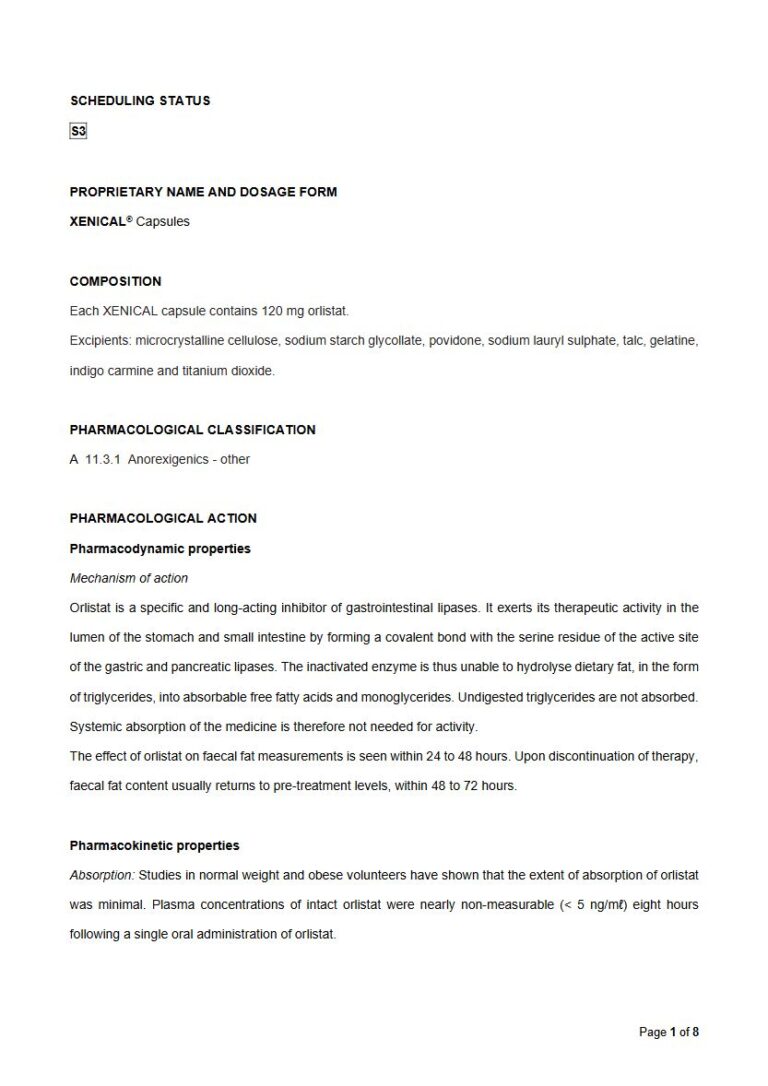
Xenical 120mg Capsules
PDF Leaflet Revision Date: 26 October 2012
Clinical Summary
Quick overview from the medicine insert
Indication
For treatment of obesity in patients with BMI u2265 30 or u2265 27 with risk factors.
Dosage (summary)
120 mg with each main meal; omit if meal is missed or fat-free.
Onset of Action / Duration
Onset: 24-48 hours, Duration: N/A
Special Populations
- Adolescents
- Elderly
- Renal impairment
- Hepatic impairment
Pregnancy & Breastfeeding
Not recommended during pregnancy and lactation.
Key Drug Interactions
- Ciclosporin
- Warfarin
- Amiodarone
- Fat soluble vitamins
Contraindications
- Chronic malabsorption syndrome
- Cholestasis
- Hypersensitivity
- Eating disorders
- Children under 12
Common side effects
- Gastrointestinal events
- Hypoglycaemia
- Headache
- Fatigue
Counselling Points
- Adhere to dietary recommendations
- Monitor fat intake
- Consider multivitamins for fat-soluble vitamins
Serious warnings
- Monitor blood glucose in diabetics
- Increased gastrointestinal events with high-fat diet
Important Disclaimer
The Xenical 120mg Capsules professional information leaflet below is the property of Pharmaco Distribution and is provided on Medinsert exactly as issued, with no.. alterations or editorial changes. We make every effort to keep content current by updating documents as soon as new versions become available. Medinsert serves as a trusted access point for healthcare professionals, but does not replace official sources or clinical judgement. For more details, please read our full disclaimer. read more>>
 Healthcare Professionals Only
This content is for registered healthcare professionals
Sign in or create a free account to read the full package insert.
Free for HPCSA-registered professionals. Powered by Medinsert.
Clinical Particulars
Section 4 of the official insert — extracted exactly as issued, no alterations
4.1 Therapeutic indications
XENICAL is indicated in conjunction with a reduced daily energy content in the diet, for the treatment of obese patients with a Body Mass Index (BMI) u2265 30 kg/m2 and overweight patients with a BMI u2265 27 kg/m2 in the presence of other risk factors. Treatment with XENICAL should be discontinued after 12 weeks if a patient has been unable to lose at least 5 % of his/her body weight as measured at the start of therapy.
4.2 Posology and method of administration
Adults: The recommended dose of XENICAL is one 120 mg capsule with each main meal (during or up to one hour after the meal). If a meal is missed or contains no fat, the dose of XENICAL should be omitted. The patient should be on a nutritionally balanced, reduced energy diet that contains approximately 30 % of calories from fat. It is recommended that the diet should be rich in fruit and vegetables. The daily intake of fat, carbohydrate and protein should be distributed over three main meals. The incidence of gastrointestinal side-effects increases the higher the fat content of the diet.
Patients should be counselled as to the possibility of gastrointestinal effects occurring and how best to handle them, such as reinforcing the diet, particularly the percentage of fat it contains. Consumption of a diet low in fat will decrease the likelihood of experiencing adverse gastrointestinal events and this may help patients to monitor and regulate their fat intake. Doses above 120 mg three times daily have not been shown to provide additional benefit. The effect of XENICAL on faecal fat measurements is seen within 24 to 48 hours. Upon discontinuation of therapy, faecal fat content usually returns to pre-treatment levels, within 48 to 72 hours. Safety and efficacy has been studied in clinical trials of up to 4 years. The effect of XENICAL in patients with hepatic and/or renal impairment, children and elderly patients has not been studied. XENICAL is not intended to be used in children under the age of 12 years.
4.3 Contraindications
XENICAL is contraindicated in patients with chronic malabsorption syndrome, cholestasis, breastfeeding and in patients with known hypersensitivity to XENICAL or any of the other components contained in the capsule. XENICAL must not be used in patients with eating disorders (e.g. bulimia) other than obesity. Not to be used in patients younger than 12 years. XENICAL should not be co-administered with ciclosporin, acarbose and amiodarone.
4.4 Special warnings and precautions for use
Blood glucose levels of patients with type 2 diabetes mellitus and oral hypoglycaemic agents should be closely monitored when taking XENICAL. Weight loss induced by XENICAL in type 2 diabetics might need adjustment in the dose of hypoglycaemic medication as hypoglycaemia may occur. In clinical trials, the decrease in bodyweight with XENICAL treatment was less in type II diabetes patients than in non-diabetic patients. Anti-diabetic treatment must be closely monitored when taking XENICAL. Patients should be advised to adhere to the dietary recommendations they are given. See DOSAGE AND DIRECTIONS FOR USE. The possibility of experiencing gastrointestinal events may increase when XENICAL is taken with a diet high in fat (e.g. in a 2 000 kcal/day diet, > 30 % of calories from fat equating to > 67 g of fat). The daily intake of fat should be distributed over three main meals. If XENICAL is taken with a meal very high in fat, the possibility of gastrointestinal adverse effects may increase.
Effects on ability to drive and use machines: No effects on the patient's ability to drive and use machines have been reported.
4.5 Interactions with other medicines
Oral anticoagulants: When warfarin or other anticoagulants are given in combination with XENICAL the INR values should be monitored more frequently. Ciclosporin: A decrease in ciclosporin plasma levels has been observed in an interaction study and also reported in several cases when XENICAL was administered concomitantly. This can lead to a decrease of immunosuppressive efficacy. Therefore the combination is not recommended. More frequent monitoring should be performed both after addition of XENICAL and upon discontinuation of XENICAL in ciclosporin treated patients. Ciclosporin plasma levels should be monitored until stabilised. Amiodarone: A decrease in plasma levels of amiodarone, when given as a single dose, has been observed in healthy volunteers who received XENICAL concomitantly; in patients receiving amiodarone treatment, the clinical relevance of this effect remains unknown. Fat soluble vitamins: Treatment with XENICAL may impair the absorption of fat-soluble vitamins (A, D, E and K). The vast majority of patients receiving up to four full years of treatment with XENICAL in clinical studies had vitamin A, D, E and K and beta-carotene levels within the normal range. However, in order to ensure adequate nutrition, patients on XENICAL should be advised to have a diet rich in fruit and vegetables and the use of multivitamin products containing fat soluble vitamins should be considered. If a multivitamin supplement is recommended, it should be taken at least two hours after the administration of XENICAL or at bedtime. Convulsions have been reported in patients treated concomitantly with XENICAL and antiepileptic medicines. A causal relationship has not been established, however, patients should be monitored for possible changes in the frequency and/or severity of convulsions. Concomitant use of XENICAL and atorvastatin or phentermine increases the gastrointestinal side-effects of XENICAL. Lack of interactions: No interactions with commonly prescribed medications such as amitriptyline, biguanides, digoxin, fibrates, fluoxetine, losartan, phenytoin, oral contraceptives, pravastatin, nifedipine GITS, nifedipine retard, sibutramine, captopril, atenolol or alcohol have been observed. The absence of these interactions has been demonstrated in specific interaction studies.
4.6 Fertility, pregnancy and lactation
XENICAL is not recommended for use in pregnancy and lactation.
4.7 Effects on ability to drive and use machines
No effects on the patient's ability to drive and use machines have been reported.
4.8 Undesirable effects
Adverse reactions to XENICAL are largely gastrointestinal in nature. The incidence of adverse events decreased with prolonged use of XENICAL. The following table of undesirable effects (first year of treatment) is based on adverse events that occurred at a frequency of > 2 % and with an incidence u2265 1 % above placebo in clinical trials of 1 and 2 years duration:
System Organ Class Adverse Event XENICAL Placebo u2022 Infections and infestations Very common ( u2265 10 %): Influenza 39,7 % 36,2 % u2022 Metabolism and nutrition disorders Very common ( u2265 10 %): Hypoglycaemia* 13,0 % 10,0 % u2022 Psychiatric disorders Common (1 - < 10 %): Anxiety 4,7 % 2,9 % u2022 Nervous system disorders Very common ( u2265 10 %): Headache 30,6 % 27,6 % u2022 Respiratory, thoracic and mediastinal disorders Very common ( u2265 10 %): Upper respiratory infection Common (1 - < 10 %): Lower respiratory infection 38,1 % 7,8 % 32,8 % 6,6 % u2022 Gastrointestinal disorders Very common ( u2265 10 %): Oily spotting from the rectum Abdominal pain/discomfort Flatus with discharge Faecal urgency Fatty/oily stool Flatulence Liquid stools Oily evacuation 26,6 % 25,5 % 23,9 % 22,1 % 20,0 % 16,0 % 15,8 % 11,9 % 1,3 % 21,4 % 1,4 % 6,7 % 2,9 % 13,1 % 11,4 % 0,8 %
System Organ Class Adverse Event XENICAL Placebo Increased defecation Common (1 - < 10 %): Soft stools Faecal incontinence Abdominal distension* Rectal pain/discomfort Tooth disorder Gingival disorder 10,8 % 8,8 % 7,7 % 6,0 % 5,2 % 4,3 % 4,1 % 4,1 % 6,8 % 0,9 % 4,0 % 4,0 % 3,1 % 2,9 % u2022 Renal and urinary disorders Common (1 - < 10 %): Urinary tract infection 7,5 % 7,3 % u2022 Reproductive system and breast disorders Common (1 - < 10 %): Menstrual irregularity 9,8 % 7,4 % u2022 General disorders and administration site conditions Common (1 - 2 % and with an incidence u2265 1 % above placebo in obese type 2 diabetic patients. The following undesirable effects are based on post-marketing spontaneous reports: u2022 Immune system disorders: Hypersensitivity (e.g. pruritus, rash, urticaria, angioedema, bronchospasm and anaphylaxis). u2022 Gastrointestinal disorders: Diverticulitis. u2022 Hepato-biliary disorders: Cholelithiasis. Hepatitis that may be serious. u2022 Skin and subcutaneous tissue disorders: Bullous eruptions. u2022 Investigations: Increase in liver transaminases and in alkaline phosphatase. Decreased prothrombin, increased INR and unbalanced anticoagulant treatment resulting in variations of haemostatic parameters have been reported in patients treated with anticoagulants in association with XENICAL. u2022 Convulsions have been reported in patients treated concomitantly with XENICAL and antiepileptic medicines. See INTERACTIONS.
4.9 Overdose
Symptomatic and supportive. Single doses of 800 mg XENICAL and multiple doses of up to 400 mg three times per day for 15 days have been studied in normal weight and obese subjects without significant adverse findings. In addition, doses of 240 mg three times per day have been administered to obese patients for 6 months. Doses above the recommended dose of 120 mg three times per day have not been found to appreciably improve efficacy and may increase gastrointestinal events. XENICAL overdose cases received during post-marketing reported either no adverse events or adverse events that are similar to those reported with the recommended dose. Should a significant overdose of XENICAL occur, it is recommended that the patient be observed for 24 hours. Based on human and animal studies, any systemic effects attributable to the lipase-inhibiting properties of XENICAL should be rapidly reversible.
