
Tagrisso 40 Mg/80 Mg Tablets
PDF Leaflet Revision Date: 07 July 2023
Clinical Summary
Quick overview from the medicine insert
Indication
Adjuvant treatment and first-line therapy for EGFR mutation-positive NSCLC.
Dosage (summary)
80 mg once daily; may reduce to 40 mg based on tolerance.
Special Populations
- Hepatic impairment
- Renal impairment
- Elderly (>65 years)
Pregnancy & Breastfeeding
Contraindicated in pregnancy and breastfeeding; use effective contraception.
Key Drug Interactions
- Strong CYP3A4 inducers
- CYP3A4 inhibitors
- BCRP and P-gp substrates
Contraindications
- Hypersensitivity
- St. John's Wort
- Pregnancy and Lactation
Common side effects
- Diarrhoea
- Rash
- Paronychia
- Dry skin
- Stomatitis
Counselling Points
- Take with or without food
- Monitor for respiratory symptoms
- Report signs of SJS
Serious warnings
- Interstitial lung disease
- QTc interval prolongation
- Stevens-Johnson syndrome
Important Disclaimer
The Tagrisso 40 Mg/80 Mg Tablets professional information leaflet below is the property of Astrazeneca Pharmaceuticals and is provided on Medinsert exactly as issued, with no.. alterations or editorial changes. We make every effort to keep content current by updating documents as soon as new versions become available. Medinsert serves as a trusted access point for healthcare professionals, but does not replace official sources or clinical judgement. For more details, please read our full disclaimer. read more>>
 Healthcare Professionals Only
This content is for registered healthcare professionals
Sign in or create a free account to read the full package insert.
Free for HPCSA-registered professionals. Powered by Medinsert.
Clinical Particulars
Section 4 of the official insert — extracted exactly as issued, no alterations
4.1 Therapeutic indications
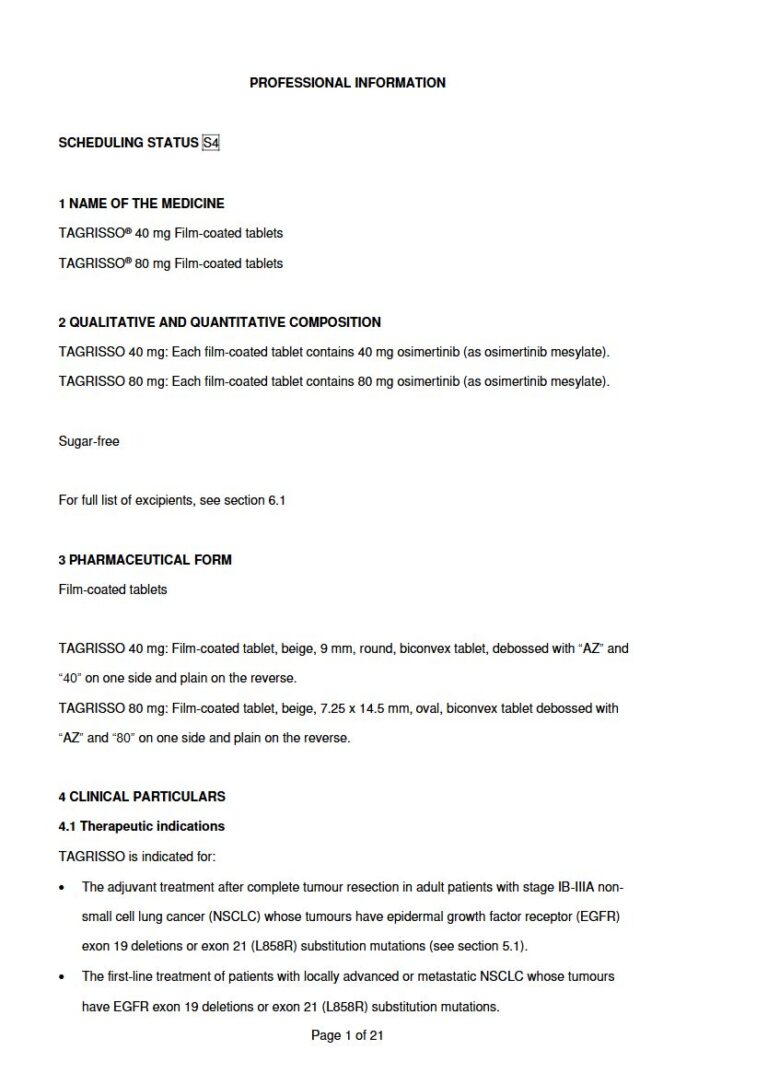
TAGRISSO is indicated for:
- The adjuvant treatment after complete tumour resection in adult patients with stage IB-IIIA non-small cell lung cancer (NSCLC) whose tumours have epidermal growth factor receptor (EGFR) exon 19 deletions or exon 21 (L858R) substitution mutations (see section 5.1).
- The first-line treatment of patients with locally advanced or metastatic NSCLC whose tumours have EGFR exon 19 deletions or exon 21 (L858R) substitution mutations.
- The treatment of adult patients with locally advanced or metastatic EGFR T790M mutation-positive NSCLC predominantly bronchial adenocarcinoma whose disease has progressed on or after EGFR TKI therapy.
4.2 Posology and method of administration
Posology
The recommended dose of TAGRISSO is 80 mg once a day. Patients in the adjuvant setting should receive treatment until disease recurrence or unacceptable toxicity. Treatment duration for more than 3 years was not studied. Patients with locally advanced or metastatic lung cancer should receive treatment until disease progression or unacceptable toxicity. Treatment with TAGRISSO should be initiated by a medical practitioner experienced in the use of anticancer therapies. When considering the use of TAGRISSO, EGFR mutation status (in tumour specimens for adjuvant treatment and tumour or plasma specimens for locally advanced or metastatic setting) should be determined using a validated test method (see section 4.4) for:
- exon 19 deletions or exon 21 (L858R) substitution mutations (for first-line treatment).
- T790M mutations (following progression on or after EGFR TKI therapy).
If a dose of TAGRISSO is missed, make up the dose unless the next dose is due within 12 hours. TAGRISSO can be taken with or without food at the same time each day.
Dose adjustments
Dosing interruption and/or dose reduction may be required based on individual safety and tolerability. If dose reduction is necessary, then the dose of TAGRISSO should be reduced to 40 mg taken once daily. Dose reduction guidelines for adverse reactions toxicities are provided in Table 1.
Special patient populations
No dosage adjustment is required due to patient age, body weight, gender, ethnicity and smoking status (see section 5.2).
Paediatric and adolescents
The safety and efficacy of TAGRISSO in children or adolescents aged less than 18 years have not been established. No data is available.
Hepatic impairment
Based on clinical studies, no dose adjustments are necessary in patients with mild hepatic impairment (Child Pugh Class A) or moderate hepatic impairment (Child Pugh Class B). Similarly, based on population pharmacokinetic (PK) analysis, no dose adjustment is recommended in patients with mild hepatic impairment (total bilirubin u2264 ULN and AST >ULN or total bilirubin between 1.0 to 0.5x ULN and any AST) or moderate hepatic impairment (total bilirubin between 1.5 to 3 times ULN and any AST). The appropriate dose of TAGRISSO has not been established in patients with severe hepatic impairment (see section 5.2).
Renal impairment
No clinical studies have been conducted to specifically evaluate the effect of renal impairment on the pharmacokinetics of TAGRISSO. No dose adjustment is recommended in patients with mild, moderate, or severe renal impairment. The safety and efficacy of TAGRISSO has not been established in patients with end-stage renal disease [Creatinine clearance (CLcr) less than 15 ml/min, calculated by the Cockcroft and Gault equation], or on dialysis. Caution should be exercised when treating patients with end-stage renal impairment (see section 5.2).
Elderly (>65 years)
Population PK analysis indicated that age did not have an impact on the exposure of TAGRISSO and hence, TAGRISSO can be used in adults without regard to age.
Method of administration
TAGRISSO is for oral use. The tablet should be swallowed whole with water. The tablet should not be crushed, split or chewed. If the patient is unable to swallow the tablet, it may first be dispersed in 50 ml of non-carbonated water. The tablet should be dropped in the water, without crushing, stirred until dispersed and immediately swallowed. An additional half a glass of water should be added to ensure that no residue remains and then immediately swallowed. No other liquids should be added.
If administration via nasogastric tube is required, the same process as above should be followed but using volumes of 15 ml for the initial dispersion and 15 ml for the residue rinses. The resulting 30 ml of liquid should be administered as per the naso-gastric tube manufactureru2019s instructions with appropriate water flushes. The dispersion and residues should be administered within 30 minutes of the addition of the tablets to water.
4.3 Contraindications
- Hypersensitivity to the active substance or to any of the excipients listed in section 6.1.
- St. Johnu2019s Wort should not be used with TAGRISSO (see section 4.5).
- Pregnancy and Lactation (see section 4.6).
4.4 Special warnings and precautions for use
Assessment of EGFR mutation status
When considering the use of TAGRISSO as adjuvant treatment after complete tumour resection in patients with NSCLC, it is important that the EGFR mutation positive status (exon 19 deletions (Ex19del) or exon 21 L858R substitution mutations (L858R)) indicates treatment eligibility. A validated test should be performed in a clinical laboratory using tumour tissue DNA from biopsy or surgical specimen.
When considering the use of TAGRISSO as a treatment for locally advanced or metastatic NSCLC, it is important that the EGFR mutation positive status is determined. A validated test should be performed in a clinical laboratory using either tumour tissue DNA or circulating tumour DNA (ctDNA) obtained from a plasma sample.
Positive determination of EGFR mutation status (exon 19 deletions or exon 21 (L858R) substitution mutations for first-line treatment or T790M mutations following progression on or after EGFR TKI therapy) (activating EGFR mutations for first-line treatment or T790M mutations following progression on or after EGFR TKI therapy) using either a tissue-based or plasma-based test indicates eligibility for treatment with TAGRISSO. However, if a plasma-based ctDNA test is used and the result is negative, it is advisable to follow-up with a tissue test wherever possible due to the potential for false negative results using a plasma-based test.
Only robust, reliable and sensitive tests with demonstrated utility for the determination of EGFR mutation status should be used.
Interstitial lung disease (ILD)
ILD or ILD-like adverse reactions were reported in 3.7 % of the 1 479 patients who received TAGRISSO in the ADAURA, FLAURA and AURA studies. Five fatal cases were reported in the locally advanced or metastatic setting. No fatal cases were reported in the adjuvant setting. The incidence of ILD was 10.9 % in patients of Japanese ethnicity, 1.6 % in patients of non-Japanese Asian ethnicity and 2.5 % in non-Asian patients. The median time to onset of ILD or ILD-like adverse reactions was 2.7 months. Withhold TAGRISSO and promptly investigate for ILD in any patient who presents with worsening of respiratory symptoms which may be indicative of ILD (e.g. dyspnoea, cough and fever). Permanently discontinue TAGRISSO if ILD is confirmed.
QTc Interval Prolongation
When possible, avoid use of TAGRISSO in patients with congenital long QT syndrome (see section 4.8). Consider periodic monitoring with electrocardiograms (ECGs) and electrolytes in patients with congestive heart failure, electrolyte abnormalities, or those who are taking medicines that are known to prolong the QTc interval. Withhold TAGRISSO in patients who develop a QTc interval greater than 500 msec on at least 2 separate ECGs until the QTc interval is less than 481 msec or recovery to baseline if the QTc interval is greater than or equal to 481 msec, then resume TAGRISSO at a reduced dose as described in Table 1. Permanently discontinue TAGRISSO in patients who develop QTc interval prolongation in combination with any of the following: Torsade de pointes, polymorphic ventricular tachycardia, signs/symptoms of serious dysrhythmia.
Changes in cardiac contractility
Across clinical trials, Left Ventricular Ejection Fraction (LVEF) decreases greater than or equal to 3.9 % and a drop to less than 50 % occurred in 3.2 % (40/1233) of patients treated with TAGRISSO who had baseline and at least one follow-up LVEF assessment. Based on the available clinical trial data, a causal relationship between effects on changes in cardiac contractility and TAGRISSO has not been established. In patients with cardiac risk factors and those with conditions that can affect LVEF, cardiac monitoring, including an assessment of LVEF at baseline and during treatment, should be considered. In patients who develop relevant cardiac signs/symptoms during treatment, cardiac monitoring including LVEF assessment should be considered. In an adjuvant placebo-controlled trial (ADAURA), 1.6 % (5/312) of patients treated with TAGRISSO and 1.5 % (5/331) of patients treated with placebo experienced LVEF decreases greater than or equal to 10 percentage points and a drop to less than 50 %.
Keratitis
Keratitis was reported in 0.7 % (n=10) of the 1 479 patients treated with TAGRISSO in the ADAURA, FLAURA and AURA studies. Patients presenting with signs and symptoms suggestive of keratitis such as acute or worsening: eye inflammation, lacrimation, light sensitivity, blurred vision, eye pain and/or red eye should be referred promptly to an ophthalmology specialist (see section 4.2).
Stevens-Johnson Syndrome
Case reports of Stevens-Johnson syndrome (SJS) have been reported rarely in association with TAGRISSO treatment. Before initiating treatment, patients should be advised of signs and symptoms of SJS. If signs and symptoms suggestive of SJS appear, TAGRISSO should be interrupted or discontinued immediately.
4.5 Interaction with other medicines and other forms of interaction
Strong CYP3A4 inducers can decrease the exposure of TAGRISSO. TAGRISSO may increase the exposure of breast cancer resistant protein (BCRP) and P-glycoprotein (P-gp) substrates.
Active substances that may increase TAGRISSO plasma concentrations
The Phase I metabolism of TAGRISSO is predominantly via CYP3A4 and CYP3A5. TAGRISSO co-administered with 200 mg itraconazole twice daily (a strong CYP3A4 inhibitor) had no clinically significant effect on the exposure of osimertinib (area under the curve (AUC) increased by 24 % (90 % CI 15; 35) and Cmax decreased -20 % (90 % CI -27; -13). Therefore, CYP3A4 inhibitors are not likely to affect the exposure of TAGRISSO.
Active substances that may decrease TAGRISSO plasma concentrations
No dose adjustments are required when TAGRISSO is used with moderate and/or weak CYP3A inducers. TAGRISSO should be avoided with strong CYP3A inducers (see section 5.2).
Effect of gastric acid reducing active substances on TAGRISSO
Co-administration of omeprazole did not result in clinically relevant changes in TAGRISSO exposures. Gastric pH modifying medicines can be concomitantly used with TAGRISSO without any restrictions.
Active substances whose plasma concentrations may be altered by TAGRISSO
TAGRISSO is a competitive inhibitor of BCRP transporter. Co-administration of TAGRISSO with rosuvastatin (sensitive BCRP substrate) increased the AUC and Cmax of rosuvastatin by 35 % (90 % CI 15, 57) and 72 % (90 % CI 46, 103), respectively. Patients taking concomitant medicines with disposition dependent upon BCRP and with narrow therapeutic index should be closely monitored for signs of changed tolerability as a result of increased exposure of the concomitant medicines whilst receiving TAGRISSO. Co-administration of TAGRISSO with simvastatin (sensitive CYP3A4 substrate) decreased the AUC and Cmax of simvastatin, -9 % (90 % CI -23; 8) and -23 % (90 % CI - 37; -6) respectively. Clinical PK interactions with CYP3A4 substrates are unlikely. In a clinical PK study, co-administration of TAGRISSO with fexofenadine (PXR/P-gp substrate) increased the AUC and Cmax of fexofenadine by 56 % (90 % CI 35, 79) and 76 % (90 % CI 49, 108) after a single dose and 27 % (90 % CI 11, 46) and 25 % (90 % CI 6, 48) at steady state, respectively. Patients taking concomitant medications with disposition dependent upon P-gp and with narrow therapeutic index (e.g. digoxin, dabigatran, aliskiren) should be closely monitored for signs of changed tolerability as a result of increased exposure of the concomitant medication whilst receiving TAGRISSO (see section 5.2).
4.6 Fertility, pregnancy and lactation
Contraception in males and females
Women of childbearing potential must avoid becoming pregnant while receiving TAGRISSO. Patients should be instructed to use effective contraception for the following periods after completion of treatment with TAGRISSO: at least 6 weeks for females and 4 months for males.
Pregnancy
TAGRISSO is contraindicated during pregnancy and in women of childbearing potential not using contraception (see section 4.3). Based on its mechanism of action and preclinical data, TAGRISSO may cause foetal harm when administered to a pregnant woman. Administration of TAGRISSO to pregnant rats was associated with embryolethality, reduced foetal growth and neonatal death at exposures similar to what is expected in humans.
Breastfeeding
Breastfeeding is contra-indicated when taking TAGRISSO. It is not known whether TAGRISSO or its metabolites are excreted in human milk. Administration to rats during early lactation was associated with adverse effects, including reduced growth rates and neonatal death.
Fertility
Results from animal studies have shown that TAGRISSO has effects on male and female reproductive organs and could impair fertility.
4.7 Effects on ability to drive and use machines
If patients experience symptoms affecting their ability to concentrate and react, it is recommended that they do not drive or use machines until the effect subsides.
4.8 Undesirable effects
a. Summary of the safety profile
Studies in EGFR mutation-positive NSCLC patients: The data described below reflect exposure to TAGRISSO in 1 479 patients with EGFR mutation positive non-small cell lung cancer. These patients received TAGRISSO at a dose of 80 mg daily in three randomised Phase 3 studies (ADAURA, adjuvant; FLAURA, first line and AURA3, second line only), two single-arm studies (AURAex and AURA2, second line or later) and one Phase 1 study (AURA1, first-line or later) (see section 5.1). Most adverse reactions were Grade 1 or 2 in severity. The most commonly reported adverse drug reactions (ADRs) were diarrhoea (47 %), rash (45 %), paronychia (33 %), dry skin (32 %) and stomatitis (24 %). Grade 3 and Grade 4 adverse reactions across the studies were 10 % and 0.1 %, respectively. In patients treated with TAGRISSO 80 mg once daily, dose reductions due to adverse reactions occurred in 3.4 % of the patients. Discontinuation due to adverse reactions was 4.8 %.
Patients with a medical history of ILD, drug-induced ILD, radiation pneumonitis that required steroid treatment, or any evidence of clinically active ILD were excluded from clinical studies. Patients with clinically important abnormalities in rhythm and conduction as measured by resting electrocardiogram (ECG) (e.g. QTc interval greater than 470 msec) were excluded from these studies. Patients were evaluated for LVEF at screening and every 12 weeks thereafter.
b. Tabulated list of adverse reactions
Adverse reactions have been assigned to the frequency categories in Table 2 where possible based on the incidence of comparable adverse event reports in a pooled dataset from the 1 479 EGFR mutation positive NSCLC patients who received TAGRISSO at a dose of 80 mg daily in the ADAURA, FLAURA, AURA3, AURAex, AURA 2 and AURA1 studies. Adverse reactions are listed according to system organ class (SOC) in MedDRA. Within each system organ class, the adverse drug reactions are ranked by frequency, with the most frequent reactions first. Within each frequency grouping, adverse drug reactions are presented in order of decreasing seriousness.
The following side effects have been reported from clinical trials. The following definitions of frequency are used: Very Common: u2265 10 % Common: u2265 1 % and < 10 % Uncommon: u2265 0.1 % and < 1 % Rare: u2265 0.01 % and < 0.1 % Very Rare: < 0.01 %
Table 2. Adverse reactions reported in ADAURA, FLAURA and AURA studies
MedDRA SOC MedDRA term CIOMS descriptor/ overall frequency (all CTCAE grades) Frequency of CTCAE grade 3 or higher
Metabolism and nutrition disorders Decreased appetite Very common (19 %) 1.1 %
Respiratory, thoracic and mediastinal disorders Epistaxis Common (5 %) 0
Interstitial lung disease Common (3.7 %) 1.1 %
Gastrointestinal disorders Diarrhoea Very common (47 %) 1.4 %
Stomatitis Very common (24 %) 0.5 %
Eye disorders Keratitis Uncommon (0.7 %) 0.1 %
Skin and subcutaneous tissue disorders Rash Very common (45 %) 0.7 %
Paronychia Very common (33 %) 0.4 %
Dry skin Very common (32 %) 0.1 %
Pruritus Very common (17 %) 0.1 %
Alopecia Common (4.6 %) 0
Urticaria Common (1.9 %) 0.1 %
Palmar-plantar erythrodysaesthesia syndrome Common (1.7 %) 0
Erythema multiforme Uncommon (0.3 %) 0
Cutaneous vasculitis Uncommon (0.3 %) 0
Stevens-Johnson syndrome Rare (0.02 %)
Investigations QTc interval prolongation Uncommon (0.8 %) (Findings based on test results presented as CTCAE grade shifts)
Leucocytes decreased Very common (65 %) 1.2 %
Lymphocytes decreased Very common (62 %) 6.1 %
Platelet count decreased Very common (53 %) 1.2 %
Neutrophils decreased Very common (33 %) 3.2 %
Blood creatinine increased Common (9 %) 0
c. Description of selected adverse reactions
Interstitial lung disease (ILD) In the ADAURA, FLAURA and AURA studies, the incidence of ILD was 11 % in patients of Japanese ethnicity, 1.6 % in patients of non-Japanese Asian ethnicity and 2.5 % in non-Asian patients. The median time to onset of ILD or ILD-like adverse reactions was 84 days (see section 4.4).
QTc prolongation Of the 1 479 patients in ADAURA, FLAURA and AURA studies treated with TAGRISSO 80 mg, 0.8 % of patients (n= 12) were found to have a QTc greater than 500 msec, and 3.1 % of patients (n= 46) had an increase from baseline QTc greater than 60 msec. A pharmacokinetic analysis with TAGRISSO predicted a concentration-dependent increase in QTc interval prolongation. No QTc-related dysrhythmias were reported in the ADAURA, FLAURA or AURA studies (see sections 4.4 and 5.1).
Gastrointestinal effects In the ADAURA, FLAURA and AURA studies, diarrhoea was reported in 47 % of patients of which 38 % were Grade 1 events, 7.9 % Grade 2 and 1.4 % were Grade 3; no Grade 4 or 5 events were reported. Dose reduction was required in 0.3 % of patients and dose interruption in 2 %. Four events (0.3 %) led to discontinuation. In ADAURA, FLAURA and AURA3 the median time to onset was 22 days, 19 days and 22 days, respectively, and the median duration of the Grade 2 events was 11 days, 19 days and 6 days, respectively.
Haematological events Early reductions in the median laboratory counts of leukocytes, lymphocytes, neutrophils and platelets have been observed in patients treated with TAGRISSO, which stabilised over time and then remained above the lower limit of normal. Adverse events of leukopenia, lymphopenia, neutropenia and thrombocytopenia have been reported, most of which were mild or moderate in severity and did not lead to dose interruptions.
Elderly In ADAURA, FLAURA and AURA3 (n= 1 479), 43 % of patients were 65 years of age and older, and 12 % were 75 years of age and older. Compared with younger subjects (<65), more subjects u226565 years old had reported adverse reactions that led to study drug dose modifications (interruptions or reductions) (16 % versus 9 %). The types of adverse events reported were similar regardless of age. Older patients reported more Grade 3 or higher adverse reactions compared to younger patients (13 % versus 8 %). No overall differences in efficacy were observed between these subjects and younger subjects. A consistent pattern in safety and efficacy results was observed in the analysis of AURA Phase 2 studies.
Low body weight Patients receiving TAGRISSO 80 mg with low body weight (< 50 kg) reported higher frequencies of Grade u22653 adverse events (46 % versus 31 %) and QTc prolongation (12 % versus 5 %) than patients with higher body weight (u2265 50 kg).
Reporting of suspected adverse reactions
Reporting suspected adverse reactions after authorisation of the medicine is important. It allows continued monitoring of the benefit/risk balance of the medicine. Health care providers are asked to report any suspected adverse reactions to SAHPRA via the u201c6.04 Adverse Drug Reactions Reporting Formu201d, found online under SAHPRAu2019s publications: https://www.sahpra.org.za/Publications/Index/8
4.9 Overdose
There is no specific treatment in the event of TAGRISSO overdose. Medical practitioner should follow general supportive measures and should treat symptomatically.
