
Oxaliplatin Pch 50 mg/100 mg/5 mg Solution
PDF Leaflet Revision Date: 12 January 2026
Clinical Summary
Quick overview from the medicine insert
Indication
Treatment of metastatic colorectal cancer and adjuvant treatment of colon cancer.
Dosage (summary)
85 mg/mu00b2 IV every 2 weeks for adults.
Special Populations
- Renal impairment
- Hepatic insufficiency
- Elderly patients
Pregnancy & Breastfeeding
Contraindicated in pregnancy and breastfeeding; teratogenic effects noted.
Key Drug Interactions
- Bone marrow depressants
- Anticoagulants
- Nephrotoxic medicines
- Ototoxic medicines
Contraindications
- Hypersensitivity to oxaliplatin
- Severe renal impairment
- Bone marrow failure
- Peripheral sensory neuropathy
- Pregnancy
- Breastfeeding
Common side effects
- Nausea
- Vomiting
- Diarrhoea
- Neutropenia
- Peripheral sensory neuropathy
Counselling Points
- Avoid cold exposure post-infusion
- Monitor for signs of infection
- Use effective contraception during treatment
Serious warnings
- Hypersensitivity reactions
- Neurological toxicity
- QT prolongation
- Rhabdomyolysis
- Gastrointestinal ulcer
Important Disclaimer
The Oxaliplatin Pch 50 mg/100 mg/5 mg Solution professional information leaflet below is the property of Teva Pharmaceuticals and is provided on Medinsert exactly as issued, with no.. alterations or editorial changes. We make every effort to keep content current by updating documents as soon as new versions become available. Medinsert serves as a trusted access point for healthcare professionals, but does not replace official sources or clinical judgement. For more details, please read our full disclaimer. read more>>
 Healthcare Professionals Only
This content is for registered healthcare professionals
Sign in or create a free account to read the full package insert.
Free for HPCSA-registered professionals. Powered by Medinsert.
Clinical Particulars
Section 4 of the official insert — extracted exactly as issued, no alterations
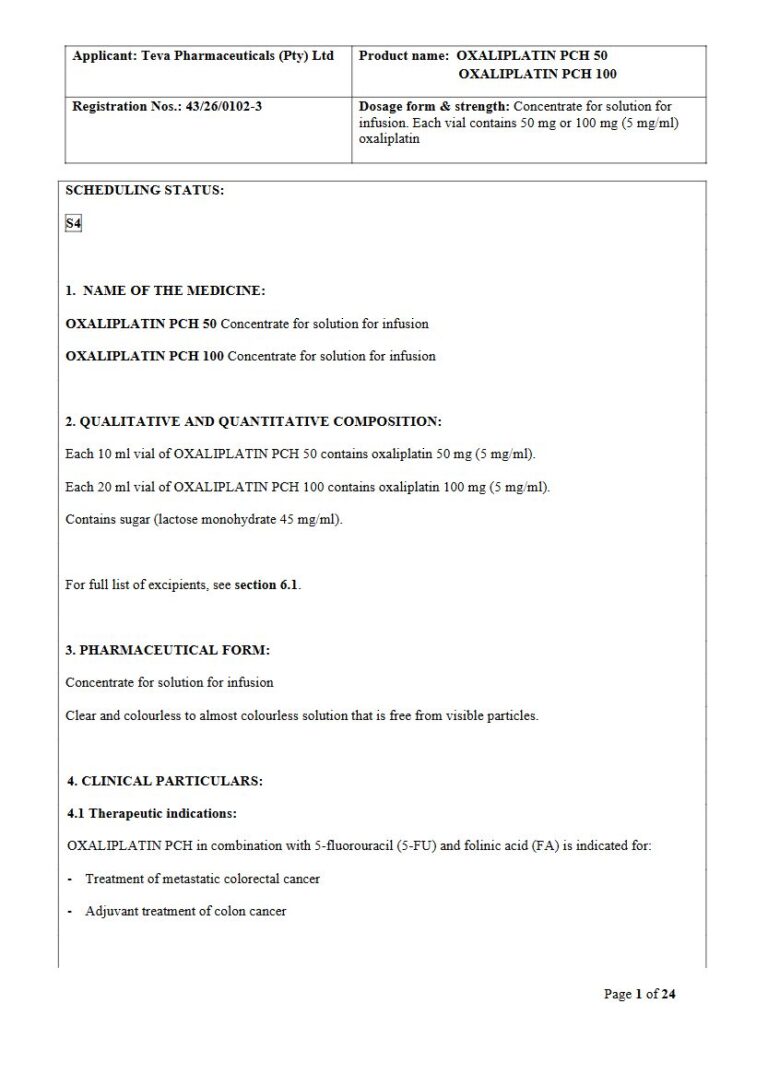
4.1 Therapeutic indications
OXALIPLATIN PCH in combination with 5-fluorouracil (5-FU) and folinic acid (FA) is indicated for:
- Treatment of metastatic colorectal cancer
- Adjuvant treatment of colon cancer
4.2 Posology and method of administration
Posology: For adults only.
Treatment of metastatic colorectal cancer: The recommended dose is 85 mg/m2 intravenously repeated every 2 weeks.
Adjuvant treatment of colon cancer: The recommended dose is 85 mg/m2 intravenously repeated every 2 weeks for 12 cycles (6 months).
Dosage given should be adjusted according to tolerability (see section 4.4)
OXALIPLATIN PCH should always be administered before fluoropyrimidines.
OXALIPLATIN PCH is administered as a 2 to 6 hour intravenous infusion in 250 to 500 ml of glucose solution.
OXALIPLATIN PCH was mainly used in combination with continuous infusion of 5-fluorouracil based regimens. For the two-weekly treatment schedule, 5-fluorouracil regimens combining bolus and continuous infusion were used.
Special populations:
Renal impairment: In patients with moderate renal impairment, treatment may be initiated at the normally recommended dose (see sections 4.4 and 4.8). There is no need for dose adjustment in patients with mild renal dysfunction.
Hepatic insufficiency: No specific dose adjustment for a patient with abnormal liver function tests is recommended.
Elderly patient: No specific dose adaptation is required for elderly patients.
Method of administration: OXALIPLATIN PCH is administered by intravenous infusion. The administration of OXALIPLATIN PCH does not require hyperhydration.
OXALIPLATIN PCH diluted in 250 to 500 ml of 5 % glucose solution, to give a concentration of not less than 0,2 mg/ml must be infused either via a peripheral vein or venous line over 2 to 6 hours.
OXALIPLATIN PCH should always precede that of 5-fluorouracil.
Instruction for use: OXALIPLATIN PCH must be diluted before use. Only the recommended diluents should be used. For instructions on dilution of the medicine before administration, see section 6.6. In the event of extravasations, administration must be discontinued immediately.
4.3 Contraindications
OXALIPLATIN PCH is contraindicated during:
- Hypersensitivity to oxaliplatin or to any of the ingredients of OXALIPLATIN PCH listed in section 6.1.
- Pregnancy and breastfeeding
- Severe renal function impairment (creatinine clearance less than 30 ml/min)
- Bone marrow failure
- Myelosuppression prior to starting treatment
- Peripheral sensory neuropathy with functional impairment before treatment
- Pulmonary toxicity
4.4 Special warnings and precautions for use
OXALIPLATIN PCH should only be used in specialised departments of oncology and administered under the supervision of an experienced oncologist.
Hypersensitivity reactions: Patients with a history of allergic reaction to platinum compounds should be monitored for allergic symptoms. In case of an anaphylactic-like reaction to OXALIPLATIN PCH, the infusion should be immediately discontinued and appropriate symptomatic treatment initiated. OXALIPLATIN PCH re-challenge is contraindicated.
Cross reactions, sometimes fatal, have been reported with all platinum compounds. Allergy/allergic reactions, occurring mainly during perfusion, sometimes fatal (frequent allergic reactions such as skin rash, in particularly urticaria, conjunctivitis, rhinitis and frequent anaphylactic reactions, including bronchospasm, angioedema, low blood pressure and anaphylactic shock) has been reported. Delayed hypersensitivity has also been reported with oxaliplatin hours or even days after the infusion.
There have been frequent reports of fever, rigors (tremors), either from infection (with or without febrile neutropenia) or possibly from immunological mechanism. The infusion must be stopped immediately, and usual local symptomatic treatment initiated, in case of OXALIPLATIN PCH extravasations. Injection site reactions including local pain, redness, swelling and thrombosis have been reported. Extravasation may also result in local pain and inflammation which may be severe and lead to complications including necrosis, especially when OXALIPLATIN PCH is infused through a peripheral vein.
Renal impairment: The primary route of OXALIPLATIN PCH elimination is renal, and clearance of OXALIPLATIN PCH is decreased in patients with renal impairment. Administration of OXALIPLATIN PCH should only be considered after suitable appraisal of the benefit/risk for the patient with moderately impaired renal function. In this situation, renal function should be closely monitored and dose adjusted according to toxicity (see section 4.2: Special populations).
Neurological symptoms: Neurological toxicity of OXALIPLATIN PCH should be carefully monitored, especially if co-administered with other medicines with specific neurological toxicity. A neurological examination should be performed before each administration and periodically thereafter. For patients who develop acute laryngo-pharyngeal dysaesthesia (see section 4.8), during or within the hours following the 2-hour infusion, the next OXALIPLATIN PCH infusion should be administered over 6 hours. To reduce such dysaesthesia, inform the patient to avoid exposure to cold and to avoid ingesting fresh/cold food and/or beverages during or within hours following OXALIPLATIN PCH administration.
Peripheral neuropathy: If neurological symptoms (paraesthesia, dysaesthesia) occur, the following recommended OXALIPLATIN PCH dosage adjustment, based on the duration and severity of the symptoms should be performed:
- If symptoms last longer than seven days and are troublesome, the subsequent OXALIPLATIN PCH dose should be reduced from 85 to 65 mg/m2 (metastatic setting) or 75 mg/m2 (adjuvant setting).
- If paraesthesia without functional impairment persists until the next cycle, the subsequent OXALIPLATIN PCH dose should be reduced from 85 to 65 mg/m2 (metastatic setting) or 75 mg/m2 (adjuvant setting).
- If paraesthesia with functional impairment persists until the next cycle, OXALIPLATIN PCH should be discontinued.
- Continuation of therapy may be considered if these symptoms improve following discontinuation of OXALIPLATIN PCH therapy.
Patients should be informed of the possibility of persistent symptoms of peripheral sensory neuropathy after the end of the treatment. Localised moderate paraesthesias or paraesthesias that may interfere with functional activities can persist for up to 3 years following treatment cessation of adjuvant setting.
Reversible Posterior Leukoencephalopathy Syndrome (RPLS): Reversible Posterior Leukoencephalopathy Syndrome (RPLS) have been reported in patients receiving oxaliplatin in combination chemotherapy. RPLS is a rare, reversible, rapidly evolving neurological condition, which can include seizure, hypertension, headache, confusion, blindness and other visual and neurological disturbances (see section 4.8). Diagnosis of RPLS is based upon confirmation by brain imaging, preferably MRI (Magnetic Resonance Imaging).
Nausea, vomiting, diarrhoea, dehydration and haematological changes: Gastrointestinal toxicity, which manifests as nausea and vomiting, warrants prophylactic and/or therapeutic anti-emetic therapy (see section 4.8). Dehydration, paralytic ileus, intestinal obstruction, hypokalaemia, metabolic acidosis, and renal impairment may be caused by severe diarrhoea/emesis particularly when combining OXALIPLATIN PCH with 5-fluorouracil.
Cases of intestinal ischemia, including fatal outcomes, have been reported with OXALIPLATIN PCH treatment. In case of intestinal ischemia, OXALIPLATIN PCH treatment should be discontinued, and appropriate measures initiated (see section 4.8).
If haematological toxicity occurs (neutrophils < 1,5 X 10⁹/l or platelets < 50 x 109/l), administration of the next course of therapy should be postponed until the haematological values return to acceptable levels. A full blood count with white cell differential should be performed prior the start of therapy and before each subsequent course. Myelosuppressive effects may be additive to those of concomitant chemotherapy. Patients with severe and persistent myelosuppression are at high risk of infectious complications. Sepsis, neutropenic sepsis and septic shock have been reported in patients treated with OXALIPLATIN PCH including fatal outcomes (see section 4.8). If any of these events occurs, OXALIPLATIN PCH should be discontinued.
Patients must be adequately informed of the risk of diarrhoea/emesis, mucositis/stomatitis and neutropenia after OXALIPLATIN PCH/5-fluorouracil administration in order to urgently contact their treating medical practitioner for appropriate treatment. The next treatment should be delayed if mucositis/stomatitis occurs with or without neutropenia, until recovery from mucositis/stomatitis to grade 1 or less and/or until the neutrophil count is u2265 1,5 x 10⁹/l.
For OXALIPLATIN PCH combined with 5-fluorouracil (with or without folinic acid), the usual dose adjustments for 5-fluorouracil associated toxicities, should apply. If grade 4 diarrhoea, grade 3-4 neutropenia (neutrophils < 1,0 x10⁹/l), febrile neutropenia (fever of unknown origin without clinically or microbiologically documented infection with an absolute neutrophil count < 1,0 x 10⁹/L, a single temperature of > 38,3 u221eC or a sustained temperature of > 38 u221eC for more than one hour), or grade 3-4 thrombocytopenia (platelets < 50 x 109/l) occur, the dose of OXALIPLATIN PCH should be reduced from 85 to 65 mg/m2 (metastatic setting) or 75 mg/m2 (adjuvant setting), in addition to any 5-fluorouracil dose reductions required.
Pulmonary: OXALIPLATIN PCH should be discontinued until further pulmonary investigations exclude an interstitial lung disease, in the case of unexplained respiratory symptoms such as non-productive cough, dyspnoea, crackles or radiological pulmonary infiltrates, (see section 4.8).
Blood disorders: Haemolytic-uraemic syndrome (HUS) is a life-threatening side effect (frequency not known). OXALIPLATIN PCH should be discontinued at the first signs of any evidence of microangiopathic haemolytic anaemia, such as rapidly falling haemoglobin with concomitant thrombocytopenia, elevation of serum bilirubin, serum creatinine, blood urea nitrogen, or LDH. Renal failure may not be reversible with discontinuation of therapy and dialysis may be required. Disseminated intravascular coagulation (DIC), including fatal outcomes, has been reported in association with OXALIPLATIN PCH treatment. If DIC is present, OXALIPLATIN PCH treatment should be discontinued and appropriate treatment should be administered (see section 4.8).
QT prolongation: QT prolongation may lead to an increased risk for ventricular dysrhythmias including Torsade de Pointes, which can be fatal (see section 4.8). The QT interval should be closely monitored on a regular basis before and after administration of OXALIPLATIN PCH. Caution should be exercised in patients with a history or a predisposition for prolongation of QT, those who are taking medicines known to prolong QT interval, and those with electrolyte disturbances such as hypokalaemia, hypocalcaemia, or hypomagnesaemia. In case of QT prolongation, OXALIPLATIN PCH treatment should be discontinued (see sections 4.5 and 4.8).
Cardiac disorders: Post-marketing reports with OXALIPLATIN PCH use include acute coronary syndrome (including myocardial infarction, coronary arteriospasm, and cardiac arrest). In case of acute coronary syndrome, treatment with OXALIPLATIN PCH may need to be interrupted or discontinued based on the individual benefit-risk assessment (see section 4.8).
Post-marketing reports with oxaliplatin include cardiac dysrhythmias (including bradydysrhythmia, tachycardia and atrial fibrillation). In case of cardiac dysrhythmias, treatment with OXALIPLATIN PCH may need to be interrupted or discontinued based on the individual benefit-risk assessment (see section 4.8).
Rhabdomyolysis: Rhabdomyolysis has been reported in patients treated with OXALIPLATIN PCH, including fatal outcomes. In case of muscle pain and swelling, in combination with weakness, fever or darkened urine, oxaliplatin treatment should be discontinued. If rhabdomyolysis is confirmed, appropriate measures should be taken. Caution is recommended if medicines associated with rhabdomyolysis are administered concomitantly with OXALIPLATIN PCH (see sections 4.5 and 4.8).
Gastrointestinal ulcer/ Gastrointestinal haemorrhage and perforation: OXALIPLATIN PCH treatment can cause gastrointestinal ulcer and potential complications, such as gastrointestinal haemorrhage and perforation, which can be fatal. In case of gastrointestinal ulcer, OXALIPLATIN PCH treatment should be discontinued, and appropriate measures taken (see section 4.8).
Hepatic: In case of abnormal liver function test results, splenomegaly or portal hypertension which does not obviously result from liver metastases, OXALIPLATIN PCH-induced hepatic vascular disorders should be considered. There have been reports of liver sinusoidal obstruction syndrome, also known as veno-occlusive disease of liver, or pathological manifestations related to such liver disorder, including peliosis hepatis, nodular regenerative hyperplasia and peri-sinusoidal fibrosis. Clinical manifestations may be portal hypertension and/or increased transaminases.
4.5 Interaction with other medicines and other forms of interaction
OXALIPLATIN PCH may have interactions with the following medicines:
- Bone marrow depressants
- Anticoagulants (prolongation of prothrombin time and of INR in patients with concomitant use)
- Nephrotoxic medicine
- Ototoxic medicine
- Vaccination with live or live attenuated vaccines should be avoided in patients receiving OXALIPLATIN PCH (see section 4.4).
The interval between discontinuation of OXALIPLATIN PCH and restoration of the patientu2019s ability to respond to the vaccine, depends on the intensity and type of immunosuppression-causing medicine used, the underlying disease, and other factors; estimates vary from 3 months to 1 year.
In patients who have received a single dose of 85 mg/m2 of OXALIPLATIN PCH, immediately before administration of 5-fluorouracil, no change in the level of exposure to 5-fluorouracil has been observed.
In vitro, no significant displacement of oxaliplatin binding to plasma proteins has been observed with the following medicines: erythromycin, salicylates, granisetron, paclitaxel and sodium valproate.
Caution is advised when OXALIPLATIN PCH treatment is co-administered with other medicines known to cause QT interval prolongation (such as quinidine, disopyramide, amiodarone, sotalol, dofetilide and ibutilide). In case of combination with such medicines, the QT interval should be closely monitored (see section 4.4).
Caution is advised when OXALIPLATIN PCH treatment is administered concomitantly with other medicines known to be associated with rhabdomyolysis (such as statins, antipsychotics, zidovudine, colchicine, selective serotonin reuptake inhibitors, and lithium) (see section 4.4).
4.6 Fertility, pregnancy and lactation
Women of childbearing potential / Contraception in males and females: Women of childbearing potential should be advised not to become pregnant. OXALIPLATIN PCH is considered teratogenic (see section 4.4). Due to the genotoxic potential of oxaliplatin (see section 4.4), women of childbearing potential should use effective contraceptive measures while being treated with OXALIPLATIN PCH and for 9 months following completion of treatment. Men are recommended to use effective contraceptive measures and to not father a child while receiving OXALIPLATIN PCH and for 6 months following completion of treatment (see section 4.4).
Pregnancy: OXALIPLATIN PCH is contraindicated during pregnancy.
Breastfeeding: OXALIPLATIN PCH is contraindicated during lactation. It is not known if OXALIPLATIN PCH or its derivatives is excreted in breastmilk. Because of the potential for serious adverse reactions in infants, breastfeeding should be discontinued before starting treatment with OXALIPLATIN PCH.
Fertility: OXALIPLATIN PCH may have anti-fertility effects (see section 4.4).
4.7 Effects on ability to drive and use machines
OXALIPLATIN PCH may cause dizziness, nausea and vomiting, vision abnormalities such as a transient loss of vision (reversible following therapy discontinuation), and other neurologic symptoms that affect gait and balance which can affect the ability to drive and use machines. Therefore, patients should be warned of the potential effect of these events on the ability to drive or use machines.
4.8 Undesirable effects
Summary of the safety profile: The most frequent adverse events of OXALIPLATIN PCH in combination with 5-fluorouracil/folinic acid (5-FU/FA) were gastrointestinal (diarrhoea, nausea, vomiting and mucositis), haematological (neutropenia, thrombocytopenia) and neurological (acute and dose cumulative peripheral sensory neuropathy). Overall, these adverse events were more frequent and severe with OXALIPLATIN PCH and 5-FU/FA combination than with 5-FU/FA alone.
Tabulated list of adverse reactions:
MedDRA system organ classes
Frequent
Less Frequent
Frequency unknown
Infections and infestations
- Infection, rhinitis, upper respiratory tract infection, neutropenic sepsis+
- Sepsis+ Septic shock*+
Blood and lymphatic system disorders
- Anaemia, neutropenia, thrombocytopenia, leukopenia, lymphopenia, febrile neutropenia
- Immuno-allergic thrombocytopenia, haemolytic anaemia**, Disseminated intravascular coagulation (DIC)+
- Haemolytic uremic syndrome, autoimmune pancytopenia, pancytopenia, secondary leukaemia*
Immune system disorders
- Allergy/allergic reaction ++
Metabolism and nutrition disorders
- Anorexia, hyperglycaemia, hypokalaemia, hyponatraemia, dehydration, hypocalcaemia
- Metabolic acidosis
Psychiatric disorders
- Depression, insomnia
- Nervousness
Nervous system disorders
- Peripheral sensory neuropathy, sensory disturbance, dysgeusia, headache, dizziness, motor neuritis, meningism
- Dysarthria, loss of deep tendon reflexes, Lhermitteu2019s sign, reversible posterior leuko-encephalopathy syndrome (RPLS, or PRES)
- Cranial nerve palsies, fasciculations, convulsion, ischemic or haemorrhagic cerebrovascular disorder*
Eye disorders
- Abnormal lacrimation, Visual acuity reduced
- conjunctivitis, visual disturbance transiently, visual field disturbances, optic neuritis, transient vision loss (reversible following therapy discontinuation)
Ear and labyrinth disorders
- Ototoxicity, deafness
Cardiac disorders
- Chest pain
- Acute coronary syndrome, including myocardial infarction and coronary arteriospasm and angina pectoris in patients treated with oxaliplatin in combination with 5-FU and bevacizumab; QT prolongation which may lead to ventricular dysrhythmias including Torsade de Pointes*+
Vascular disorders
- Haemorrhage, flushing, deep vein thrombosis, hypertension
Respiratory, thoracic and mediastinal disorders
- Dyspnoea, Interstitial lung disease, Laryngospasm, pneumonia sometimes fatal, pulmonary fibrosis and broncho-pneumonia*+
Gastrointestinal disorders
- Nausea, diarrhoea, vomiting, stomatitis/ mucositis, abdominal pain, constipation, dyspepsia, gastroesophageal reflux, gastrointestinal haemorrhage, rectal haemorrhage, flatulence
- Ileus, intestinal obstruction, colitis including clostridium difficile diarrhoea, pancreatitis
- Severe diarrhoea, oesophagitis, intestinal ischaemia+, gastrointestinal ulcer and perforation+
Hepato-biliary disorders
- Hepatic veno-occlusive disease, portal hypertension, ascites, hepatic lesions
- Focal nodular hyperplasia
Skin and subcutaneous tissue disorders
- Skin disorders, alopecia, skin exfoliation (i.e. hand & foot syndrome), rash, erythematous rash, hyperhidrosis, nail disorder
- Hypersensitivity vasculitis*
Musculo-skeletal and connective tissue disorders
- Back pain, arthralgia, bone pain
- Rhabdomyolysis*
Renal and urinary disorders
- Haematuria, dysuria, abnormal micturition frequency
- Interstitial nephritis and acute renal failure
General disorders and administration site conditions
- Fatigue, fever+++, asthenia, pain, injection site reaction++++
Investigations
- Increase hepatic enzyme, increased blood alkaline phosphatase, increased blood bilirubin, increased blood lactate dehydrogenase (LDH), increased weight (adjuvant setting), increased blood creatinine, decreased weight (metastatic setting)
Injury, poisoning and procedural complications
- Fall
* post-marketing experience.
** Microangiopathic haemolytic anaemia associated with haemolytic uraemic syndrome (HUS) or Coombs positive haemolytic anaemia (see section 4.4).
+ including fatal outcomes.
++ Very frequent allergies/allergic reactions, occurring mainly during infusion, sometimes fatal. Frequent allergic reactions include skin rash, particularly urticaria, conjunctivitis and rhinitis. Frequent anaphylactic or anaphylactoid reactions, include bronchospasm, angioedema, hypotension, sensation of chest pain and anaphylactic shock. Delayed hypersensitivity has also been reported with OXALIPLATIN PCH hours or even days after the infusion.
+++ Very frequent fever, rigors (tremors), either from infection (with or without febrile neutropenia) or possibly from immunological mechanism.
++++ Injection site reactions including local pain, redness, swelling and thrombosis have been reported. Extravasation may also result in local pain and inflammation which may be severe and lead to complications including necrosis, especially when oxaliplatin is infused through a peripheral vein (see section 4.4).
Description of selected adverse reactions: Dysaesthesia/paraesthesia of extremities and peripheral neuropathy: The dose limiting toxicity of OXALIPLATIN PCH is neurological (see section 4.4). It involves a sensory peripheral neuropathy characterised by dysaesthesia and/or paraesthesia of the extremities with or without cramps, often triggered by the cold. These symptoms occur in up to 95 % of patients treated. The duration of these symptoms, which usually regress between courses of OXALIPLATIN PCH treatment, increases with the number of treatment cycles.
The onset of pain and/or a functional disorder are indications, depending on the duration of the symptoms, for dose adjustment, or even OXALIPLATIN PCH treatment discontinuation.
This functional disorder includes difficulties in executing delicate movements and is a possible consequence of sensory impairment. The risk of occurrence of persistent symptoms for a cumulative dose of 850 mg/m2 (10 cycles) is approximately 10 % and 20 % for a cumulative dose of 1 020 mg/m2 (12 cycles). In the majority of the cases, the neurological signs and symptoms improve or totally recover when OXALIPLATIN PCH treatment is discontinued. In the adjuvant setting of colon cancer, 6 months after treatment cessation, 87 % of patients had no or mild symptoms. After up to 3 years of follow up, about 3 % of patients presented either with persisting localised paraesthesias of moderate intensity (2,3 %) or with paraesthesias that may interfere with functional activities (0,5 %).
Acute neurosensory manifestations: Acute neurosensory manifestations have been reported. They start within hours of administration and often occur on exposure to cold. They usually present as transient paraesthesia, dysaesthesia and hypoaesthesia. An acute syndrome of pharyngolaryngeal dysaesthesia occurs in 1 % to 2 % of patients and is characterised by subjective sensations of dysphagia or dyspnoea/feeling of suffocation, without any objective evidence of respiratory distress (no cyanosis or hypoxia) or of laryngospasm or bronchospasm (no stridor or wheezing). Although antihistamines and bronchodilators have been administered in such cases, the symptoms are rapidly reversible even in the absence of treatment. Prolongation of the infusion helps to reduce the incidence of this syndrome. Occasionally other symptoms that have been observed include jaw spasm/muscle spasms/muscle contractions- involuntary/muscle twitching/myoclonus, co-ordination abnormal/gait abnormal/ataxia/balance disorders, throat or chest tightness/pressure/discomfort/pain. In addition, cranial nerve dysfunctions may be associated, or also occur as an isolated event such as ptosis, diplopia, aphonia/dysphonia/hoarseness, sometimes described as vocal cord paralysis, abnormal tongue sensation or dysarthria, sometimes described as aphasia, trigeminal neuralgia/facial pain/eye pain, decrease in visual acuity, visual field disorders.
4.9 Overdose
There is no known specific antidote for OXALIPLATIN PCH. The management of overdosage is symptomatic and supportive.
