
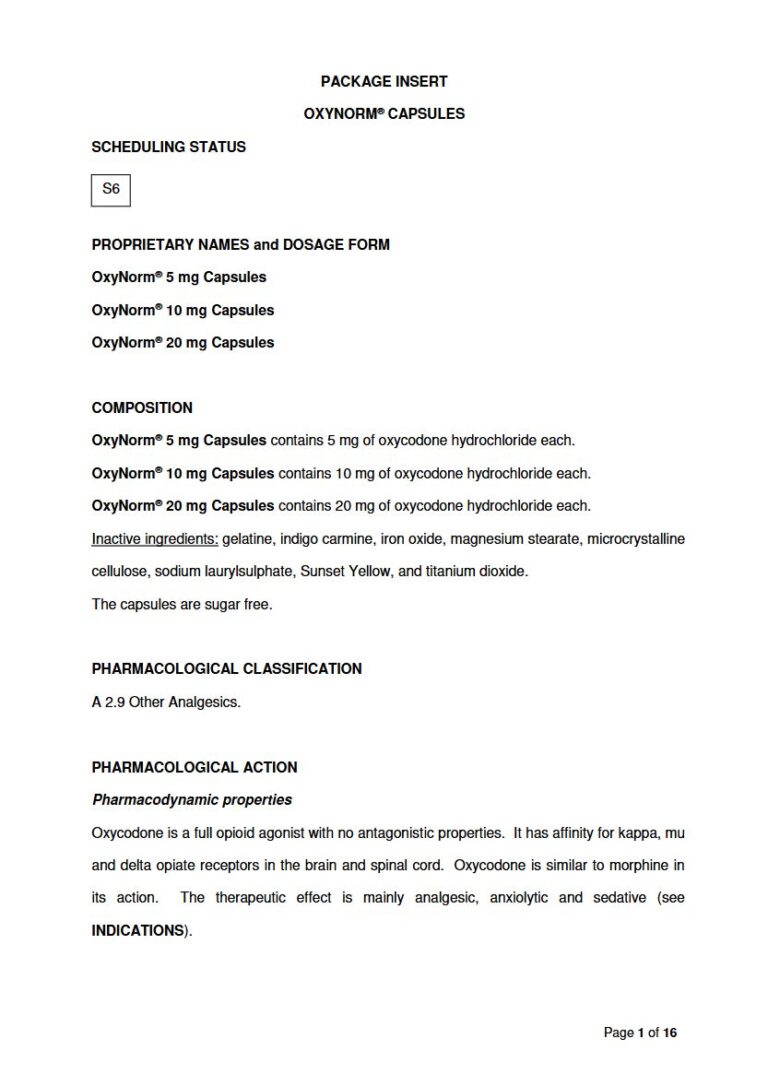
Oxynorm 5mg / 10mg / 20mg Capsules
PDF Leaflet Revision Date: 26 November 2019
Clinical Summary
Quick overview from the medicine insert
Indication
Moderate to severe pain management.
Dosage (summary)
5 mg every 4-6 hours, titrate as needed.
Special Populations
- Elderly
- Renal impairment
- Hepatic impairment
Pregnancy & Breastfeeding
Contraindicated in pregnancy and breastfeeding; may cause respiratory depression in newborns.
Key Drug Interactions
- CYP450 inhibitors
- Monoamine oxidase inhibitors
- Alcohol
- Other opioids
Contraindications
- Hypersensitivity to oxycodone
- Severe respiratory depression
- Pregnancy
- Breastfeeding
Common side effects
- Constipation
- Nausea
- Vomiting
- Dizziness
- Sedation
Counselling Points
- Do not chew or crush capsules
- Monitor for signs of dependence
- Taper off to avoid withdrawal symptoms
Serious warnings
- Risk of respiratory depression
- Potential for abuse and dependence
- Caution in head injury
Important Disclaimer
The Oxynorm 5mg / 10mg / 20mg Capsules professional information leaflet below is the property of Mundipharma and is provided on Medinsert exactly as issued, with no.. alterations or editorial changes. We make every effort to keep content current by updating documents as soon as new versions become available. Medinsert serves as a trusted access point for healthcare professionals, but does not replace official sources or clinical judgement. For more details, please read our full disclaimer. read more>>
 Healthcare Professionals Only
This content is for registered healthcare professionals
Sign in or create a free account to read the full package insert.
Free for HPCSA-registered professionals. Powered by Medinsert.
Clinical Particulars
Section 4 of the official insert — extracted exactly as issued, no alterations
4.1 Therapeutic indications
OxyNorm u00ae Capsules are indicated for the treatment of moderate to severe pain in patients with cancer and post-operative pain after gastrointestinal function has returned. OxyNorm u00ae Capsules are indicated for the treatment of severe pain requiring the use of a strong opioid analgesic.
4.2 Posology and method of administration
The need for continued treatment should be assessed at regular intervals. Elderly and adults over 18 years: OxyNorm u00ae Capsules should be taken at 4-6 hourly intervals. The dosage is dependent on the severity of the pain and the patientu2019s previous history of analgesic requirements. Increasing severity of pain will require an increased dose of OxyNorm u00ae Capsules. The correct dosage for any individual patient is that which controls the pain and is well tolerated throughout the dosing period. Patients should be titrated to pain relief unless unmanageable adverse medicine reactions prevent this. The usual starting dose for opioid nau00efve patients or patients presenting with severe pain uncontrolled by weaker opioids is 5 mg, 4-6 hourly. The dose should then be carefully titrated, as frequently as once a day, if necessary, to achieve pain relief. The majority of patients will not require a daily dose greater than 400 mg. However, a few patients may require higher doses. Patients receiving oral morphine before OxyNorm u00ae Capsules therapy should have their daily dose based on the following ratio: 10 mg of oral oxycodone is equivalent to 20 mg of oral morphine. It must be emphasised that this is a guide to the dose of OxyNorm u00ae Capsules required. Inter-patient variability requires that each patient is carefully titrated to the appropriate dose. Controlled pharmacokinetic studies in elderly patients (aged over 65 years) have shown that compared with younger adults, the clearance of OxyNorm u00ae Capsules is only slightly reduced. No untoward adverse medicine reactions were seen based on age, therefore adult doses and dosage intervals are appropriate (see Pharmacokinetic properties under PHARMACOLOGICAL ACTION). Children under 18 years: The safety and efficacy of OxyNorm u00ae Capsules in patients under 18 years of age has not been established. Adults with mild to moderate renal impairment and mild hepatic impairment: The plasma concentration in this population may be increased. Therefore dose initiation should follow a conservative approach. Opioid nau00efve patients should be started on OxyNorm u00ae 5 mg Capsules 6 hourly. Cessation of therapy: When a patient no longer requires therapy with OxyNorm u00ae Capsules, it may be advisable to taper the dose gradually to prevent symptoms of withdrawal (see also WARNINGS AND SPECIAL PRECAUTIONS as well as SIDE EFFECTS).
4.3 Contraindications
OxyNorm u00ae Capsules are contraindicated in patients with known hypersensitivity to oxycodone or to any of the excipients (see COMPOSITION) or in any situation where opioids are contraindicated. OxyNorm u00ae Capsules are contraindicated in patients who are pregnant or breastfeeding; or patients on concurrent administration of monoamine oxidase inhibitors or within 2 weeks of discontinuation of their use. OxyNorm u00ae Capsules are contraindicated in patients suffering from:
- severe respiratory depression with hypoxia and/or hypercapnia;
- head injury;
- paralytic ileus;
- acute abdomen;
- delayed gastric emptying;
- severe chronic obstructive lung disease;
- cor pulmonale;
- chronic bronchial asthma;
- moderate to severe hepatic impairment;
- severe renal impairment (creatinine clearance < 10 ml/min);
- chronic constipation.
4.4 Special warnings and precautions for use
OxyNorm u00ae Capsules should be swallowed whole and not chewed or crushed. Abuse of oral dosage forms by parenteral administration can be expected to result in other serious adverse events that might be fatal. The major risk of all opioid excess is respiratory depression. A reduction in dosage may be advisable in hypothyroidism. OxyNorm u00ae Capsules should be used with caution in patients with:
- opioid dependence;
- head injury (due to risk of increased intracranial pressure);
- hypotension;
- hypovolaemia;
- toxic psychosis;
- disease of the biliary tract;
- pancreatitis;
- inflammatory bowel disorders;
- prostatic hypertrophy;
- adrenocortical insufficiency, Addisonu2019s disease;
- myxoedema;
- alcoholism;
- delirium tremens;
- impaired renal or hepatic function;
- severe impaired pulmonary function;
- debilitated elderly and infirm patients.
OxyNorm u00ae Capsules should not be used where there is a possibility of paralytic ileus occurring. Should paralytic ileus occur, or be suspected during use, OxyNorm u00ae Capsules should be discontinued immediately. Patients who are to undergo cordotomy or other pain relieving surgical procedures should not receive OxyNorm u00ae Capsules for 6 hours before surgery or within the first 12 u2013 24 hours post-operatively. If further treatment with OxyNorm u00ae Capsules is then indicated, the dosage should be adjusted to the new post-operative requirement. OxyNorm u00ae Capsules should be used with caution following abdominal surgery as opioids are known to impair intestinal motility and should not be used until the physician is assured of normal bowel function. For patients who suffer from chronic non-malignant pain, opioids should be used as part of a comprehensive treatment programme involving other medications and treatment modalities.
A crucial part of the assessment of a patient with chronic non-malignant pain is the patientu2019s addiction and substance abuse history. OxyNorm u00ae Capsules should be used with particular care in patients with a history of alcohol and drug abuse. If opioid treatment is considered appropriate for the patient, then the main aim of treatment is not to minimise the dose, but rather to achieve a dose that provides adequate pain relief with minimum side effects. There must be frequent contact between the physician and the patient so that the dosage adjustments can be made. It is strongly suggested that the physician defines treatment outcomes in accordance with pain management guidelines. The physician and patient can then agree to discontinue treatment if these objectives are not met. Tolerance and dependence: The patient may develop tolerance to the medicine with chronic use which will require progressively higher doses to maintain pain control. Prolonged use of OxyNorm u00ae Capsules may also lead to physical dependence and a withdrawal syndrome may occur upon abrupt cessation of therapy. When a patient no longer requires therapy with OxyNorm u00ae Capsules, it may be advisable to taper the dose gradually to prevent symptoms of withdrawal. OxyNorm u00ae Capsules has an abuse liability similar to other strong opioids and may be sought and abused by people with latent or manifest addiction disorders. There is potential for development of psychological dependence (addiction) to opioid analgesics, including oxycodone. Hyperalgesia that will not respond to a further dose increase of oxycodone may occur in particular in high doses. An oxycodone dose reduction or change in opioid may be required. For more information on tolerance and dependence please refer to DOSAGE AND DIRECTIONS FOR USE as well as SIDE EFFECTS.
4.6 Fertility, pregnancy and lactation
OxyNorm u00ae Capsules are not recommended for the use in pregnancy nor during labour (see CONTRAINDICATIONS). Infants born to mothers who have received opioids during pregnancy should be monitored for respiratory depression (see CONTRAINDICATIONS). Prolonged use of oxycodone during pregnancy can result in neonatal opioid withdrawal syndrome. Oxycodone may be secreted in breast milk and may cause respiratory depression in the newborn. OxyNorm u00ae Capsules should therefore not be used by breastfeeding mothers.
4.7 Effects on ability to drive and use machines
OxyNorm u00ae Capsules may modify patientsu2019 reactions to a varying extent depending on the dosage and individual susceptibility. Therefore, patients should not drive or operate machinery if affected.
4.8 Undesirable effects
Adverse medicine reactions are typical of full opioid agonists. Tolerance and dependence may also occur (see WARNINGS AND SPECIAL PRECAUTIONS). Constipation may be prevented with an appropriate laxative. If nausea and vomiting are troublesome, OxyNorm u00ae Capsules may be combined with an anti-emetic. The reactions are listed as MeDRA preferred term by system organ class and absolute frequency.
Body System Frequency of Occurrence
- Very Common > 10 %
- Common > 1 % and < 10 %
- Uncommon > 0,1 % and < 1 %
- Rare > 0,01 % and < 0,1 %
- Very Rare < 0,01 %
- Not known (cannot be estimated from the available data)
Gastrointestinal disorders: constipation, nausea, vomiting, abdominal pain, diarrhoea, dry mouth, hiccups, dyspepsia, mouth ulceration, stomatitis, flatulence, dysphagia, ileus, eructation, melaena, tooth disorder, gingival bleeding, dental caries.
Hepatobiliary disorders: biliary colic, hepatic enzymes increased, cholestasis.
Metabolism and nutrition disorders: decreased appetite, dehydration, increased appetite.
Nervous system disorders: headache, dizziness, sedation, somnolence, tremor, lethargy, concentration impaired, migraine, dysgeusia, hypertonia, muscle contractions involuntary, hypo-aesthesia, abnormal coordination, syncope, paraesthesia, amnesia, convulsion, speech disorder, hyperalgesia.
Psychiatric disorders: altered mood and personality change (e.g. anxiety, depression), decreased activity, restlessness, psychomotor hyperactivity, nervousness, insomnia, thinking abnormal, confusion al state, perception disturbances (e.g. hallucination, derealisation), libido decreased, affect lability, agitation, euphoric mood, medicine dependence, aggression.
Infections and infestations: herpes simplex.
Immune system disorders: hypersensitivity, anaphylactic reaction, anaphylactoid reaction.
Eye disorders: miosis, visual impairment.
Ear and labyrinth disorders: hearing impaired, vertigo.
Renal and urinary disorders: dysuria, micturition urgency, urinary retention.
Reproductive system and breast disorders: erectile dysfunction, hypogonadism, amenorrhoea.
Cardiac disorders: tachycardia, palpitations (in the context of withdrawal syndrome).
Vascular disorders: vasodilatation, hypotension, orthostatic hypotension.
Respiratory, thoracic and mediastinal disorders: dyspnoea, dysphonia, cough, respiratory depression.
Skin and subcutaneous tissue disorders: pruritus, skin reactions / rash, hyperhidrosis, dry skin, urticaria.
Injury, poisoning and procedural complications: injury from accidents.
General disorders and administration site conditions: asthenia, fatigue, chills, medicine withdrawal syndrome, pain (e.g. chest pain), malaise, oedema, oedema peripheral, thirst, medicine tolerance, weight increase, weight decrease, medicine withdrawal syndrome, neonatal.
4.9 Overdose
Signs of oxycodone toxicity and overdosage are miosis, respiratory depression, pulmonary oedema and hypotension. Circulatory failure and somnolence progressing to stupor or deepening coma, hypotonia, bradycardia and death may occur in more severe cases. Treatment of overdosage: primary attention should be given to the establishment of a patent airway and the institution of assisted or controlled ventilation. In case of massive overdosage (if the patient is in a coma or respiratory depression is present), administer naloxone intravenously (0,4 to 2 mg for an adult and 0,01 mg/kg body weight for children). Repeat the dose at 2 minute intervals if there is no response. If repeat doses are required, then an infusion of 60 % of the initial dose per hour is a useful starting point. A solution of 10 mg made up in 50 ml dextrose will produce 200 micrograms/ml for infusion using an IV pump (dose adjusted to the clinical response). Infusions are not a substitute for frequent review of the patientu2019s clinical state. Intramuscular naloxone is an alternative in the event that IV access is not possible. As the duration of action of naloxone is relatively short, the patient must be carefully monitored until spontaneous respiration is reliably re-established. Naloxone is a competitive antagonist and large doses (4 mg) may be required in seriously poisoned patients. For a less severe overdosage, administer naloxone 0,2 mg intravenously followed by increments of 0,1 mg every 2 minutes if required. Naloxone should be administered in the absence of clinically significant respiratory or circulatory depression secondary to oxycodone overdosage. Naloxone should be administered cautiously to persons who are known, or suspected, to be physically dependent on oxycodone. In such cases, an abrupt or complete reversal of opioid effects may precipitate pain and an acute withdrawal syndrome. Additional/other considerations: Consider activated charcoal (50 g for adults, 10-15 g for children), if a substantial amount has been ingested within 1 hour, provided the airway can be protected. It may be reasonable to assume that late administration of activated charcoal may be beneficial for prolonged release preparations, however there is no evidence to support this.
