
Oxymetazoline Cipla 0,025 / 0,05 Metered nasal spray
PDF Leaflet Revision Date: 27 March 2025
Clinical Summary
Quick overview from the medicine insert
Indication
Relief of nasal congestion due to common cold, sinusitis, allergic rhinitis, and as adjunctive treatment in otitis media.
Dosage (summary)
Adults: 1-2 sprays into each nostril 2-3 times a day; Children (6+ years): 1 spray into each nostril 2-3 times a day; Children (up to 6 years): 2-3 sprays into each nostril 2-3 times a day.
Onset of Action / Duration
Onset: a few minutes, Duration: up to 12 hours
Special Populations
- Children under 6 years
- Patients with severe cardiovascular diseases
- Patients with hepatic disorders
- Patients with renal disorders
Pregnancy & Breastfeeding
Use only after consulting a medical practitioner during pregnancy and breastfeeding.
Key Drug Interactions
- MAO inhibitors
- Tricyclic antidepressants
- Beta-blockers
- Cardiac glycosides
- Ergot alkaloids
Contraindications
- Hypersensitivity to oxymetazoline
- Rhinitis sicca
- Recent nasal surgery
- Concomitant use of other sympathomimetics
- Phaeochromocytoma
- Children under 6 years
Common side effects
- Nasal irritation
- Headache
- Dizziness
- Nervousness
- Palpitations
Counselling Points
- Do not exceed recommended dosage
- Use for a maximum of 5 consecutive days
- Consult a healthcare provider if symptoms persist
- Avoid contact with eyes
Serious warnings
- Risk of rebound congestion with prolonged use
- Use with caution in patients with hypertension
- Potential for systemic effects with overdose
Important Disclaimer
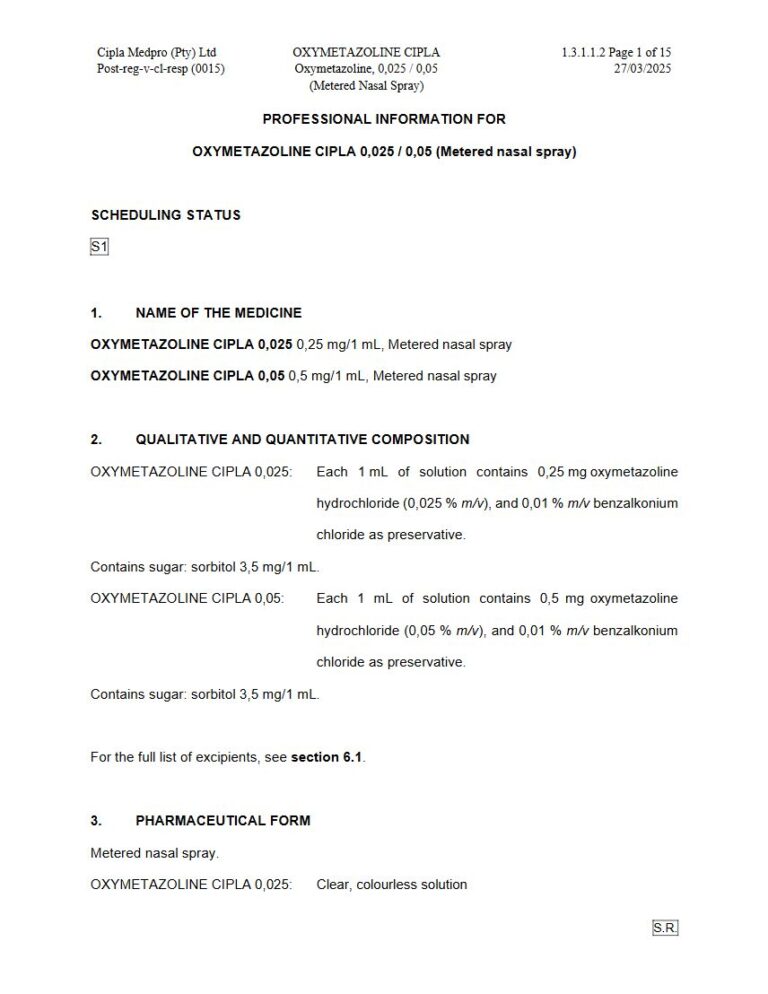
The Oxymetazoline Cipla 0,025 / 0,05 Metered nasal spray professional information leaflet below is the property of Cipla Medpro and is provided on Medinsert exactly as issued, with no.. alterations or editorial changes. We make every effort to keep content current by updating documents as soon as new versions become available. Medinsert serves as a trusted access point for healthcare professionals, but does not replace official sources or clinical judgement. For more details, please read our full disclaimer. read more>>
 Healthcare Professionals Only
This content is for registered healthcare professionals
Sign in or create a free account to read the full package insert.
Free for HPCSA-registered professionals. Powered by Medinsert.
Clinical Particulars
Section 4 of the official insert — extracted exactly as issued, no alterations
4.1 Therapeutic indications
OXYMETAZOLINE CIPLA is indicated:
- For the relief of nasal congestion due to:
- The common cold (acute rhinitis).
- Sinusitis.
- Allergic rhinitis.
- Hay-fever.
- As adjunctive treatment in otitis media (middle ear infection).
4.2 Posology and method of administration
Posology
OXYMETAZOLINE CIPLA 0,05 metered spray is indicated for adults and children over 6 years. OXYMETAZOLINE CIPLA 0,025 metered spray is indicated for children up to the age of 6 years. OXYMETAZOLINE CIPLA should not be used for a period longer than five days (see section 4.4). Do not exceed the recommended dosage. If symptoms persist, consult a health care provider.
Dosage:
OXYMETAZOLINE CIPLA 0,05:
Adults: 1 - 2 sprays into each nostril 2 u2013 3 times a day
Paediatric population
OXYMETAZOLINE CIPLA 0,05: Children over 6 years: 1 spray into each nostril 2 - 3 times a day. OXYMETAZOLINE CIPLA 0,05 is contraindicated in children below the age of 6 years (see section 4.3). The single dose given for OXYMETAZOLINE CIPLA 0,05 must not be administered more than 3 times a day.
OXYMETAZOLINE CIPLA 0,025: Children up to the age of 6 years: 2 to 3 sprays into each nostril 2 u2013 3 times a day.
Method of administration
Metered nasal spray for nasal use. For best results keep both the head and spray bottle in an upright position. Remove the cap by pulling and insert the nozzle of the spray loosely into the nostril with the middle and forefinger around the bottom of the nozzle and the thumb on the base of the bottle. Depress the spray mechanism (as shown in the diagram) thus producing a fine mist. Sniff in to ensure an even distribution of the spray. Withdraw from nostril and release the spray mechanism. Repeat for the other nostril.
Prevention of contamination:
- Patients should be instructed to wipe the tip of the applicator with a clean, damp tissue and replace the cap directly after use.
- Each bottle of OXYMETAZOLINE CIPLA should not be used by more than one patient.
4.3 Contraindications
OXYMETAZOLINE CIPLA is contraindicated in:
- Patients with known hypersensitivity to oxymetazoline hydrochloride, benzalkonium chloride, or to any of the other ingredients in OXYMETAZOLINE CIPLA (see section 6.1).
- Patients with rhinitis sicca (inflammation of the skin and mucosa of the nasal vestibule and encrustation).
- Patients who underwent trans-sphenoidal hypophysectomy or nasal surgery exposing the dura mater.
- Patients concomitantly using other sympathomimetic decongestants.
- Phaeochromocytoma.
- OXYMETAZOLINE CIPLA 0,05 is contraindicated in children below six years of age.
- OXYMETAZOLINE CIPLA is considered unsafe in porphyria and has been associated with acute attacks of porphyria.
4.4 Special warnings and precautions for use
In the following cases, OXYMETAZOLINE CIPLA may only be used after carefully weighing the risk-to-benefit ratio:
- Patients treated with monoamine oxidase inhibitors or, have taken MAOIs in the previous two weeks or, tricyclic antidepressants, and other medicines such as stated in section 4.5.
- Medicines potentially increasing blood pressure.
- Increased intraocular pressure, especially narrow-angle glaucoma.
- Severe cardiovascular diseases (e.g. coronary heart disease, angina, hypertension, cardiac asthma).
- Metabolic disorders (e.g. hyperthyroidism, diabetes mellitus).
- Hyperplasia of the prostate.
- Hepatic disorders.
- Renal disorders.
- Occlusive vascular disease.
- Do not exceed the recommended dose.
- If symptoms worsen or do not improve after 3 days, a medical practitioner should re-evaluate the clinical situation.
- OXYMETAZOLINE CIPLA should be used for a maximum of 5 consecutive days to avoid a rebound-effect and medicine-induced rhinitis.
- Long-term use and overdosage of OXYMETAZOLINE CIPLA should be avoided.
- The efficacy OXYMETAZOLINE CIPLA may be reduced (tachyphylaxis) with long-term use or overdose. This may lead to use of higher doses or to more frequent usage which, in turn, can result in permanent use. If long-term use or overdose occurs, treatment should be discontinued immediately.
- Continuous use may cause nasal congestion due to reactive hyperaemia of the nasal mucosa (rebound effect) and chronic swelling of the nasal mucosa (rhinitis medicamentosa) as well as mucosal atrophy or rhinitis sicca. Rebound effects and tachyphylaxis should stop once use of OXYMETAZOLINE CIPLA is discontinued.
- OXYMETAZOLINE CIPLA contains benzalkonium chloride, its long-term use may cause oedema of the nasal mucosa.
- Medical supervision is indicated in patients with chronic rhinitis.
- Dosages higher than recommended may only be used under medical supervision.
- Patients should be advised to stop using OXYMETAZOLINE CIPLA if any of the following occur and to contact their medical practitioner:
- Hallucinations.
- Restlessness.
- Sleep disturbances.
- Patients should take care to keep the mist away from the eyes.
- Children may be especially prone to systemic absorption of oxymetazoline with resulting adverse effects.
4.5 Interaction with other medicines and other forms of interaction
The concomitant use of OXYMETAZOLINE CIPLA and certain mood-stimulating medicines with hypertensive effect (e.g. MAO inhibitors and tricyclic antidepressants) may lead to an increase in blood pressure or hypertensive crisis due to their cardiovascular activity.
The efficacy of beta-blocking medicines such as methyldopa, bethanidine, debrisoquine and guanethidine or other anti-hypertensive medicines may be reduced with concomitant use of OXYMETAZOLINE CIPLA.
Possible additive cardiovascular toxicity may occur when sympathomimetics are given with antiparkinsonian medicines, such as bromocriptine.
There is an increased risk of dysrhythmias when cardiac glycosides (e.g. digoxin) are given with sympathomimetics, such as OXYMETAZOLINE CIPLA.
There is an increased risk of ergotism when ergot alkaloids (ergotamine and methysergide) are given with sympathomimetics, such as OXYMETAZOLINE CIPLA.
4.6 Fertility, pregnancy and lactation
Pregnancy and breastfeeding
OXYMETAZOLINE CIPLA should only be used after the consultation with a medical practitioner during pregnancy and breastfeeding. The recommended dosage must not be exceeded.
Fertility
No data are available on the effects of OXYMETAZOLINE CIPLA on human fertility. OXYMETAZOLINE CIPLA 0,025 is indicated for paediatric use only.
4.7 Effects on ability to drive and use machines
Systemic effects with involvement of the cardiovascular or central nervous system cannot be excluded after prolonged administration of OXYMETAZOLINE CIPLA or intake of oxymetazoline containing cold remedies in doses higher than recommended. In these cases, the ability to drive a vehicle or operate machinery can be impaired. OXYMETAZOLINE CIPLA may have influence on driving and operating machines considering reported side effects such as insomnia, nervousness, anxiety, restlessness, irritability, tremor, headache or light-headedness, dizziness, somnolence, sedation, hallucinations, convulsions, rebound hypotension and hypertension.
4.8 Undesirable effects
Tabulated list of adverse reactions
MedDRA system organ class
Frequency
Side effects
Immune system disorders
Frequency unknown
Hypersensitivity reactions (angioedema, rash, pruritus).
Psychiatric disorders
Less frequent
Nervousness, anxiety, irritability.
Frequency unknown
Insomnia, restlessness.
Nervous system disorders
Less frequent
Tremor, headache or light-headedness, nervousness, anxiety, irritability.
Frequency unknown
Dizziness, somnolence, sedation, hallucinations, convulsions.
Eye disorders
Less frequent
Eye irritation, dryness, discomfort or redness.
Cardiac disorders
Frequency unknown
Palpitations, tachycardia.
Vascular disorders
Frequency unknown
Rebound hypotension, hypertension (increased blood pressure).
Respiratory, thoracic and mediastinal disorders
Frequent
Aqueous nasal secretions, crusted nose.
Less frequent
Discomfort, irritation, or dryness of the nose, mouth or throat, sneezing.
Rebound congestion (increase in runny or stuffy nose).
Frequency unknown
Local stinging or burning, transient irritation, rebound congestion after frequent or prolonged use, nasal discomfort (burning of the nasal mucosa), nasal dryness, sneezing, after the effect has worn off increased swelling of the mucosa (reactive hyperaemia), epistaxis.
General disorders and administration site conditions
Less frequent
Nausea.
Frequency unknown
Fatigue, tachyphylaxis (associated with long-term use or overdose).
Systemic effects have occurred after local administration. If unexpected side effects appear, a medical practitioner should be consulted immediately.
Reporting of suspected adverse reactions
Reporting suspected adverse reactions after authorisation of the medicine is important. It allows continued monitoring of the benefit/risk balance of the medicine. Health care providers are requested to report any suspected adverse reactions to SAHPRA via the Med Safety APP (Medsafety X SAHPRA) and eReporting platform (who-umc.org) found on the SAHPRA website, or to Cipla Medpro (Pty) Ltd. by email: [email protected] or telephone: 080 222 6662 (toll free).
4.9 Overdose
Overdosage may occur after nasal or accidental oral administration. The efficacy of OXYMETAZOLINE CIPLA may be reduced (tachyphylaxis) with long-term use or overdose. This may lead to use of higher doses or to more frequent usage which, in turn, can result in permanent use. If long term use or overdose occurs, treatment should be discontinued immediately. The clinical picture following intoxication with imidazol-derivatives may be unclear due to the occurrence of episodes of hyperactivity alternated with episodes of depression of the central nervous system and of the cardiovascular and pulmonary system.
Symptoms
Symptoms of an overdose may be: Hypertension, tachycardia, palpitations, cardiac dysrhythmia, cardiac arrest, sweating, agitation, convulsions, mydriasis, nausea, vomiting, cyanosis, fever, spasms, circulatory collapse, pulmonary oedema, respiratory disorders, psychotic disorders, drowsiness, paleness, miosis, decrease in body temperature, bradycardia, shock-like hypotension, apnoea, loss of consciousness and coma.
In children above 6 years, in particular, overdose often causes dominating central nervous effects with convulsions and coma, bradycardia, apnoea as well as hypertension possibly followed by hypotension.
Therapeutic measures after overdosage
In-house intensive-care therapy is indicated in cases of severe overdose. Administration of medicinal charcoal (absorbent) or sodium sulfate (laxative) should be performed rapidly. A non-selective alpha-blocker can be given as antidote. If required, initiate fever lowering measures, anticonvulsive therapy and oxygen ventilation. Vasopressors are contraindicated.
