
Sandoz Paclitaxel 30 mg/100 mg/300 mg Solution
PDF Leaflet Revision Date: 14 March 2022
Clinical Summary
Quick overview from the medicine insert
Indication
Palliative treatment of advanced ovarian, breast, and non-small cell lung cancer.
Dosage (summary)
Ovarian carcinoma: 135 mg/mu00b2 + cisplatin; Breast carcinoma: 175 mg/mu00b2; Lung carcinoma: 175 mg/mu00b2, every 3 weeks.
Special Populations
- Hepatic impairment
- Renal impairment
Pregnancy & Breastfeeding
Embryotoxic; contraindicated in pregnancy. Discontinue breastfeeding during therapy.
Key Drug Interactions
- Ketoconazole may inhibit metabolism
- Increased doxorubicin levels when combined
Contraindications
- Hypersensitivity to paclitaxel
- Neutrophil count < 1500/mmu00b3
Common side effects
- Myelosuppression
- Peripheral neuropathy
- Alopecia
- Hypotension
Counselling Points
- Pre-medicate with corticosteroids and antihistamines
- Avoid pregnancy during treatment
- Monitor for signs of hypersensitivity
Serious warnings
- Severe hypersensitivity reactions
- Bone marrow suppression
- Cardiac conduction abnormalities
Important Disclaimer
The Sandoz Paclitaxel 30 mg/100 mg/300 mg Solution professional information leaflet below is the property of Sandoz Sa 1 and is provided on Medinsert exactly as issued, with no.. alterations or editorial changes. We make every effort to keep content current by updating documents as soon as new versions become available. Medinsert serves as a trusted access point for healthcare professionals, but does not replace official sources or clinical judgement. For more details, please read our full disclaimer. read more>>
 Healthcare Professionals Only
This content is for registered healthcare professionals
Sign in or create a free account to read the full package insert.
Free for HPCSA-registered professionals. Powered by Medinsert.
Clinical Particulars
Section 4 of the official insert — extracted exactly as issued, no alterations
4.1 Therapeutic indications
SANDOZ PACLITAXEL is indicated for:
- The palliative treatment of stage 3 or 4 advanced local carcinoma of the ovary after surgical resection, in combination with cisplatin.
- The palliative management of metastatic carcinoma of the ovary after failure of first line or subsequent chemotherapy.
- The treatment of metastatic carcinoma of the breast after failure of combination chemotherapy or relapse within 6 months of adjuvant chemotherapy. Prior therapy should have included an anthracycline unless clinically contraindicated.
- Palliative treatment of advanced non-small cell lung cancer in patients who are not candidates for potentially curative surgery and/or radiation therapy.
4.2 Posology and method of administration
Posology
Primary treatment of ovarian carcinoma: A combination regimen consisting of SANDOZ PACLITAXEL 135 mg/m2 administered over 24 hours, followed by cisplatin 75 mg/m2, every 3 weeks. SANDOZ PACLITAXEL should be administered before cisplatin.
Secondary treatment of ovarian and breast carcinoma: SANDOZ PACLITAXEL at a dose of 175 mg/m2, administered intravenously over 3 hours every 3 weeks has been shown to be effective in patients with metastatic carcinoma of the ovary or breast after the failure of first line or subsequent chemotherapy.
Palliative treatment of advanced non-small cell lung carcinoma: The recommended dose of SANDOZ PACLITAXEL is 175 mg/m2 administered over a period of 3 hours; followed by a platinum compound, with a 3-week interval between courses. SANDOZ PACLITAXEL should not be re-administered until the neutrophil count is at least 1500/mm3 and the platelet count is at least 100000/mm3. Patients who experience severe neutropenia (neutrophil count < 500/mm3) or moderate to severe peripheral neuropathy, should receive a dose reduction of 20% for subsequent courses (see section 4.4). The incidence and severity of neurotoxicity and haematologic toxicity increases with an increase in dose.
All patients should be pre-medicated with corticosteroids, antihistamines, and H2 antagonists prior to SANDOZ PACLITAXEL administration, e.g., dexamethasone 20 mg orally approximately 12 and 6 hours before SANDOZ PACLITAXEL, promethazine 25 mg IV 30 to 60 minutes prior to SANDOZ PACLITAXEL, and cimetidine 300 mg or ranitidine 50 mg IV 30 to 60 minutes before SANDOZ PACLITAXEL.
SANDOZ PACLITAXEL should be administered through an in-line filter with a microporous membrane not greater than 0.22 u03bcm.
Method of administration
Directions for Use/Handling: Handling: Caution should be exercised when handling SANDOZ PACLITAXEL. Dilution should be carried out by trained personnel in a designated area. Adequate protective gloves should be worn. Precautions should be taken to avoid contact with the skin, and mucous membranes. Following topical exposure, tingling, burning and redness have been observed. In the event of contact with the skin, the area should be washed with soap and water. In the event of contact with mucous membranes, these should be flushed thoroughly with water. Upon inhalation, dyspnoea, chest pain, burning eyes, sore throat and nausea have been reported.
Preparation for IV administration: SANDOZ PACLITAXEL must be diluted prior to infusion. The concentrate for infusion is stable for 48 hours when diluted with 0.9% sodium chloride or 5% glucose solution to concentrations of 0.3 mg/ml or 1.2 mg/ml when stored below 25 u00b0C. Parenteral medicines should be inspected visually for particulate matter and discolouration prior to administration whenever solution and container permit. SANDOZ PACLITAXEL should be administered through an in-line filter with a microporous membrane not greater than 0.22 u03bcm. No significant losses in potency have been noted following delivery of the solution through IV tubing containing an in-line filter.
In order to minimise patient exposure to the plasticiser DEHP [di-(2-ethylhexyl) phthalate], which may be leached from plasticized PVC infusion bags or sets, diluted SANDOZ PACLITAXEL solutions should preferably be stored in bottles (glass, polypropylene) or plastic bags (polypropylene, polyolefin) and administered through polyethylene-lined administration sets. Use of filter devices which incorporate short inlet and/or outlet plasticized PVC tubing has not resulted in significant leaching of DEHP.
Disposal: All items used for reconstitution, administration or otherwise coming into contact with SANDOZ PACLITAXEL should undergo disposal according to local guidelines for the handling of cytotoxic compounds.
4.3 Contraindications
SANDOZ PACLITAXEL is contra-indicated in patients who are hypersensitive to paclitaxel or who have a history of severe hypersensitivity reactions to other medicines formulated with polyoxyl castor oil, or to any of the other ingredients in the formulation (see section 6.1). SANDOZ PACLITAXEL should not be used in patients with baseline neutrophils of < 1500/mm3. Pregnancy and lactation (see section 4.6). The safety and effectiveness of SANDOZ PACLITAXEL in children have not been established.
4.4 Special warnings and precautions for use
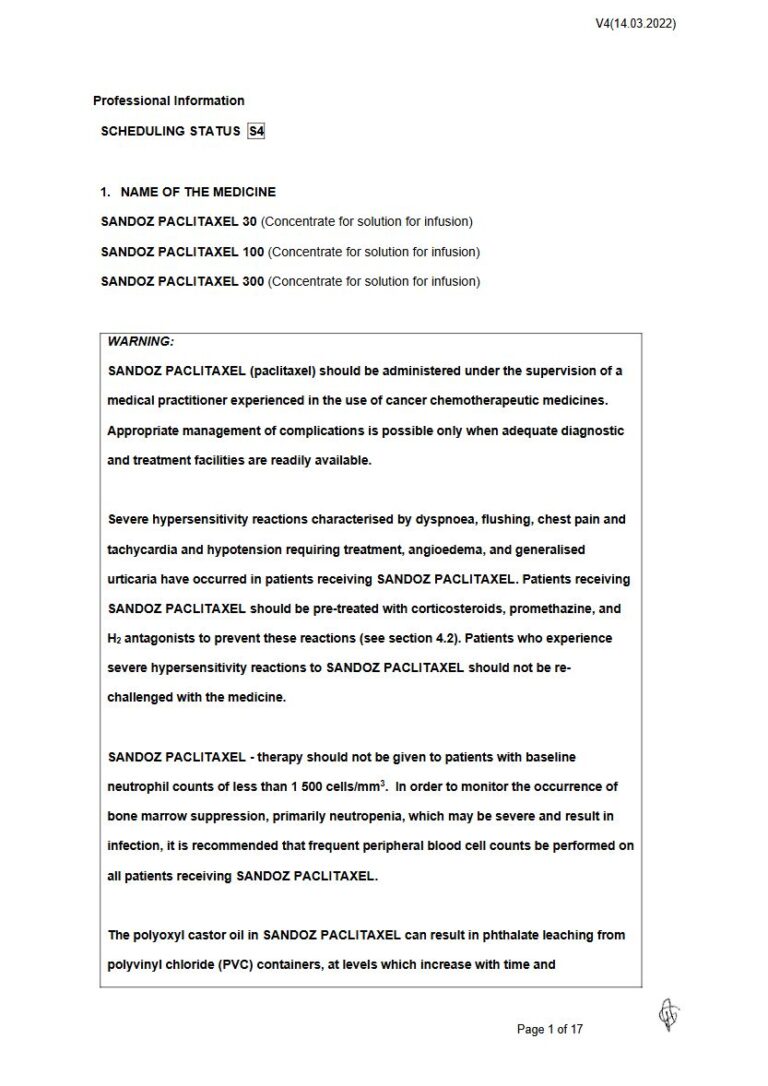
SANDOZ PACLITAXEL should be administered under the supervision of a medical practitioner experienced in the use of cancer chemotherapeutic medicines. Since severe hypersensitivity reactions may occur, appropriate supportive equipment should be available. SANDOZ PACLITAXEL should be administered as a diluted infusion. Given the possibility of extravasation it is advisable to closely monitor the infusion site for possible infiltration during SANDOZ PACLITAXEL administration.
Patients with a history of severe hypersensitivity reactions to products containing Cremophor EL (e.g., cyclosporine for injection concentrate and teniposide for injection concentrate) should not be treated with SANDOZ PACLITAXEL. SANDOZ PACLITAXEL should be given before cisplatin when used in combination. Severe hypersensitivity reactions, probably histamine-mediated, characterised by dyspnoea, flushing, chest pain and tachycardia and hypotension requiring treatment, angioedema and generalised urticaria have occurred in patients receiving SANDOZ PACLITAXEL. In order to avoid the occurrence of severe hypersensitivity reactions, all patients treated with SANDOZ PACLITAXEL should be pre-medicated with corticosteroids (such as dexamethasone), promethazine and H2 antagonists (such as cimetidine or ranitidine). Symptoms such as flushing, skin reaction, dyspnoea, hypotension or tachycardia do not require interruption of therapy. However, in cases of severe hypersensitivity reactions, such as hypotension requiring treatment, dyspnoea requiring bronchodilators, angioedema or generalised urticaria require immediate discontinuation of SANDOZ PACLITAXEL and aggressive symptomatic therapy and the patient should not be re-challenged with this medicine.
Bone marrow suppression (primary neutropenia) is the principal dose-limiting toxicity. Frequent monitoring of blood counts should be instituted during SANDOZ PACLITAXEL treatment. Patients should not be re-treated until neutrophils recover to a level > 1 500/mm3 and platelets recover to a level > 100 000/mm3. In the case of severe neutropenia (< 500 cells/mm3 for seven days or more) during a course of SANDOZ PACLITAXEL therapy, a 20% reduction in dose for subsequent courses of therapy is recommended. Severe cardiac conduction abnormalities have been reported. If patients develop significant conduction abnormalities during SANDOZ PACLITAXEL administration, appropriate therapy should be administered, and continuous cardiac monitoring should be performed during subsequent therapy with SANDOZ PACLITAXEL. Severe cardiovascular events were observed more frequently in patients with non-small cell lung carcinoma than breast or ovarian carcinoma.
Hypotension and bradycardia have been observed during administration of SANDOZ PACLITAXEL, but generally do not require treatment. Frequent vital sign monitoring, particularly during the first hour of SANDOZ PACLITAXEL infusion is recommended. Continuous cardiac monitoring is not required except for patients with serious conduction abnormalities. Cases of myocardial infarction have been reported. Congestive heart failure has been reported typically in patients who have received other chemotherapy, notably anthracyclines. Patients may experience severe cardiovascular events possibly related to SANDOZ PACLITAXEL administration. Included are hypertension, venous thrombosis, ventricular tachycardia, and atrioventricular conduction block. ECG alterations are experienced by some patients. The most frequently reported ECG modification is non-specific repolarization abnormalities, sinus tachycardia and premature beats. The relationship between SANDOZ PACLITAXEL administration and ECG alterations is not clear. Neurological symptoms may occur following the first course and the frequency of symptoms may increase with increasing exposure to SANDOZ PACLITAXEL. Sensory symptoms have usually improved or resolved within several months of SANDOZ PACLITAXEL discontinuation. Pre-existing neuropathies resulting from prior therapies are not a contraindication for SANDOZ PACLITAXEL therapy. Although the occurrence of peripheral neuropathy is frequent, the development of moderate to severe symptomatology is unusual and requires a dose reduction of 20% for all subsequent courses of SANDOZ PACLITAXEL. In non-small cell lung carcinoma patients, the administration of SANDOZ PACLITAXEL in combination with cisplatin resulted in a greater incidence of neurotoxicity than usually seen in patients receiving single agent SANDOZ PACLITAXEL. There is no evidence that the toxicity of SANDOZ PACLITAXEL is enhanced when given as a 3-hour infusion in patients with elevated liver enzymes, but no data are available for patients with baseline cholestasis.
When SANDOZ PACLITAXEL is given as a 24-hour infusion to patients with moderate to severe hepatic impairment, increased myelosuppression may be seen as compared to patients with mildly elevated liver function tests given 24-hour infusions. Analysis restricted to patients with normal baseline liver function, shows instances of elevated bilirubin elevated alkaline phosphate, and elevated AST (SGOT). Hepatic necrosis and hepatic encephalopathy leading to death have been reported. Excipients SANDOZ PACLITAXEL contains ethanol (see section 2), and consideration should be given to possible CNS and other effects of alcohol. SANDOZ PACLITAXEL contains polyoxyl castor oil (macrogolglycerolricinoleate) (see section 6.1), which may cause severe allergic reactions.
4.5 Interaction with other medicines and other forms of interaction
The recommended regimen of SANDOZ PACLITAXEL administration for the primary treatment of ovarian carcinoma is for SANDOZ PACLITAXEL to be given before cisplatin. When SANDOZ PACLITAXEL is given before cisplatin, the safety profile of SANDOZ PACLITAXEL is consistent with that reported for single agent use. When SANDOZ PACLITAXEL is given after cisplatin, patients showed a more profound myelosuppression and an approximately 20% decrease in paclitaxel clearance. Medicine concomitantly administered with SANDOZ PACLITAXEL (e.g., corticosteroids, antihistamines, and H2 antagonists) did not appear to interact adversely; however, possible interactions of SANDOZ PACLITAXEL with concomitantly administered medicines have not been formally investigated. Based on in vitro data, there is the possibility of an inhibition of SANDOZ PACLITAXEL metabolism in patients treated with ketoconazole. As a result, caution should be exercised when treating patients with SANDOZ PACLITAXEL when they are receiving ketoconazole as concomitant therapy. Plasma levels of doxorubicin and doxorubicinol may be increased when paclitaxel and doxorubicin are used in combination. The metabolism of paclitaxel is catalysed by cytochrome P450 isoenzymes CYP2C8 and CYP3A4, caution should be exercised when administering SANDOZ PACLITAXEL concomitantly with known substrates or inhibitors of these isoenzymes. Contact of the undiluted concentrate with plasticized polyvinyl chloride (PVC) equipment or devices used to prepare solutions for infusion is not recommended. In order to minimise patient exposure to the plasticizer DEHP [di-(2-ethylhexyl)phthalate], which may be leached from PVC infusion bags or sets, diluted SANDOZ PACLITAXEL solution should preferably be stored in bottles (glass, polypropylene) or plastic bags (polypropylene, polyolefin) and administered through polyethylene-lined administration sets. SANDOZ PACLITAXEL should be administered through an in-line filter with a microporous membrane not greater than 0.22 microns. Use of filter devices such as IVEX-2 filters which incorporate short inlet and outlet PVC-coated tubing has not resulted in significant leaching of DEHP.
4.6 Fertility, pregnancy, and lactation
Pregnancy SANDOZ PACLITAXEL has been shown to be embryotoxic, fetotoxic and to decrease fertility in animal studies. SANDOZ PACLITAXEL should not be used during pregnancy (see section 4.3). Women of childbearing potential should be advised to avoid becoming pregnant during therapy with SANDOZ PACLITAXEL, and to inform the treating doctor immediately should this occur. Female and male patients of fertile age and/or their partners should use contraception during treatment and for at least 6 months after treatment with SANDOZ PACLITAXEL. Male patients should seek advice regarding cryoconservation of sperm prior to treatment with SANDOZ PACLITAXEL because of the possibility of infertility.
Breastfeeding It is not known whether SANDOZ PACLITAXEL is excreted in human milk. Breast feeding should be discontinued for the duration of SANDOZ PACLITAXEL therapy (see section 4.3).
4.7 Effects on ability to drive and use machines
SANDOZ PACLITAXEL contains ethanol (see u2018COMPOSITIONu2019), which may impair the ability to drive and use machines. Patients should therefore be advised not to drive or operate machinery directly after treatment with SANDOZ PACLITAXEL.
4.8 Undesirable effects
The frequency and severity of undesirable effects are generally similar between patients receiving paclitaxel as in SANDOZ PACLITAXEL for the treatment of ovarian, breast or lung carcinoma. None of the observed toxicities were clearly influenced by age. Safety of the paclitaxel (as in SANDOZ PACLITAXEL)/platinum combination has been evaluated in a randomized trial in ovarian carcinoma and 2 phase III trials in non-small cell lung carcinoma. Unless otherwise mentioned the combination of SANDOZ PACLITAXEL with platinum medicines did not result in clinically relevant changes to the safety profile of single medicine SANDOZ PACLITAXEL. Bone marrow suppressions and peripheral neuropathy are the principal dose-related adverse effects associated with SANDOZ PACLITAXEL. Myelosuppression is less frequent and less severe with a 3-hour infusion than with a 24-hour infusion schedule. The recommended SANDOZ PACLITAXEL/cisplatin regimen for the primary treatment of ovarian cancer caused more severe myelosuppression than single dose SANDOZ PACLITAXEL using the recommended schedule of 175 mg/m2 over 3-hour infusion. There was no increase in clinical sequelae, however.
Alopecia was observed in > 80% of the patients treated with paclitaxel as in SANDOZ PACLITAXEL. The majority of alopecia events occurred less than one month after initiation of paclitaxel.
Infections and infestations Frequent: Infection (mainly urinary tract and upper respiratory tract infections), with reported cases of fatal outcome Less frequent: Septic shock, sepsis, peritonitis, pneumonia Frequency not known: Pseudomembranous colitis
Blood and lymphatic system disorders Frequent: Myelosuppression, neutropenia, anaemia, thrombocytopenia, leucopenia, bleeding Less frequent: Febrile neutropenia, acute myeloid leukaemia, myelodysplastic syndrome Frequency unknown: Disseminated intravascular coagulation
Immune system disorders Frequent: Significant hypersensitivity reactions requiring therapy (e.g., hypotension, angioneurotic oedema, respiratory distress, generalised urticaria, chills, back pain, chest pain, tachycardia, abdominal pain, pain in extremities, diaphoresis and hypertension), minor hypersensitivity reactions (mainly excessive flushing and rash) Less frequent: Anaphylactic reactions, anaphylactic shock Frequency unknown: Bronchospasm
Metabolism and nutrition disorders Less frequent: Anorexia, dehydration Frequency unknown: Tumour lysis syndrome
Psychiatric disorders Less frequent: Confusional state
Nervous system disorders Frequent: Neurotoxicity (mainly: peripheral neuropathy), mild paraesthesia Less frequent: Motor neuropathy (with resultant minor distal weakness), grand mal seizures, autonomic neuropathy (resulting in paralytic ileus and orthostatic hypotension), encephalopathy, convulsions, dizziness, ataxia, headache
Eye disorders Less frequent: Optic nerve and/or visual disturbances (scintillating scotomata), particularly in patients who have received higher doses than recommended Frequency unknown: Macular oedema, photopsia, vitreous floaters
Ear and labyrinth disorders Less frequent: Hearing loss, ototoxicity, tinnitus, vertigo
Cardiac disorders Frequent: Bradycardia Less frequent: Myocardial infarction, AV block and syncope, cardiomyopathy, asymptomatic ventricular tachycardia, tachycardia with bigeminy, heart failure, atrial fibrillation, supraventricular tachycardia
Vascular disorders Frequent: Hypotension Less frequent: Thrombosis, hypertension, thrombophlebitis, shock, fibrotic phlebitis Frequency unknown: Phlebitis
Respiratory, thoracic, and mediastinal disorders Less frequent: Respiratory failure, pulmonary embolism, lung fibrosis, interstitial pneumonia, dyspnoea, pleural effusion, cough
Gastrointestinal disorders Frequent: Diarrhoea, vomiting, nausea Less frequent: Bowel obstruction, bowel perforation, ischaemic colitis, pancreatitis, mesenteric thrombosis, neutropenic colitis, ascites, oesophagitis, constipation
Hepatobiliary disorders Less frequent: Hepatic necrosis, hepatic encephalopathy (both with reported cases of fatal outcome)
Skin and subcutaneous tissue disorders Frequent: Alopecia, transient and mild nail, and skin changes Less frequent: Pruritus, rash, erythema, Stevens-Johnson syndrome, epidermal necrolysis, erythema multiforme, exfoliative dermatitis, urticaria, onycholysis (patients on therapy should wear sun protection on hands and feet) Frequency unknown: Scleroderma, Palmar-plantar erythrodysesthesia syndrome*
*As reported post-marketing
Musculoskeletal and connective tissue disorders Frequent: Arthralgia, myalgia Frequency unknown: Systemic lupus erythematosus, scleroderma
General disorders and administration site conditions Frequent: Mucosal inflammation, injection site reactions (including localised oedema, pain, erythema induration, on occasion extravasation can result in cellulitis, phlebitis, skin fibrosis and skin necrosis. Skin discolouration may also occur In some cases, the onset of the injection site reaction either occurred during a prolonged infusion or was delayed by a week to 10 days. Less frequent: Pyrexia, asthenia, oedema, malaise
Investigations Frequent: Severe elevation in AST (SGOT), severe elevation in alkaline phosphatase Less frequent: Severe elevation in bilirubin, increase in blood creatinine Frequency unknown: ECG alterations
Paediatric Use: The safety and effectiveness of SANDOZ PACLITAXEL in children have not been established.
Reporting of suspected adverse reactions Reporting suspected adverse reactions after authorisation of the medicine is important. It allows continued monitoring of the benefit/risk balance of the medicine. Health care providers are asked to report any suspected adverse reactions to SAHPRA via the u201c6.04 Adverse Drug Reactions Reporting Formu201d, found online under SAHPRAu2019s publications: https://www.sahpra.org.za/Publications/Index/8 Suspected side effects can also be reported directly to the HCR via [email protected].
4.9 Overdose
There is no antidote for SANDOZ PACLITAXEL overdosage. The primary anticipated complications of overdosage would consist of bone marrow suppression, peripheral neurotoxicity, and mucositis. Treatment is symptomatic and supportive. In case of overdose, the patient should be closely monitored. Treatment should be directed at the primary anticipated toxicities. Overdose in paediatric patients may be associated with acute ethanol toxicity.
