
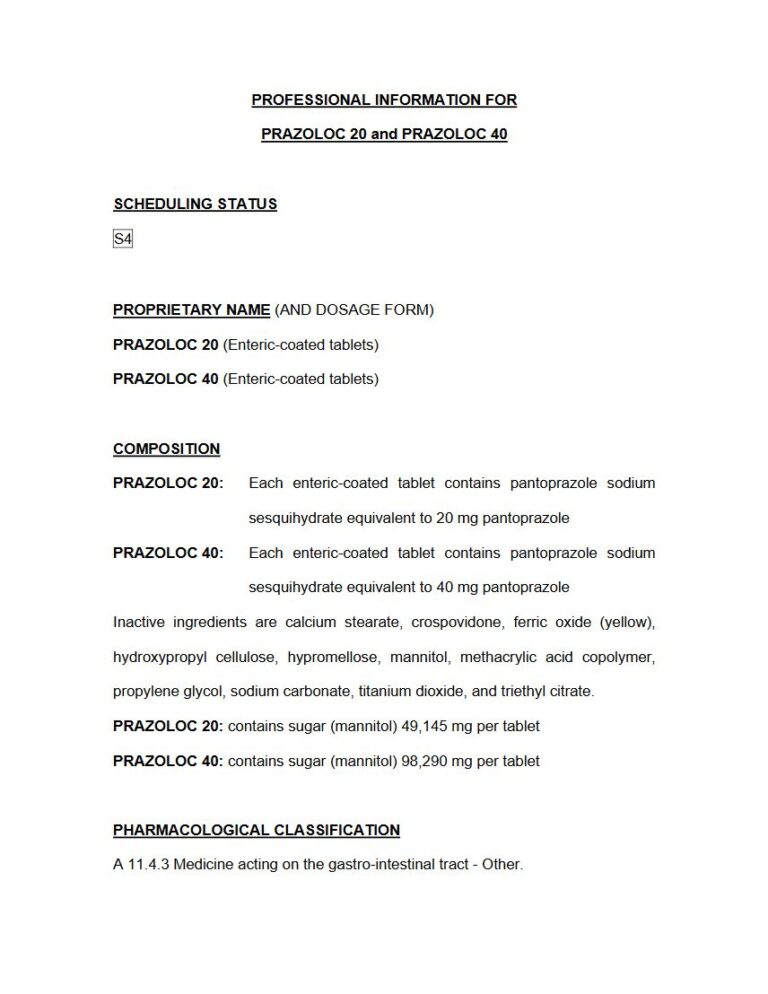
Prazoloc 20 mg/40 mg Tablets
PDF Leaflet Revision Date: 29 March 2021
Clinical Summary
Quick overview from the medicine insert
Indication
Treatment of gastro-oesophageal reflux disease and ulcers.
Dosage (summary)
PRAZOLOC 20: 20 mg once daily; PRAZOLOC 40: 40 mg once daily.
Onset of Action / Duration
Onset: 30 mins, Duration: 24 hours
Special Populations
- Elderly
- Renal impairment
- Hepatic impairment
Pregnancy & Breastfeeding
Not recommended; safety not established.
Key Drug Interactions
- Decreases atazanavir and nelfinavir levels
- May affect warfarin metabolism
Contraindications
- Hypersensitivity to pantoprazole
- Severe liver impairment
- Children
Common side effects
- Headache
- Diarrhoea
- Constipation
- Fatigue
Counselling Points
- Take 30 mins before meals
- Do not crush tablets
- Monitor for signs of renal issues
Serious warnings
- Risk of tubulointerstitial nephritis
- May mask gastric malignancy
Important Disclaimer
The Prazoloc 20 mg/40 mg Tablets professional information leaflet below is the property of Cipla Medpro and is provided on Medinsert exactly as issued, with no.. alterations or editorial changes. We make every effort to keep content current by updating documents as soon as new versions become available. Medinsert serves as a trusted access point for healthcare professionals, but does not replace official sources or clinical judgement. For more details, please read our full disclaimer. read more>>
 Healthcare Professionals Only
This content is for registered healthcare professionals
Sign in or create a free account to read the full package insert.
Free for HPCSA-registered professionals. Powered by Medinsert.
Clinical Particulars
Section 4 of the official insert — extracted exactly as issued, no alterations
4.1 Therapeutic indications
PRAZOLOC 20 is indicated in the following:
- For the symptomatic improvement (e.g. heartburn, acid regurgitation, pain on swallowing) and healing of mild gastro-oesophageal reflux disease (GORD).
- In patients with healed reflux disease, recurring symptoms can be controlled using an on-demand regimen of 20 mg once daily when required.
- For long-term management and prevention of relapse in gastro-oesophageal reflux disease (GORD).
- For the prevention of gastroduodenal lesions and dyspeptic symptoms induced by non-selective non-steroidal anti-inflammatory drugs (NSAIDs) in patients at risk, and with a need for continuous NSAID treatment.
PRAZOLOC 40 is indicated in the following:
- For the short-term treatment of duodenal ulcer.
- Gastric ulcer.
- Reflux oesophagitis.
- For the treatment of Zollinger-Ellison Syndrome.
4.2 Posology and method of administration
PRAZOLOC should be taken preferably in the morning. PRAZOLOC may be taken with food or on an empty stomach. PRAZOLOC should be swallowed whole with a little water either before or during breakfast. Do not crush, break, or chew the tablet.
Duodenal ulcer: The recommended oral dose is PRAZOLOC 40 once daily. The total treatment with oral PRAZOLOC should be 2 to 4 weeks. If the duodenal ulcer has been demonstrated to be associated with Helicobacter pylori infection, PRAZOLOC should be used in combination with appropriate antibiotics.
Gastric ulcer: The recommended oral dose is PRAZOLOC 40 once daily for 4 to 8 weeks. In the case of suspected gastric ulcer, malignancy of the gastric ulcer should be excluded, as treatment could conceal the symptoms and may delay diagnosis.
Reflux oesophagitis: The recommended oral dose is PRAZOLOC 40 once daily for 4 to 8 weeks.
Zollinger-Ellison Syndrome: For management of Zollinger-Ellison Syndrome patients should start their treatment with a daily dose of 80 mg (2 tablets of PRAZOLOC 40). Thereafter, the dosage can be titrated up or down as needed using measurements of gastric acid secretion as a guide. With doses above 80 mg daily, the dose should be divided and given twice daily.
Mild gastro-oesophageal reflux disease (GORD): The recommended oral dose is PRAZOLOC 20 per day. A 4 week period is usually required for healing of mild (GORD). If this is not sufficient, healing will usually be achieved within a further 4 weeks. In patients with healed reflux disease, reoccurring symptoms can be controlled using an on-demand regimen of 20 mg once daily when required. If symptom control has not been achieved after four weeks of treatment with the prescribed daily dose, further investigation is recommended.
Long-term management and prevention of relapse in gastro-oesophageal reflux disease (GORD): For long-term management a maintenance dose of one PRAZOLOC 20 tablet per day is recommended, increasing to PRAZOLOC 40 per day if a relapse occurs. After healing of the relapse, the dose can be reduced to PRAZOLOC 20. Experience with long-term administration is limited. If symptom control has not been achieved after four weeks of treatment with the prescribed daily dose, further investigation is recommended.
For prevention of gastro-duodenal lesions and dyspeptic symptoms induced by non-selective non-steroidal anti-inflammatory drugs (NSAIDs) in patients at risk and with a need for continuous NSAID treatment. The recommended oral dose is one PRAZOLOC 20 per day.
Elderly patients: No dosage adjustment is necessary in the elderly.
Impaired renal function: No dosage adjustment is required in the presence of impaired renal function.
Impaired liver function: A daily dose of PRAZOLOC 20 should not be exceeded in patients with mild to moderate liver impairment (see Pharmacokinetic properties and WARNINGS AND SPECIAL PRECAUTIONS). Doses of PRAZOLOC may need to be reduced in patients with hepatic impairment.
4.3 Contraindications
PRAZOLOC is contraindicated in the following:
- Hypersensitivity to pantoprazole or to any of the other ingredients of PRAZOLOC.
- Severe impairment of liver function.
- Safety and efficacy in children have not been established.
- Co-administration with atazanavir and nelfinavir (see INTERACTIONS).
4.4 Special warnings and precautions for use
PRAZOLOC is not indicated for mild gastro-intestinal complaints such as nervous dyspepsia. Prior to treatment the possibility of malignancy of gastric ulcer or a malignant disease of the oesophagus should be excluded, as the treatment with PRAZOLOC may alleviate the symptoms of malignant ulcers and can thus delay diagnosis. Use of PRAZOLOC 20 as preventative of gastroduodenal ulcers, induced by non-selective non-steroidal anti-inflammatory drugs (NSAIDs) should be restricted to patients who require continued NSAID treatment and have an increased risk to develop gastro-intestinal complications. Daily treatment with any acid-blocking medicines over a long period of time (e.g. longer than 3 years) may lead to malabsorption of cyanocobalamin caused by hypo- or achlorhydria. Rare cases of cyanocobalamin deficiency under acid-blocking therapy have been reported in the literature. This should be considered when respective clinical symptoms are observed. In the case of a rise of the liver enzymes, PRAZOLOC should be discontinued. Diagnosis of reflux oesophagitis should be confirmed by endoscopy. Tubulointerstitial nephritis: The risk of tubulointerstitial nephritis leading to chronic renal inflammation and reduced renal function is associated with the use of PPIs. Tubulointerstitial nephritis may progress to renal failure as it is not necessarily reversed when treatment is discontinued (see SIDE EFFECTS).
4.5 Interactions with other medicines
Pantoprazole decreases the concentrations of atazanavir and nelfinavir. Co-administration of PRAZOLOC and atazanavir or nelfinavir is contraindicated (see CONTRAINDICATIONS). PRAZOLOC is metabolised by the cytochrome P450 system, primarily by isoenzyme CYP2C19, and may alter the metabolism of some medicines metabolised by these enzymes. No clinically significant interactions were, however, observed in specific tests with a number of such medicines or compounds, namely antipyrine, caffeine, carbamazepine, diazepam, diclofenac, digoxin, ethanol, glibenclamide, metoprolol, naproxen, nifedipine, phenytoin, piroxicam, theophylline, warfarin and oral contraceptives. However, the response to anticoagulants such as warfarin, may be affected by PRAZOLOC. It is therefore good practice to monitor the patient with additional PT (prothrombin time) / INR (international normalised ratio) determinations when PRAZOLOC is initiated, discontinued or taken irregularly. Changes in absorption should be observed when medicines whose absorption is pH-dependent, e.g. ketoconazole, are taken concomitantly. There are no interactions with concomitantly administered antacids. Concomitant intake of food has no influence on the bioavailability of PRAZOLOC.
4.6 Fertility, pregnancy and lactation
The use of PRAZOLOC in pregnancy and lactation is not recommended as safety and efficacy have not been established.
4.7 Effects on ability to drive and use machines
PRAZOLOC may cause dizziness, disturbances in vision, somnolence or vertigo. Patients should be advised to refrain from operating machinery or driving, until they know how PRAZOLOC affects them.
4.8 Undesirable effects
The following side effects may occur:
Infections and infestations: Frequent: Gastro-intestinal infection.
Blood and lymphatic system disorders: Less frequent: Thrombocytopenia, leukopenia, agranulocytosis.
Immune system disorders: Less frequent: Anaphylactic reactions including anaphylactic shock, angioedema.
Metabolism and nutrition disorders: Less frequent: Elevated triglycerides and increased body temperature.
Psychiatric disorders: Frequent: Insomnia. Less frequent: Mental depression, reversible confusional state, agitation, hallucinations, somnolence.
Nervous system disorders: Frequent: Headache. Less frequent: Dizziness, paraesthesia.
Eye disorders: Less frequent: Disturbances in vision (blurred vision), anterior ischaemic optic neuropathy.
Ear and labyrinth disorders: Less frequent: Vertigo, tinnitus.
Vascular disorders: Less frequent: Peripheral oedema.
Respiratory, thoracic and mediastinal disorders: Less frequent: Dyspnoea, bronchospasm.
Gastro-intestinal disorders: Frequent: Constipation or flatulence, diarrhoea, upper abdominal pain. Less frequent: Vomiting, nausea, dry mouth, stomatitis, taste disturbances.
Hepatobiliary disorders: Less frequent: Severe hepatocellular damage leading to jaundice with or without hepatic failure, increased liver enzymes (transaminases, u03b3-GT), hepatitis, hepatic encephalopathy.
Skin and subcutaneous tissue disorders: Less frequent: Allergic reactions such as pruritus, and skin rash, urticaria, severe skin reactions, such as Stevens-Johnson syndrome, erythema multiforme, toxic epidermal necrolysis (Lyell-syndrome) and photosensitivity.
Musculoskeletal, connective tissue and bone disorders: Less frequent: Arthralgia, myalgia.
Renal and urinary system disorders: Less frequent: Difficulty in urinating, increased frequency and volume of urination, painful urination, and interstitial nephritis with possible progression to renal failure as it is not necessarily reversed when treatment is discontinued. (See WARNINGS AND SPECIAL PRECAUTIONS).
Reproductive system and breast disorders: Less frequent: Impotence, gynaecomastia.
General disorders and administrative site conditions: Frequent: Fatigue. Less frequent: Increased sweating, malaise.
Post-marketing exposure: Frequency unknown: Interstitial nephritis with possible progression to renal failure as it is not necessarily reversed when treatment is discontinued.
4.9 Overdose
No specific therapeutic recommendation can be made in cases of overdosage. There are no known symptoms of overdosage.
