
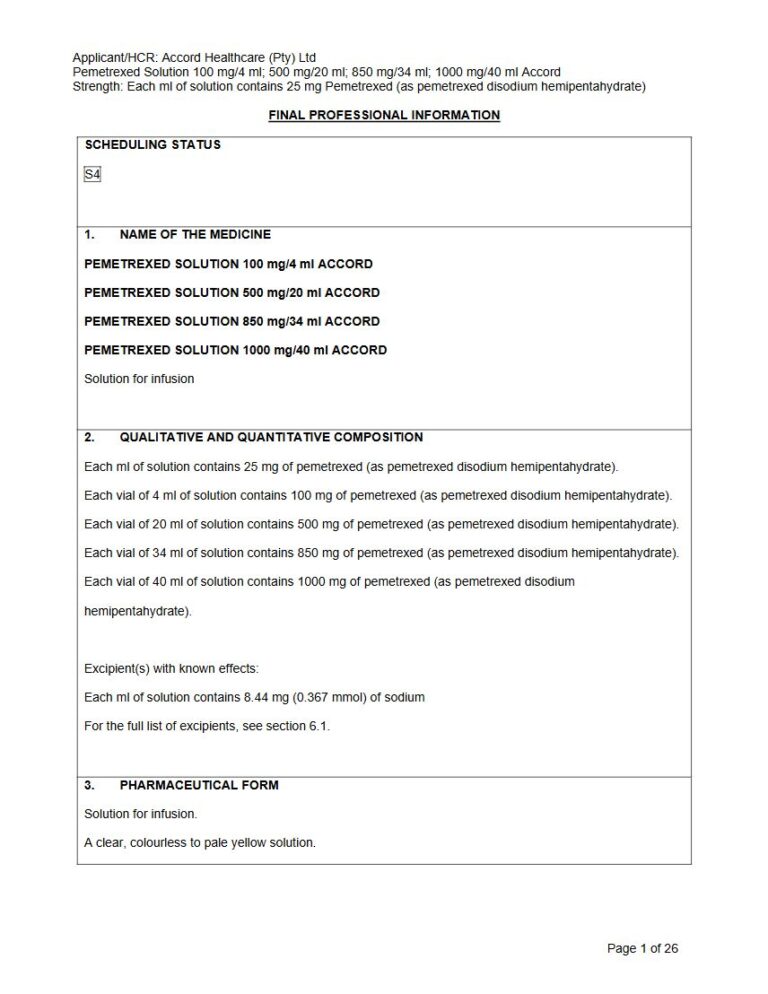
Pemetrexed Solution Accord
Clinical Summary
Quick overview from the medicine insert
Indication
Treatment of malignant pleural mesothelioma and non-small cell lung cancer.
Dosage (summary)
500 mg/mu00b2 IV infusion over 10 mins on day 1 of each 21-day cycle.
Special Populations
- Elderly
- Renal impairment
- Hepatic impairment
Pregnancy & Breastfeeding
Avoid in pregnancy; discontinue breastfeeding during treatment.
Key Drug Interactions
- Nephrotoxic drugs
- NSAIDs
- Live attenuated vaccines
Contraindications
- Hypersensitivity to pemetrexed
- Breastfeeding
- Concomitant yellow fever vaccine
Common side effects
- Neutropenia
- Anemia
- Nausea
- Vomiting
- Fatigue
Counselling Points
- Take folic acid and vitamin B12 as directed
- Monitor for signs of infection
- Avoid pregnancy during treatment
Serious warnings
- Myelosuppression
- Risk of severe skin reactions
- Potential for renal toxicity
Important Disclaimer
The Pemetrexed Solution Accord professional information leaflet below is the property of Accord Healthcare and is provided on Medinsert exactly as issued, with no.. alterations or editorial changes. We make every effort to keep content current by updating documents as soon as new versions become available. Medinsert serves as a trusted access point for healthcare professionals, but does not replace official sources or clinical judgement. For more details, please read our full disclaimer. read more>>
 Healthcare Professionals Only
This content is for registered healthcare professionals
Sign in or create a free account to read the full package insert.
Free for HPCSA-registered professionals. Powered by Medinsert.
Clinical Particulars
Section 4 of the official insert — extracted exactly as issued, no alterations
4.1 Therapeutic indications
PEMETREXED SOLUTION is indicated for the treatment of patients with malignant pleural mesothelioma in combination with cisplatin. PEMETREXED SOLUTION as monotherapy for the treatment of patients with locally advanced or metastatic non-small cell lung cancer after prior chemotherapy.
4.2 Posology and method of administration
PEMETREXED SOLUTION should only be administered under the supervision of a medical practitioner qualified in the use of anti-cancer chemotherapy.
Posology
Malignant pleural mesothelioma
Combination use with cisplatin: Adults: In patients treated for malignant pleural mesothelioma, the recommended dose of PEMETREXED SOLUTION is 500 mg/m2 administered as an intravenous infusion over 10 minutes on the first day of each 21-day cycle. The recommended dose of cisplatin is 75 mg/m2 infused over 2 hours approximately 30 minutes after completion of PEMETREXED SOLUTION infusion on the first day of each 21-day cycle. Patients should receive hydration consistent with local practice prior to and/or after receiving cisplatin. See cisplatin professional information for specific dosing advice.
Non-small cell lung cancer
Single medicine use: Adults: In patients treated for non-small cell lung cancer, the recommended dose of PEMETREXED SOLUTION is 500 mg/m2 administered as an intravenous infusion over 10 minutes on the first day of each 21-day cycle.
Premedication regimen
To reduce the incidence and severity of skin reactions, a corticosteroid should be given the day prior to, on the day of, and the day after PEMETREXED SOLUTION administration. The corticosteroid should be equivalent to 4 mg of dexamethasone administered orally twice a day. (See section 4.4 & 4.8).
To reduce toxicity, patients treated with PEMETREXED SOLUTION should also receive vitamin supplementation (see section 4.4 & 4.8). Patients must take oral folic acid or multivitamin containing folic acid (350 to 1000 u03bcg) on a daily basis. At least 5 daily doses of folic acid must be taken during the 7 days preceding the first dose of PEMETREXED SOLUTION, and dosing should continue during the full course of therapy and for 21 days after the last dose of PEMETREXED SOLUTION. Patients must also receive an intramuscular injection of vitamin B12 (1000 u03bcg) in the week preceding the first dose of PEMETREXED SOLUTION and every 3 cycles thereafter.
Monitoring
Patients receiving PEMETREXED SOLUTION should be monitored before each dose with a full blood count, including a differential and platelet count. Periodic blood chemistry tests should be collected to evaluate renal and hepatic function. Absolute Neutrophil Count (ANC) should be u2265 1500 cells/mm3 and platelets should be u2265 100 000 cells/mm3 prior to the start of each cycle.
Dose adjustments
Dose adjustments at the start of a subsequent cycle should be based on nadir haematologic counts or maximum non-haematologic toxicity from the preceding cycle of therapy. Treatment may be delayed to allow sufficient time for recovery. Upon recovery, patients may be retreated using the guidelines in Tables 1, 2 and 3, which are applicable for PEMETREXED SOLUTION used as a single medicine or in combination with cisplatin.
4.3 Contraindications
Hypersensitivity to pemetrexed or to any of the excipients listed in section 6.1.
Breast-feeding (see section 4.6)
Concomitant yellow fever vaccine (see section 4.5)
4.4 Special warnings and precautions for use
Pemetrexed can suppress bone marrow function as manifested by neutropenia, thrombocytopenia and anaemia (or pancytopenia) (see section 4.8). Myelosuppression is usually the dose-limiting toxicity. Patients should be monitored for myelosuppression during therapy and pemetrexed should not be given to patients until absolute neutrophil count (ANC) returns to u2265 1500 cells/mm3 and platelet count returns to u2265 100,000 cells/mm3. Dose reductions for subsequent cycles are based on nadir ANC, platelet count and maximum non-haematologic toxicity seen from the previous cycle (see section 4.2).
Less toxicity and reduction in Grade 3/4 haematologic and non-haematologic toxicities such as neutropenia, febrile neutropenia and infection with Grade 3/4 neutropenia were reported when pre-treatment with folic acid and vitamin B12 was administered. Therefore, all patients treated with pemetrexed must be instructed to take folic acid and vitamin B12 as a prophylactic measure to reduce treatment-related toxicity (see section 4.2).
Skin reactions have been reported in patients not pre-treated with a corticosteroid. Pre-treatment with dexamethasone (or equivalent) can reduce the incidence and severity of skin reactions (see section 4.2).
An insufficient number of patients has been studied with creatinine clearance of below 45 mL/min. Therefore, the use of pemetrexed in patients with creatinine clearance of < 45 mL/min is not recommended (see section 4.2).
Patients with mild to moderate renal insufficiency (creatinine clearance from 45 to 79 mL/min) should avoid taking nonsteroidal anti-inflammatory drugs (NSAIDs) such as ibuprofen, and acetylsalicylic acid (> 1.3 g daily) for 2 days before, on the day of, and 2 days following pemetrexed administration (see section 4.5).
In patients with mild to moderate renal insufficiency eligible for pemetrexed therapy NSAIDs with long elimination half-lives should be interrupted for at least 5 days prior to, on the day of, and at least 2 days following pemetrexed administration (see section 4.5).
Serious renal events, including acute renal failure, have been reported with pemetrexed alone or in association with other chemotherapeutic agents. Many of the patients in whom these occurred had underlying risk factors for the development of renal events including dehydration or pre-existing hypertension or diabetes. Nephrogenic diabetes insipidus and renal tubular necrosis were also reported in post marketing setting with pemetrexed alone or with other chemotherapeutic medicines. Most of these events resolved after pemetrexed withdrawal. Patients should be regularly monitored for acute tubular necrosis, decreased renal function and signs and symptoms of nephrogenic diabetes insipidus (e.g. hypernatremia).
The effect of third space fluid, such as pleural effusion or ascites, on pemetrexed is not fully defined. A phase 2 study of pemetrexed in 31 solid tumour patients with stable third space fluid demonstrated no difference in pemetrexed dose normalized plasma concentrations or clearance compared to patients without third space fluid collections. Thus, drainage of third space fluid collection prior to pemetrexed treatment should be considered, but may not be necessary.
Due to the gastrointestinal toxicity of pemetrexed given in combination with cisplatin, severe dehydration has been observed. Therefore, patients should receive adequate antiemetic treatment and appropriate hydration prior to and/or after receiving treatment.
Serious cardiovascular events, including myocardial infarction and cerebrovascular events have been uncommonly reported during clinical studies with pemetrexed, usually when given in combination with another cytotoxic agent. Most of the patients in whom these events have been observed had pre-existing cardiovascular risk factors (see section 4.8).
Immunodepressed status is common in cancer patients. As a result, concomitant use of live attenuated vaccines is not recommended (see section 4.3 and 4.5).
Pemetrexed can have genetically damaging effects. Sexually mature males are advised not to father a child during the treatment and up to 6 months thereafter. Contraceptive measures or abstinence are recommended. Owing to the possibility of pemetrexed treatment causing irreversible infertility, men are advised to seek counselling on sperm storage before starting treatment. Women of childbearing potential must use effective contraception during treatment with pemetrexed (see section 4.6).
Cases of radiation pneumonitis have been reported in patients treated with radiation either prior, during or subsequent to their pemetrexed therapy. Particular attention should be paid to these patients and caution exercised with use of other radiosensitising agents.
Cases of radiation recall have been reported in patients who received radiotherapy weeks or years previously. This medicine contains 900 mg of sodium per maximum daily dose. To be taken into consideration by patients on a controlled sodium diet.
4.5 Interaction with other medicinal products and other forms of interaction
Pemetrexed is mainly eliminated unchanged renally by tubular secretion and to a lesser extent by glomerular filtration. Concomitant administration of nephrotoxic drugs (e.g. aminoglycoside, loop diuretics, platinum compounds, cyclosporin) could potentially result in delayed clearance of pemetrexed. This combination should be used with caution. If necessary, creatinine clearance should be closely monitored.
Concomitant administration of substances that are also tubularly secreted (e.g. probenecid, penicillin) could potentially result in delayed clearance of pemetrexed. Caution should be made when these drugs are combined with pemetrexed. If necessary, creatinine clearance should be closely monitored.
In patients with normal renal function (creatinine clearance u2265 80 mL/min), high doses of non-steroidal anti-inflammatory medicines (NSAIDs, such as ibuprofen > 1600 mg/day) and acetylsalicylic acid at higher dose (u2265 1.3 g daily) may decrease pemetrexed elimination and, consequently, increase the occurrence of pemetrexed adverse events. Therefore, caution should be made when administering higher doses of NSAIDs or acetylsalicylic acid, concurrently with pemetrexed to patients with normal function (creatinine clearance u2265 80 mL/min).
In patients with mild to moderate renal insufficiency (creatinine clearance from 45 to 79 mL/min), the concomitant administration of pemetrexed with NSAIDs (e.g. ibuprofen) or acetylsalicylic acid at higher dose should be avoided for 2 days before, on the day of, and 2 days following pemetrexed administration (see section 4.4).
In the absence of data regarding potential interaction with NSAIDs having longer half-lives such as piroxicam or rofecoxib, the concomitant administration with pemetrexed in patients with mild to moderate renal insufficiency should be interrupted for at least 5 days prior to, on the day of, and at least 2 days following pemetrexed administration (see section 4.4).
If concomitant administration of NSAIDs is necessary, patients should be monitored closely for toxicity, especially myelosuppression and gastrointestinal toxicity.
Pemetrexed undergoes limited hepatic metabolism. Results from in vitro studies with human liver microsomes indicated that pemetrexed would not be predicted to cause clinically significant inhibition of the metabolic clearance of medicines metabolised by CYP3A, CYP2D6, CYP2C9, and CYP1A2.
Interactions common to all cytotoxics
Due to the increased thrombotic risk in patients with cancer, the use of anticoagulation treatment is frequent. The high intra-individual variability of the coagulation status during diseases and the possibility of interaction between oral anticoagulants and anticancer chemotherapy require increased frequency of INR (International Normalised Ratio) monitoring, if it is decided to treat the patient with oral anticoagulants.
Concomitant use contraindicated: Yellow fever vaccine: risk of fatal generalised vaccinale disease (see section 4.3).
Concomitant use not recommended: Live attenuated vaccines (except yellow fever, for which concomitant use is contraindicated): risk of systemic, possibly fatal, disease. The risk is increased in subjects who are already immunosuppressed by their underlying disease. Use an inactivated vaccine where it exists (poliomyelitis) (see section 4.4).
4.6 Fertility, pregnancy and lactation
Contraception in males and females
Women of childbearing potential must use effective contraception during treatment with pemetrexed. Pemetrexed can have genetically damaging effects. Sexually mature males are advised not to father a child during the treatment and up to 6 months thereafter. Contraceptive measures or abstinence are recommended.
Pregnancy
There are no data from the use of pemetrexed in pregnant women but pemetrexed, like other anti-metabolites, is suspected to cause serious birth defects when administered during pregnancy. Animal studies have shown reproductive toxicity (see section 5.3). Pemetrexed should be avoided during pregnancy due to the potential hazard to the foetus. Women should be advised to avoid becoming pregnant when being treated with PEMETREXED SOLUTION.
Breast-feeding
It is not known whether pemetrexed is excreted in human milk and adverse reactions on the suckling child cannot be excluded. Breast-feeding must be discontinued during pemetrexed therapy (see section 4.3).
Fertility
Owing to the possibility of pemetrexed treatment causing irreversible infertility, men are advised to seek counselling on sperm storage before starting treatment.
4.7 Effects on ability to drive and use machines
No studies on the effects on the ability to drive and use machines have been performed. However, it has been reported that pemetrexed may cause fatigue. Therefore, patients should be cautioned against driving or operating machines if this event occurs.
4.8 Undesirable effects
Summary of safety profile
The frequently reported undesirable effects related to pemetrexed, whether used as monotherapy or in combination, are bone marrow suppression manifested as anaemia, neutropenia, leukopenia, thrombocytopenia; and gastrointestinal toxicities, manifested as anorexia, nausea, vomiting, diarrhoea, constipation, pharyngitis, mucositis, and stomatitis. Other undesirable effects include renal toxicities, increased aminotransferases, alopecia, fatigue, dehydration, rash, infection/sepsis and neuropathy. Rarely seen events include Stevens-Johnson syndrome and Toxic epidermal necrolysis.
Tabulated list of adverse reactions
The table below provides the frequency and severity of undesirable effects that have been reported in > 5 % of 168 patients with mesothelioma who were randomised to receive cisplatin and pemetrexed and 163 patients with mesothelioma randomised to receive single medicine cisplatin. In both treatment arms, these chemonaive patients were fully supplemented with folic acid and vitamin B12.
System Organ Class Frequency Event*
Blood and lymphatic system disorders Frequent Neutrophils/granulocytes decreased; leukocytes decreased, haemoglobin decreased, platelets decreased
Metabolism and nutrition disorders Frequent Dehydration
Nervous system disorders Frequent Neuropathy - Sensory, taste disturbance
Eye disorders Frequent Conjunctivitis
Gastro-intestinal Frequent Diarrhoea, vomiting, Stomatitis/Pharyngitis, nausea, anorexia, constipation, dyspepsia
Skin and subcutaneous tissue disorders Frequent Rash, alopecia
Renal and urinary disorders Frequent Creatinine elevation, creatinine clearance decreased**
General disorders and administration site conditions Frequent Fatigue
*Refer to National Cancer Institute CTC version 2 for each grade of toxicity except the term u201ccreatine clearance decreased.u201d
**Which is derived from the term u201crenal/genitourinary other.u201d
***According to National Cancer Institute CTC (v2.0; NCL 1998), taste disturbance and alopecia should only be reported as Grade 1 or 2. For the purpose of this table a cut off of 5 % was used for inclusion of all events where the reporter considered a possible relationship to pemetrexed and cisplatin. Clinically relevant CTC toxicities that were reported in u2265 1 % and u2264 5 % of the patients that were randomly assigned to receive cisplatin and pemetrexed include: renal failure, infection, pyrexia, febrile neutropenia, increased AST, ALT, and GGT, urticaria and chest pain. Clinically relevant CTC toxicities that were reported in < 1 % of the patients that were randomly assigned to receive cisplatin and pemetrexed include arrhythmia and motor neuropathy.
4.9 Overdose
Reported symptoms of overdose include neutropenia, anaemia, thrombocytopenia, mucositis, sensory polyneuropathy and rash. Anticipated complications of overdose include bone marrow suppression as manifested by neutropenia, thrombocytopenia and anaemia. In addition, infection with or without fever, diarrhoea, and/or mucositis may be seen. In the event of suspected overdose, patients should be monitored with blood counts and should receive supportive therapy as necessary. The use of calcium folinate/folinic acid in the management of pemetrexed overdose should be considered.
