
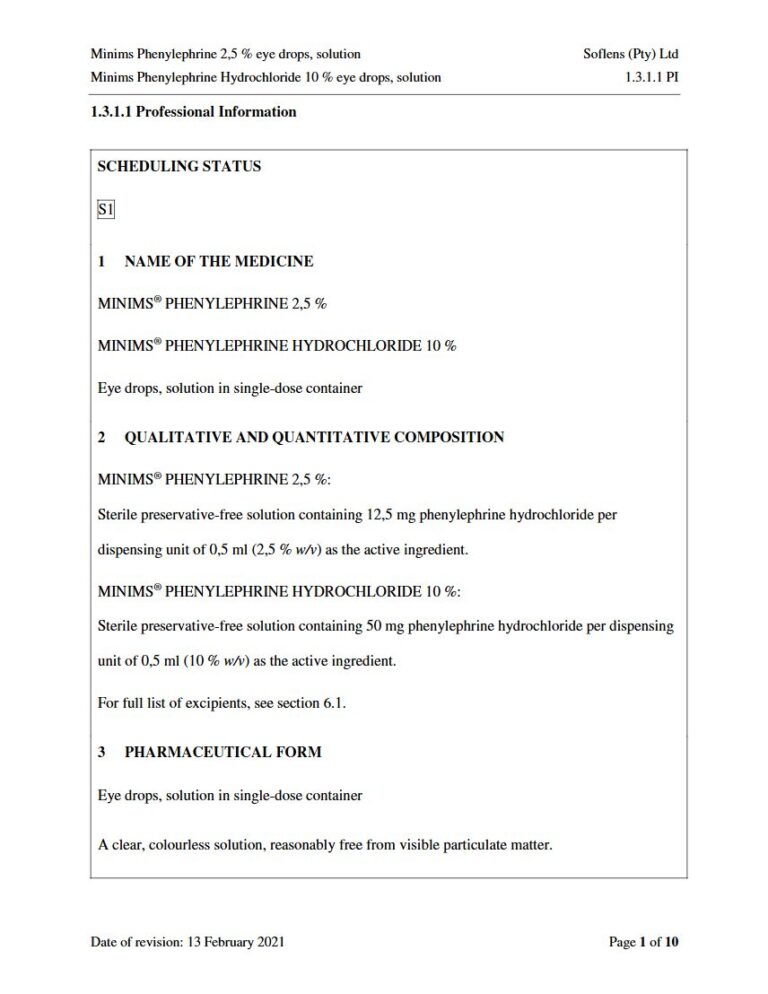
Minims Phenylephrine 2,5 %/10 %/12,5 mg Drops
PDF Leaflet Revision Date: 13 February 2021
Clinical Summary
Quick overview from the medicine insert
Indication
Mydriatic for ophthalmic use.
Dosage (summary)
Use as directed by ophthalmologist; discard after use.
Onset of Action / Duration
Onset: 15 mins, Duration: ~5 hours
Special Populations
- Children under 12 years
- Elderly
- Patients with cardiac disease
Pregnancy & Breastfeeding
Safety not established during pregnancy and lactation.
Key Drug Interactions
- MAOIs
- Tricyclic antidepressants
- Anti-hypertensive medicines
Contraindications
- Hypersensitivity to phenylephrine
- Angle-closure glaucoma
- Severe hypertension
Common side effects
- Eye irritation
- Blurred vision
- Tachycardia
Counselling Points
- Discard after single use
- May impair vision temporarily
- Monitor for allergic reactions
Serious warnings
- Use with caution in cardiovascular disease
- Risk of serious systemic reactions
Important Disclaimer
The Minims Phenylephrine 2,5 %/10 %/12,5 mg Drops professional information leaflet below is the property of Soflens and is provided on Medinsert exactly as issued, with no.. alterations or editorial changes. We make every effort to keep content current by updating documents as soon as new versions become available. Medinsert serves as a trusted access point for healthcare professionals, but does not replace official sources or clinical judgement. For more details, please read our full disclaimer. read more>>
 Healthcare Professionals Only
This content is for registered healthcare professionals
Sign in or create a free account to read the full package insert.
Free for HPCSA-registered professionals. Powered by Medinsert.
Clinical Particulars
Section 4 of the official insert — extracted exactly as issued, no alterations
4.1 Therapeutic indications
For ophthalmic purposes MINIMS u00ae Phenylephrine act as mydriatics. They are sometimes used in open-angle glaucoma, to reduce intraocular pressure by virtue of their local vasoconstrictor action, which reduces the production of aqueous humour.
4.2 Posology and method of administration
Adults and children: to be used as directed by the ophthalmologist. Use once and discard. Paediatric population MINIMS u00ae PHENYLEPRINE HYDROCHLORIDE 10 % is contraindicated in children aged below 12 years (see section 4.3). There are no data in children aged 12 to 18 years, MINIMS u00ae PHENYLEPRINE HYDROCHLORIDE 10 % is not recommended in these patients.
4.3 Contraindications
- Hypersensitivity to phenylephrine, pseudoephedrine or to any of the ingredients of MINIMS u00ae Phenylephrine (see Section 6.1 List of excipients).
- In patients with angle-closure glaucoma
- Patients on Monoamine Oxidase Inhibitors (MAOIs), tricyclic anti-depressants and antihypertensive medicines (including beta-blockers).
- Patients on Reversible Inhibitors of Monoamine Oxidase (RIMAs)
- Should not be used in the presence of:
- severe hypertension as it may cause a prolonged rise in blood pressure
- hyperthyroidism as it induces tachycardia or reflex bradycardia
- partial heart-block
- myocarditis
- bradycardia
- serious impairment of the coronary circulation.
- MINIMS u00ae PHENYLEPHRINE HYDROCHLORIDE 10 % is contraindicated:
- in children aged below 12 years (see section 4.4)
- in the elderly
- in patients with cardiac disease or
- in patients with significant hypertension or
- in patients with advanced arteriosclerosis
4.4 Special warnings and precautions for use
MINIMS u00ae Phenylephrine must be used with caution in patients suffering from severe ischaemic heart disease. Fatalities have been reported in patients with pre-existing cardiovascular disease.
The use should also be avoided by patients with diabetes mellitus or prostatic hyperplasia. To reduce the risk of precipitating an attack of narrow angle glaucoma the anterior chamber angle should be evaluated before use. Ocular hyperaemia can increase the systemic absorption of phenylephrine administered topically. The use of MINIMS u00ae Phenylephrine in the eyes may liberate pigment granules from the iris, especially when given in high doses to the elderly. Corneal clouding may occur if the corneal epithelium has been denuded or damaged. MINIMS u00ae Phenylephrine can cause intense irritation and a local anaesthetic should be instilled into the eye a few minutes beforehand. Systemic absorption may be minimised by compressing the lacrimal sac at the medial canthus for one minute during and after the instillation of the drops. This blocks the passage of the drops via the naso-lacrimal duct to the wide absorptive area of the nasal and pharyngeal mucosa.
Paediatric population Use of MINIMS u00ae PHENYLEPHRINE HYDROCHLORIDE 10 % in children aged below 12 years is contraindicated, since serious systemic adverse reactions have been reported with ophthalmic products containing phenylephrine. Use of MINIMS u00ae PHENYLEPHRINE HYDROCHLORIDE 10 % in children aged 12 to 18 years is not recommended as adequate clinical experience is missing.
4.5 Interaction with other medicines and other forms of interaction
Anti-hypertensive medicines: Topical MINIMS u00ae Phenylephrine should not be used with anti-hypertensive medicines as they may reverse the action of many of these medicines with possibly fatal consequences.
Monoamine Oxidase Inhibitors (MAOIs): Since phenylephrine is absorbed through the mucosa, interactions may also follow topical application, particularly in patients receiving a MOAI (including a RIMA) e.g. phenelzine and moclobemide. There is an increased risk of adrenergic reactions when used simultaneously with, or up to three weeks after, the administration of MAOIs.
Tricyclic Antidepressants: The pressor response to adrenergic medicines and the risk of cardiac dysrhythmia may be potentiated in patients receiving tricyclic antidepressants (or within several days of their discontinuation).
Halothane: Because of the increased risk of ventricular fibrillation, MINIMS u00ae PHENYLEPHRINE HYDROCHLORIDE 10 % should be used with caution during general anaesthesia with anaesthetics which sensitise the myocardium to sympathomimetics.
Digoxin or Quinidine: There is an increased risk of dysrhythmias.
4.6 Fertility, pregnancy and lactation
Pregnancy and Breastfeeding Safety during pregnancy and lactation has not been established.
4.7 Effects on ability to drive and use machines
The mydriatic effect of phenylephrine can last several hours. Vision impairment may affect the ability to drive and use machines.
4.8 Undesirable effects
Systemic effects are those of sympathetic stimulation.
Immune system disorders Less frequent: Hypersensitivity and cross-sensitivity to phenylephrine have been reported in a patient hypersensitive to pseudoephedrine.
Eye disorders Frequent: Acute and chronic allergic conjunctivitis, corneal clouding, irritation (eye pain and stinging) on application to the eye. Blurred vision, photophobia, conjunctival sensitisation and allergy.
Cardiac disorders Less frequent: Tachycardia or reflex bradycardia (fatal myocardial infarction after the use of MINIMS u00ae PHENYLEPHRINE HYDROCHLORIDE 10 % in the eye). Palpitations, extrasystoles and cardiac dysrhythmias.
Vascular disorders Less frequent: Peripheral vasoconstriction and hypertension. Frequency unknown: Periorbital pallor in preterm patients.
Respiratory, thoracic and mediastinal disorders Frequency unknown: Pulmonary oedema in paediatric patients.
Reporting of suspected adverse reactions Reporting suspected adverse reactions after authorisation of the medicine is important. It allows continued monitoring of the benefit-risk balance of the medicine. Health care providers are asked to report any suspected adverse reactions to SAHPRA via the u201c6.04 Adverse Drug Reactions Reporting Formu201d, found online under SAHPRAu2019s publications: https://www.sahpra.org.za/Publications/Index/8 Suspected adverse reactions may also be reported directly to the Holder of the Certificate of registration using the following e-mail address: [email protected]
4.9 Overdose
See sections 4.4 and 4.8. Because a severe toxic reaction to MINIMS u00ae Phenylephrine is of rapid onset and short duration, treatment is primarily supportive. Prompt injection of a rapidly acting alpha-adrenergic blocking medicine such as phentolamine (dose 2 to 5 mg IV) may be considered.
