
Esbriet 267 mg Capsules
PDF Leaflet Revision Date: 21 September 2022
Clinical Summary
Quick overview from the medicine insert
Indication
Reduction of progression of mild to moderately severe idiopathic pulmonary fibrosis (IPF).
Dosage (summary)
Initial: 801 mg/day (3 capsules, TID) for 14 days, then 2403 mg/day (9 capsules, TID).
Special Populations
- Elderly
- Hepatic impairment
- Renal impairment
Pregnancy & Breastfeeding
Not recommended during pregnancy or breastfeeding.
Key Drug Interactions
- Fluvoxamine
- CYP1A2 inducers
- Ciprofloxacin
Contraindications
- Hypersensitivity to pirfenidone
- Severe hepatic impairment
- Severe renal impairment
- History of angioedema
Common side effects
- Nausea
- Diarrhoea
- Fatigue
- Rash
- Dizziness
Counselling Points
- Take with food to reduce nausea
- Avoid sun exposure
- Monitor liver function regularly
Serious warnings
- Drug-Induced Liver Injury
- Photosensitivity reactions
- Angioedema
Important Disclaimer
The Esbriet 267 mg Capsules professional information leaflet below is the property of Roche Products and is provided on Medinsert exactly as issued, with no.. alterations or editorial changes. We make every effort to keep content current by updating documents as soon as new versions become available. Medinsert serves as a trusted access point for healthcare professionals, but does not replace official sources or clinical judgement. For more details, please read our full disclaimer. read more>>
 Healthcare Professionals Only
This content is for registered healthcare professionals
Sign in or create a free account to read the full package insert.
Free for HPCSA-registered professionals. Powered by Medinsert.
Clinical Particulars
Section 4 of the official insert — extracted exactly as issued, no alterations
4.1 Therapeutic Indications
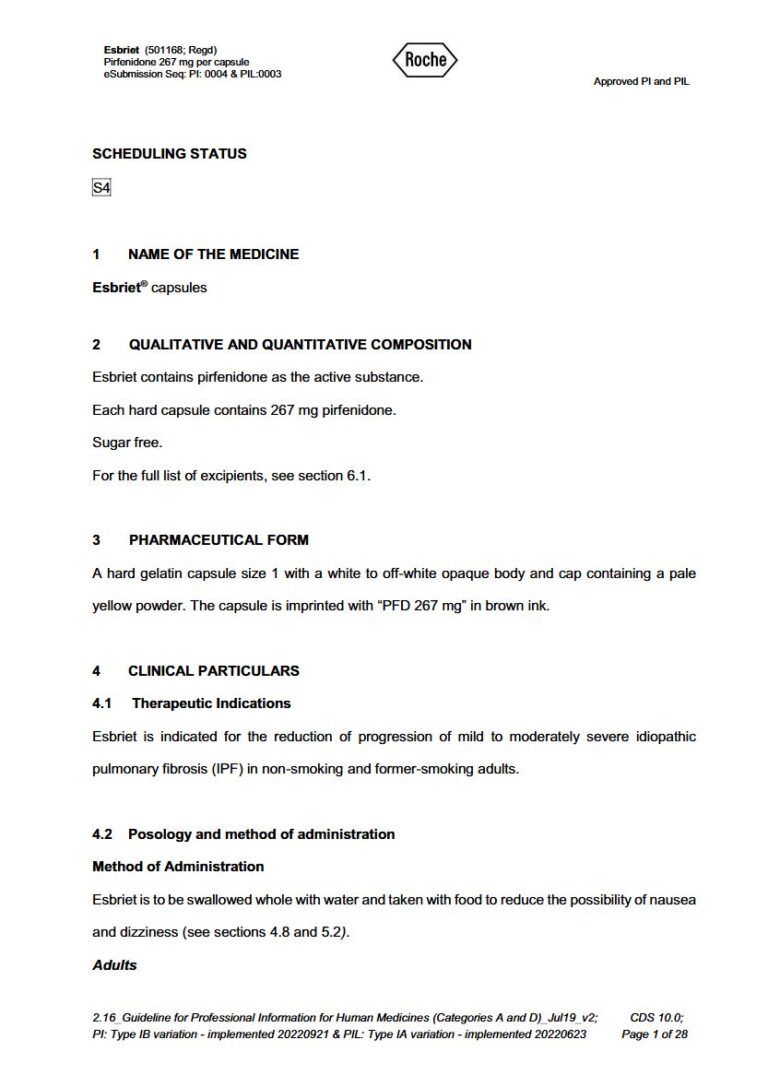
Esbriet is indicated for the reduction of progression of mild to moderately severe idiopathic pulmonary fibrosis (IPF) in non-smoking and former-smoking adults.
4.2 Posology and method of administration
Method of Administration
Esbriet is to be swallowed whole with water and taken with food to reduce the possibility of nausea and dizziness (see sections 4.8 and 5.2).
Adults
The recommended daily dose of Esbriet for patients with IPF is 801 mg (three capsules) three times a day with food i.e. a total of 2 403 mg/day. Upon initiating treatment, the dose should be titrated to the recommended daily dose of 2 403 mg/day (nine capsules) per day over a 14 day period as follows:
- Days 1 to 7: 267 mg (one capsule), three times a day (801 mg/day)
- Days 8 to 14: (534 mg) (two capsules), three times a day (1 602 mg/day)
- Day 15 onward: (801 mg) (three capsules), three times a day (2 403 mg/day)
Doses above 2 403 mg/day are not recommended for any patient. Patients who miss 14 consecutive days or more of Esbriet treatment should re-initiate therapy by undergoing the initial 2 week titration regimen up to the recommended daily dose. For treatment interruption of less than 14 consecutive days, the dose can be resumed at the previous recommended daily dose without titration.
Dose Adjustments and Other Considerations
Gastrointestinal events
Patients who experience intolerance to therapy due to gastrointestinal side effects should be reminded to take Esbriet with food. If symptoms persist the dose of Esbriet may be reduced to 267 mg - 534 mg (1 - 2 capsules) two u2013 three times a day with food with re-escalation to the recommended daily dose as tolerated. If symptoms continue, patients may be instructed to interrupt treatment for one to two weeks to allow symptoms to resolve.
Photosensitivity reaction or rash
Patients who experience a mild to moderate photosensitivity reaction or rash should be reminded to use a sunblock daily and to avoid exposure to the sun (see section 4.4). The dose of Esbriet may be reduced to 801 mg each day (267 mg, three times daily). If the rash persists after 7 days, Esbriet should be discontinued for 15 days, with re-escalation to the recommended daily dose in the same manner as the dose escalation period. Patients who experience severe photosensitivity reaction or rash should be instructed to interrupt the dose and to seek medical advice (see section 4.4). Once the rash has resolved, Esbriet may be reintroduced and re-escalated up to the recommended daily dose at the discretion of the doctor.
Hepatic function
If a patient exhibits an aminotransferase elevation > 3 to u2264 5 x ULN without bilirubin elevation after starting Esbriet therapy:
- confounding medicines should be discontinued, other causes should be excluded, and the patient monitored closely.
- Discontinuation of other medicines associated with liver toxicity should be considered.
- If clinically appropriate the dose of Esbriet should be reduced or interrupted. Once liver function tests are within normal limits Esbriet may be re-escalated to the recommended daily dose if tolerated.
If a patient exhibits an aminotransferase elevation >3 to 5 u00d7 ULN, Esbriet should be discontinued and the patient should not be re-challenged.
Special Dosage Instructions
Elderly
No dose adjustment is necessary in patients 65 years and older (see section 5).
Hepatic impairment
No dose adjustment is necessary in patients with mild to moderate hepatic impairment (i.e., Child- Pugh Class A and B). However, since plasma levels of Esbriet may be increased in some individuals with mild to moderate hepatic impairment, caution should be used with Esbriet treatment in this population. Patients should be monitored closely for signs of toxicity especially if concomitantly taking a known CYP1A2 inhibitor (see sections 4.5 and 5). Esbriet has not been studied and is not recommended in patients with severe hepatic impairment or end stage liver disease, (see sections 4.2, 4.4 and 5.2). It is recommended to monitor liver function during treatment, and dose adjustments may be necessary in the event of elevations (see sections 4.4 and 5.2).
Renal impairment
No dose adjustment is necessary in patients with mild renal impairment. Esbriet should be used with caution in patients with moderate (CrCl 30-50 mL/min) to severe (CrCl <30 mL/min) renal impairment. Esbriet has not been studied and is not recommended in patients with end-stage renal disease requiring dialysis (see sections 4.2 and 5.2).
4.3 Contraindications
- Hypersensitivity to pirfenidone or to any of the excipients of Esbriet.
- Concomitant use of fluvoxamine (see section 4.5).
- History of angioedema with Esbriet (see section 4.4).
- Concomitant use of strong Cytochrome P450 CYP 1A2 inducers, including cigarette smoking.
- Severe hepatic impairment or end stage liver disease (see sections 4.2 and 4.4).
- Severe renal impairment (CrCl <30 mL/min) or end stage renal disease requiring dialysis (see sections 4.2 and 4.4).
4.4 Special warnings and precautions for use
General
Hepatic Function
Drug-Induced Liver Injury (DILI) in the form of transient and clinically silent elevations in transaminases, has been commonly reported in patients treated with Esbriet. Uncommonly, these elevations were associated with concomitant bilirubin increases, and serious clinical consequences including isolated cases with fatal outcome have been reported post-marketing. Liver function tests (ALT, AST and bilirubin) should be performed prior to the initiation of treatment with Esbriet, and subsequently at monthly intervals for the first 6 months and then every 3 months thereafter. In addition, liver function tests should be promptly measured in patients who report symptoms that may indicate liver injury, including fatigue, anorexia, right upper abdominal discomfort, dark urine, or jaundice. In the event of significant elevation of liver aminotransferases or clinical signs and symptoms of liver injury, the dose of Esbriet should be adjusted or treatment discontinued. For patients with confirmed elevations in ALT, AST or bilirubin during treatment, dose adjustments may be necessary (see section 4.2).
Photosensitivity Reaction and Rash
Exposure to direct sunlight (including sunlamps) should be avoided or minimised during treatment with Esbriet. Patients should be instructed to use an effective sunblock daily, to wear clothing that protects against sun exposure, and to avoid other medicinal products known to cause photosensitivity. Patients should be instructed to report symptoms of photosensitivity reaction or rash to their doctor. Dose adjustments or temporary treatment discontinuation may be necessary for photosensitivity reaction or rash (see section 4.2).
Angioedema
Reports of angioedema (some serious) such as swelling of the face, lips and/or tongue which may be associated with difficulty breathing or wheezing have been received in association with Esbriet in the post-marketing setting. Therefore, patients who develop signs and symptoms of angioedema following administration with Esbriet should immediately discontinue treatment. Patients with angioedema should be managed according to standard of care. Esbriet should not be used in patients with a history of angioedema due to Esbriet (see section 4.3).
Use in Special Populations
Renal Impairment
See (sections 4.2 and 5.2).
Hepatic Impairment
See (sections 4.2 and 5.2).
Paediatric use
Safety and effectiveness of Esbriet in paediatric patients has not been established.
4.5 Interaction with other medicines and other forms of interaction
Esbriet is metabolised primarily via CYP1A2 with minor contributions from other CYP isoenzymes including CYP2C9, 2C19, 2D6 and 2E1. Concomitant use of strong inducers of CYP1A2 including smoking should be avoided during Esbriet therapy based on the observed relationship between cigarette smoking and its potential to induce CYP1A2. Patients should be encouraged to discontinue use of strong inducers of CYP1A2 and should not smoke before and during treatment with pirfenidone (see section 4.3).
Fluvoxamine and Inhibitors of CYP1A2
In a Phase 1 study, the co-administration of Esbriet and fluvoxamine (a strong inhibitor of CYP1A2 with inhibitory effects on other CYP isoenzymes [CYP2C9, 2C19, and 2D6]) resulted in a 4-fold increase in exposure to pirfenidone in non-smokers. Esbriet is contraindicated in patients with concomitant use of fluvoxamine (see section 4.3). Fluvoxamine should be discontinued prior to the initiation of Esbriet therapy and avoided during Esbriet therapy due to the reduced clearance of pirfenidone.
In vitro-in vivo extrapolations indicate that strong and selective inhibitors of CYP1A2 have the potential to increase the exposure to Esbriet by approximately 2 to 4-fold. If concomitant use of Esbriet with a strong and selective inhibitor of CYP1A2 cannot be avoided, the dose of Esbriet should be reduced to 801 mg daily (267 mg, three times a day). Patients should be closely monitored for emergence of adverse reactions associated with Esbriet therapy. Discontinue Esbriet if necessary (see sections 4.2 and 4.4).
Co-administration of Esbriet and 750 mg of ciprofloxacin (a moderate and selective inhibitor of CYP1A2) increased the exposure to Esbriet by 81 %. If ciprofloxacin at the dose of 750 mg twice daily cannot be avoided, the dose of Esbriet should be reduced to 1 602 mg daily (534 mg, three times a day). Esbriet should be used with caution when ciprofloxacin is used at a dose of 250 mg or 500 mg once or twice daily. Esbriet should be used with caution in patients treated with other moderate inhibitors of CYP1A2.
Agents or combinations of agents that are moderate or strong inhibitors of both CYP1A2 and one or more other CYP isoenzymes involved in the metabolism of pirfenidone (i.e., CYP2C9, 2C19, 2D6, and 2E1) should be avoided during Esbriet treatment.
Cigarette Smoking and Inducers of CYP1A2
Concomitant use of strong inducers of CYP1A2 including smoking should be avoided during Esbriet therapy based on the observed relationship between cigarette smoking and its potential to induce CYP1A2. Patients should be encouraged to discontinue use of strong inducers of CYP1A2 and abstain from smoking during treatment with Esbriet as efficacy in smokers has not been established (see section 4.3). In the case of moderate inducers of CYP1A2 (e.g., omeprazole), concomitant use may theoretically result in a lowering of pirfenidone plasma levels. Co-administration of medicines that act as potent inducers of both CYP1A2 and the other CYP isoenzymes involved in the metabolism of Esbriet (e.g., rifampicin) may result in significant lowering of Esbriet plasma levels. These medicines should be avoided whenever possible.
4.6 Fertility, pregnancy and lactation
Safety in pregnancy and lactation has not been demonstrated. Esbriet must not be used during breastfeeding as safety and/or efficacy has not been established.
4.7 Effects on ability to drive and use machines
Esbriet may cause dizziness and fatigue, which could influence the ability to drive or use machines.
4.8 Undesirable effects
a. Summary of the safety profile : Clinical Trials
The safety of Esbriet has been evaluated in 623 patients from three Phase 3 clinical studies.
Table 1 summarises the adverse drug reactions (ADRs) that have been reported in association with the use of Esbriet in clinical trials. The adverse reactions are ranked as per CIOMS System Organ Class, using the following convention: Very common (u2265 1/10); common (u2265 1/100 to < 1/10); uncommon (u22651/1 000 to <1/100); rare (u2265 1/10 000 to < 1/1 000); very rare (<1/10 000), including isolated reports.
b. Tabulated list of adverse reactions
Table 1: Adverse Drug Reactions Occurring in Patients Treated with Esbriet in Clinical Trials
| ADR (MedDRA) | Esbriet (n = 623) | System Organ Class | All grades (%) | Frequency Category |
|---|---|---|---|---|
| Metabolism and Nutrition Disorders | Decreased weight | 10,1 % | Very common | |
| Decreased appetite | 20,7 % | Very common | ||
| Psychiatric Disorders | Insomnia | 10,4% | Very common | |
| Nervous system Disorders | Headache | 22,0 % | Very common | |
| Dizziness | 18,0 % | Very common | ||
| Dysgeusia | 5,8 % | Common | ||
| Gastrointestinal Disorders | Dyspepsia | 18,5 % | Very common | |
| Nausea | 36,1 % | Very common | ||
| Diarrhoea | 25,8 % | Very common | ||
| Abdominal pain | 6,3 % | Common | ||
| Vomiting | 13,3 % | Very common | ||
| Gastro-esophageal reflux disease | 11,1 % | Very common | ||
| Hepatobiliary Disorders | Increased ALT | 3,2 % | Common | |
| Increased AST | 2,7 % | Common | ||
| Skin and subcutaneous disorders | Photosensitivity reaction | 9,3 % | Common | |
| Rash | 30,3 % | Very common | ||
| Pruritus | 7,9 % | Common | ||
| Musculoskeletal and connective tissue disorders | Arthralgia | 10,0 % | Very Common | |
| General disorders and administration site conditions | Fatigue | 26,0 % | Very common | |
| Asthenia | 6,4 % | Common |
Post Marketing
In addition to adverse reactions identified from clinical trials the following adverse reactions have been identified during post-approval use of Esbriet.
Blood and Lymphatic System Disorders: Agranulocytosis
Immune System Disorders: Angioedema
Hepatobiliary Disorders: Increased bilirubin in combination with increases of ALT and AST. Clinically relevant Drug-Induced Liver Injury (uncommon), including isolated reports with fatal outcome.
Reporting of suspected adverse reactions
Reporting suspected adverse reactions after authorisation of the medicine is important. It allows continued monitoring of the benefit/risk balance of the medicine. Healthcare professionals are asked to report any suspected adverse reactions to SAHPRA via the u201c6.04 Adverse Drug Reaction Report Formu201d, found online under SAHPRAu2019s publications: https://www.sahpra.org.za/Publications/Index/8
4.9 Overdose
There is limited clinical experience with overdose. In the event of a suspected overdose, supportive medical care should be provided including monitoring of vital signs and close observation of the clinical status of the patient.
