
Vaxneuvance 32 µg Suspension for Injection
PDF Leaflet Revision Date: 13 September 2024
Clinical Summary
Quick overview from the medicine insert
Indication
Active immunization against invasive disease and pneumonia caused by Streptococcus pneumoniae.
Dosage (summary)
0.5 mL IM for adults; 3 doses for infants, with a booster at 11-15 months.
Special Populations
- Elderly (u2265 65 years)
- Preterm infants
- Individuals with HIV
Pregnancy & Breastfeeding
Use only if clearly needed during pregnancy; unknown if excreted in breast milk.
Key Drug Interactions
- Concomitant with inactivated influenza vaccine
- Immunosuppressive therapies may reduce immune response
Contraindications
- Severe allergic reaction to any component or diphtheria toxoid-containing vaccine
Common side effects
- Injection site pain
- Fatigue
- Myalgia
- Headache
- Fever
Counselling Points
- Shake vigorously before use
- Do not inject if discolored or contains particulates
- Administer IM only
Serious warnings
- Altered immunocompetence may reduce immune response
- Risk of apnea in preterm infants
Important Disclaimer
The Vaxneuvance 32 µg Suspension for Injection professional information leaflet below is the property of Msd and is provided on Medinsert exactly as issued, with no.. alterations or editorial changes. We make every effort to keep content current by updating documents as soon as new versions become available. Medinsert serves as a trusted access point for healthcare professionals, but does not replace official sources or clinical judgement. For more details, please read our full disclaimer. read more>>
 Healthcare Professionals Only
This content is for registered healthcare professionals
Sign in or create a free account to read the full package insert.
Free for HPCSA-registered professionals. Powered by Medinsert.
Clinical Particulars
Section 4 of the official insert — extracted exactly as issued, no alterations
4.1 Therapeutic indications
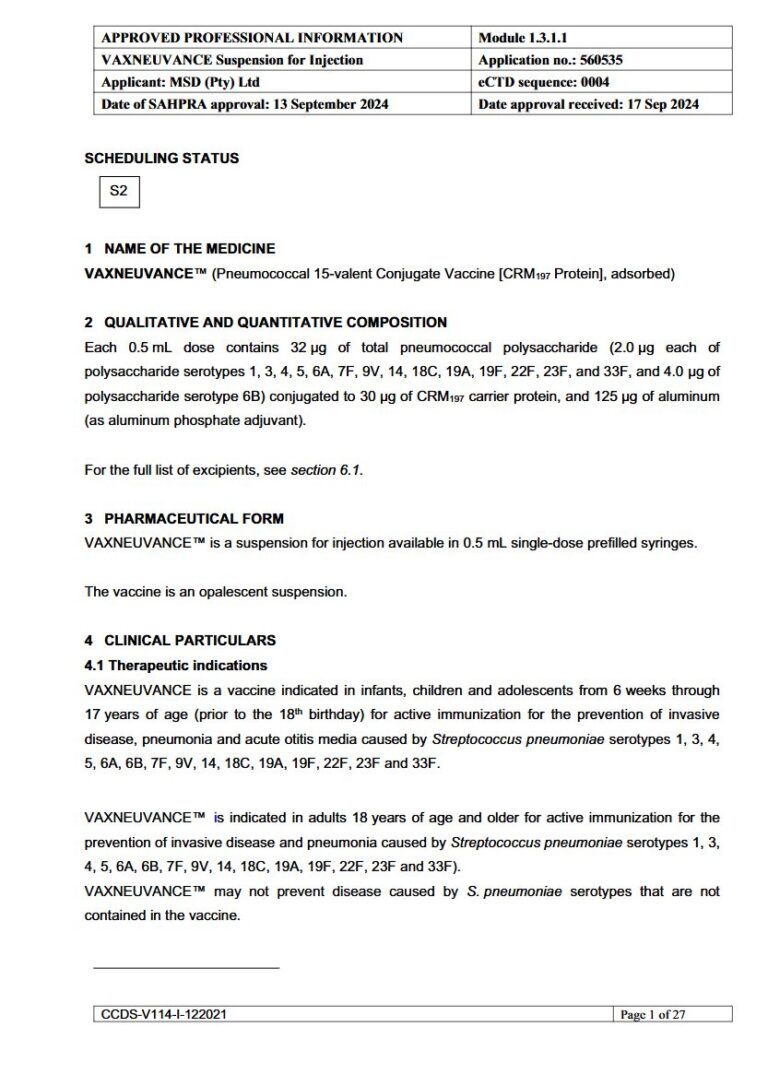
VAXNEUVANCE is a vaccine indicated in infants, children and adolescents from 6 weeks through 17 years of age (prior to the 18th birthday) for active immunization for the prevention of invasive disease, pneumonia and acute otitis media caused by Streptococcus pneumoniae serotypes 1, 3, 4, 5, 6A, 6B, 7F, 9V, 14, 18C, 19A, 19F, 22F, 23F and 33F. VAXNEUVANCEu2122 is indicated in adults 18 years of age and older for active immunization for the prevention of invasive disease and pneumonia caused by Streptococcus pneumoniae serotypes 1, 3, 4, 5, 6A, 6B, 7F, 9V, 14, 18C, 19A, 19F, 22F, 23F and 33F). VAXNEUVANCEu2122 may not prevent disease caused by S. pneumoniae serotypes that are not contained in the vaccine.
4.2 Posology and method of administration
General
The vaccination schedule for VAXNEUVANCE should be based on official recommendations.
Posology
Administer a 0.5 mL dose of VAXNEUVANCE intramuscularly.
Method of administration
For intramuscular use only. Do not inject intravascularly. The preferred site for injection is the anterolateral aspect of the thigh in infants or the deltoid muscle of the upper arm in children and adults. The vaccine should not be injected in the gluteal area or areas where there may be a major nerve trunk and/or blood vessel.
Routine vaccination schedule in infants and children aged 6 weeks to less than 2 years
Two-dose primary series followed by a booster dose
The recommended immunisation regimen consists of 3 doses of Vaxneuvance, each of 0.5 ml. The first dose is given as early as 6 weeks of age, with a second dose administered 8 weeks later. The third (booster) dose is recommended between 11 through 15 months of age.
Three-dose primary series followed by a booster dose
An immunisation regimen consisting of 4 doses of Vaxneuvance, each of 0.5 mL, may be given. This primary series consists of 3 doses, with the first dose given as early as 6 weeks of age, with an interval of 4 to 8 weeks between doses in the primary series. The fourth (booster) dose is recommended between 11 through 15 months of age and at least 2 months after the third dose.
Preterm infants (<37 weeks gestation at birth)
The recommended immunisation regimen consists of a three-dose primary series of Vaxneuvance followed by a fourth (booster) dose, each of 0.5 mL, as per three-dose primary series followed by a booster dose posology (see sections 4.4 and 5.1).
Prior vaccination with another pneumococcal conjugate vaccine
Infants and children who have begun immunisation with another pneumococcal conjugate vaccine may switch to Vaxneuvance at any point in the schedule (see section 5.1).
Catch-up vaccination schedule for children 7 months to less than 18 years of age
Unvaccinated infants 7 to less than 12 months of age
3 doses, each of 0.5 mL, with the first two doses given at least 4 weeks apart. A third (booster) dose is recommended after 12 months of age, separated from the second dose by at least 2 months.
Unvaccinated children 12 months to less than 2 years of age
2 doses, each of 0.5 mL, with an interval of 2 months between doses.
Unvaccinated or not fully vaccinated children and adolescents 2 to less than 18 years of age
1 dose (0.5 mL). If a previous pneumococcal conjugate vaccine was administered, at least 2 months should elapse before administering Vaxneuvance.
Vaccination schedule for individuals 18 years of age and older
Individuals 18 years of age and older
1 dose (0.5 mL). The need for revaccination with a subsequent dose of Vaxneuvance has not been established. If a previous pneumococcal conjugate vaccine was administered, at least 2 months should elapse before receiving VAXNEUVANCE.
Instructions for use
VAXNEUVANCEu2122 should not be diluted or mixed with other vaccines. The full recommended dose of the vaccine should be used. When VAXNEUVANCEu2122 is administered at the same time as another injectable vaccine(s), the vaccines should always be given at different injection sites (see section 4.5). Because this product is a suspension containing an adjuvant, hold horizontally and shake vigorously immediately prior to use to obtain an opalescent suspension in the vaccine container. Do not use the vaccine if it cannot be resuspended. Parenteral drug products should be inspected visually for particulate matter and discoloration prior to administration. This product should not be used if particulate matter or discoloration is found. The prefilled syringe is for single use only and should not be used for more than one individual. Attach a needle by twisting in a clockwise direction until the needle fits securely on the syringe. Inject the entire contents of the syringe. Exercise caution to avoid harm from an accidental needle stick.
Special populations
Elderly (u2265 65 years of age)
Of the 4 344 individuals aged 50 years and older who received, 2 470 (56.9 %) were 65 years and older, and 479 (11.0 %) were 75 years and older (see sections 4.8 and 5.1).
Paediatric use
The safety and effectiveness of VAXNEUVANCEu2122 in children younger than 6 weeks of age have not yet been established. Individuals at Increased Risk for Pneumococcal Disease
One dose of VAXNEUVANCEu2122 should be given to individuals who have one or more underlying conditions predisposing them to an increased risk of pneumococcal disease (i.e. adults living with human immunodeficiency virus (HIV) or immunocompetent adults 18 to 49 years of age with risk factors for pneumococcal disease; see section 5.1).
4.3 Contraindications
VAXNEUVANCEu2122 is contraindicated in individuals with a history of a severe allergic reaction (e.g., anaphylaxis) to any component of the vaccine or any diphtheria toxoid-containing vaccine. See section 6.1.
4.4 Special warnings and precautions for use
Individuals with altered immunocompetence, including those receiving immunosuppressive therapy, may have a reduced immune response to VAXNEUVANCE (See sections 4.5 and 5.1). The potential risk of apnea should be considered when administering any intramuscular vaccine to infants born prematurely. As the benefit of vaccination is high in this group of infants, vaccination generally should not be withheld or delayed. As with any vaccine, VAXNEUVANCE may not protect all vaccine recipients. This medicinal product contains less than 1 mmol sodium (23 milligrams) per dose, i.e. essentially u2018sodium-freeu2019.
4.5 Interaction with other medicines and other forms of interaction
Use with Other Vaccines
Infants and Children Less Than 2 Years of Age
VAXNEUVANCE can be administered concomitantly with other routine paediatric vaccines (See sections 4.5 and 5.1). Children and Adolescents 2 Through 17 Years of Age
There are no data on the concomitant administration of VAXNEUVANCE with other vaccines. Adults
VAXNEUVANCE can be administered concomitantly with inactivated influenza vaccine (see sections 4.8 and 5.1). There are no data on the concomitant administration of VAXNEUVANCE with other vaccines.
Use with Immunosuppressive Therapies
Immunosuppressive therapies, including irradiation, antimetabolites, alkylating agents, cytotoxic drugs, corticosteroids, therapeutic proteins and targeted immunomodulators may reduce the immune responses to vaccines (see section 4.4).
4.6 Fertility, pregnancy and lactation
Pregnancy
Animal Data
Developmental and reproductive toxicity studies have been performed in female rats at a dose approximately 200 times the adult human dose on a mcg/kg basis. In these studies, female rats received VAXNEUVANCE (32 mcg/rat/dose) by intramuscular injection 28 days and 7 days prior to mating, on gestation day 6 and on lactation day 7. There was no evidence of embryofoetal lethality or foetal malformations and variations and no adverse effects on pre-weaning development were observed. Antibodies to all 15 serotypes contained in VAXNEUVANCE were detected in offspring, attributable to the acquisition of maternal antibodies via placental transfer during gestation and possibly via lactation.
Human Data
There are no adequate and well-controlled studies of VAXNEUVANCE in pregnant women, and human data available from clinical trials with VAXNEUVANCE have not established the presence or absence of vaccine-associated risk during pregnancy. The decision to vaccinate a woman who is pregnant should consider the womanu2019s risk of pneumococcal disease; VAXNEUVANCE should be administered only if clearly needed.
Breastfeeding
It is not known whether this vaccine is excreted in human milk.
Fertility
No human data on the effect of VAXNEUVANCE on fertility are available. Animal studies in female rats do not indicate harmful effects (see section 5.3).
4.7 Effects on ability to drive and use machines
VAXNEUVANCE has no or negligible influence on the ability to drive and use machines.
4.8 Undesirable effects
Clinical Trials Experience
Paediatric population
Infants and children aged 6 weeks to less than 2 years The safety of Vaxneuvance in healthy infants, including preterm infants (from 6 weeks of age at first vaccination) and children (11 through 15 months of age) was assessed as a 3 dose or 4 dose regimen in 5 clinical studies with a total of 7,229 participants. All 5 studies evaluated the safety of Vaxneuvance when administered concomitantly with other routine paediatric vaccines. In these studies, 4,286 participants received a complete regimen of Vaxneuvance, 2,405 participants received a complete regimen of the 13-valent pneumococcal conjugate vaccine (PCV) and 538 participants received Vaxneuvance when used to complete a regimen initiated with the 13-valent PCV (mixed dose regimen). The most frequent adverse reactions were pyrexia u226538 u00b0C (75.2 %), irritability (74.5 %), somnolence (55.0 %), injection-site pain (44.4 %), injection-site erythema (41.7 %), decreased appetite (38.2 %), injection-site induration (28.3 %) and injection-site swelling (28.2 %) based on results in 3,589 participants (Table 1), excluding participants who received a mixed dose regimen. The majority of solicited adverse reactions were mild to moderate (based on intensity or size) and of short duration (u22643 days). Severe reactions (defined as being extremely distressed or unable to do usual activities or size of injection site reaction >7.6 cm) occurred in u2264 3.5 % of infants and children following any dose, with the exception of irritability which occurred in 11.4 % of participants.
Children and adolescents 2 to less than 18 years of age
The safety of Vaxneuvance in healthy children and adolescents was assessed in a study that included 352 participants 2 to less than 18 years of age, of whom 177 received a single dose of Vaxneuvance. In this age cohort, 42.9 % of all participants had a history of previous vaccination with a lower valency pneumococcal conjugate vaccine. The most frequent adverse reactions were injection-site pain (54.8 %), myalgia (23.7 %), injection-site swelling (20.9 %), injection-site erythema (19.2 %), fatigue (15.8 %), headache (11.9 %), injection-site induration (6.8 %), and pyrexia u226538 u00b0C (5.6 %) (Table 1). The majority of solicited adverse reactions were mild to moderate (based on intensity or size) and of short duration (u22643 days); severe reactions (defined as being extremely distressed or unable to do usual activities or size of injection site reaction >7.6 cm) occurred in u22644.5 % of children and adolescents.
Adults 18 years of age and older
The safety of VAXNEUVANCE in healthy and immunocompetent adults was assessed in 6 randomized, double-blind clinical studies (Protocol 007, Protocol 016, Protocol 017, Protocol 019, Protocol 020 and Protocol 021) conducted across the Americas, Europe and Asia Pacific, which included 7,136 adults ranging in age from 18 to 98 years. Each study enrolled adults with stable underlying medical conditions and/or risk factors that are known to increase the risk of pneumococcal disease. VAXNEUVANCE was administered to 5,478 adults; 1,134 were 18 to 49 years of age, 1,874 were 50 to 64 years of age, and 2,470 were 65 years of age and older. Of those who received VAXNEUVANCE, 5,101 adults were pneumococcal vaccine-nau00efve and 377 adults were previously vaccinated with PNEUMOVAX 23 at least 1 year prior to enrollment. The safety of VAXNEUVANCE in pneumococcal vaccine-nau00efve adults 50 years of age and older was evaluated in 3 active comparator-controlled clinical studies (Protocol 016, Protocol 019 and Protocol 020) in which 3,032 participants received VAXNEUVANCE and 1,154 participants received Pneumococcal 13-valent Conjugate Vaccine (PCV13). A descriptive study (Protocol 017) evaluated the safety of VAXNEUVANCE in pneumococcal vaccine-nau00efve adults 18 to 49 years of age. The safety of VAXNEUVANCE in adults 65 years of age and older who were previously vaccinated with PNEUMOVAX 23 (at least 1 year prior to study entry) was evaluated in an additional descriptive study (Protocol 007). The safety of concomitant administration of VAXNEUVANCE with seasonal inactivated influenza vaccine was evaluated in 1,196 adults 50 years of age and older, including those with or without a history of prior vaccination with PNEUMOVAX 23 (Protocol 021). Safety was evaluated using a Vaccination Report Card for up to 14 days postvaccination. Oral body temperature and injection-site adverse events were solicited on Day 1 through Day 5 postvaccination. Systemic adverse events were solicited on Day 1 through Day 14 postvaccination. Unsolicited adverse events were reported on Day 1 through Day 14 postvaccination. The duration of the safety follow-up period postvaccination with VAXNEUVANCE was 1 month in Protocol 007, 6 months in Protocol 019, Protocol 020, Protocol 017 and Protocol 021 and 12 months in Protocol 016. The most frequently reported adverse reactions following vaccination with Vaxneuvance were solicited. In the pooled analysis of the 7 studies, the most frequent adverse reactions were injection site pain (64.6%), fatigue (23.4%), myalgia (20.7%), headache (17.3%), injection-site swelling (16.1%), injection-site erythema (11.3%) and arthralgia (7.9%) (Table 1). The majority of solicited adverse reactions were mild (based on intensity or size) and of short duration (u22643 days); severe reactions (defined as an event that prevents normal daily activity or size of injection site reaction >10 cm) occurred in u22641.5% of adults across the clinical program. Older adults reported fewer adverse reactions than younger adults.
Tabulated list of adverse reactions
In clinical studies of adults, local and systemic adverse reactions were solicited daily after vaccination for 5 and 14 days, respectively and in infants, children and adolescents up to 14 days after vaccination. In all populations, unsolicited adverse reactions were reported for 14 days after vaccination. Adverse reactions reported for all age groups are listed in this section per system organ class, in decreasing order of frequency and seriousness. The frequency is defined as follows:
- Very common (u22651/10)
- Common (u22651/100 to <1/10)
- Uncommon (u22651/1,000 to <1/100)
- Rare (u22651/10,000 to <1/1,000)
- Very rare (<1/10,000)
- Not known (cannot be estimated from the available data).
4.9 Overdose
There are no data with regard to overdose.
