
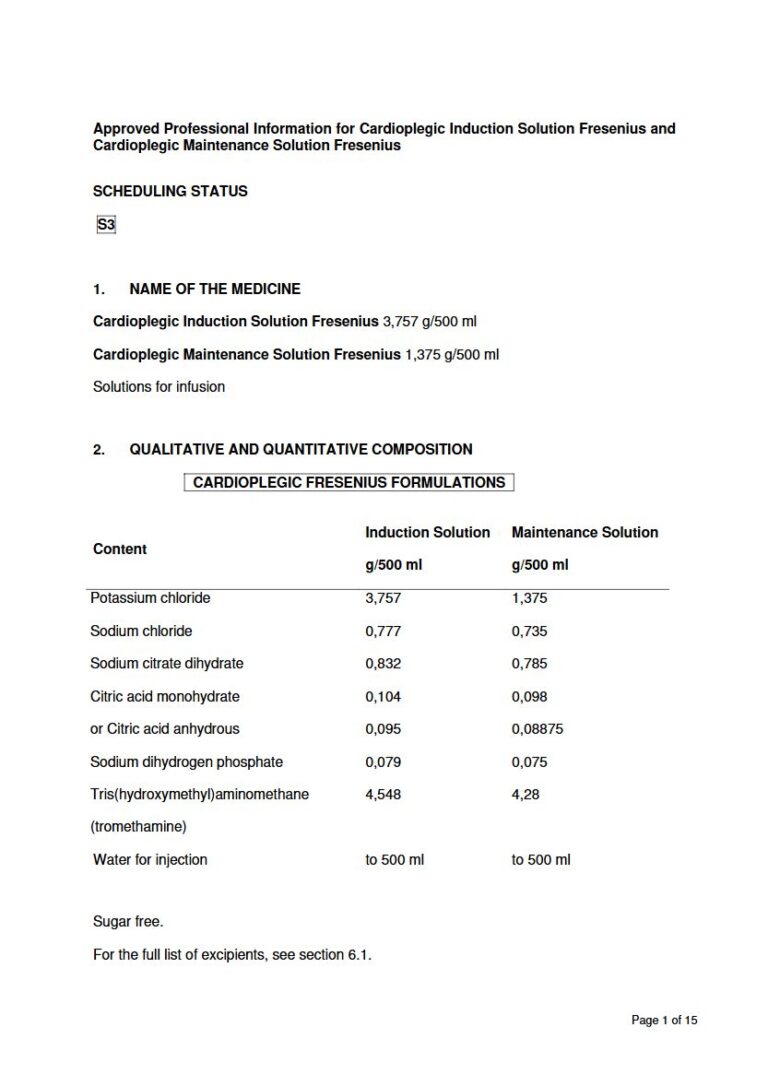
Cardioplegic Induction 3.757 g/1.375 g/500 ml Solution
PDF Leaflet Revision Date: 01 April 2022
Clinical Summary
Quick overview from the medicine insert
Indication
For blood cardioplegic cardiac bypass procedures.
Dosage (summary)
Induction: 300 ml/min for 3 mins; Maintenance: every 20 mins during surgery.
Special Populations
- Children
- Geriatric patients
Pregnancy & Breastfeeding
Safety in pregnancy and lactation not established.
Key Drug Interactions
- Lithium
- Potassium-sparing diuretics
- NSAIDs
Contraindications
- Hypersensitivity to potassium chloride
- Hyperchloremia
- Severe renal insufficiency
- Uncompensated heart failure
- Addison's disease
Common side effects
- Hyperkalaemia
- Hyponatraemia
- Anaphylactic reaction
- Infusion site pain
Counselling Points
- Monitor serum electrolytes and ECG
- Discard unused solution
- Use aseptic technique when adding glucose
Serious warnings
- Risk of hyperkalaemia
- Risk of hyponatraemic encephalopathy
Important Disclaimer
The Cardioplegic Induction 3.757 g/1.375 g/500 ml Solution professional information leaflet below is the property of Fresenius Kabi Manufacturing Sa and is provided on Medinsert exactly as issued, with no.. alterations or editorial changes. We make every effort to keep content current by updating documents as soon as new versions become available. Medinsert serves as a trusted access point for healthcare professionals, but does not replace official sources or clinical judgement. For more details, please read our full disclaimer. read more>>
 Healthcare Professionals Only
This content is for registered healthcare professionals
Sign in or create a free account to read the full package insert.
Free for HPCSA-registered professionals. Powered by Medinsert.
Clinical Particulars
Section 4 of the official insert — extracted exactly as issued, no alterations
4.1 Therapeutic indications
For blood cardioplegic cardiac bypass procedures.
4.2 Posology and method of administration
Posology
- Both Cardioplegic Fresenius solutions are designed to be mixed with blood in the ratio of four parts blood and one part cardioplegic solution.
- Add 35 ml of 50 % glucose injection BP per 500 ml Cardioplegic Fresenius solution using aseptic technique.
- Discard after 24 hours following addition of glucose.
- Cardioplegic Induction Solution Fresenius: This high K + arresting solution is used and is given at 300 ml/min at 8 u00b0C for three (3) minutes. Higher flow rates and longer infusion times may be necessary if the patient has mild aortic insufficiency.
- Cardioplegic Maintenance Solution Fresenius: This product is given every twenty (20) minutes or after the completion of each distal anastomosis when coronary artery bypass grafting is being performed.
The Cardioplegic Fresenius solution used is the low K + Maintenance solution and is given at a flow rate of 200 ml/min for two (2) minutes at 8 u00b0C. If retrograde cardioplegia is to be used, then one (1) minute of anterograde to the aortic root and grafts are given at 200 ml/min and one (1) minute of retrograde are given to the coronary sinus and grafts at 200 ml/min.
Method of administration
Intravenous infusion.
4.3 Contraindications
- Hypersensitivity to potassium chloride or to any of the excipients listed in section 6.1.
- Hyperchloremia and hyperkalaemia that are not related to the concentration effect associated with a volume depletion.
- Severe renal insufficiency (with oliguria/anuria).
- Uncompensated heart failure and severe congestive heart failure.
- Addison's disease.
- Fluid and sodium retention.
- Acute ischaemic stroke.
- Head trauma (first 24 hours).
4.4 Special warnings and precautions for use
Care must be taken that all Cardioplegic Fresenius solutions are mixed with blood in the ratio of four parts blood and one part cardioplegic solution (see section 4.2). Add 35 ml of 50 % glucose injection BP per 500 ml Cardioplegic Fresenius solution before administration (see section 4.2).
Potassium should be administered with considerable care to patients with cardiac disease or conditions predisposing to hyperkalaemia such as renal or adrenocortical insufficiency, acute dehydration, or extensive tissue destruction as occurs with severe burns. Regular monitoring of clinical status, serum electrolytes and ECG is advisable in patients receiving potassium therapy, particularly those with cardiac or renal impairment.
Sodium salts should be administered with caution to patients with hypertension, heart failure, peripheral or pulmonary oedema, impaired renal function, pre-eclampsia, or other conditions associated with sodium retention (see section 4.5).
Hyponatraemia
Patients with non-osmotic vasopressin release (e.g. in acute illness, pain, post-operative stress, infections, burns, and CNS diseases), patients with heart-, liver- and kidney diseases and patients exposed to vasopressin agonists (see section 4.5) are at particular risk of acute hyponatraemia upon infusion of hypotonic fluids. Acute hyponatraemia can lead to acute hyponatraemic encephalopathy (brain oedema) characterised by headache, nausea, seizures, lethargy and vomiting. Patients with brain oedema are at particular risk of severe, irreversible and life-threatening brain injury.
Children, women in the fertile age and patients with reduced cerebral compliance (e.g. meningitis, intracranial bleeding, and cerebral contusion) are at particular risk of the severe and life-threatening brain swelling caused by acute hyponatraemia.
Paediatric population
The infusion rate and volume depends on the age, weight, clinical and metabolic conditions of the patient, concomitant therapy, and should be determined by a doctor experienced in paediatric intravenous fluid therapy. Children (including neonates and older children) are at increased risk of developing hyponatraemia as well as for developing hyponatraemic encephalopathy. The infusion of hypotonic fluids together with the non-osmotic secretion of ADH may result in hyponatraemia. Plasma electrolyte concentrations should be closely monitored in the paediatric population as this population may have impaired ability to regulate fluids and electrolytes. Rapid correction of hyponatraemia is potentially dangerous (risk of serious neurologic complications). Dosage, rate, and duration of administration should be determined by a doctor experienced in paediatric intravenous fluid therapy. In order to avoid potentially fatal over infusion of intravenous fluids to the neonate, special attention needs to be paid to the method of administration. When using a syringe pump to administer intravenous fluids or medicines to neonates, a bag of fluid should not be left connected to the syringe. When using an infusion pump all clamps on the intravenous administration set must be closed before removing the administration set from the pump, or switching the pump off. This is required regardless of whether the administration set has an anti free flow device. The intravenous infusion device and administration equipment must be frequently monitored.
Geriatric population
When selecting the type of infusion solution and the volume/rate of infusion for a geriatric patient, consider that geriatric patients are generally more likely to have cardiac, renal, hepatic, and other diseases or concomitant medicine therapy. Cardioplegic Fresenius solutions contain sodium. Cardioplegic Induction Solution Fresenius contains 306 mg sodium per 500 ml, equivalent to 15,3 % of the WHO recommended maximum daily intake of 2 g sodium for an adult. Cardioplegic Maintenance Solution Fresenius contains 289 mg sodium per 500 ml, equivalent to 14,5 % of the WHO recommended maximum daily intake of 2 g sodium for an adult.
4.5 Interaction with other medicines and other forms of interaction
Caution is advised in patients treated with lithium. Renal sodium and lithium clearance may be increased during administration of Cardioplegic Fresenius solutions and can result in decreased lithium levels. Cardioplegic Fresenius solutions should be used with caution in patients treated concurrently or recently with medicines that can cause hyperkalaemia or increase the risk of hyperkalaemia, such as potassium sparing diuretics (e.g. amiloride, spironolactone, triamterene). Administration of potassium in patients treated with such medicines is associated with an increased risk of severe and potentially fatal hyperkalaemia, in particular in the presence of other risk factors for hyperkalaemia.
Regarding medicines (such as certain antiepileptic and psychotropic medications) that increase the risk of hyponatraemia or sodium and fluid retention, see section 4.4.
Medicines leading to an increased vasopressin effect
The below listed medicines increase the vasopressin effect, leading to reduced renal electrolyte free water excretion and increase the risk of hospital acquired hyponatraemia following inappropriately balanced treatment with i.v. fluids (see sections 4.4 and 4.8).
- Medicines stimulating vasopressin release, e.g. chlorpropamide, clofibrate, carbamazepine, vincristine, selective serotonin reuptake inhibitors, 3.4- methylenedioxy-N-methamphetamine, ifosfamide, antipsychotics, narcotics.
- Medicines potentiating vasopressin action, e.g. chlorpropamide, NSAIDs, cyclophosphamide.
- Vasopressin analogues, e.g. desmopressin, oxytocin, terlipressin.
Other medicines increasing the risk of hyponatraemia also include diuretics in general and antiepileptics such as oxcarbazepine. Solutions containing potassium should be used with caution in patients receiving medicines that increase serum potassium concentrations (potassium-sparing diuretics, ACE inhibitors, cyclosporin, and medicines that contain potassium such as potassium salts of penicillin). Corticosteroids are associated with the retention of sodium and water, with oedema and hypertension.
4.6 Fertility, pregnancy and lactation
The safety of Cardioplegic Fresenius solutions in pregnancy and lactation has not been established.
4.7 Effects on ability to drive and use machines
There is no information on the effects of Cardioplegic Fresenius solutions on the ability to drive and use machines.
4.8 Undesirable effects
a) Summary of the safety profile
Hyperkalaemia may occur. The most serious effects of hyperkalaemia are disturbances in cardiac conduction, arrhythmias, hypotention and muscle weakness (see sections 4.4 and 4.9). Hyponatraemia may occur and can lead to CNS manifestations including seizures, coma, cerebral oedema and death (see sections 4.4 and 4.9).
b) Tabulated summary of adverse reactions
| System organ class | Adverse reaction | Frequency unknown (cannot be estimated from the available data) | |||||
|---|---|---|---|---|---|---|---|
| Immune system disorders | Anaphylactic reaction | Hypersensitivity | |||||
| Metabolism and nutrition disorders | Hospital acquired hyponatraemia* | Hyperkalaemia | Hypervolaemia | ||||
| Nervous system disorders | Hyponatraemic encephalopathy* | ||||||
| Cardiac disorders | Cardiac arrest** | ||||||
| Vascular disorders | Phlebitis | Venous thrombosis | Thrombophlebitis | ||||
| Skin and subcutaneous tissue disorders | Rash | Pruritis | |||||
| General disorders and administrative site conditions | Infusion site pain | Injection site vesicles | Injection site infection | Extravasation | Chills | Pyrexia | Sweating |
* Hospital acquired hyponatraemia may cause irreversible brain injury and death due to development of acute hyponatraemic encephalopathy (see section 4.4).
** As a manifestation of rapid intravenous administration and/or of hyperkalaemia.
c) Description of selected adverse reactions
Incorrect administration technique might cause the appearance of fever reactions such as chills and sweating. Injection site reactions include infusion site pain, injection site vesicles, injection site infection and extravasation.
d) Paediatric population
Children (including neonates and older children) are at increased risk of developing hyponatraemia as well as for developing hyponatraemic encephalopathy (see section 4.4).
e) Other special populations
Children, women in the fertile age and patients with reduced cerebral compliance (e.g. meningitis, intracranial bleeding, and cerebral contusion) are at particular risk of the severe and life-threatening brain swelling caused by acute hyponatraemia (see section 4.4). When selecting the type of infusion solution and the volume/rate of infusion for a geriatric patient, consider that geriatric patients are generally more likely to have cardiac, renal, hepatic, and other diseases or concomitant medicine therapy (see section 4.4).
4.9 Overdose
Excess administration of Cardioplegic Fresenius solutions can cause:
- Adverse effects on water and electrolyte balance with corresponding complications. Severe dilutional hyponatraemia and its complications can be fatal.
- Hyponatraemia (which can lead to CNS manifestations including seizures, coma, cerebral oedema and death).
- Fluid overload (which can lead to central and/or peripheral oedema).
- Hyperkalaemia. If hyperkalaemia is present or suspected, discontinue the infusion immediately and institute close ECG, laboratory and other monitoring and, as necessary, corrective therapy to reduce serum potassium levels. Manifestations of hyperkalaemia may include:
- disturbances in cardiac conduction and arrhythmias, including bradycardia, heart block, asystole, ventricular tachycardia, ventricular fibrillation
- hypotension
- muscle weakness up to and including muscular and respiratory paralysis, paraesthesia of extremities, gastrointestinal symptoms (ileus, nausea, vomiting, abdominal pain).
- Arrhythmias and conduction disorders. In addition, the ECG shows progressive changes that occur with increasing potassium levels. Possible changes include:
- peaking of T waves,
- loss of P waves, and
- QRS widening.
However, the correlation between potassium levels and ECG changes is not precise, and whether or at which potassium level certain ECG signs develop depends on factors such as patient sensitivity, the presence of other electrolyte disorders, and the rapidity of the development of hyperkalaemia. The presence of any ECG findings that are suspected to be caused by hyperkalaemia should be considered a medical emergency. See also sections 4.4 and 4.8
When assessing an overdose, any additives in the solution must also be considered.
Clinically significant overdose of Cardioplegic Fresenius solutions may, therefore, constitute a medical emergency. Interventions include discontinuation of Cardioplegic Fresenius solutions, dose reduction and other measures as indicated for the specific clinical constellation.
