
Scheriproct Ointment 1.9 mg/ 5 mg OINTMENT
PDF Leaflet Revision Date: 19 April 2022
Clinical Summary
Quick overview from the medicine insert
Indication
Symptomatic relief of perianal discomfort and inflammation.
Dosage (summary)
Apply a thin layer twice daily; up to 3-4 times on the first day.
Special Populations
- Infants
- Elderly
Pregnancy & Breastfeeding
Contraindicated in pregnancy; insufficient data on lactation.
Key Drug Interactions
- CYP3A inhibitors may increase systemic side effects
Contraindications
- Hypersensitivity to ingredients
- Viral infections in treatment area
- Corticosteroids during pregnancy
- Tuberculous or syphilitic processes
Common side effects
- Skin atrophy
- Allergic skin reactions
- Blurred vision
Counselling Points
- Apply after defecation
- Avoid contact with eyes
- Wash hands after use
Serious warnings
- Do not use continuously for more than 7 days
- Risk of adrenal suppression
- Consult doctor if symptoms persist
Important Disclaimer
The Scheriproct Ointment 1.9 mg/ 5 mg OINTMENT professional information leaflet below is the property of Adcock Ingram and is provided on Medinsert exactly as issued, with no.. alterations or editorial changes. We make every effort to keep content current by updating documents as soon as new versions become available. Medinsert serves as a trusted access point for healthcare professionals, but does not replace official sources or clinical judgement. For more details, please read our full disclaimer. read more>>
 Healthcare Professionals Only
This content is for registered healthcare professionals
Sign in or create a free account to read the full package insert.
Free for HPCSA-registered professionals. Powered by Medinsert.
Clinical Particulars
Section 4 of the official insert — extracted exactly as issued, no alterations
4.1 Therapeutic indications
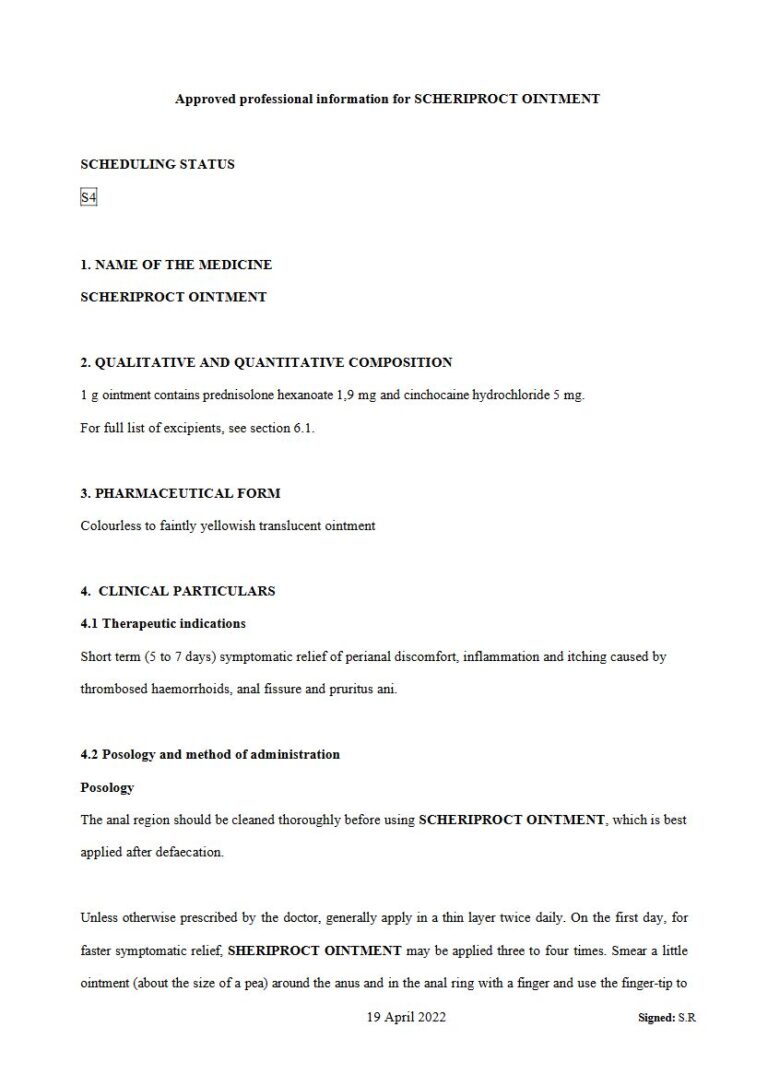
Short term (5 to 7 days) symptomatic relief of perianal discomfort, inflammation and itching caused by thrombosed haemorrhoids, anal fissure and pruritus ani.
4.2 Posology and method of administration
Posology
The anal region should be cleaned thoroughly before using SCHERIPROCT OINTMENT, which is best applied after defaecation. Unless otherwise prescribed by the doctor, generally apply in a thin layer twice daily. On the first day, for faster symptomatic relief, SHERIPROCT OINTMENT may be applied three to four times. Smear a little ointment (about the size of a pea) around the anus and in the anal ring with a finger and use the finger-tip to overcome the resistance of the sphincter. Before applying within the rectum, the enclosed applicator should be screwed on to the tube (For use and cleaning of the applicator, see section 6.6). However, for very inflamed and hence painful lesions it is advisable initially to apply the ointment internally with the finger. Protruding lumps should be thickly smeared and carefully pressed back with the finger.
4.3 Contraindications
- Hypersensitivity to prednisolone hexanoate, cinchocaine hydrochloride or to any of the other excipients of SCHERIPROCT OINTMENT.
- Viral infections, primary bacterial or fungal infections in the treatment area.
- Virus diseases (e.g. vaccinia, chickenpox).
- Secondary infections of the skin in the absence of appropriate anti-infective therapy.
- Known sensitivity to local anaesthetics.
- Corticosteroids have been shown to be teratogenic in animals following dermal application. As these agents are absorbed percutaneously, teratogenicity following topical application cannot be excluded. Therefore, SCHERIPROCT OINTMENT should not be used during pregnancy.
- Tuberculous or syphilitic processes in the area to be treated.
4.4 Special warnings and precautions for use
This product should not be used continuously for more than 7 days. If symptoms do not disappear quickly, discontinue treatment and consult your doctor. Certain anal disorders require specific treatment and a proctological examination. In case of bleeding, consult a doctor promptly. In infants, long-term continuous therapy with topical corticosteroids should be avoided. Occlusion is not appropriate on the perineum. Adrenal suppression can occur, even without occlusion. As with all topical steroids, there is a risk of developing skin atrophy following extensive therapy. The application of unusually large quantities of topical corticoids may result in the absorption of systemically active amounts of corticoid. Infections or secondarily infected dermatoses definitely require additional therapy with antibiotics or chemotherapeutic agents. This treatment can often be topical, but for heavy infections, systemic antibacterial therapy may be necessary. If fungal infections are present, a topically active antimycotic should be applied.
The excipients in SCHERIPROCT OINTMENT may reduce the effectiveness of latex products such as condoms. Inadvertent contact of the preparation with the eyes should be avoided. Careful hand-washing after use is recommended. Visual disturbance: Visual disturbance may be reported with systemic and topical corticosteroid use. If a patient presents with symptoms such as blurred vision or other visual disturbances, the patient should be considered for referral to an ophthalmologist for evaluation of possible causes, which may include cataract, glaucoma or rare diseases such as central serous chorioretinopathy (CSCR) which have been reported after use of systemic and topical corticosteroids.
4.5 Interactions with other medicines and other forms of interaction
No interaction studies have been performed. Co-treatment with CYP3A inhibitors, including cobicistat-containing products, is expected to increase the risk of systemic side-effects, including adrenal suppression. The combination should be avoided unless the benefit outweighs the increased risk of systemic corticosteroid side effects, in which case the patients should be monitored for systemic corticosteroid side-effects.
4.6 Fertility, pregnancy and lactation
Pregnancy
Corticosteroids have been shown to be teratogenic in animals following dermal application. As these agents are absorbed percutaneously, teratogenicity following application cannot be excluded. Therefore, SCHERIPROCT OINTMENT is contraindicated to be used during pregnancy. There is insufficient data on the use of SCHERIPROCT OINTMENT in pregnant women. Studies in animals (mice and rats) have shown reproductive toxicity for prednisolone hexanoate. In general, the use of topical preparations containing glucocorticoids should be avoided during the first trimester of pregnancy. Epidemiological studies suggest that there could possibly be an increased risk of oral clefts among newborns of women who were treated with glucocorticoids during the first trimester of pregnancy.
Lactation
There is insufficient information on the excretion of prednisolone hexanoate and cinchocaine hydrochloride in human milk.
4.7 Effects on ability to drive and use machines
None known.
4.8 Undesirable effects
As with all topical steroids, there is a risk of developing skin atrophy following extensive therapy (more than 4 weeks). Allergic skin reactions may occur. Eye disorders Not known (frequency cannot be estimated from the available data): Vision, blurred (see also section 4.4). Reporting of suspected adverse reactions Reporting suspected adverse reactions after authorisation of the medicine is important. It allows continued monitoring of the benefit/risk balance of the medicine. Healthcare professionals are asked to report any suspected adverse reactions to SAHPRA via the u201c6.04 Adverse Drug Reaction Reporting Formu201d, found online under SAHPRAu2019s publications: https://www.sahpra.org.za/Publications/Index/8
4.9 Overdose
In the case of accidental oral intake of the preparation (e.g. by swallowing a few grams of the ointment) mainly systemic effects of the local anaesthetic cinchocaine hydrochloride are to be expected, which, according to the dose, may manifest themselves as severe cardiovascular (depression to cessation of cardiac function) and CNS symptoms (convulsions; inhibition to arrest of respiratory function).
