
Veregen 1 g Ointment
PDF Leaflet Revision Date: 25 May 2021
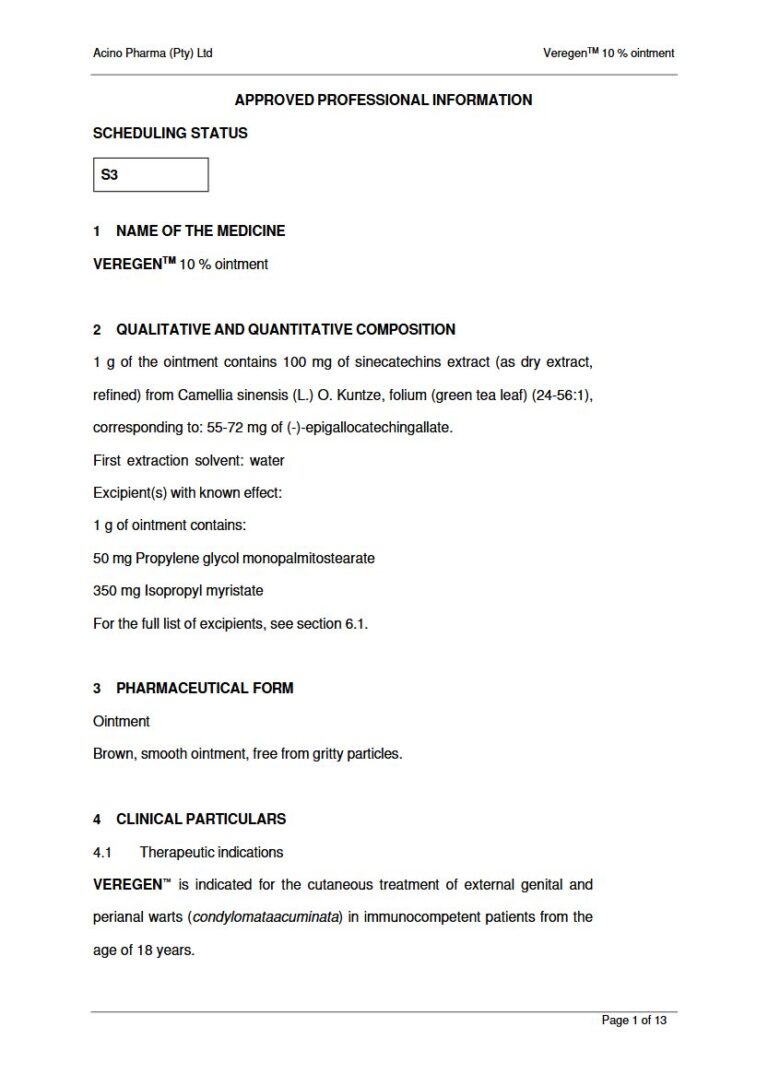
Clinical Summary
Quick overview from the medicine insert
Indication
Treatment of external genital and perianal warts in immunocompetent adults.
Dosage (summary)
Apply up to 250 mg three times daily for a maximum of 16 weeks.
Special Populations
- Hepatic impairment
- Older adults
Pregnancy & Breastfeeding
Use during pregnancy is not recommended; unknown if excreted in breast milk.
Key Drug Interactions
- Avoid other local treatments in wart area
- Avoid high-dosed oral green tea extracts
Contraindications
- Hypersensitivity to active substance or excipients
Common side effects
- Erythema
- Pruritus
- Irritation
- Pain
- Oedema
Counselling Points
- Wash hands before and after application
- Do not apply to mucous membranes
- Use condoms until warts are cleared
Serious warnings
- Avoid contact with eyes and mucous membranes
- Not for open wounds
- May weaken condoms
Important Disclaimer
The Veregen 1 g Ointment professional information leaflet below is the property of Acino Pharma and is provided on Medinsert exactly as issued, with no.. alterations or editorial changes. We make every effort to keep content current by updating documents as soon as new versions become available. Medinsert serves as a trusted access point for healthcare professionals, but does not replace official sources or clinical judgement. For more details, please read our full disclaimer. read more>>
 Healthcare Professionals Only
This content is for registered healthcare professionals
Sign in or create a free account to read the full package insert.
Free for HPCSA-registered professionals. Powered by Medinsert.
Clinical Particulars
Section 4 of the official insert — extracted exactly as issued, no alterations
4.1 Therapeutic indications
VEREGEN u2122 is indicated for the cutaneous treatment of external genital and perianal warts (condylomata acuminata) in immunocompetent patients from the age of 18 years.
4.2 Posology and method of administration
Posology for adults
Up to 250 mg VEREGEN ointment as total single dose, corresponding to about 0.5 cm of ointment strand, to be applied three times per day to all external genital and perianal warts (750 mg total daily dose).
Duration of use
Treatment with VEREGEN should be continued until complete clearance of all warts, however, no longer than 16 weeks, even if new warts develop during the treatment period.
Paediatric population
The safety and efficacy of VEREGEN in children and adolescents below the age of 18 years have not been investigated. No data are available.
Older people
An insufficient number of older people were treated with VEREGEN ointment to determine whether they respond differently from younger subjects.
Patients with hepatic impairment
Patients with severe liver dysfunction (e.g. clinically relevant elevation of liver enzymes, increase of bilirubin, increase of INR) should not use VEREGEN due to insufficient safety data. (see sections 4.4 and 4.8).
Method of administration
A small amount of VEREGEN should be applied to each wart using the fingers, dabbing it on to ensure complete coverage and leaving a thin layer of the ointment on the warts (max. 250 mg in total for all warts/ per single dose). Only apply to affected areas; any application into the vagina, urethra or anus must be avoided. Do not apply to mucous membranes. For cutaneous use only.
If a dose is missed, the patient should continue with the normal treatment regimen. It is recommended to wash the hands before and after application of VEREGEN . It is not necessary to wash off the ointment from the treated area prior to the next application. VEREGEN should be washed off the treated area before sexual activity. Female patients using tampons should insert the tampon before applying VEREGEN .
4.3 Contraindications
Hypersensitivity to the active substance or to any of the excipients listed in section 6.1.
4.4 Special warnings and precautions for use
Avoid contact with the eyes, nostrils, lips and mouth. VEREGEN should not be applied to open wounds, broken or inflamed skin. Therapy with VEREGEN is not recommended until the skin has completely healed from any previous surgical or drug treatment. VEREGEN has not been evaluated for the treatment of urethral, intra-vaginal, cervical, rectal or intra-anal warts and must not be used for the treatment of these conditions. Female patients with genital warts in the vulvar region should use the ointment with caution as treatment in this area is associated more often with severe local adverse reactions (see section 4.8). Accidental application into the vagina must be avoided. In case of accidental application into the vagina immediately wash off the ointment with warm water and mild soap. Uncircumcised male patients treating warts under the foreskin should retract the foreskin and clean the area daily to prevent phimosis. When early signs of stricture occur (e.g. ulceration, induration or increasing difficulty in retracting the foreskin) the treatment should be stopped. New warts may develop during treatment. Condoms should be used until complete clearance of all warts as VEREGEN does not eliminate the HPV-virus and does not prevent transmission of the disease. VEREGEN may weaken condoms and vaginal diaphragms. Therefore, the ointment should be washed off the treated area before the use of condoms and sexual contact. Additional methods of contraception should be considered. If the sexual partner of the patient is infected, treatment of the partner is advisable to prevent re-infection of the patient. Do not expose the treated area to sunlight or UV irradiation, as VEREGEN has not been tested under these conditions. The use of an occlusive dressing should be avoided (see section 4.8). VEREGEN stains clothing and bedding. Mild local skin reactions such as erythema, pruritus, irritation (mostly burning), pain and oedema at the site of application are very common and should not lead to discontinuation. They should decrease after the first weeks of treatment (see section 4.8). An interruption of the treatment may be indicated in case of more intense local skin reaction causing unacceptable discomfort or increase in severity or associated with a lymph node reaction. The treatment with VEREGEN can be resumed after the skin reaction has diminished. In case a vesicular local reaction occurs, the patient should be advised to consult a doctor to exclude a genital herpes infection. The effectiveness and safety in patients taking immunomodulatory medicines have not been investigated. Those patients should not use VEREGEN ointment.
The safety and effectiveness for treatment beyond 16 weeks or for multiple treatment courses have not been investigated. Patients with severe liver dysfunction (e.g. clinically relevant elevation of liver enzymes, increase of bilirubin, increase of INR) should not use VEREGEN due to insufficient safety data. (see section 4.8). VEREGEN contains propylene glycol monopalmitostearate which may cause skin irritations and isopropyl myristate which may cause irritation and sensitization of the skin.
4.5 Interaction with other medicines and other forms of interaction
No interaction studies have been performed. Concomitant use of other local treatments in the wart area should be avoided (even like sitz baths, topically applied zinc or vitamin E etc.). Concomitant intake of high-dosed oral green tea extract preparations (food supplements) should be avoided (see section 4.8).
4.6 Fertility, pregnancy and lactation
Pregnancy
There are no or limited amount of data from the use of VEREGEN in pregnant women. Studies in animals have shown reproductive toxicity (see section 5.3). As a precautionary measure, it is preferable to avoid the use of VEREGEN during pregnancy, although systemic exposure to epigallocatechingallate is expected to be low following dermal application of VEREGEN .
Breastfeeding
It is unknown whether VEREGEN or its metabolites are excreted in human milk. A risk to the suckling child cannot be excluded. No effects on the breastfed newborn / infant are anticipated since systemic exposure to epigallocatechingallate is expected to be low following dermal application of VEREGEN .
Fertility
There is no evidence of an effect on the fertility in the rat following dermal (male) and vaginal (female) application, respectively (see section 5.3).
4.7 Effects on ability to drive and use machines
No studies on the effects on the ability to drive and use machines have been performed. However, it is unlikely that VEREGEN will have an effect on the ability to drive or use machines.
4.8 Undesirable effects
a. Summary of the safety profile
The safety of VEREGEN was assessed in pivotal clinical studies and post-marketing surveillance. The most frequently reported adverse drug reactions were local skin and application site reactions at the wart treatment site. Most commonly erythema, pruritus, irritation (mostly burning), pain, oedema, ulcer, indurations and vesicles were observed. Mild local skin reactions are related to the mode of action and should not lead to discontinuation. Female patients with warts in the vulva had a higher incidence of local skin and application site reactions. Hypersensitivity was observed. In case of hypersensitivity to VEREGEN treatment should be discontinued.
b. Tabulated summary of adverse reactions
Adverse reactions are presented below by system organ class and absolute frequency. Frequencies are defined as: very common (u2265 1/10); common (u2265 1/100 to < 1/10); uncommon (u22651/1,000 to <1/100); rare (u22651/10,000 to <1/1,000); very rare (<1/10,000); not known (cannot be estimated from the available data). Within each frequency grouping, adverse reactions are presented in the order of decreasing seriousness
MedDRA system organ class Frequency Adverse reactions Infections and Infestations Uncommon Application site infection, application site pustules, genital herpes infection, staphylococcal infection, urethritis, vaginal candidiasis, vulvovaginitis Blood and lymphatic system disorders Common Inguinal lymphadenitis/ lymphadenopathy Skin and subcutaneous tissue disorders Uncommon Rash and papullar rash Renal and urinary disorders Uncommon Dysuria, micturition urgency, pollakisuria Reproductive system and breast disorders Common Phimosis Uncommon Balanitis, dyspareunia General disorders and administration site conditions Very common Local reactions at the application site like erythema, pruritus, irritation/burning, pain, ulcer, oedema, induration and vesicles
Common Local reactions at the application site like exfoliation, discharge, bleeding and swelling. Uncommon Local reactions at the application site like discolouration, discomfort, dryness, erosion, fissure, hyperaesthesia, anaesthesia, scar, nodule, dermatitis, hypersensitivity, local necrosis, papules, and eczema Adverse effects occur with a higher incidence under occlusive conditions (see section 4.4). Reporting of suspected adverse reactions
Reporting suspected adverse reactions after authorisation of the medicine is important. It allows continued monitoring of the benefit/risk balance of the medicine. Health care providers are asked to report any suspected adverse reactions to SAHPRA via the u201c 6.04 Adverse Drug Reactions Reporting Form u201d, found online under SAHPRAu2019s publications: https://www.sahpra.org.za/Publications/Index/8
4.9 Overdose
In overdose, side effects can be precipitated and/or be of increased severity. No case of overdose has been reported. In case of accidental oral intake symptomatic treatment is indicated. There is no specific antidote for Veregen. No experience with oral intake of the product is available.
