
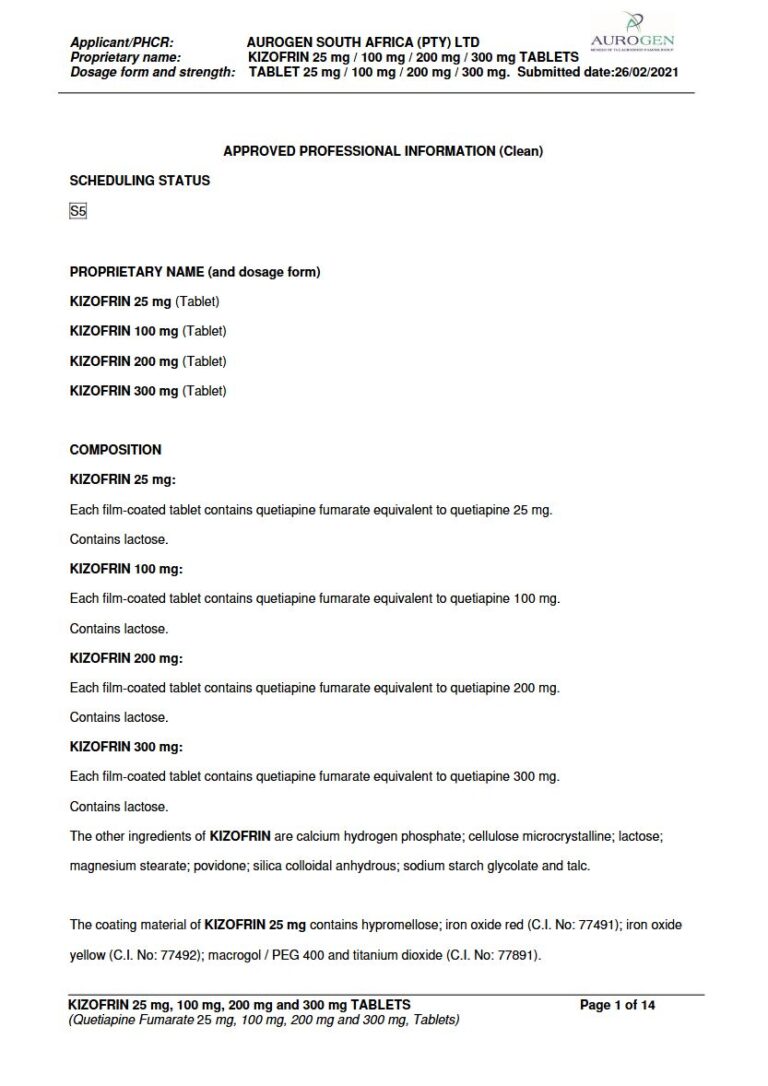
Kizofrin 25 mg / 100 mg / 200 mg / 300 mg TABLETS
PDF Leaflet Revision Date: 05 December 2022
Clinical Summary
Quick overview from the medicine insert
Indication
Treatment of schizophrenia and manic episodes associated with bipolar disorder.
Dosage (summary)
Adults: Start at 50 mg, titrate to 300-450 mg/day for schizophrenia; 100 mg to 400 mg/day for bipolar disorder.
Special Populations
- Elderly
- Renal impairment
- Hepatic impairment
Pregnancy & Breastfeeding
Contraindicated due to lack of safety data.
Key Drug Interactions
- CYP3A4 inhibitors
- Antihypertensives
- Dopaminergics
Contraindications
- Hypersensitivity
- Pregnancy
- Lactation
- Severe liver/renal impairment
Common side effects
- Somnolence
- Dizziness
- Tachycardia
- Weight gain
Counselling Points
- Monitor for mood changes
- Avoid driving if drowsy
- Regular glucose monitoring for diabetics
Serious warnings
- Risk of suicidal ideation
- Hyperglycaemia
- Neuroleptic malignant syndrome
Important Disclaimer
The Kizofrin 25 mg / 100 mg / 200 mg / 300 mg TABLETS professional information leaflet below is the property of Aurogen South Africa and is provided on Medinsert exactly as issued, with no.. alterations or editorial changes. We make every effort to keep content current by updating documents as soon as new versions become available. Medinsert serves as a trusted access point for healthcare professionals, but does not replace official sources or clinical judgement. For more details, please read our full disclaimer. read more>>
 Healthcare Professionals Only
This content is for registered healthcare professionals
Sign in or create a free account to read the full package insert.
Free for HPCSA-registered professionals. Powered by Medinsert.
Clinical Particulars
Section 4 of the official insert — extracted exactly as issued, no alterations
4.1 Therapeutic indications
KIZOFRIN are indicated for the treatment of schizophrenia. KIZOFRIN are also indicated for the treatment of manic episodes associated with a bipolar disorder. Safety and efficacy beyond 12 weeks has not been established.
4.2 Posology and method of administration
KIZOFRIN should be administered twice daily, with or without food. Adults: For the treatment of schizophrenia the total daily dose for the first 4 days of therapy is 50 mg (Day 1), 100 mg (Day 2), 200 mg (Day 3) and 300 mg (Day 4). From Day 4 onwards, the dose should be titrated to the effective dose range of 300 - 450 mg/day. However this may be adjusted, depending on the clinical response and tolerability of the individual patient, within the range 150 - 750 mg/day. For the treatment of manic episodes associated with bipolar disorder, the total daily dose for the first 4 days of therapy is 100 mg (Day 1), 200 mg (Day 2), 300 mg (Day 3) and 400 mg (Day 4). Further dosage adjustments up to 800 mg/day by Day 6 should be in increments of no greater than 200 mg/day. The dose may be adjusted depending on the clinical response and tolerability of the individual patient, within the range of 200 - 800 mg/day. The usual effective dose is in the range of 400 - 800 mg/day. It should be noted that the recommended maximum daily dose of KIZOFRIN is 750 mg/day, for the treatment of schizophrenia, and 800 mg/day for the treatment of manic episodes associated with bipolar disorder. Continued treatment at higher doses should only be considered as a result of careful consideration of the benefit-risk assessment for an individual patient. Elderly: KIZOFRIN should be used with caution in the elderly, especially during the initial dosing period. Elderly patients should be started on KIZOFRIN 25 mg/day. The dose should be increased daily, in increments of 25-50 mg, to an effective dose, which is likely to be lower than that in younger patients. Renal and hepatic impairment: In patients with mild to moderate renal or hepatic impairment, the oral clearance of KIZOFRIN is reduced by approximately 25%. KIZOFRIN are extensively metabolised by the liver. Therefore, caution should be exercised when administered to patients with known hepatic impairment. Patients with renal or hepatic impairment should be started on KIZOFRIN 25 mg/day. The dose should be increased daily in increments of 25 - 50 mg, to an effective dose.
4.3 Contraindications
Hypersensitivity to quetiapine or to any of the other ingredients of [PRODUCT NAME]. Pregnancy and lactation, since safety has not been established. Safety and efficacy in children and adolescents have not been established. Advanced liver and renal function impairment, since safety has not been established.
4.4 Special warnings and precautions for use
Patients with major depressive disorder, both adults and children, may experience worsening of their depression and or the emergence of suicidal ideation and behaviour, whether or not they are taking antidepressant medicines. This risk may persist until significant remission occurs. A casual role, however, for antidepressant medicine in inducing such behaviour has not been established. Patients being treated with KIZOFRIN should, nevertheless, be observed closely for clinical worsening and suicidality, especially at the beginning of a course of therapy or at any time of dose changes, either increases or decreases. Because of the possibility of co-morbidity between major depressive disorder and other psychiatric and non-psychiatric disorders, the same precautions observed when treating patients with major depressive disorders should be observed when treating patients with other psychiatric and non-psychiatric disorders. The following symptoms have been reported in patients being treated with antidepressants for major depressive disorder as well as for other indications, both psychiatric and non-psychiatric: anxiety, agitation, panic attacks, insomnia, irritability, hostility (aggressiveness, impulsivity, akathisia, hypomania, and mania. Although a causal link between the emergence of suicidal impulses has not been established, consideration should be given to changing the therapeutic regimen, including possibly discontinuing [PRODUCT NAME], in patients for whom such symptoms are severe, abrupt in onset, or were not part of the patientu2019s presenting symptoms. If the decision is made to discontinue treatment, KIZOFRIN should be tapered (See u201cDOSAGE AND DIRECTIONS FOR USEu201d). Hyperglycaemia and diabetes mellitus: Hyperglycaemia, in some cases extreme and associated with ketoacidosis or hyperosmolar coma or death, has been reported in patients treated with atypical antipsychotics, including [PRODUCT NAME]. Patients with an established diagnosis of diabetes mellitus who are started on atypical antipsychotics such as [PRODUCT NAME], should be monitored regularly for worsening of glucose control. Patients with risk factors for diabetes mellitus (e.g. obesity, family history of diabetes) who are starting treatment with atypical antipsychotics such as KIZOFRIN should be monitored for symptoms of hyperglycaemia including polydipsia, polyuria, polyphagia, and weakness. Patients who develop symptoms of hyperglycaemia during treatment with atypical antipsychotics such as [PRODUCT NAME], should undergo fasting blood glucose testing. In some cases, hyperglycaemia has resolved when the atypical antipsychotic such as [PRODUCT NAME], was discontinued; however, some patients required continuation of antidiabetic treatment despite discontinuation of the suspect medicine. Somnolence may occur, usually during the first 2 weeks of treatment and generally resolves with the continued administration of [PRODUCT NAME]. Resolution of leucopenia and/or neutropenia usually follows cessation of therapy with [PRODUCT NAME]. Possible risk factors for leucopenia and/or neutropenia include pre-existing low white cell count and history of medicine induced leucopenia and/or neutropenia. Agranulocytosis has been reported in patients on treatment with quetiapine. Although a causal relationship could not be established, the possibility that KIZOFRIN may be implicated could not be excluded. Concomitant illness: KIZOFRIN should be used with caution in patients with mild to moderate hepatic or renal impairment, with known cerebrovascular disease, cardiovascular disease or other conditions predisposing to hypotension, or with a history of seizures. KIZOFRIN may induce orthostatic hypotension, especially during the initial dose-titration period; this is more common in elderly patients than in younger patients. Quetiapine as in KIZOFRIN has not been associated with a persistent increase in QTc intervals. However, caution should be exercised when KIZOFRIN is prescribed with medicines known to prolong the QTc interval, especially in the elderly. Seizures: When treating patients with a history of seizures, caution is recommended. Tardive dyskinesia: There is a potential for KIZOFRIN to cause tardive dyskinesia. If signs and symptoms of tardive dyskinesia appear, discontinuation of KIZOFRIN should be considered. Neuroleptic malignant syndrome: Neuroleptic malignant syndrome has been associated with KIZOFRIN treatment. Clinical manifestations include hyperthermia, altered mental status, muscular rigidity, autonomic instability, and increased creatine phosphokinase. In such an event, KIZOFRIN should be discontinued and appropriate medical treatment given. KIZOFRIN contains lactose. Patients with rare hereditary problems of galactose intolerance, lapp lactase efficiency, or glucose-galactose malabsorption should not take [PRODUCT NAME].
4.5 Interactions with other medicines
Because of the primary central nervous system effects of [PRODUCT NAME], KIZOFRIN should be used with caution in combination with other centrally acting medicines and alcohol. The pharmacokinetics of lithium are not altered when co-administered with [PRODUCT NAME]. When co-administered, the pharmacokinetics of sodium valproate and KIZOFRIN are not altered to a clinically relevant extent. The pharmacokinetics of KIZOFRIN are not significantly altered following co-administration with the antipsychotics risperidone or haloperidol. However, co-administration of KIZOFRIN and thioridazidine may cause increases in clearance of [PRODUCT NAME]. KIZOFRIN does not induce the hepatic enzyme systems involved in the metabolism of antipyrine. Enzyme inducers such as carbamazepine may decrease the plasma concentrations of quetiapine, and higher doses of KIZOFRIN may be necessary. Co-administration of KIZOFRIN with another microsomal enzyme inducer, phenytoin, may also cause increases in clearance of [PRODUCT NAME]. Increased doses of KIZOFRIN may be required to maintain control of psychotic symptoms in patients co-administered KIZOFRIN and phenytoin and other hepatic enzyme inducers (e.g. rifampicin, barbiturates, etc.) The dose of KIZOFRIN may need to be reduced if phenytoin, carbamazepine or other hepatic enzyme inducers are withdrawn and replaced with a non-inducer (e.g. sodium valproate). CYP3A4 is the primary enzyme responsible for cytochrome P450 mediated metabolism of [PRODUCT NAME]. The pharmacokinetics of KIZOFRIN is not altered following co-administration with cimetidine a known P450 enzyme inhibitor. The pharmacokinetics of KIZOFRIN are not significantly altered following co-administration with the antidepressants imipramine (a known CYP2D6 inhibitor) or fluoxetine (a known CYP3A4 and CYP2D6 inhibitor). CYP3A4 is the main isoenzyme responsible for cytochrome P450 mediated metabolism of quetiapine and caution is advised when KIZOFRIN are used with potent inhibitors of CYP3A4 such as macrolide antibiotics (e.g. erythromycin) and azole antifungals (e.g. fluconazole, itraconazole, and ketoconazole); lower doses of KIZOFRIN should be used when given with such inhibitors. KIZOFRIN should be used with caution in patients also receiving antihypertensives or medicines that prolong the QT interval. KIZOFRIN may antagonise the actions of dopaminergics such as levodopa.
4.6 Fertility, pregnancy and lactation
KIZOFRIN are contra-indicated during pregnancy and lactation, since safety has not been established.
4.7 Effects on ability to drive and use machines
KIZOFRIN TABLETS may cause somnolence which may interfere with activities requiring mental alertness. Therefore, until individual susceptibility is known, patients should be advised not to drive or operate machinery.
4.8 Undesirable effects
The following side-effects have been reported. Blood and lymphatic system disorders: Frequent: Leucopenia. Less frequent: Eosinophilia, neutropenia. Immune system disorders: Less frequent: Hypersensitivity (angioedema, anaphylaxis, urticaria/rash). Endocrine disorders: Less frequent: Treatment with quetiapine is associated with dose-related decreases in thyroid hormone levels, particularly total T4 and free T4. The reduction in total and free T4 was maximal within the first 2 to 4 weeks of KIZOFRIN treatment. Frequency not known: Rises in prolactin concentrations. Metabolism and nutrition disorders: Less frequent: Anorexia. Nervous system disorders: Frequent: Dizziness, somnolence, syncope. Less frequent: Seizure, dysarthria, hypertonia, extrapyramidal symptoms (akathisia, akinesia, cogwheel rigidity, extrapyramidal syndrome, hypertonia, hypokinesia, neck rigidity and tremor) occur and are not dose related. Frequency not known: Anxiety. Eye disorders: Less frequent: Asymptomatic changes in the lens of the eye may occur in patients during long-term treatment with [PRODUCT NAME]. Abnormal vision. Frequency not known: Dry eyes. Ear and labyrinth disorders: Frequency not known: Ear pain. Cardiac disorders: Frequent: Tachycardia. Less frequent: Palpitation, prolongation of the QTc interval. Vascular disorders: Less frequent: Hypotension, orthostatic hypotension. Frequency not known: Hypertension. Respiratory, thoracic and mediastinal disorders: Less frequent: Dyspnoea, pharyngitis, rhinitis. Gastrointestinal disorders: Less frequent: Abdominal pain. Frequency not known: Diarrhoea, dry mouth; constipation; dyspepsia. Skin and subcutaneous tissue disorders: Less frequent: Increased sweating. Musculoskeletal, connective tissue and bone disorders: Frequency not known: Myalgia. Renal and urinary disorders: Frequency not known: Urinary tract infection. Reproductive system and breast disorders: Less frequent: Menstrual changes, galactorrhoea. Rare: Priapism. General disorders and administrative site conditions: Frequent: Asthenia, peripheral oedema. Less frequent: Headache, flu-like symptoms, fever. Frequency not known: Back pain, chest pain. Rare: Neuroleptic malignant syndrome. Investigations: Frequent: Weight gain; Elevations in serum transaminases (ALT, AST). Less frequent: Elevations in gamma-GT levels; Elevations in non-fasting serum triglyceride.
4.9 Overdose
There have been less frequent reports of overdose of quetiapine alone resulting in death or coma. In general, reported signs and symptoms were those resulting from an exaggeration of the medicineu2019s known pharmacological effects, i.e. drowsiness, sedation, tachycardia and hypotension. There is no specific antidote to [PRODUCT NAME]. Treatment is symptomatic and supportive.
