
Razagin 1 mg Tablets
PDF Leaflet Revision Date: Jan 2022
Clinical Summary
Quick overview from the medicine insert
Indication
Treatment of idiopathic Parkinson's disease.
Dosage (summary)
1 mg once daily, with or without levodopa.
Special Populations
- Elderly
- Hepatic impairment
- Renal impairment
Pregnancy & Breastfeeding
Safety in pregnancy and lactation not established.
Key Drug Interactions
- MAO inhibitors
- Pethidine
- Fluoxetine
- Fluvoxamine
- Dextromethorphan
Contraindications
- Hypersensitivity
- Moderate or severe hepatic impairment
Common side effects
- Headache
- Depression
- Vertigo
- Dyskinetic movements
- Orthostatic hypotension
Counselling Points
- Avoid driving if experiencing drowsiness
- Monitor for impulse control disorders
- Caution with other CNS depressants
Serious warnings
- Impulse control disorders
- Melanoma risk
- Excessive daytime sleepiness
Important Disclaimer
The Razagin 1 mg Tablets professional information leaflet below is the property of Abex Pharmaceutica and is provided on Medinsert exactly as issued, with no.. alterations or editorial changes. We make every effort to keep content current by updating documents as soon as new versions become available. Medinsert serves as a trusted access point for healthcare professionals, but does not replace official sources or clinical judgement. For more details, please read our full disclaimer. read more>>
 Healthcare Professionals Only
This content is for registered healthcare professionals
Sign in or create a free account to read the full package insert.
Free for HPCSA-registered professionals. Powered by Medinsert.
Clinical Particulars
Section 4 of the official insert — extracted exactly as issued, no alterations
4.1 Therapeutic indications
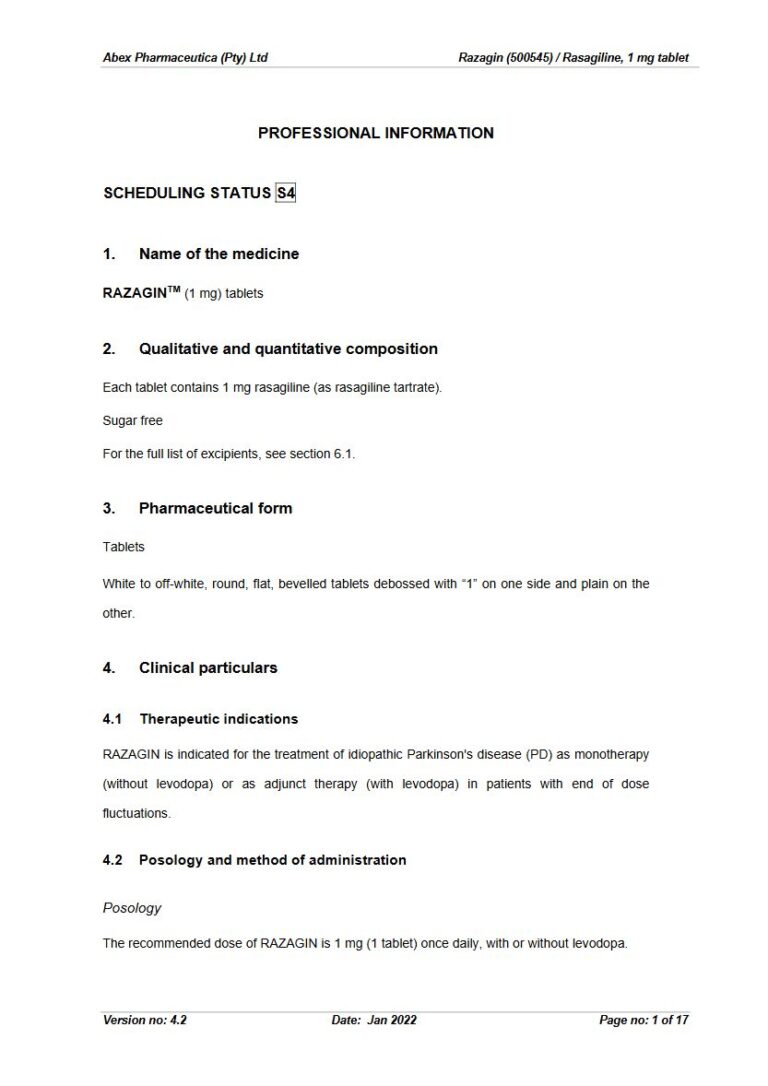
RAZAGIN is indicated for the treatment of idiopathic Parkinson's disease (PD) as monotherapy (without levodopa) or as adjunct therapy (with levodopa) in patients with end of dose fluctuations.
4.2 Posology and method of administration
Posology
The recommended dose of RAZAGIN is 1 mg (1 tablet) once daily, with or without levodopa.
Elderly: No change in dose is required for elderly patients.
Children and adolescents (< 18 years): RAZAGIN is not recommended as safety and efficacy have not been established in this population.
Patients with hepatic impairment: RAZAGIN use in patients with moderate or severe hepatic impairment is contraindicated (see section 4.3). Caution should be used when initiating treatment with RAZAGIN in patients with mild hepatic insufficiency. In case patients progress from mild to moderate hepatic impairment RAZAGIN should be stopped (see section 4.4).
Patients with renal impairment: No change in dose is required for renal impairment.
Method of administration
For oral use. RAZAGIN may be taken with or without food.
4.3 Contraindications
- Hypersensitivity to rasagiline or to any of the excipients of RAZAGIN, listed in section 6.1.
- Concomitant treatment with other monoamine oxidase (MAO) inhibitors (including products without prescription e.g. St. John's Wort) or pethidine (see section 4.5). At least 14 days must elapse between discontinuation of RAZAGIN and initiation of treatment with MAO inhibitors or pethidine.
- Moderate or severe hepatic impairment (Child Pugh B and C).
4.4 Special warnings and precautions for use
Concomitant use of RAZAGIN with other medicines
The concomitant use of RAZAGIN and fluoxetine or fluvoxamine should be avoided (see section 4.5). At least five weeks should elapse between discontinuation of fluoxetine and initiation of treatment with RAZAGIN. At least 14 days should elapse between discontinuation of RAZAGIN and initiation of treatment with fluoxetine or fluvoxamine.
The concomitant use of RAZAGIN and dextromethorphan or sympathomimetics such as those present in nasal and oral decongestants or cold medicines containing ephedrine or pseudoephedrine is not recommended (see section 4.5).
Concomitant use of RAZAGIN and levodopa
Since rasagiline as in RAZAGIN potentiates the effects of levodopa, the adverse reactions of levodopa may be increased and pre-existing dyskinesia exacerbated. Decreasing the dose of levodopa may ameliorate this adverse reaction. There have been reports of hypotensive effects when RAZAGIN is taken concomitantly with levodopa. Patients with Parkinson's disease are particularly vulnerable to the adverse reactions of hypotension due to existing gait issues.
Dopaminergic effects
Excessive daytime sleepiness (EDS) and sudden sleep onset (SOS) episodes. Rasagiline as in RAZAGIN may cause daytime drowsiness, somnolence, and less frequently (especially if used with other dopaminergic medicines) falling asleep during activities of daily living. Patients must be informed of this and advised to exercise caution while driving or operating machines during treatment with RAZAGIN. Patients who have experienced somnolence and/or an episode of sudden sleep onset must refrain from driving or operating machines (see section 4.7).
Impulse control disorders (ICDs)
ICDs can occur in patients treated with dopamine agonists and/or dopaminergic treatments. Similar reports of ICDs have also been received post-marketing with rasagiline (contained in RAZAGIN). Patients should be regularly monitored for the development of impulse control disorders. Patients and carers should be made aware of the behavioural symptoms of impulse control disorders that were observed in patients treated with rasagiline as in RAZAGIN, including cases of compulsions, obsessive thoughts, pathological gambling, increased libido, hypersexuality, impulsive behaviour and compulsive spending or buying.
Melanoma
During the clinical development program, the occurrence of cases of melanoma prompted the consideration of a possible association with rasagiline as in RAZAGIN. The data collected suggests that Parkinson's disease, and not any medicines in particular, is associated with a higher risk of skin cancer (not exclusively melanoma). Any suspicious skin lesion should be evaluated by a specialist.
Hepatic impairment
Caution should be used when initiating treatment with RAZAGIN in patients with mild hepatic impairment. RAZAGIN use in patients with moderate or severe hepatic impairment is contraindicated. In case patients progress from mild to moderate hepatic impairment, RAZAGIN should be stopped (see section 5.2).
4.5 Interaction with other medicinal products and other forms of interaction
MAO Inhibitors
There are a number of known interactions between non-selective MAO inhibitors and other medicines. RAZAGIN should not be administered along with other MAO inhibitors (including medicines and natural products obtained without prescription e.g. St. John's Wort) as there may be a risk of non-selective MAO inhibition that may lead to hypertensive crises (see section 4.3).
Pethidine
Serious adverse reactions have been reported with the concomitant use of pethidine and MAO inhibitors, including another selective MAO-B inhibitor. The concomitant administration of rasagiline as in RAZAGIN and pethidine is contraindicated (see section 4.3).
Sympathomimetics
With MAO inhibitors, as well as with another selective MAO-B inhibitor, there have been reports of medicine interactions with the concomitant use of sympathomimetic medicines. Therefore, in view of the MAO inhibitory activity of rasagiline as in RAZAGIN, concomitant administration of RAZAGIN and sympathomimetics, such as those present in nasal and oral decongestants or cold medicinal products, containing ephedrine or pseudoephedrine, is not recommended (see section 4.4).
Dextromethorphan
There have been reports of medicine interactions with the concomitant use of dextromethorphan and non-selective MAO inhibitors. Therefore, in view of the MAO inhibitory activity of rasagiline as in RAZAGIN, the concomitant administration of RAZAGIN and dextromethorphan is not recommended (see section 4.4).
SNRI/SSRI/tri- and tetracyclic antidepressants
The concomitant use of RAZAGIN and fluoxetine or fluvoxamine should be avoided (see section 4.4). Serious adverse reactions have been reported with the concomitant use of selective serotonin reuptake inhibitors (SSRIs), tricyclic/tetracyclic antidepressants and MAO inhibitors as well as with another selective MAO-B inhibitor. Therefore, in view of the MAO inhibitory activity of rasagiline as in RAZAGIN, antidepressants should be administered with caution.
Medicines that affect CYP1A2 activity
In vitro metabolism studies have indicated that cytochrome P450 1A2 (CYP1A2) is the major enzyme responsible for the metabolism of rasagiline.
4.6 Fertility, pregnancy and lactation
Pregnancy
Safety in pregnancy has not been demonstrated.
Breastfeeding
It is not known whether rasagiline is excreted in human milk. Safety in lactation has not been demonstrated.
Fertility
No human data on the effect of rasagiline on fertility are available. Non-clinical data indicate that rasagiline has no effect on fertility.
4.7 Effects on ability to drive and use machines
In patients experiencing somnolence/sudden sleep episodes, rasagiline as in RAZAGIN may have a major influence on the ability to drive and use machines. Patients should be cautioned about operating hazardous machines, including motor vehicles, until they are reasonably certain that RAZAGIN does not affect them adversely. Patients should be cautioned about possible additive effects of sedating medicines, alcohol, or other central nervous system depressants (e.g. benzodiazepines, antipsychotics, antidepressants) in combination with RAZAGIN, or when taking concomitant medicines that increase plasma levels of rasagiline (e.g. ciprofloxacin) (see section 4.4).
4.8 Undesirable effects
Summary of the safety profile
In clinical studies in Parkinson's disease patients the most commonly reported adverse reactions were headache, depression, vertigo, and flu (influenza and rhinitis) in monotherapy; dyskinesia, orthostatic hypotension, fall, abdominal pain, nausea and vomiting, and dry mouth in adjunct to levodopa therapy; musculoskeletal pain, as back and neck pain, and arthralgia in both regimens. These adverse reactions were not associated with an elevated rate of medicine discontinuation.
Tabulated list of adverse reactions
Adverse reactions are listed below in Tables 1 and 2 by system organ class and frequency.
4.9 Overdose
Symptoms
Symptoms reported following overdose of rasagiline as in RAZAGIN, in doses ranging from 3 mg to 100 mg included hypomania, hypertensive crisis and serotonin syndrome. Overdose can be associated with significant inhibition of both MAO-A and MAO-B. In a single-dose study healthy volunteers received 20 mg/day and in a ten-day study healthy volunteers received 10 mg/day. Adverse reactions were mild or moderate and not related to rasagiline treatment. In a dose escalation study in patients on chronic levodopa therapy treated with 10 mg/day of rasagiline, there were reports of cardiovascular adverse reactions (including hypertension and postural hypotension) which resolved following treatment discontinuation. These symptoms may resemble those observed with non-selective MAO inhibitors.
Management
There is no specific antidote. In case of overdose, patients should be monitored and the appropriate symptomatic and supportive therapy instituted.
