
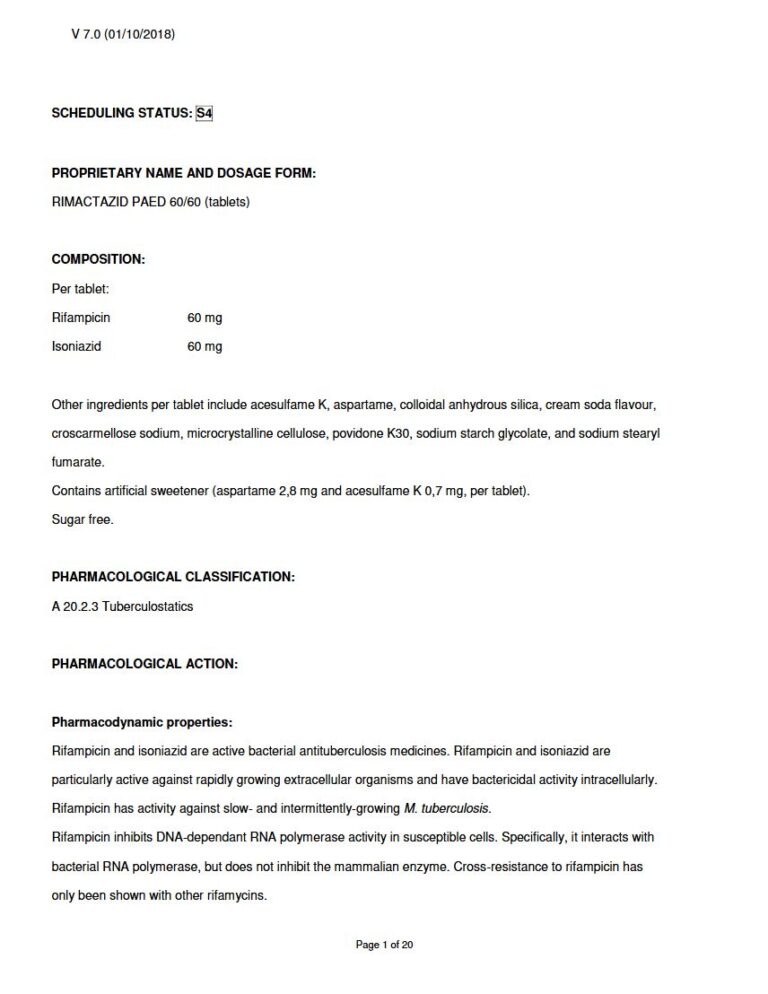
Rimactazid Paed 60 mg Tablets
PDF Leaflet Revision Date: 06 September 2018
Clinical Summary
Quick overview from the medicine insert
Indication
Pulmonary tuberculosis in children.
Dosage (summary)
10 mg/kg rifampicin and 10 mg/kg isoniazid, 3 times a week.
Special Populations
- Renal impairment
- Hepatic impairment
Pregnancy & Breastfeeding
Safety not established; may cause post-natal hemorrhages; excreted in breast milk.
Key Drug Interactions
- Anticonvulsants
- Oral anticoagulants
- Antiretroviral medicines
- Oral contraceptives
Contraindications
- Hypersensitivity to rifamycins or isoniazid
- Jaundice
- Impaired liver function
- Acute porphyria
Common side effects
- Nausea
- Vomiting
- Headache
- Dizziness
- Peripheral neuropathy
Counselling Points
- Take on an empty stomach
- Avoid alcohol
- Monitor for signs of liver damage
- Inform about potential discoloration of body fluids
Serious warnings
- Risk of severe liver dysfunction
- Monitor liver function regularly
- Severe hypersensitivity reactions
Important Disclaimer
The Rimactazid Paed 60 mg Tablets professional information leaflet below is the property of Sandoz and is provided on Medinsert exactly as issued, with no.. alterations or editorial changes. We make every effort to keep content current by updating documents as soon as new versions become available. Medinsert serves as a trusted access point for healthcare professionals, but does not replace official sources or clinical judgement. For more details, please read our full disclaimer. read more>>
 Healthcare Professionals Only
This content is for registered healthcare professionals
Sign in or create a free account to read the full package insert.
Free for HPCSA-registered professionals. Powered by Medinsert.
Clinical Particulars
Section 4 of the official insert — extracted exactly as issued, no alterations
4.1 Therapeutic indications
Pulmonary tuberculosis in children.
4.2 Posology and method of administration
RIMACTAZID PAED 60/60 is recommended in the continuation phase of the treatment of pulmonary tuberculosis. During this phase this medicine should be administered on an intermittent basis.
The total dosage requirement is as follows:
- Intermittent (3 x/ week)
- Rifampicin 10 mg/kg (8 to 12)
- Isoniazid 10 mg/kg (8 to 12)
Each RIMACTAZID PAED 60/60 tablet contains rifampicin (RMP) and isoniazid (INH) in such a ratio that the administration of 10 mg/kg RMP and 10 mg/kg INH can be achieved by giving 1 tablet per 5 kg body mass, i.e. 1 tablet to children of 5 kg, 2 tablets to children of 10 kg, 3 tablets to children of 15 kg, 4 tablets to children of 20 kg, 5 tablets to children of 25 kg body mass per day. No child should take more than 6 RIMACTAZID PAED 60/60 tablets per day.
The daily dosage is calculated from the recommended daily requirement given above and the tablets can be halved to more closely regulate dosage according to body mass.
Number of tablets For infants/children with body mass
- u00bd tablet 3 kg up to less than 5 kg
- 1 tablet 5 kg up to less than 7,5 kg
- 1u00bd tablets 7,5 kg up to less than 10 kg
- 2 tablets 10 kg up to less than 15 kg
- 3 tablets 15 kg up to less than 20 kg
- 4 tablets 20 kg up to less than 25 kg
- 5 tablets 25 kg up to less than 30 kg
- 6 tablets 30 kg up to less than 35 kg
The tablets can either be dispersed in as little as 5 mu2113 water or chewed and should preferably be taken on an empty stomach, as a single dosage.
4.3 Contraindications
Known or suspected hypersensitivity to rifamycins, isoniazid or any of the excipients of Rimactazid Paed 60/60 tablets (see u201cCOMPOSITIONu201d). Rimactazid Paed 60/60 tablets are contraindicated in the presence of jaundice, in patients with impaired liver function or with acute porphyria. Rifampicin can cause thrombocytopenia and purpura usually with intermittent tuberculosis regimens; further administration is contraindicated. Rimactazid Paed 60/60 tablets is contraindicated when given concurrently with the combination of saquinavir/ritonavir (see u201cINTERACTIONSu201d). Caution is advised in patients with impaired renal function, diabetes mellitus and chronic alcoholism, a history of gout, and patients suffering from convulsive disorders and acute porphyria. Safety during pregnancy and lactation has not been established.
4.4 Special warnings and precautions for use
RIMACTAZID PAED 60/60 is a combination of two medicines, each of which has been associated with liver dysfunction. All tuberculosis patients should have pre-treatment measurements of liver function. Adults treated for tuberculosis with RIMACTAZID PAED 60/60 should have baseline measurements of hepatic enzymes, bilirubin, serum creatinine, a complete blood count and a platelet count (or estimate). Patients should be seen at least monthly during therapy and should be questioned specifically about symptoms associated with adverse reactions. All patients with abnormalities should have follow-up, including laboratory testing, if necessary. However, because there is a higher frequency of isoniazid-associated hepatitis among persons older than 35 years of age, a transaminase measurement should be obtained at baseline and at least monthly during therapy in this age group. Other factors associated with an increased risk of hepatitis include daily use of alcohol, chronic liver disease, intravenous medicine use and being a black or Hispanic woman. If the patient has no evidence of pre-existing liver disease and normal pre-treatment liver function, liver function tests need only be repeated if fever, vomiting, jaundice or other deterioration in the patient's condition occurs.
Severe, systemic hypersensitivity reactions, including fatal cases, such as Drug Reaction with Eosinophilia and Systemic Symptoms (DRESS) syndrome have been observed during treatment with anti-tuberculosis therapy. It is important to note that early manifestations of hypersensitivity, such as fever, lymphadenopathy or biological abnormalities (including eosinophilia, liver abnormalities) may be present even though rash is not evident. If such signs or symptoms are present, the patient should be advised to consult immediately their physician. RIMACTAZID PAED 60/60 should be discontinued if an alternative etiology for the signs and symptoms cannot be established.
Rifampicin: Rifampicin should be given under the supervision of a respiratory or other suitably qualified physician. Patients with chronic liver disease, impaired liver function, or severe renal dysfunction should only be given RIMACTAZID PAED 60/60 in case of necessity, and then with caution, under strict medical supervision. In these patients, careful monitoring of liver function, especially serum glutamic pyruvic transaminase (ALT) and serum glutamic oxaloacetic transaminase (AST) should be carried out prior to therapy and repeated every two to four weeks during therapy. If signs of hepatocellular damage occur, RIMACTAZID PAED 60/60 should be withdrawn, immediately. Rifampicin should also be withdrawn if clinically significant changes in hepatic function occur. The need for other forms of antituberculosis therapy and a different regimen should be considered. Urgent advice should be obtained from a specialist in the management of tuberculosis. If rifampicin is re-introduced after liver function has returned to normal, liver function should be monitored daily.
In elderly patients, malnourished patients and possibly children under two years of age, caution is particularly recommended when instituting therapeutic regimens in which isoniazid is to be used concurrently with rifampicin. In some cases, hyperbilirubinemia resulting from competition between rifampicin and bilirubin for excretory pathways of the liver at cell levels can occur in the early days of treatment. An isolated report showing a moderate rise in bilirubin and/or transaminase levels is not in itself an indication for interrupting treatment; rather, the decision should be made after repeating the test, noting trends in the levels and considering them in conjunction with the patientu2019s clinical condition. Due to the possibility of immunological reactions, including anaphylaxis occurring with intermittent therapy (less than 2 to 3 times per week), patients should be closely monitored. Patients should be cautioned against interruption of dosage regimens since these reactions may occur. Rifampicin has enzyme induction properties that can enhance the metabolism of endogenous substrates including adrenal hormones, thyroid hormones and vitamin D. Isolated reports have associated porphyria exacerbation with rifampicin administration. Rifampicin may produce a discolouration (yellow, orange, red, brown) of the teeth, urine, sputum, tears, saliva and other body fluids and the patient should be forewarned of this. Soft contact lenses worn by patients receiving rifampicin may become permanently stained. Blood counts should be monitored during prolonged treatment and in patients with hepatic disorders. Should thrombocytopenia or purpura occur, rifampicin should be withdrawn permanently. Rifampicin must be withdrawn in patients who develop haemolytic anaemia or renal failure.
Isoniazid: Use of isoniazid should be carefully monitored in patients with current chronic liver disease or renal dysfunction. Severe and sometimes fatal hepatitis associated with isoniazid therapy may occur and may develop even after many months of treatment. The risk of developing hepatitis is age related. Patients should be monitored for prodromal symptoms of hepatitis such as fatigue, weakness, malaise, anorexia, nausea or vomiting. If these symptoms appear or if signs suggestive of hepatic damage are detected, treatment should be discontinued promptly. Continued use of this medicine in these cases may cause a more severe form of liver damage. Liver function should therefore be checked before and during treatment with RIMACTAZID PAED 60/60 and special care should be taken in alcoholic patients or those with pre-existing liver disease. Cases of severe cutaneous reactions including Stevens-Johnson syndrome (SJS) and Toxic Epidermal Necrolysis (TEN), some with a fatal outcome, have been reported with the use of isoniazid. Patients should be advised of the signs and symptoms and monitored closely for skin reactions. If signs or symptoms of SJS or TEN (e.g. progressive skin rash often with blisters or mucosal lesions) develops, the patient should be advised to consult immediately their physician. Isoniazid should be permanently discontinued if an alternative etiology for the signs and symptoms cannot be established. Patients who are at risk of neuropathy or pyridoxine deficiency including those who are diabetic, alcoholic, elderly, malnourished, uraemic or pregnant should receive pyridoxine usually in a dose of 10 to 15 mg daily, with a maximum of 30 mg/day during treatment with RIMACTAZID PAED 60/60. Periodic eye examinations during isoniazid treatment with RIMACTAZID PAED 60/60 are suggested. High doses of isoniazid can cause convulsions. The possibility that the frequency of fits may increase in patients with epilepsy should be borne in mind. Use of isoniazid should be carefully monitored in patients with slow acetylator status, epilepsy, history of psychosis, history of peripheral neuropathy, diabetes, alcohol dependence, HIV infection or porphyria.
4.5 Interactions with other medicines
Rifampicin is known to induce and isoniazid is known to inhibit certain cytochrome P-450 enzymes. Therefore, caution should be used when prescribing RIMACTAZID PAED 60/60 with medicines metabolised by cytochrome P-450. To maintain optimum therapeutic blood levels, dosages of medicines metabolised by these enzymes may require adjustment when starting or stopping RIMACTAZID PAED 60/60.
Rifampicin: Examples of medicines metabolised by cytochrome P-450 enzyme are:
- Anticonvulsants (e.g. phenytoin).
- Antidysrhythmics (e.g. disopyramide, lorcainide, mexiletine, propafenone, quinidine, tocainide).
- Antiestrogens (e.g. tamoxifen, toremifene, gestrinone).
- Antipyschotics (e.g. haloperidol, aripiprazole).
- Oral anticoagulants (e.g. warfarin).
- Antifungals (e.g. fluconazole, itraconazole, ketoconazole, voriconazole).
- Antiretroviral medicines (e.g. zidovudine, saquinavir, ritonavir, indinavir, efavirenz, amprenavir, nelfinavir, atazanavir, lopinavir, nevirapine).
- Barbiturates.
- Beta-blockers (e.g. bisoprolol, propranolol).
- Benzodiazepines (e.g. diazepam).
- Benzodiazepine-related medicines (e.g. zopiclone, zolpidem).
- Calcium channel blockers (e.g, diltiazem, nifedipine, verapamil, nimodipine, isradipine, nicardipine, nisoldipine).
- Antibacterial (e.g. chloramphenicol, clarithromycin, dapsone, fluoroquinolones, doxycycline, telithromycin).
- Corticosteroids.
- Cardiac glycoside (e.g. digitoxin, digoxin).
- Clofibrate.
- Systemic hormonal contraceptives.
- Oestrogens.
- Oral hypoglycaemic medicines (e.g. sulfonylureas, chlorpropamide, tolbutamide).
- Immunosuppressive medicines (e.g. tacrolimus, ciclosporine, sirolimus).
- Irinotecan.
- Thyroid hormone (e.g. levothyroxine).
- Losartan.
- Analgesics (e.g. narcotic analgesics, methadone).
- Praziquantel.
- Progestogens.
- Quinine.
- Riluzole.
- Selective 5-HT3 receptor antagonists (e.g. ondansetron).
- Statins metabolised by CYP 3A4 (e.g. simvastatin).
- Theophylline.
- Thiazolidinediones (e.g. rosiglitazone).
- Tricyclic antidepressants (e.g. amitriptyline, nortriptyline).
- Cytotoxics (e.g. imatinib).
- Diuretics (e.g. eplerenone).
It may be necessary to adjust the dosages of these medicines if they are given concurrently with RIMACTAZID PAED 60/60.
Other interactions: The absorption of rifampicin may be reduced by concomitant administration with antacids (such as magnesium trisilicate, aluminium hydroxide or sodium bicarbonate), medicines that reduce gastric motility (anticholinergics and opioids), ketoconazole, or preparations containing bentonite (for example some aminosalicylic acid preparations). Daily doses of RIMACTAZID PAED 60/60 should be given at least 1 hour before ingestion of one of these medicines. When RIMACTAZID PAED 60/60 is taken with para-aminosalicylic acid (PAS), rifampicin levels in the serum may decrease. Therefore, the medicines should be taken at least eight hours apart. The prothrombin time of patients receiving concurrent anticoagulant therapy may be decreased. Frequent monitoring of the prothrombin level in such patients with subsequent adjustment in anticoagulant dosage is recommended. Patients using oral contraceptives should be advised to change to non-hormonal methods of birth control during RIMACTAZID PAED 60/60 therapy as rifampicin reduces the efficacy of oral contraceptives. Diabetes may become more difficult to control. Halothane, when given concomitantly with rifampicin has been reported to increase the hepatotoxicity of both medicines. Ketoconazole has been reported to diminish the serum concentrations of both medicines when given concomitantly. The concentration of enalaprilat, the active metabolite of enalapril may be decreased. Dosage should be adjusted if indicated by the patientu2019s clinical condition. When RIMACTAZID PAED 60/60 is given concomitantly with the combination saquinavir/ritonavir, the potential for hepatotoxicity is increased. Therefore, concomitant use of RIMACTAZID PAED 60/60 with saquinavir/ritonavir is contraindicated (see u201cCONTRAINDICATIONSu201d). Therapeutic levels of RIMACTAZID PAED 60/60 have been shown to inhibit standard microbiological assays for serum folate and vitamin B12. Thus, alternatively assay methods should be considered. Transient elevation of serum bilirubin has also been observed. RIMACTAZID PAED 60/60 may impair biliary excretion of contrast media used for visualisation of the gallbladder, due to competition for biliary excretion.
4.6 Fertility, pregnancy and lactation
The safety of RIMACTAZID PAED 60/60 during pregnancy and lactation has not been established. When administered during the last few weeks of pregnancy, rifampicin can cause post-natal haemorrhages in the mother and infant, for which treatment with vitamin K may be indicated. RIMACTAZID PAED 60/60 should be used in pregnant women or in women of childbearing potential only if the potential benefit justifies the potential risk to the foetus. Disturbance of menstrual cycle have been reported in women receiving long term antitubercular therapy with regimens containing rifampicin. The effectiveness of oral contraceptives may also be reduced. Rifampicin and isoniazid are excreted in maternal breast milk. Therefore, mothers on RIMACTAZID PAED 60/60 should not breastfeed their babies unless in the physician's judgement the potential benefit to the patient outweighs the potential risk to the infant. In breastfed infants whose mothers are taking isoniazid, there is a theoretical risk of convulsions and neuropathy (associated with vitamin B6 deficiency), therefore they should be monitored for early signs of these effects and consideration should be given to treating both mother and infant prophylactically with pyridoxine.
4.7 Effects on ability to drive and use machines
Isoniazid has been associated with vertigo, visual disorders and psychotic reactions (see u201cSIDE EFFECTSu201d). Patients should be informed of these and advised that if affected, they should not drive, operate machinery or take part in any activities where these symptoms may put either themselves or others at risk when taking RIMACTAZID PAED 60/60.
4.8 Undesirable effects
RIMACTAZID PAED 60/60 is a combination of 2 medicines, each of which has been associated with liver dysfunction. Rifampicin: Infections and infestations: Less frequently: Pseudomembranous colitis. Blood and the lymphatic system disorders: Frequent: Neutropenia, thrombocytopenia with or without purpura may occur, usually associated with intermittent therapy, but is reversible if the medicine is discontinued as soon purpura occurs. Cerebral haemorrhage and fatalities have been reported when rifampicin administration has been continued or resumed after the appearance of purpura. Less frequent: Haemolysis, eosinophilia, leucopenia, haemolytic anaemia, agranulocytosis. Disseminated intravascular coagulation has also been reported. Immune system disorders: Less frequent: Influenza-like symptoms consisting of episodes of fever, chills, headache, dizziness, and bone pain, anaphylaxis. Endocrine disorders: Less frequent: Adrenal insufficiency, menstrual disturbances and reduced effectiveness of oral contraception. Psychiatric disorders: Less frequent: Confusion. Nervous system disorders: Frequent: Headache, drowsiness, dizziness, and peripheral neuropathy. Less frequent: Cerebral haemorrhage and shock. Eye disorders: Less frequent: Blurred vision, eye irritation. Ear and labyrinth disorders: Less frequent: Hearing loss. Gastrointestinal disorders: Frequent: Nausea, vomiting, anorexia, abdominal discomfort and diarrhoea. Less frequent: Epigastric distress. Hepatobiliary disorders: Less frequent: Abnormalities in liver function and rise in serum transaminase levels. Frequency unknown: hepatitis, hyperbilirubinaemia. Skin and subcutaneous disorders: Frequent: A cutaneous syndrome, which presents 2 to 3 hours after a daily or intermittent dose as skin rashes, facial flushing, itching, or rarely eye irritation. Less frequent: Urticaria and more serious hypersensitivity cutaneous reactions. Frequency unknown: Erythema multiforme including Stevens-Johnson syndrome and toxic epidermal necrolysis, Drug Reaction with Eosinophilia and Systemic Symptoms (DRESS) syndrome, pruritus, rash pruritic, dermatitis allergic, pemphigoid, sweat discolouration. Musculoskeletal, connective tissue and bone disorders: Less frequent: Muscular weakness, myopathy, and ataxia. Renal and urinary disorders: Less frequent: Haemoglobinuria, haematuria, renal insufficiency, acute renal failure usually due to acute tubular necrosis or to acute interstitial nephritis. Frequency unknown: chromaturia. Respiratory, thoracic and mediastinal disorders: Frequency unknown: Dyspnoea, wheezing. Pregnancy, puerperium and perinatal conditions: Frequency unknown: Post-partum haemorrhage, foetal-maternal haemorrhage. Congenital, familial and genetic disorders: Frequency unknown: Porphyria. General disorders and administration site conditions: Frequent: Fever, orange-red discolouration of the faeces, urine, sputum, tears, saliva and other bodily fluids. Soft contact lenses may become permanently stained. Frequency unknown: Oedema. Isoniazid: Blood and the lymphatic system disorders: Less frequent: Eosinophilia, agranulocytosis, thrombocytopenia, anaemia, aplastic anaemia and haemolytic anaemia, methaemoglobinaemia. Immune system disorders: Less frequent: Hypersensitivity reactions including skin eruptions, fever, lymphadenopathy and vasculitis. Systemic lupus erythematous-like syndrome. Metabolism and nutrition disorders: Less frequent: Pellagra, hyperglycaemia, and metabolic acidosis. Nervous system disorders: Frequent: Peripheral neuropathy, neurotoxic effects including, vertigo, convulsions, toxic encephalopathy, optic neuritis and atrophy, memory impairment and toxic psychosis. Less frequent: Polyneuritis, paraesthesia, dizziness, ataxia, stupor. Ear and labyrinth disorders: Less frequent: Tinnitus. Gastrointestinal disorders: Less frequent: Vomiting and nausea, dryness of mouth, epigastric distress, constipation and pancreatitis. Hepato-biliary disorders: Frequent: Elevated serum transaminases. Less frequent: Hepatic injury, hepatitis. Skin and subcutaneous tissue disorders: Less frequent: Skin reactions including rash, acne, Drug Reaction with Eosinophilia and Systemic Symptoms (DRESS) syndrome, Stevens-Johnson syndrome, exfoliative dermatitis, erythema multiforme, pemphigus, toxic epidermal symptoms. Vascular disorders: Frequency unknown: Vasculitis. Musculoskeletal, connective tissue and bone disorders: Less frequent: Muscle weakness, loss of tendon reflexes and rheumatic syndrome, atrophy, muscle twitching. Renal and urinary disorders: Less frequent: Urinary retention. Reproductive system and breast disorders: Less frequent: Gynaecomastia.
4.9 Overdose
There is limited overdose information involving isoniazid and rifampicin in combination. Symptoms are more likely to be related to isoniazid. Rifampicin: Nausea, vomiting, abdominal pain, pruritus, headache and increasing lethargy will probably occur within a short time after acute ingestion; unconsciousness may occur when there is severe hepatic disease. Transient increases in liver enzymes and/or bilirubin may occur. Brownish-red or orange colouration of the skin, urine, sweat, saliva, tears and faeces will occur, and its intensity is proportional to the amount ingested. Facial or periorbital oedema has also been reported in paediatric patients. Hypotension, sinus tachycardia, ventricular arrhythmias, seizures and cardiac arrest were reported in some fatal cases. The minimum acute lethal or toxic dose is not well established. However, nonfatal acute overdoses in adults have been reported with doses ranging from 9 to 12 g rifampicin. Fatal acute overdoses in adults have been reported with doses ranging from 14 to 60 g. Alcohol or a history of alcohol abuse was involved in some of the fatal and nonfatal reports. Nonfatal overdoses in paediatric patients ages 1 to 4 years old of 100 mg/kg for one to two doses have been reported. Isoniazid: Isoniazid doses of 6 g or more are associated with severe toxicity and doses above 15 g may be fatal without appropriate treatment.
Isoniazid overdosage produces signs and symptoms within 30 minutes to 3 hours after ingestion. Nausea, vomiting, dizziness, slurring of speech, blurring of vision, and visual hallucinations (including bright colours and strange designs) are among the early manifestations. With marked overdosage, respiratory distress and CNS depression, progressing rapidly from stupor to profound coma are to be expected, along with severe, intractable seizures. Severe metabolic acidosis, acetonuria and hyperglycaemia are typical laboratory findings.
Management: The instillation of activated charcoal slurry into the stomach may help absorb RIMACTAZID PAED 60/60 from the gastrointestinal tract. Intensive supportive measures should be instituted, including airway patency and individual symptoms treated as they arise. If acute RIMACTAZID PAED 60/60 overdose is suspected, even in asymptomatic patients, the administration of intravenous pyridoxine (vitamin B6) should be considered. An initial dose of pyridoxine hydrochloride 5 g (even if the amount of isoniazid ingested is unknown), given intravenously over 3 to 5 minutes, has been recommended. This dose is repeated at 5 to 20 minute intervals, until the dose greatly exceeds that of the ingested isoniazid, seizures cease, or consciousness is regained. In patients with seizures not controlled with pyridoxine, anticonvulsant therapy should be administered. Sodium bicarbonate should be given to control metabolic acidosis. Haemodialysis is advised for refractory cases; if this is not available, peritoneal dialysis can be used along with forced diuresis.
