
Xadago 50 mg & 100 mg Tablets
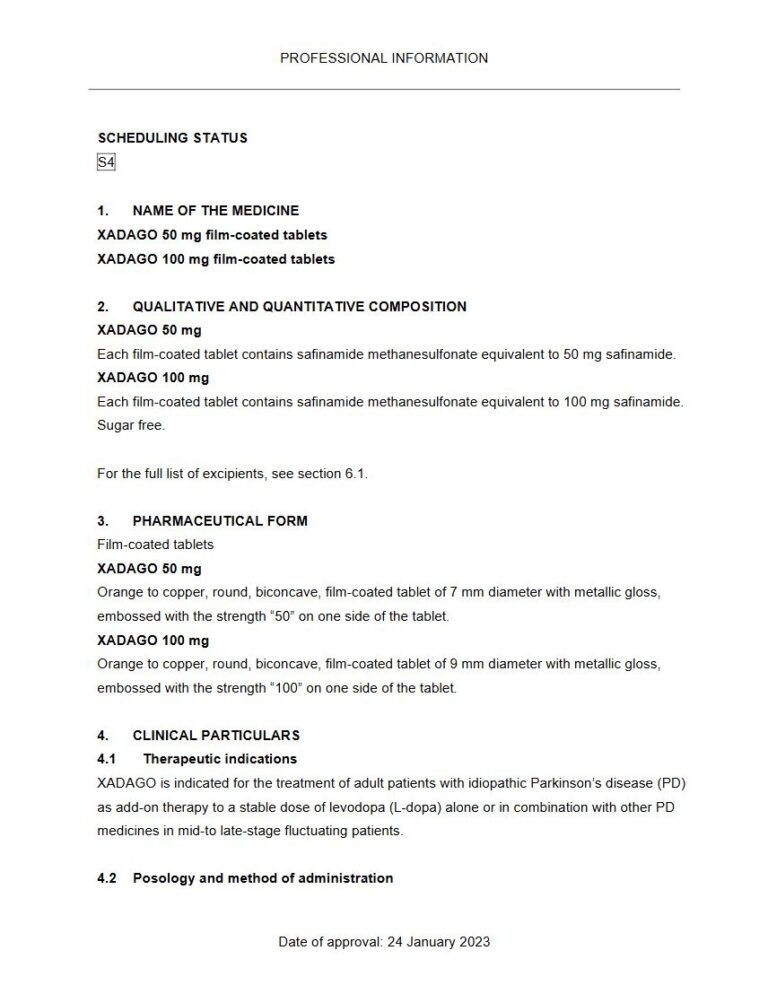
PDF Leaflet Revision Date: 24 January 2023
Clinical Summary
Quick overview from the medicine insert
Indication
Add-on therapy for adult patients with idiopathic Parkinson's disease.
Dosage (summary)
Start at 50 mg/day, may increase to 100 mg/day based on clinical need. No change for elderly.
Special Populations
- Elderly
- Hepatic impairment
- Renal impairment
Pregnancy & Breastfeeding
Not recommended during pregnancy or breastfeeding due to potential risks.
Key Drug Interactions
- MAO inhibitors
- Pethidine
- SSRIs
- SNRIs
Contraindications
- Hypersensitivity to safinamide
- Severe hepatic impairment
- Concomitant MAO inhibitors
- Concomitant pethidine
Common side effects
- Dyskinesia
- Somnolence
- Dizziness
- Nausea
Counselling Points
- Take with or without food
- Monitor for impulse control disorders
- Avoid driving if affected by somnolence
Serious warnings
- Risk of serotonin syndrome
- Impulse control disorders
- Potential retinal degeneration
Important Disclaimer
The Xadago 50 mg & 100 mg Tablets professional information leaflet below is the property of Adcock Ingram and is provided on Medinsert exactly as issued, with no.. alterations or editorial changes. We make every effort to keep content current by updating documents as soon as new versions become available. Medinsert serves as a trusted access point for healthcare professionals, but does not replace official sources or clinical judgement. For more details, please read our full disclaimer. read more>>
 Healthcare Professionals Only
This content is for registered healthcare professionals
Sign in or create a free account to read the full package insert.
Free for HPCSA-registered professionals. Powered by Medinsert.
Clinical Particulars
Section 4 of the official insert — extracted exactly as issued, no alterations
4.1 Therapeutic indications
XADAGO is indicated for the treatment of adult patients with idiopathic Parkinsonu2019s disease (PD) as add-on therapy to a stable dose of levodopa (L-dopa) alone or in combination with other PD medicines in mid-to late-stage fluctuating patients.
4.2 Posology and method of administration
Treatment with XADAGO should be started at 50 mg per day. This daily dose may be increased to 100 mg/day on the basis of individual clinical need. If a dose is missed the next dose should be taken at the usual time the next day.
Elderly patients
No change in dose is required for elderly patients. Experience of use of safinamide in patients over 75 years of age is limited.
Hepatic impairment
XADAGO use in patients with severe hepatic impairment is contraindicated (see section 4.3). No dose adjustment is required in patients with mild hepatic impairment. The lower dose of 50 mg/day is recommended for patients with moderate hepatic impairment. If patients progress from moderate to severe hepatic impairment, XADAGO should be stopped (see section 4.4).
Renal impairment
No change in dose is required for patients with renal impairment.
Paediatric population
The safety and efficacy of XADAGO in children and adolescents under 18 years of age have not been established. No data are available.
Method of administration
For oral use. XADAGO should be taken with water. XADAGO may be taken with or without food.
4.3 Contraindications
- Hypersensitivity to safinamide or to any of the excipients (see section 6.1).
- Concomitant treatment with other monoamine oxidase (MAO) inhibitors (see sections 4.4 and 4.5).
- Concomitant treatment with pethidine (see sections 4.4 and 4.5).
- Use in patients with severe hepatic impairment (see section 4.2).
- Use in patients with albinism, retinal degeneration, uveitis, inherited retinopathy or severe progressive diabetic retinopathy (see sections 4.4 and 5.3).
4.4 Special warnings and precautions for use
General warning
In general, safinamide may be used with selective serotonin re-uptake inhibitors (SSRIs) at the lowest effective dose, with caution for serotoninergic symptoms. In particular, the concomitant use of safinamide and fluoxetine or fluvoxamine should be avoided, or if concomitant treatment is necessary these medicines should be used at low doses (see section 4.5). A washout period corresponding to 5 half-lives of the SSRI used previously should be considered prior to initiating treatment with safinamide.
At least 7 days must elapse between discontinuation of safinamide and initiation of treatment with MAO inhibitors or pethidine (see section 4.3 and 4.5).
When safinamide is co-administered with products that are BCRP substrates, please refer to the professional information (PI) for that particular medicine.
Hepatic impairment
Caution should be exercised when initiating treatment with safinamide in patients with moderate hepatic impairment. In case patients progress from moderate to severe hepatic impairment, treatment with XADAGO should be stopped (see sections 4.2, 4.3 and 5.2).
Potential for retinal degeneration in patients with prior history of retinal disease
XADAGO should not be administered to patients with ophthalmological history that would put them at increased risk for potential retinal effects (e.g., family history of hereditary retinal disease, or history of uveitis) see sections 4.3 and 5.3.
Impulse control disorders (ICDs)
Impulse control disorders can occur in patients treated with dopamine agonists and/or dopaminergic treatments. Some reports of ICDs have also been observed with other MAO-inhibitors. Safinamide treatment has not been associated with any increase in the appearance of ICDs. Patients and carers should be made aware of the behavioural symptoms of ICDs that were observed in patients treated with MAO-inhibitors, including cases of compulsions, obsessive thoughts, pathological gambling, increased libido, hypersexuality, impulsive behaviour and compulsive spending or buying.
Dopaminergic side effects
Safinamide used as an adjunct to levodopa may potentiate the side effects of levodopa, and pre-existing dyskinesia may be exacerbated, requiring a decrease of levodopa (refer to levodopa Professional Information for further information). This effect was not seen when safinamide was used as an adjunct to dopamine agonists in early-stage PD patients.
In addition, Dopamine dysregulation syndrome (DDS) has been reported in literature reports in patients treated with carbidopa/levodopa. Although Safinamide (contained in XADAGO) never showed this risk both alone nor when administered with carbidopa/levodopa, patients and caregivers should be warned of the potential risk of developing DDS when Xadago is co-administered with carbidopa/levodopa. Dopamine Dysregulation Syndrome (DDS) is an addictive disorder seen in some patients treated with carbidopa/levodopa. Affected patients show a compulsive pattern of dopaminergic drug misuse above doses adequate to control motor symptoms, which may in some cases result in severe dyskinesias.
4.5 Interaction with other medicines and other forms of interaction
In vivo and in vitro pharmacodynamic interactions
MAO inhibitors and pethidine
XADAGO must not be administered along with other MAO inhibitors (including moclobemide) as there may be a risk of non-selective MAO inhibition that may lead to a hypertensive crisis (see section 4.3). Serious adverse reactions have been reported with the concomitant use of pethidine and MAO inhibitors. As this may be a class-effect, the concomitant administration of safinamide and pethidine is contraindicated (see section 4.3).
There have been reports of interactions with the concomitant use of MAO inhibitors and sympathomimetic medicines. In view of the MAO inhibitory activity of safinamide, concomitant administration of safinamide and sympathomimetics, such as those present in nasal and oral decongestants or cold and flu medicines containing ephedrine or pseudoephedrine, requires caution (see section 4.4).
Dextromethorphan
There have been reports of interactions with the concomitant use of dextromethorphan and non-selective MAO inhibitors. In view of the MAO inhibitory activity of safinamide, the concomitant administration of safinamide and dextromethorphan is not recommended, or if concomitant treatment is necessary, it should be used with caution (see section 4.4).
Antidepressants
The concomitant use of XADAGO and fluoxetine or fluvoxamine should be avoided (see section 4.4), this precaution is based on the occurrence of serious adverse reactions (e.g. serotonin syndrome), although rare, that have occurred when SSRIs and dextromethorphan have been used with MAO inhibitors (including selective MAO-B inhibitors), selective serotonin reuptake inhibitors (SSRIs), serotonin-norepinephrine reuptake inhibitors (SNRIs), tricyclic antidepressants, tetracyclic antidepressants, triazolopyridine antidepressants, cyclobenzaprine, opioid drugs and methylphenidate, amphetamine and their derivatives. If necessary, the concomitant use of these medicines should be at the lowest effective dose. A washout period corresponding to 5 half-lives of the SSRI used previously should be considered prior to initiating treatment with XADAGO. Serotonin syndrome symptoms may include mental status changes (e.g., agitation, hallucinations, delirium, and coma), autonomic instability (e.g., tachycardia, labile blood pressure, dizziness, diaphoresis, flushing, and hyperthermia), neuromuscular symptoms (e.g., tremor, rigidity, myoclonus, hyperreflexia, and incoordination), seizures, and/or gastrointestinal symptoms (e.g., nausea, vomiting, and diarrhoea.
Serious adverse reactions have been reported with the concomitant use of selective serotonin reuptake inhibitors (SSRIs), serotonin norepinephrine reuptake inhibitors (SNRIs), tricyclic/tetracyclic antidepressants and MAO inhibitors (see section 4.4). In view of the selective and reversible MAO-B inhibitory activity of safinamide, antidepressants may be administered but used at the lowest doses necessary.
In vivo and in vitro pharmacokinetic interactions
Safinamide may transiently inhibit BCRP in vitro. In interaction studies in human, a weak interaction was observed with rosuvastatin (AUC increase between 1,25 and 2,00-fold) but no significant interaction was found with diclofenac. It is recommended to monitor patients when safinamide is taken with medicinal products that are BCRP substrates (e.g., rosuvastatin, pitavastatin, pravastatin, ciprofloxacin, methotrexate, topotecan, diclofenac or glyburide) and to refer to their professional information to determine if a dose adjustment is needed.
Safinamide is almost exclusively eliminated via metabolism, largely by high capacity amidases that have not yet been characterised. Safinamide is eliminated mainly in the urine. In human liver microsomes (HLM), the N-dealkylation step appears to be catalysed by CYP3A4, as safinamide clearance in HLM was inhibited by ketoconazole by 90%. Safinamide inhibits OCT1 in vitro at clinically relevant portal vein concentrations. Therefore, caution is necessary when safinamide is taken concomitantly with medicines that are OCT1 substrates and have a t max similar to safinamide (2 hours) (e.g. metformin, aciclovir, ganciclovir) as exposure to these substrates might be increased as a consequence. The metabolite NW-1153 is a substrate for OAT3 at clinically relevant concentrations. Medicines that are inhibitors of OAT3 given concomitantly with XADAGO may reduce clearance of NW-1153, i.e., and thus may increase its systemic exposure. The systemic exposure of NW-1153 is low (1/10 of parent safinamide). This potential increase is most likely of no clinical relevance as NW-1153, the first product in the metabolic pathway, is further transformed to secondary and tertiary metabolites.
Paediatric population
Interaction studies have only been performed in adults.
4.6 Fertility, pregnancy and lactation
Women of childbearing potential
XADAGO should not be given to women of childbearing potential unless adequate contraception is practiced.
Pregnancy
There are no or limited amount of data from the use of XADAGO in pregnant women. Studies in animals have shown reproductive toxicity (see section 5.3). XADAGO is not recommended during pregnancy and in women of childbearing potential not using contraception.
Breastfeeding
Available pharmacodynamic/toxicological data in animals have shown excretion of safinamide in milk (for details see 5.3). A risk for the breastfed child cannot be excluded. XADAGO should not be used during breastfeeding.
Fertility:
Animal studies indicate that XADAGO treatment is associated with adverse reactions on female rat reproductive performance and sperm quality. Male rat fertility is not affected (see section 5.3).
4.7 Effects on ability to drive and use machines
Somnolence and dizziness may occur during safinamide treatment, therefore patients should be cautioned about using hazardous machines, including motor vehicles, until they are reasonably certain that XADAGO does not affect them adversely.
4.8 Undesirable effects
Summary of the safety profile
Dyskinesia was the most common adverse reaction reported in XADAGO patients when used in combination with L-dopa alone or in combination with other PD treatments. Serious adverse reactions are known to occur with the concomitant use of SSRIs, SNRIs, tricyclic/tetracyclic antidepressants and MAO inhibitors, such as hypertensive crisis (high blood pressure, collapse), neuroleptic malignant syndrome (confusion, sweating, muscle rigidity, hyperthermia, CPK increase), serotonin syndrome (confusion, hypertension, muscle stiffness, hallucinations), and hypotension. With MAO-inhibitors there have been reports of interactions with concomitant use of sympathomimetic medicines.
Impulse control disorders: pathological gambling, increased libido, hypersexuality, compulsive spending or buying, binge eating and compulsive eating can occur in patients treated with dopamine agonists and/or other dopaminergic treatments.
Tabulated list of adverse reactions
The tabulation below includes all adverse reactions in clinical trials where adverse reactions were considered related. Adverse reactions are ranked under headings of frequency using the following conventions: very common (u22651/10), common (u2265 1/100 to < 1/10), uncommon (u2265 1/1 000 to < 1/100), rare (u2265 1/10 000 to < 1/1 000), very rare (< 1/10 000) and not known (cannot be estimated from the available data).
4.9 Overdose
In one patient suspected of consuming more than the daily prescribed dose of 100 mg for one month, symptoms of confusion, sleepiness, forgetfulness and dilated pupils were reported. These symptoms resolved on discontinuing XADAGO, without sequelae. The expected pattern of events or symptoms following intentional or accidental overdose with safinamide would be those related to its pharmacodynamic profile: MAO-B inhibition with activity-dependent inhibition of Na+ channels. The symptoms of an excessive MAO-B inhibition (increase in dopamine level) could include hypertension, postural hypotension, hallucinations, agitation, nausea, vomiting, and dyskinesia. There is no known antidote to XADAGO or any specific treatment for XADAGO overdose. If an important overdose occurs, XADAGO treatment should be discontinued and supportive treatment should be administered as clinically indicated.
