
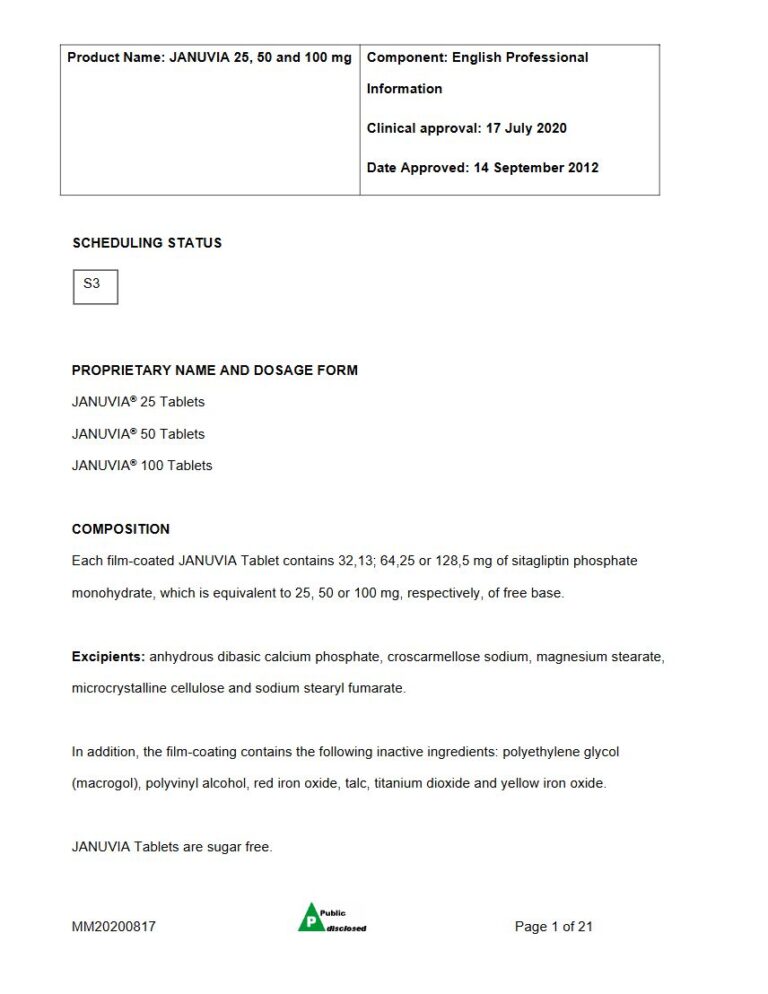
Januvia 25mg. 50mg. 100mg Tablet
PDF Leaflet Revision Date: 17 July 2020
Clinical Summary
Quick overview from the medicine insert
Indication
Adjunct to diet and exercise for type 2 diabetes control.
Dosage (summary)
100 mg once daily; adjust for renal insufficiency.
Special Populations
- Renal impairment
- Hepatic impairment
- Elderly
Pregnancy & Breastfeeding
Not recommended in pregnancy; unknown if excreted in human milk.
Key Drug Interactions
- Increased digoxin levels
- Ciclosporin increases JANUVIA levels
Contraindications
- Hypersensitivity to sitagliptin
- Type 1 diabetes
- Severe hepatic insufficiency
Common side effects
- Hypoglycaemia
- Headache
- Upper respiratory tract infection
Counselling Points
- Monitor for signs of pancreatitis.
- Inform about potential hypoglycaemia.
- Take with or without food.
Serious warnings
- Risk of pancreatitis
- Serious hypersensitivity reactions
Important Disclaimer
The Januvia 25mg. 50mg. 100mg Tablet professional information leaflet below is the property of Msd and is provided on Medinsert exactly as issued, with no.. alterations or editorial changes. We make every effort to keep content current by updating documents as soon as new versions become available. Medinsert serves as a trusted access point for healthcare professionals, but does not replace official sources or clinical judgement. For more details, please read our full disclaimer. read more>>
 Healthcare Professionals Only
This content is for registered healthcare professionals
Sign in or create a free account to read the full package insert.
Free for HPCSA-registered professionals. Powered by Medinsert.
Clinical Particulars
Section 4 of the official insert — extracted exactly as issued, no alterations
4.1 Therapeutic indications
Monotherapy
JANUVIA is indicated as an adjunct to diet and exercise to improve glycaemic control in adult patients with type 2 diabetes mellitus.
Combination therapy
JANUVIA is indicated in patients with type 2 diabetes mellitus to improve glycaemic control in combination with metformin, pioglitazone, a sulphonylurea or combinations thereof, or insulin when diet and exercise, plus the other therapies do not provide adequate glycaemic control.
4.2 Posology and method of administration
JANUVIA can be taken with or without food. The recommended dose of JANUVIA is 100 mg once daily as monotherapy or as combination therapy with metformin, a sulfonylurea, insulin (with or without metformin), a PPAR u03b3 agonist, metformin plus a sulphonylurea or metformin plus a PPAR u03b3 agonist.
When JANUVIA is used in combination with a sulphonylurea or with insulin, a lower dose of sulphonylurea or insulin may be considered to reduce the risk of hypoglycaemia (see WARNINGS AND SPECIAL PRECAUTIONS, Hypoglycaemia in combination with a sulphonylurea or with insulin).
If a dose of JANUVIA is missed, it should be taken as soon as the patient remembers. A double dose of JANUVIA should not be taken on the same day.
Patients with renal insufficiency
For patients with mild renal insufficiency (creatinine clearance [CrCl] u2265 50 mL/min, approximately corresponding to serum creatinine levels of u2264 150 u03bcmol/L in men and u2264 133 u03bcmol/L in women), no dosage adjustment for JANUVIA is required.
For patients with moderate renal insufficiency (CrCl u2265 30 to 150 u03bcmol/L to u2264 265 u03bcmol/L in men and > 133 u03bcmol/L to not u2264 221 u03bcmol/L in women), the dose of JANUVIA is 50 mg once daily. This dose should be decreased if CrCl decreases to < 30mL/min.
For patients with severe renal insufficiency (CrCl 265 u03bcmol/L in men and > 221 u03bcmol/L in women) or with end-stage renal disease requiring haemodialysis or peritoneal dialysis, the dose of JANUVIA is 25 mg once daily. JANUVIA may be administered without regard to the timing of dialysis.
Patients with hepatic insufficiency
No dosage adjustment is necessary for patients with mild to moderate hepatic insufficiency. JANUVIA has not been studied in patients with severe hepatic insufficiency.
Elderly
No dosage adjustment is necessary for elderly patients.
Paediatric Population
There are no data available on the use of JANUVIA in patients younger than 18 years of age. Therefore, use of JANUVIA in paediatric patients is not recommended.
4.3 Contraindications
JANUVIA is contraindicated in patients with:
- hypersensitivity to sitagliptin, other gliptins (DPP-4 inhibitors) or to any components of JANUVIA or have a history of serious hypersensitivity reactions, such as anaphylaxis and angioedema to JANUVIA or other gliptins (DPP-4 inhibitors).
- type 1 diabetes mellitus
- JANUVIA has not been studied in patients with severe hepatic insufficiency (see Pharmacokinetic properties, Hepatic Insufficiency).
4.4 Special warnings and precautions for use
Pancreatitis: In post-marketing experience there have been reports of acute pancreatitis, including fatal and non-fatal haemorrhagic or necrotising pancreatitis (see SIDE EFFECTS, Post-Marketing Experience), in patients taking JANUVIA. Patients should be informed of the characteristic symptom of acute pancreatitis such as persistent, abdominal pain. Resolution of pancreatitis has been observed after discontinuation of JANUVIA. If pancreatitis is suspected, JANUVIA should be discontinued immediately.
Hypersensitivity Reactions: There have been post-marketing reports of serious hypersensitivity reactions in patients treated with JANUVIA. These reactions include anaphylaxis, angioedema and exfoliative skin conditions including Stevens-Johnson syndrome. Onset of these reactions usually occurred within the first 3 months after initiation of treatment with JANUVIA, with some reports occurring after the first dose. If a hypersensitivity reaction is suspected, discontinue JANUVIA immediately, assess for other potential causes for the event and institute an alternative class of medicines for treatment for diabetes (see CONTRAINDICATIONS and SIDE EFFECTS, Post-Marketing Experience).
Hypoglycaemia in combination with a sulphonylurea or with insulin: When JANUVIA was used in combination with a sulphonylurea or with insulin, medicines known to cause hypoglycaemia, the incidence of hypoglycaemia was increased over that of placebo (see SIDE EFFECTS). Therefore, to reduce the risk of sulphonylurea- or insulin-induced hypoglycaemia, a lower dose of sulphonylurea or insulin may be considered (see DOSAGE AND DIRECTIONS FOR USE).
Renal insufficiency: A dosage adjustment is recommended in patients with moderate or severe renal insufficiency and in patients with end-stage renal disease requiring haemodialysis or peritoneal dialysis (see DOSAGE AND DIRECTIONS FOR USE, Patients with renal insufficiency).
There have been post-marketing reports of severe and disabling arthralgia in patients taking DPP-4 inhibitors such as JANUVIA. The time to onset of symptoms following initiation of drug therapy varied from one day to years. Patients experienced relief of symptoms upon discontinuation of the drug therapy Some patients experienced a recurrence of symptoms when restarting JANUVIA or a different DPP-4 inhibitor. Consider DPP-4 inhibitors such as JANUVIA as a possible cause for severe joint pain and discontinue drug therapy if appropriate.
Effects on ability to drive and use machinery
No studies of the effects of JANUVIA on the ability to drive and use machines have been performed.
4.5 Interactions with other medicines
In interaction studies, JANUVIA did not have clinically meaningful effects on the pharmacokinetics of the following: metformin, a thiazolinedione (glitazone), glyburide, simvastatin, warfarin and oral contraceptives. Based on these data, JANUVIA does not inhibit CYP isozymes CYP3A4, 2C8 or 2C9. Based on in vitro data, sitagliptin is also not expected to inhibit CYP2D6, 1A2, 2C19 or 2B6 or to induce CYP3A4. There is limited information on multiple dose co-administration of these medicines.
There was an increase in the area under the curve (AUC, 11 %) and mean peak medicine concentration (C max, 18 %) of digoxin with the co-administration of sitagliptin. Patients receiving digoxin should be monitored appropriately.
The AUC and C max of JANUVIA were increased approximately 29 % and 68 %, respectively, in subjects with co-administration of a single 100 mg oral dose of JANUVIA and a single 600 mg oral dose of ciclosporin, a potent probe inhibitor of p-glycoprotein. The observed changes in JANUVIA pharmacokinetics are not considered likely to be clinically meaningful. No dosage adjustment for JANUVIA is recommended when co-administered with ciclosporin or other p-glycoprotein inhibitors (e.g. ketoconazole).
4.6 Fertility, pregnancy and lactation
There are no studies in pregnant women; therefore, JANUVIA is not recommended for use in pregnancy.
Lactation
JANUVIA is secreted in the milk of lactating rats. It is not known whether JANUVIA is secreted in human milk. Therefore, JANUVIA should not be used by women who are breastfeeding their infants.
4.8 Undesirable effects
Adverse reactions considered as medicine related reported in patients treated with sitagliptin occurring in excess (> 0,2 % and difference more than 1 patient) of that in patients treated with placebo are listed below by system organ class and frequency. Frequencies are defined as: very common (u2265 to 1/10); common (u2265 to 1/100, < 1/10); uncommon (u2265 1 /1 000, < 1/100); rare (u2265 1 /10 000, < 1/1 000); and very rare (< 1/10 000).
JANUVIA Monotherapy
Infections and Infestations
Common: upper respiratory tract infection, nasopharyngitis
Metabolism and nutrition disorders
Common: hypoglycaemia
Nervous system disorders
Common: headache
Uncommon: dizziness
Gastrointestinal disorders
Uncommon: constipation
Musculoskeletal and connective tissue disorders
Common: osteoarthritis, pain in extremity.
Post-Marketing Experience
During post-marketing experience the following additional side effects have been reported: hypersensitivity reactions including anaphylaxis, angioedema, rash, urticaria, cutaneous vasculitis and exfoliative skin conditions including Stevens-Johnson syndrome (see WARNINGS AND SPECIAL PRECAUTIONS); acute pancreatitis, including fatal and non-fatal haemorrhagic and necrotising pancreatitis (see WARNINGS AND SPECIAL PRECAUTIONS, Pancreatitis); worsening renal function, including acute renal failure (sometimes requiring dialysis); vomiting, headache, constipation, nasopharyngitis, upper respiratory tract infection; severe and disabling arthralgia (see WARNINGS AND SPECIAL PRECAUTIONS); myalgia; pain in extremity; back pain, pemphigoid, pruritus.
4.9 Overdose
In the event of an overdose it is reasonable to employ the usual supportive measures, e.g. remove unabsorbed material from the gastrointestinal tract, employ clinical monitoring (including obtaining an electrocardiogram) and institute supportive therapy if required.
JANUVIA is modestly dialysable in clinical studies, approximately 13,5 % of the dose was removed over a 3- to 4-hour haemodialysis session. Prolonged haemodialysis may be considered if clinically appropriate. It is not known if JANUVIA is dialysable by peritoneal dialysis.
