
Sitagliptin 25/50/ 100 Adco 25 mg, 50 mg and 100 mg FC Tablets
PDF Leaflet Revision Date: 29 July 2025
Clinical Summary
Quick overview from the medicine insert
Indication
Adjunct to diet and exercise for type 2 diabetes mellitus.
Dosage (summary)
100 mg once daily; 50 mg for moderate renal impairment; 25 mg for severe renal impairment.
Special Populations
- Renal impairment
- Hepatic impairment
- Elderly
Pregnancy & Breastfeeding
Not recommended during pregnancy or breastfeeding.
Key Drug Interactions
- CYP3A4 inhibitors
- Metformin
- Digoxin
Contraindications
- Hypersensitivity to sitagliptin
- Severe hepatic insufficiency
Common side effects
- Hypoglycaemia
- Headache
- Dizziness
- Nausea
Counselling Points
- Take with or without food
- Monitor for signs of pancreatitis
- Risk of hypoglycaemia with insulin or sulphonylureas
Serious warnings
- Risk of acute pancreatitis
- Serious hypersensitivity reactions
Important Disclaimer
The Sitagliptin 25/50/ 100 Adco 25 mg, 50 mg and 100 mg FC Tablets professional information leaflet below is the property of Adcock Ingram and is provided on Medinsert exactly as issued, with no.. alterations or editorial changes. We make every effort to keep content current by updating documents as soon as new versions become available. Medinsert serves as a trusted access point for healthcare professionals, but does not replace official sources or clinical judgement. For more details, please read our full disclaimer. read more>>
 Healthcare Professionals Only
This content is for registered healthcare professionals
Sign in or create a free account to read the full package insert.
Free for HPCSA-registered professionals. Powered by Medinsert.
Clinical Particulars
Section 4 of the official insert — extracted exactly as issued, no alterations
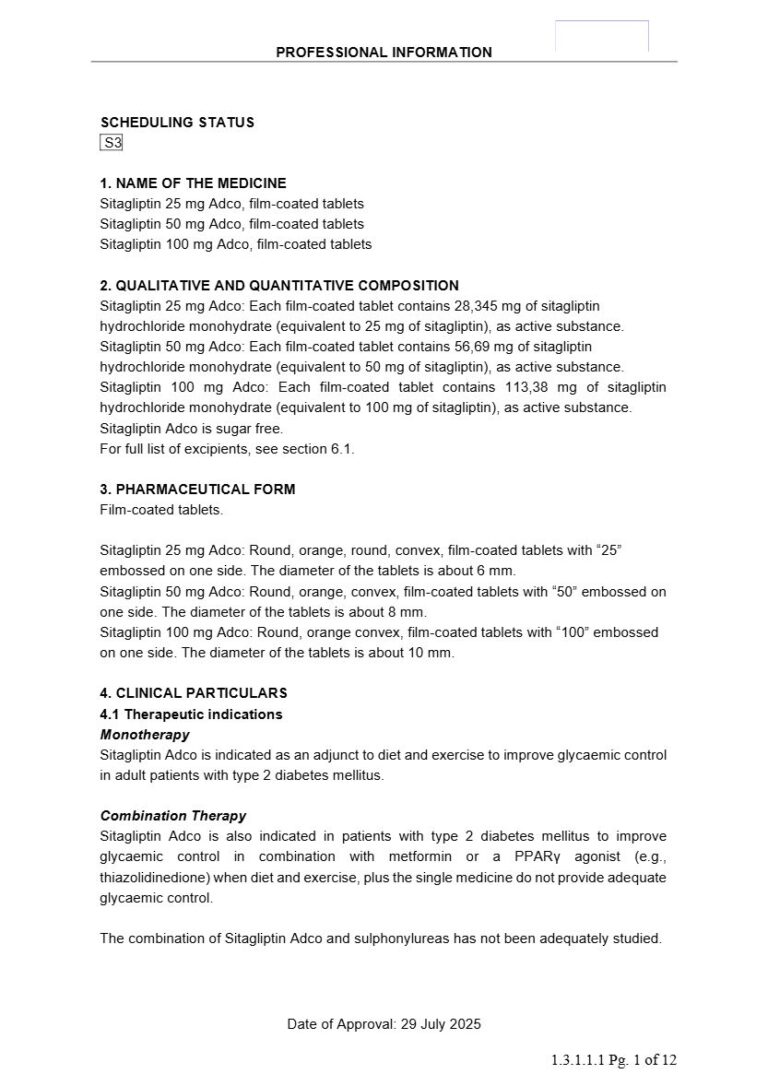
4.1 Therapeutic indications
Monotherapy
Sitagliptin Adco is indicated as an adjunct to diet and exercise to improve glycaemic control in adult patients with type 2 diabetes mellitus.
Combination Therapy
Sitagliptin Adco is also indicated in patients with type 2 diabetes mellitus to improve glycaemic control in combination with metformin or a PPARu03b3 agonist (e.g., thiazolidinedione) when diet and exercise, plus the single medicine do not provide adequate glycaemic control. The combination of Sitagliptin Adco and sulphonylureas has not been adequately studied.
4.2 Posology and method of administration
Posology
The dose of Sitagliptin Adco in combination with metformin or a PPARu03b3 agonist is 100 mg once daily. The dosage of metformin or PPARu03b3 agonist should be maintained, and Sitagliptin Adco administered concomitantly. If a dose of Sitagliptin Adco is missed, it should be taken as soon as the patient remembers. A double dose of Sitagliptin Adco should not be taken on the same day.
Special populations
Patients with Renal Insufficiency
For patients with mild renal insufficiency (creatinine clearance [CrCl] u2265 50 mL/min, approximately corresponding to serum creatinine levels of u2264 150 micromol/litre in men and u2264 133 micromol/litre in women), no dosage adjustment for Sitagliptin Adco is required. For patients with moderate renal insufficiency (CrCl u2265 30 to 150 micromol/litre to u2264 265 micromol/litre in men and > 133 micromol/litre to not u2264 221 micromol/litre in women), the dose of Sitagliptin Adco is 50 mg once daily. This dose should be decreased if CrCl decreases to < 30 mL/min. For patients with severe renal insufficiency (CrCl 265 micromol/litre in men and > 221 micromol/litre in women) or with end-stage renal disease requiring haemodialysis, the dose of Sitagliptin Adco is 25 mg once daily. Sitagliptin Adco may be administered without regard to the timing of haemodialysis.
Patients with Hepatic Insufficiency
No dosage adjustment is necessary for patients with mild to moderate hepatic insufficiency. Sitagliptin Adco has not been studied in patients with severe hepatic insufficiency.
Elderly
No dosage adjustment is necessary for elderly patients.
Paediatric Population
There are no data available on the use of Sitagliptin Adco in patients younger than 18 years of age. Therefore, use of Sitagliptin Adco in paediatric patients is not recommended.
Method of administration
Oral. Sitagliptin Adco can be taken with or without food.
4.3 Contraindications
- Hypersensitivity to sitagliptin hydrochloride or to any of the excipients listed in section 6.1.
- A history of serious hypersensitivity reactions, such, as anaphylaxis and angioedema to Sitagliptin Adco or other gliptins (DPP-4).
- Sitagliptin Adco has not been studied in patients with severe hepatic insufficiency (see section 5.2).
4.4 Special warnings and precautions for use
General
Sitagliptin Adco should not be used in patients with type 1 diabetes or for the treatment of diabetic ketoacidosis.
Acute pancreatitis
Use of DPP-4 inhibitors has been associated with a risk of developing acute pancreatitis. Patients should be informed of the characteristic symptom of acute pancreatitis: persistent severe abdominal pain. Resolution of pancreatitis has been observed after discontinuation of Sitagliptin Adco (with or without supportive treatment) but cases of necrotising or haemorrhagic pancreatitis and/or death have been reported. If pancreatitis is suspected, Sitagliptin Adco and other potentially suspect medicines should be discontinued immediately. If acute pancreatitis is confirmed, Sitagliptin Adco should not be restarted. Caution should be exercised in patients with a history of pancreatitis.
Hypoglycaemia when used in combination with other anti-hyperglycaemic medicines
In clinical trials of sitagliptin (as contained in Sitagliptin Adco) as monotherapy and as part of combination therapy with medicines not known to cause hypoglycaemia (i.e., metformin and/or a PPARu03b3 agonist), rates of hypoglycaemia reported with sitagliptin (as contained in Sitagliptin Adco) were similar to rates in patients taking placebo. Hypoglycaemia has been observed when Sitagliptin Adco was used in combination with insulin or a sulphonylurea. Therefore, to reduce the risk of hypoglycaemia, a lower dose of sulphonylurea or insulin may be considered (see section 4.2).
Renal impairment
Sitagliptin Adco is renally excreted. To achieve plasma concentrations of Sitagliptin Adco similar to those in patients with normal renal function, lower dosages are recommended in patients with moderate and severe renal impairment, as well as in ESRD patients requiring haemodialysis or peritoneal dialysis (see section 4.2 and 5.2). When considering the use of Sitagliptin Adco in combination with another antidiabetic medicines, its conditions for use in patients with renal impairment should be checked.
Hypersensitivity Reactions:
There have been post-marketing reports of serious hypersensitivity reactions in patients treated with sitagliptin (as contained in Sitagliptin Adco). These reactions included anaphylaxis, angioedema and exfoliative skin conditions including Stevens-Johnson syndrome. Onset of these reactions occurred within the first 3 months after initiation of treatment with sitagliptin (as contained in Sitagliptin Adco) with some reports occurring after the first dose. If a hypersensitivity reaction is suspected, discontinue Sitagliptin Adco immediately. Other potential causes for the event should be assessed, and alternative treatment for diabetes initiated (see sections 4.3 and 4.8).
Bullous pemphigoid
There have been post-marketing reports of bullous pemphigoid in patients taking DPP-4 inhibitors including sitagliptin. If bullous pemphigoid is suspected, Sitagliptin Adco should be discontinued.
Sitagliptin Adco contains less than 1 mmol sodium (23 mg) per tablet, that is to say essentially 'sodium-free'.
4.5 Interaction with other medicines and other forms of interaction
Effects of other medicines on Sitagliptin Adco
Clinical data described below suggest that the risk for clinically meaningful interactions by co-administered medicines is low. In vitro studies indicated that the primary enzyme responsible for the limited metabolism of Sitagliptin as in Sitagliptin Adco is CYP3A4, with contribution from CYP2C8. In patients with normal renal function, metabolism, including via CYP3A4, plays only a small role in the clearance of sitagliptin. Metabolism may play a more significant role in the elimination of Sitagliptin Adco in the setting of severe renal impairment or end stage renal disease (ESRD). For this reason, it is possible that potent CYP3A4 inhibitors (i.e., ketoconazole, itraconazole, ritonavir, clarithromycin) could alter the pharmacokinetics of Sitagliptin Adco in patients with severe renal impairment or ESRD. The effect of potent CYP3A4 inhibitors in the setting of renal impairment has not been assessed in a clinical study.
In vitro transport studies showed that Sitagliptin as in Sitagliptin Adco is a substrate for p-glycoprotein and organic anion transporter-3 (OAT3). OAT3 mediated transport of Sitagliptin as in Sitagliptin Adco was inhibited in vitro by probenecid, although the risk of clinically meaningful interactions is considered to be low. Concomitant administration of OAT3 inhibitors has not been evaluated in vivo.
Metformin:
Co-administration of multiple twice-daily doses of 1 000 mg metformin with 50 mg Sitagliptin Adco did not meaningfully alter the pharmacokinetics of Sitagliptin Adco in patients with type 2 diabetes.
Ciclosporin:
A study was conducted to assess the effect of ciclosporin, a potent inhibitor of p-glycoprotein, on the pharmacokinetics of sitagliptin (as contained in Sitagliptin Adco). Co-administration of a single 100 mg oral dose of sitagliptin (as contained in Sitagliptin Adco) and a single 600 mg oral dose of ciclosporin increased the AUC and C max of sitagliptin (as contained in Sitagliptin Adco) by approximately 29 % and 68 %, respectively. These changes in sitagliptin (as contained in Sitagliptin Adco) pharmacokinetics were not considered to be clinically meaningful. The renal clearance of sitagliptin (as contained in Sitagliptin Adco) was not meaningfully altered. Therefore, meaningful interactions would not be expected with other p-glycoprotein inhibitors.
Effects of Sitagliptin Adco on other medicines
Digoxin:
Sitagliptin (as contained in Sitagliptin Adco) had a small effect on plasma digoxin concentrations. Following administration of 0,25 mg digoxin concomitantly with 100 mg of sitagliptin daily for 10 days, the plasma AUC of digoxin was increased on average by 11 %, and the plasma C max on average by 18 %. No dose adjustment of digoxin is recommended. However, patients at risk of digoxin toxicity should be monitored for this when Sitagliptin Adco and digoxin are administered concomitantly.
In vitro data suggest that sitagliptin does not inhibit nor induce CYP450 isoenzymes. In clinical studies, sitagliptin did not meaningfully alter the pharmacokinetics of metformin, glyburide, simvastatin, rosiglitazone, warfarin, or oral contraceptives, providing in vivo evidence of a low propensity for causing interactions with substrates of CYP3A4, CYP2C8, CYP2C9, and organic cationic transporter (OCT). Sitagliptin may be a mild inhibitor of p-glycoprotein in vivo.
4.6 Fertility, pregnancy and lactation
Pregnancy
There are no adequate data from the use of Sitagliptin Adco in pregnant women. Studies in animals have shown reproductive toxicity at high doses (see section 5.3). Sitagliptin Adco should not be used during pregnancy.
Breastfeeding
It is unknown whether Sitagliptin Adco is excreted in human breast milk. Animal studies have shown excretion of Sitagliptin Adco in breast milk. Sitagliptin Adco should not be used during breastfeeding.
Fertility
Animal data do not suggest an effect of treatment with Sitagliptin Adco on male and female fertility. No human data is available.
4.7 Effects on ability to drive and use machines
Dizziness and somnolence have been reported with sitagliptin, which may influence the ability to drive and use machines. In addition, patients should be alerted to the risk of hypoglycaemia when Sitagliptin Adco is used in combination with a sulphonylurea or with insulin.
4.8 Undesirable effects
a. Summary of the safety profile
Serious adverse reactions including pancreatitis and hypersensitivity reactions have been reported. Hypoglycaemia has been reported in combination with sulphonylurea and insulin (see section 4.4).
b. Tabulated list of adverse reactions
Table 1 The frequency of adverse reactions identified from placebo-controlled clinical studies of sitagliptin monotherapy and post-marketing experience
Blood and lymphatic system disorders
Less frequent Thrombocytopenia
Immune system disorders
Frequency unknown Hypersensitivity reactions including anaphylactic responses*,u2020, angioedema*
Metabolism and nutrition disorders
Frequent Hypoglycaemiau2020
Nervous system disorders
Frequent Headache
Less frequent Dizziness
Respiratory, thoracic and mediastinal disorders
Frequency unknown Interstitial lung disease*
Gastrointestinal disorders
Less frequent Constipation
Frequency unknown Vomiting*, acute pancreatitis*,u2020,u2021 , fatal and non-fatal haemorrhagic and necrotising pancreatitis*
Skin and subcutaneous tissue disorders
Less frequent Pruritus*
Frequency unknown Rash*,u2020, urticaria*,u2020, cutaneous vasculitis*,u2020, exfoliative skin conditions including Stevens-Johnson syndrome*,u2020, bullous pemphigoid*
Musculoskeletal and connective tissue disorders
Frequency unknown Arthralgia*, myalgia*, back pain*, arthropathy*
Renal and urinary disorders
Frequency unknown Impaired renal function*, acute renal failure*
*Adverse reactions were identified through post-marketing surveillance.
u2020 See section 4.4.
u2021 See Cardiovascular safety study below.
Table 2 The frequency of adverse reactions identified from placebo-controlled clinical studies of sitagliptin with Metformin and sitagliptin with a PPAR u03b3 medicine (pioglitazone)
Frequency of adverse reaction by treatment regimen
Sitagliptin with Metformin
Sitagliptin with a PPARu03b3 medicine (pioglitazone)
Investigations
Less frequent Decreased blood glucose levels
Nervous system disorders
Less frequent Somnolence
Gastrointestinal disorders
Frequent Nausea Flatulence
Less frequent Diarrhoea, upper abdominal pain
Metabolism and nutrition disorders
Frequent Hypoglycaemia
General disorders and administration site conditions
Frequent Peripheral oedema
In addition, in monotherapy studies of up to 24 weeks in duration of sitagliptin 100 mg once daily alone compared to placebo, adverse reactions considered as medicine-related reported in patients treated with sitagliptin in excess (> 0,2 % and difference more than 1 patient) of that in patients receiving placebo are headache, hypoglycaemia, constipation and dizziness.
c. Description of selected adverse reactions
In addition to the medicine-related adverse experiences described above, adverse experiences reported regardless of causal relationship to medication and occurring in at least 5 % and more commonly in patients treated with sitagliptin (e.g., Sitagliptin Adco) included upper respiratory tract infection and nasopharyngitis. Additional adverse experiences reported regardless of causal relationship to medication that occurred more frequently in patients treated with sitagliptin (not reaching the 5 % level but occurring with an incidence of > 0,5 % higher with sitagliptin than that in the control group) included osteoarthritis and pain in extremity.
Some adverse reactions were observed more frequently in studies of combination use of sitagliptin (e.g., Sitagliptin Adco) with other anti-diabetic medicines than in studies of sitagliptin monotherapy. These included hypoglycaemia (frequency very frequent with the combination of sulphonylurea and metformin), influenza (frequent with insulin) (with or without metformin), nausea and vomiting (frequent with metformin), flatulence (frequent with metformin or pioglitazone), constipation (frequent with the combination of sulphonylurea and metformin), peripheral oedema (frequent with pioglitazone or the combination of pioglitazone and metformin), somnolence and diarrhoea (less frequent with metformin), and dry mouth (less frequent with insulin (with or without metformin)).
Cardiovascular Safety Study
A clinical study was conducted that included patients treated with sitagliptin, 100 mg daily (or 50 mg daily if the baseline eGFR was u2265 30 and < 50 mL/min/1,73 m2), and patients treated with placebo in the intention-to-treat population. The overall incidence of serious adverse events in patients receiving sitagliptin was similar to that in patients receiving placebo. In the intention-to-treat population, among patients who were using insulin and/or a sulfonylurea at baseline, the incidence of severe hypoglycaemia was 2,7 % in sitagliptin - treated patients and 2,5 % in placebo-treated patients; among patients who were not using insulin and/or a sulfonylurea at baseline, the incidence of severe hypoglycaemia was 1,0 % in sitagliptin-treated patients and 0,7 % in placebo-treated patients. The incidence of adjudication-confirmed pancreatitis events was 0,3 % in sitagliptin-treated patients and 0,2 % in placebo-treated patients.
Reporting of suspected adverse reactions
Reporting suspected adverse reactions after authorisation of the medicine is important. It allows continued monitoring of the benefit/risk balance of the medicine. Healthcare providers are asked to report any suspected adverse reactions to SAHPRA via the Med Safety APP (Medsafety X SAHPRA) and eReporting platform (who-umc.org) found on SAHPRA website.
4.9 Overdose
Single doses of up to 800 mg sitagliptin are generally well tolerated. There is no experience with doses above 800 mg. In the event of an overdose, it is reasonable to employ the usual supportive measures, e.g., remove unabsorbed material from the gastrointestinal tract, employ clinical monitoring (including obtaining an electrocardiogram), and institute supportive therapy if required. Sitagliptin Adco is modestly dialysable. In clinical studies, approximately 13,5 % of the dose was removed over a 3- to 4-hour haemodialysis session. Prolonged haemodialysis may be considered if clinically appropriate. It is not known if Sitagliptin Adco is dialysable by peritoneal dialysis.
