
Sodium Bicarbonate 4 % & 8.5% Injection
PDF Leaflet Revision Date: 17 June 2025
Clinical Summary
Quick overview from the medicine insert
Indication
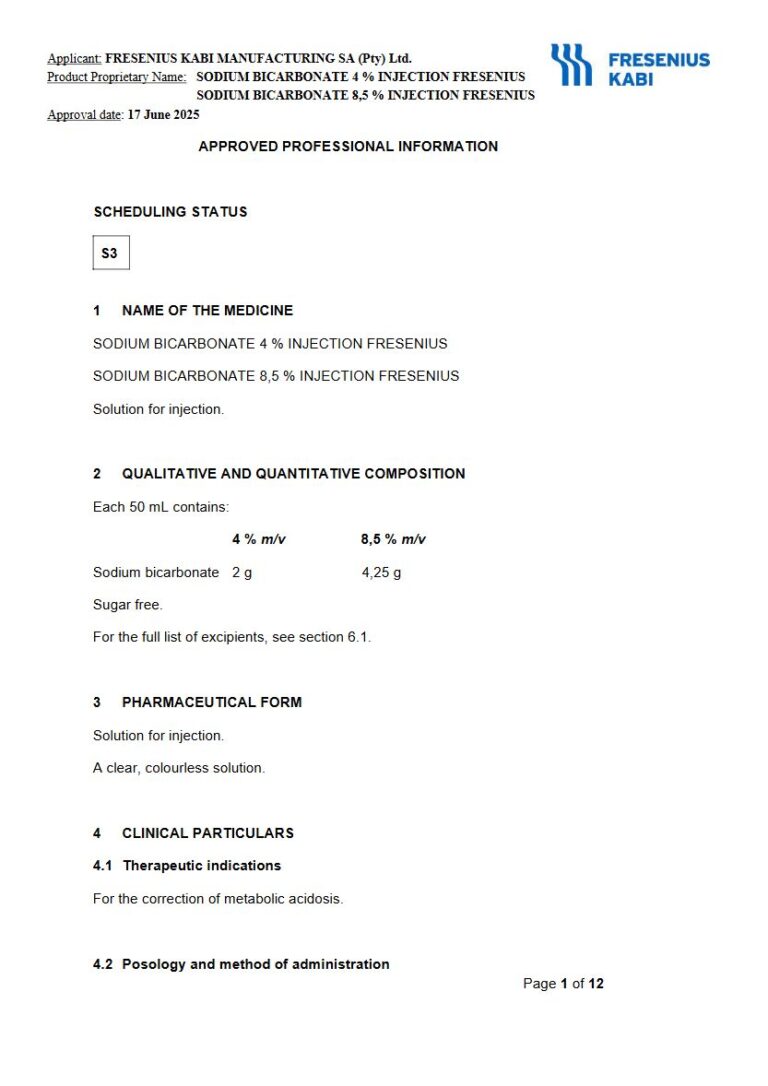
Correction of metabolic acidosis.
Dosage (summary)
Administer diluted solutions intravenously; initial doses should be small to avoid overtreatment.
Special Populations
- Renal impairment
- Neonates
- Elderly
Pregnancy & Breastfeeding
Safety in pregnancy and lactation not established.
Key Drug Interactions
- Corticosteroids
- Potassium depleting diuretics
- Acidic medications
Contraindications
- Hypersensitivity
- Renal failure
- Metabolic alkalosis
- Hypoventilation
Common side effects
- Metabolic alkalosis
- Hypokalaemia
- Muscle weakness
- Shortness of breath
Counselling Points
- Dilute before use
- Monitor electrolytes
- Avoid rapid infusion in neonates
Serious warnings
- Risk of fluid overload
- Chemical cellulitis from extravasation
- Monitor acid-base status
Important Disclaimer
The Sodium Bicarbonate 4 % & 8.5% Injection professional information leaflet below is the property of Fresenius Kabi Manufacturing Sa and is provided on Medinsert exactly as issued, with no.. alterations or editorial changes. We make every effort to keep content current by updating documents as soon as new versions become available. Medinsert serves as a trusted access point for healthcare professionals, but does not replace official sources or clinical judgement. For more details, please read our full disclaimer. read more>>
 Healthcare Professionals Only
This content is for registered healthcare professionals
Sign in or create a free account to read the full package insert.
Free for HPCSA-registered professionals. Powered by Medinsert.
Clinical Particulars
Section 4 of the official insert — extracted exactly as issued, no alterations
4.1 Therapeutic indications
For the correction of metabolic acidosis.
4.2 Posology and method of administration
Posology
Dilute before use: The dose must be found in an empirical fashion. If possible, small doses should be used initially so as not to overtreat. SODIUM BICARBONATE INJECTION FRESENIUS is incompatible with acids, acidic salts, many alkaloidal salts, aspirin and with bismuth salicylate. Solutions up to 4,2 % (0,5 mmol per mL) of SODIUM BICARBONATE INJECTION FRESENIUS are administered intravenously for the rapid correction of acidosis. Solutions containing up to 8,4 % (1 mmol per mL) are used for the initial treatment of metabolic acidosis caused by cardiac arrest. When used in the treatment of persistent metabolic acidosis in neonates the SODIUM BICARBONATE INJECTION FRESENIUS should be given slowly as a dilute (M/4) solution to prevent intraventricular haemorrhage.
Method of administration
For intravenous administration only.
4.3 Contraindications
- Hypersensitivity to the active substance or to any of the excipients listed in section 6.1.
- Conditions where sodium intake is restricted (e.g., renal failure, hypertension, oedema, congestive heart failure).
- Patients with hypoventilation (risk of worsening of acidosis).
- Metabolic or respiratory alkalosis.
- Patients with a history of urinary calculi.
- Patients with coexistent potassium depletion or chloride depletion, hypocalcaemia and hypernatraemia.
- Patients who are losing chloride by vomiting or from continuous gastrointestinal suction.
- Hypochlorhydria.
- Patients receiving diuretics known to produce hypochloraemic alkalosis.
4.4 Special warnings and precautions for use
SODIUM BICARBONATE INJECTION FRESENIUS should be used extremely cautiously in patients with impaired renal function, in toxaemia of pregnancy, aldosteronism and oliguria or anuria. In patients with diminished renal function, administration of SODIUM BICARBONATE INJECTION FRESENIUS may result in sodium retention. The intravenous administration of SODIUM BICARBONATE INJECTION FRESENIUS can cause fluid and/or solute overloading resulting in dilution of serum electrolyte concentrations, overhydration, congested states or pulmonary oedema (see section 4.8). The risk of dilutional states is inversely proportional to the electrolyte concentrations of administered parenteral solutions. The risk of solute overload causing congested states with peripheral and pulmonary oedema is directly proportional to the electrolyte concentrations of such solutions. Whenever SODIUM BICARBONATE INJECTION FRESENIUS is used intravenously, arterial blood gas analyses, in particular arterial/venous blood pH and carbon dioxide levels, should be performed before and during the course of treatment to minimise the possibility of overdosage and resultant alkalosis. Inadvertent extravasation of intravenously administered hypertonic solutions of SODIUM BICARBONATE INJECTION FRESENIUS have been reported to cause chemical cellulitis because of their alkalinity, with tissue necrosis, ulceration or sloughing at the site of infiltration (see section 4.4). Prompt elevation of the part, warmth and local injection of lidocaine or hyaluronidase are recommended to prevent sloughing of extravasated intravenous infusions. The use of scalp veins should be avoided. Whenever respiratory acidosis is concomitant with metabolic acidosis, both pulmonary ventilation and perfusion must be adequately supported to get rid of excess CO2. Administration of sodium bicarbonate to a patient with inadequate minute ventilation can cause worsening of the acidosis. The treatment of metabolic acidosis must, if possible, be combined with concurrent treatment to combat the primary cause of the acidosis, for example the administration of insulin in uncomplicated diabetes, or blood volume restoration in shock. During treatment of acidosis, frequent monitoring of serum-electrolyte concentrations and acid-base status is essential. Alkalinisation of the urine by bicarbonates or bicarbonate precursors leads to increased renal clearance of acidic medicines. If this feature is being used to eliminate medicines such as salicylates or barbiturates, then it is essential to maintain a high urine output. Conversely, urinary alkalinisation prolongs the half-life of basic medicines and may result in toxicity. In long-term therapy, care is essential to prevent the risk of overdose and alkalosis (see section 4.9). Therefore, repeat administrations of fractional doses, or an infusion, should be given while regularly monitoring the acid-base balance and electrolytes. As soon as the most severe symptoms are under control, the dose and frequency of administration must be reduced until normal values have been restored.
4.5 Interaction with other medicines and other forms of interaction
Caution should be used when administering SODIUM BICARBONATE INJECTION FRESENIUS to patients receiving corticosteroids or corticotrophin. Urinary alkalisation will increase the renal clearance of medicines which are acid in nature e.g., tetracyclines, especially doxycycline, acetylsalicylic acid, chlorpropamide, lithium, methenamine. It increases the half-life and duration of action of basic medicines such as quinidine, amphetamines, ephedrine, pseudoephedrine, memantine and flecainide. SODIUM BICARBONATE INJECTION FRESENIUS increases renal tubular reabsorption of mecamylamine causing hypotension. Hypochloraemic alkalosis may occur if SODIUM BICARBONATE INJECTION FRESENIUS is used in conjunction with potassium depleting diuretics such as bumetamide, ethacrynic acid, furosemide, and thiazides. Concurrent use in patients taking potassium supplements may reduce serum potassium concentration by promoting an intracellular ion shift.
4.6 Fertility, pregnancy and lactation
Safety in pregnancy and lactation has not been established (see section 4.4).
4.7 Effects on ability to drive and use machines
Not applicable. SODIUM BICARBONATE INJECTION FRESENIUS is intended for use only in emergencies.
4.8 Undesirable effects
a. Summary of the safety profile
Excessive administration of bicarbonate may lead to metabolic alkalosis, especially in patients with impaired renal function. Symptoms may include shortness of breath and muscle weakness (associated with potassium depletion). Muscle hypertonicity, twitching, and tetany may develop, especially in hypocalcaemic patients. Seizures may be exacerbated or precipitated in epileptic patients. Excessive doses of sodium salts may also lead to sodium overloading and hyperosmolality.
b. Tabulated summary of adverse reactions
MedDRA system organ class Frequency Adverse reactions
Metabolism and nutrition disorders Frequency unknown Metabolic alkalosis, hypokalaemia, sodium overloading/hypernatraemia, hyperosmolality, hypocalcaemia, hypoglycaemia, paradoxical intracellular acidosis
Nervous system disorders Frequency unknown Intracranial haemorrhage (in neonates), hyperirritability, tetany, seizures
Cardiac disorders Frequency unknown Deterioration of hemodynamic status associated with volume overload
Respiratory, thoracic and mediastinal disorders Frequency unknown Shortness of breath
Musculoskeletal and connective tissue disorders Frequency unknown Muscle weakness, muscle hypertonicity, twitching
General disorders and administration site conditions Frequency unknown Extravasation, tissue necrosis from incorrect administration (intra-arterial, paravenous), chemical cellulitis, ulceration, sloughing
c. Description of selected adverse reactions
Inadvertent extravasation of intravenously administered hypertonic solutions of SODIUM BICARBONATE INJECTION FRESENIUS have been reported to cause chemical cellulitis because of their alkalinity, with tissue necrosis, ulceration or sloughing at the site of infiltration (see section 4.4).
d. Paediatric population
Rapid injection (10 ml/min) of hypertonic SODIUM BICARBONATE INJECTION FRESENIUS into neonates and children under two years of age may produce hypernatraemia, a decrease in cerebrospinal fluid pressure and possible intracranial haemorrhage (see section 4.4).
4.9 Overdose
Symptoms of hypernatraemia may include hypotension, oliguria, restlessness, weakness, thirst, reduced salivation and lacrimation, swollen tongue, tachycardia, flushing of the skin, pyrexia, dizziness, headache, delirium, hyperpnoea and respiratory arrest. Retention of sodium leads to the accumulation of fluid with cerebral oedema and peripheral and pulmonary oedema. Treatment is symptomatic and supportive. Symptoms of metabolic alkalosis may include compensatory hyperventilation, paradoxical acidosis of the cerebrospinal fluid, severe hypokalaemia, hyperirritability and tetany (see section 4.8). Treatment of metabolic alkalosis associated with bicarbonate overdose consists mainly of appropriate correction of fluid and electrolyte balance as does the treatment of any hypernatraemia associated with excessive intake of sodium salts. Replacement of calcium, chloride, and potassium ions may be of particular importance. Discontinue the administration of SODIUM BICARBONATE INJECTION FRESENIUS, rebreathe expired air or, if more severe, administer calcium gluconate especially if tetany is present. In severe alkalosis, an infusion of 2,14 % ammonium chloride is recommended, except in patients with pre-existing hepatic disease. If hypokalaemia is present administer potassium chloride.
