
Gaviscon Liquid Peppermint 10 ml Suspension
PDF Leaflet Revision Date: 26 August 2025
Clinical Summary
Quick overview from the medicine insert
Indication
Gastric reflux, heartburn, and related conditions.
Dosage (summary)
Adults: 10-20 ml after meals and at bedtime; Children 12+: 10 ml; Under 2 years: 5 ml if necessary.
Onset of Action / Duration
Onset: 30 mins, Duration: up to 4 hours
Special Populations
- Elderly
- Hepatic impairment
- Renal impairment
Pregnancy & Breastfeeding
Safe during pregnancy and breastfeeding.
Key Drug Interactions
- Tetracyclines
- Digoxin
- Fluoroquinolones
- Iron salts
- Ketoconazole
Contraindications
- Hypersensitivity to active substances or excipients
Common side effects
- Stomach cramps
- Flatulence
- Hypersensitivity reactions
Counselling Points
- Shake well before use
- Report any adverse reactions
- Use caution if on a restricted salt diet
Serious warnings
- Caution in patients with congestive heart failure
- Monitor sodium intake
Important Disclaimer
The Gaviscon Liquid Peppermint 10 ml Suspension professional information leaflet below is the property of Reckitt Benckiser Pharmaceuticals and is provided on Medinsert exactly as issued, with no.. alterations or editorial changes. We make every effort to keep content current by updating documents as soon as new versions become available. Medinsert serves as a trusted access point for healthcare professionals, but does not replace official sources or clinical judgement. For more details, please read our full disclaimer. read more>>
 Healthcare Professionals Only
This content is for registered healthcare professionals
Sign in or create a free account to read the full package insert.
Free for HPCSA-registered professionals. Powered by Medinsert.
Clinical Particulars
Section 4 of the official insert — extracted exactly as issued, no alterations
4.1 Therapeutic indications
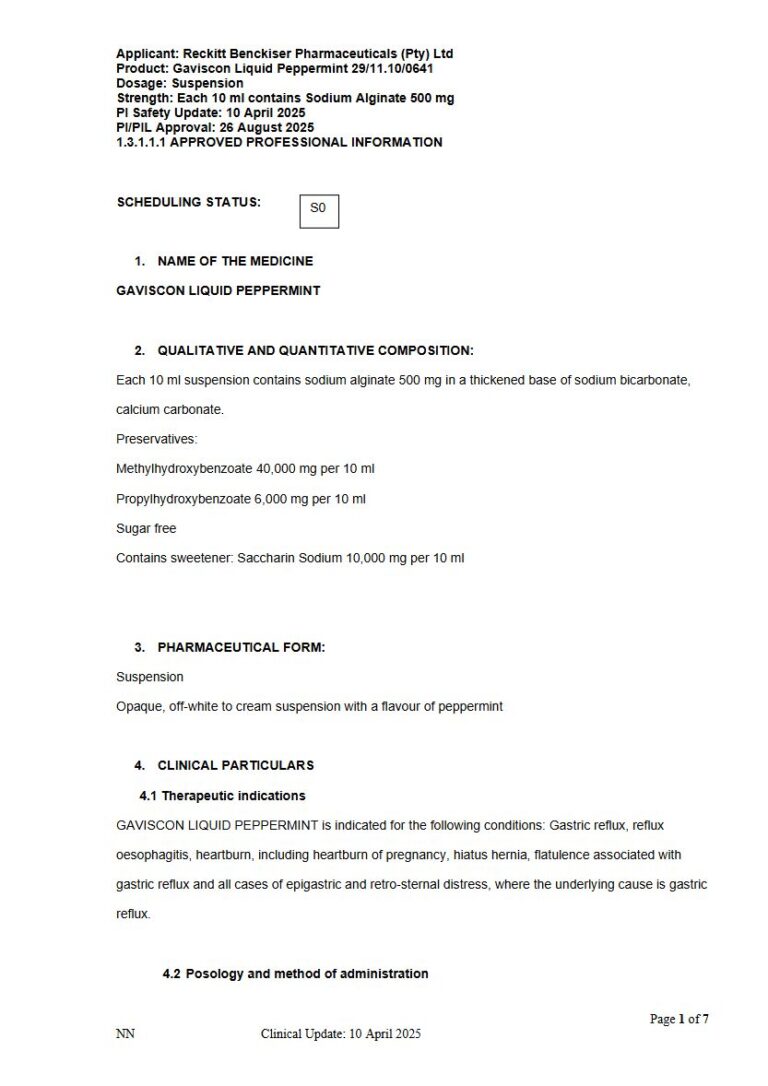
GAVISCON LIQUID PEPPERMINT is indicated for the following conditions: Gastric reflux, reflux oesophagitis, heartburn, including heartburn of pregnancy, hiatus hernia, flatulence associated with gastric reflux and all cases of epigastric and retro-sternal distress, where the underlying cause is gastric reflux.
4.2 Posology and method of administration
SHAKE WELL BEFORE USE.
Adults and children over 12 years: 10 - 20 ml after meals and at bedtime.
Children under 12 years: 10 ml after meals and at bedtime.
Children under 2 years: Although GAVISCON LIQUID PEPPERMINT are not normally recommended for children under the age of two, where the physician considers its use necessary, a dose of 5 ml should not be exceeded.
Method of administration: For oral use.
4.3 Contraindications
GAVISCON LIQUID PEPPERMINT is contraindicated in patients with known or suspected hypersensitivity to the active substances or to any of the excipients listed in section 6.1, including methyl parahydroxybenzoate (E218) and parahydroxybenzoate (E216) (see section 4.4)
4.4 Special warnings and precautions for use
If symptoms do not improve after 7 days, the clinical situation should be reviewed.
Each 10 mI dose GAVISCON LIQUID PEPPERMINT contains 145 mg (6,3 mmoI) of sodium. As congestive cardiac failure may result from excessive sodium absorption, GAVISCON LIQUID PEPPERMINT should be administered with caution to patients on a highly restricted salt diet.
Sodium bicarbonate should be administered with caution in patients with cognitive heart failure, renal impairment, cirrhosis of the liver, hypertension and to patients receiving corticosteroids, patients with metabolic or respiratory alkalosis, hypocalcaemia or hypochlorhydria.
Hypercalcaemia/alkalosis can occur following the regular use of calcium carbonate.
Elderly: No dosage modification is required in this age group.
Hepatic Impairment: No dose modification necessary.
Renal Insufficiency: Caution if highly restricted salt diet is necessary (see section 4.4).
Contains methyl parahydroxybenzoate (E218) and propyl parahydroxybenzoate (E216) which may cause allergic reactions (possibly delayed).
Paediatric population: In children under 12 years GAVISCON LIQUID PEPPERMINT should be given only on medical advice.
4.5 Interactions with other medicinal products and other forms of interaction
Large doses of GAVISCON LIQUID PEPPERMINT may affect the rate and/or the extent of absorption of other oral medicines. A time-interval of 2 hours should be considered between GAVISCON LIQUID PEPPERMINT intake and the administration of other medicinal products, especially tetracyclines, digoxine, fluoroquinolone, iron salt, ketoconazole, neuroleptics, thyroid hormones, penicillamine, beta-blockers (atenolol, metoprolol, propanolol), glucocorticoid, chloroquine and biphosphonates (diphosphonates) and estramustine. (see also 4.4).
4.6 Fertility, Pregnancy and Lactation
Problems with taking GAVISCON LIQUID PEPPERMINT during lactation have not been documented.
Pregnancy: Clinical studies in more than 500 pregnant women as well as a large amount of data from post-marketing experience indicate no malformative nor feto/neonatal toxicity of the active substances. GAVISCON LIQUID PEPPERMINT can be used during pregnancy, if clinically needed.
Breastfeeding: No effects of the active substances have been shown in breastfed newborns/infants of treated mothers. GAVISCON LIQUID PEPPERMINT can be used during breast-feeding.
Fertility: GAVISCON LIQUID PEPPERMINT has no negative effect in parental or offspring fertility or reproduction. Clinical data do not suggest that GAVISCON LIQUID PEPPERMINT has effect on human fertility.
4.7 Effects on ability to drive and use machines
None
4.8 Undesirable effects
Adverse reactions have been ranked under headings of frequency using the following convention: Very common: u2265 1/10; common: u2265 1/100 to < 1/10; uncommon: u2265 1/1,000 to < 1/100; rare: u2265 1/10,000 to < 1/1,000; very rare: < 1/10,000; Not known: cannot be estimated from the available data.
Side effects:
System Organ Class Frequency Adverse Event
Immune system disorders Very rare Anaphylactic and anaphylactoid reactions. Hypersensitivity reactions such as urticaria.
Respiratory, Thoracic and Mediastinal disorders Very rare Respiratory effects such as bronchospasm.
Gastrointestinal disorders Not known/uncommon Stomach cramps, flatulence.
Reporting of suspected adverse reactions: Reporting suspected adverse reactions after authorisation of the medicine is important. It allows continued monitoring of the benefit/risk balance of the medicine. Health care providers are requested to report any suspected adverse drug reactions to SAHPRA via the Med Safety APP (Medsafety X SAHPRA) and eReporting platform (who-umc.org) found on SAHPRA website.
Contact details for the reporting of side effects: 0861 11 1100
4.9 Overdose
Very large doses may produce a feeling of abdominal distension. Treatment of overdosage is symptomatic and supportive.
