
Trasylol 10 000 KIU/mL Injection
PDF Leaflet Revision Date: 14 August 2023
Clinical Summary
Quick overview from the medicine insert
Indication
Prophylaxis to reduce blood loss in high-risk adult patients undergoing isolated cardiopulmonary bypass graft surgery.
Dosage (summary)
Test dose of 1 mL (10,000 KIU) prior to therapeutic dose; loading dose of 1-2 million KIU followed by continuous infusion of 250,000-500,000 KIU/hour.
Special Populations
- Renal impairment
- Hepatic impairment
- Elderly
Pregnancy & Breastfeeding
Use with caution in pregnancy; unknown if excreted in breast milk.
Key Drug Interactions
- Thrombolytic agents
- Aminoglycosides
Contraindications
- Hypersensitivity to aprotinin
- Pancreatitis
- Positive aprotinin-specific IgG test
Common side effects
- Allergic reactions
- Myocardial infarction
- Acute renal failure
Counselling Points
- Test dose required before full dose
- Monitor for allergic reactions
- Ensure emergency treatment available
Serious warnings
- Increased risk of anaphylaxis upon re-exposure
- Not for use in combined cardiovascular surgeries
Important Disclaimer
The Trasylol 10 000 KIU/mL Injection professional information leaflet below is the property of Equity Pharmaceuticals and is provided on Medinsert exactly as issued, with no.. alterations or editorial changes. We make every effort to keep content current by updating documents as soon as new versions become available. Medinsert serves as a trusted access point for healthcare professionals, but does not replace official sources or clinical judgement. For more details, please read our full disclaimer. read more>>
 Healthcare Professionals Only
This content is for registered healthcare professionals
Sign in or create a free account to read the full package insert.
Free for HPCSA-registered professionals. Powered by Medinsert.
Clinical Particulars
Section 4 of the official insert — extracted exactly as issued, no alterations
4.1 Therapeutic indications
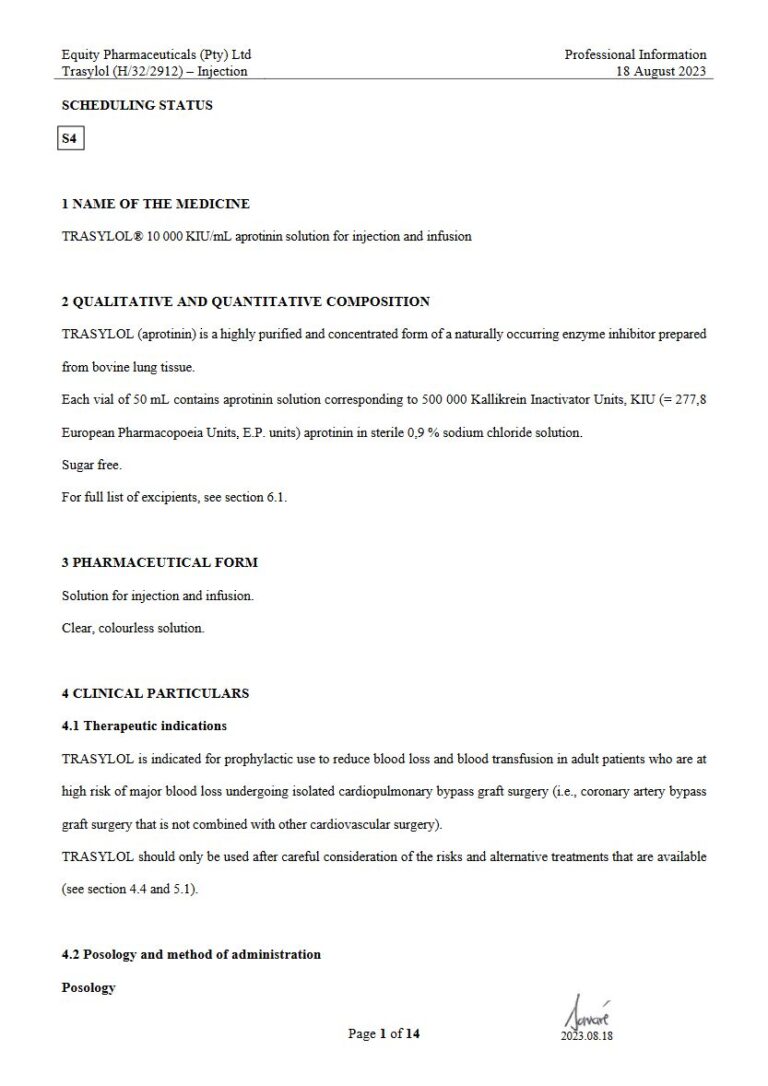
TRASYLOL is indicated for prophylactic use to reduce blood loss and blood transfusion in adult patients who are at high risk of major blood loss undergoing isolated cardiopulmonary bypass graft surgery (i.e., coronary artery bypass graft surgery that is not combined with other cardiovascular surgery). TRASYLOL should only be used after careful consideration of the risks and alternative treatments that are available (see section 4.4 and 5.1).
4.2 Posology and method of administration
An appropriate aprotinin-specific IgG antibody test should be performed in all patients before administration of TRASYLOL (see section 4.3). The following dose regimen is recommended for adult patients: Owing to the risk of allergic/anaphylactic reactions, a 1 mL (10 000 KIU) test dose should be administered to all patients at least 10 minutes prior to the remainder of the dose. After the uneventful administration of the 1 mL test dose, the therapeutic dose may be given. A H1-antagonist and a H2-antagonist may be administered 15 minutes prior to the test dose of TRASYLOL. Standard emergency treatments for anaphylactic and allergic reactions should be readily available (see section 4.4). A loading dose of 1 u2013 2 million KIU is administered as a slow intravenous injection or infusion over 20 u2013 30 minutes after induction of anaesthesia and prior to sternotomy. A further 1 u2013 2 million KIU should be added to the pump prime of the heart-lung machine. To avoid physical incompatibility of aprotinin and heparin when adding to the pump prime solution, each agent must be added during recirculation of the pump prime to assure adequate dilution prior to admixture with the other component. The initial bolus infusion is followed by the administration of a continuous infusion of 250 000 u2013 500 000 KIU per hour until the end of the operation. In general, the total amount of TRASYLOL administered per treatment course should not exceed 7 million KIU.
Paediatric population
The safety and efficacy in children below 18 years of age have not been established.
Renal impairment
Clinical experience suggests that patients with decreased renal function do not require special dose adjustment.
Hepatic impairment
No data are available on dosage recommendations for patients with hepatic dysfunction.
Elderly
Reported clinical experience has not identified differences in responses in elderly patients.
Method of administration
Intravenous doses of TRASYLOL should be administered through a central venous line. Do not administer any other medicine using the same line. TRASYLOL must be given only to patients in the supine position and must be given slowly (maximum u2013 mL/min) as an intravenous injection or a short infusion.
4.3 Contraindications
Hypersensitivity to aprotinin or any of the excipients listed in section 6.1. Pancreatitis. Patients with a positive aprotinin-specific IgG antibody test are at increased risk of anaphylactic reaction when treated with TRASYLOL. Therefore, administration of TRASYLOL is contraindicated in these patients. In case no aprotinin specific IgG antibody test is possible prior to treatment, administration of TRASYLOL to patients with a suspected previous exposure including in fibrin sealant products during the last 12 months is contraindicated.
4.4 Special warnings and precautions for use
TRASYLOL should not be used when coronary artery bypass graft (CABG) surgery is combined with another cardiovascular surgery because the safety and/or efficacy of TRASYLOL in other cardiovascular procedures have not been established.
Laboratory monitoring of anticoagulation during cardiopulmonary bypass: Aprotinin is not a heparin-sparing medicine and it is important that adequate anticoagulation with heparin be maintained during TRASYLOL therapy. Elevations in the partial thromboplastin time (PTT) and celite Activated Clotting Time (Celite ACT) is expected in TRASYLOL-treated patients during surgery, and in the hours after surgery. Therefore, the partial thromboplastin time (PTT) should not be used to maintain adequate anticoagulation with heparin. In patients undergoing cardiopulmonary bypass with TRASYLOL therapy, one of three methods is recommended to maintain adequate anticoagulation: activated clotting time (ACT), fixed heparin dosing, or heparin titration (see below). If activated clotting time (ACT) is used to maintain adequate anticoagulation, a minimal celite-ACT of 750 seconds or kaolin-ACT of 480 seconds, independent of the effects of haemodilution and hypothermia, is recommended in the presence of aprotinin.
In patients undergoing cardiopulmonary bypass with TRASYLOL therapy, one of the following methods is recommended to maintain adequate anticoagulation:
- Activated Clotting Time (ACT)
An ACT is not a standardised coagulation test, and different formulations of the assay are affected differently by the presence of aprotinin. The test is further influenced by variable dilution effects and the temperature experienced during cardiopulmonary bypass. It has been observed that kaolin-based ACTs are not increased to the same degree by aprotinin as are diatomaceous earth-based (celite) ACTs. While protocols vary, a minimal celite ACT of 750 seconds or kaolin ACT of 480 seconds, independent of the effects of haemodilution and hypothermia, is recommended in the presence of aprotinin. Consult the manufacturer of the ACT test regarding the interpretation of the assay in the presence of aprotinin. - Fixed heparin dosing
A standard loading dose of heparin administered prior to cannulation of the heart, plus the quantity of heparin added to the prime volume of the cardiopulmonary bypass circuit, should total at least 350 IU/kg. Additional heparin should be administered in a fixed-dose regimen based on patient weight and duration of cardiopulmonary bypass. - Determination of heparin levels
Protamine titration, a method that is not affected by aprotinin, can be used to measure heparin levels. A heparin dose response, assessed by protamine titration, should be performed prior to administration of aprotinin to determine the heparin loading dose. Additional heparin should be administered on the basis of heparin levels measured by protamine titration. Heparin levels during bypass should not be allowed to drop below 2,7 U/mL (2,0 mg/kg) or below the level indicated by heparin dose-response testing performed prior to administration of aprotinin.
In TRASYLOL-treated patients the neutralisation of heparin by protamine after discontinuation of cardiopulmonary bypass should either be based on a fixed ratio to the amount of heparin applied or be controlled by a protamine titration method. Important: aprotinin is not a heparin-sparing agent.
Graft conservation: Blood drawn from the TRASYLOL central infusion line should not be used for graft preservation.
Re-exposure to TRASYLOL: Administration of TRASYLOL, especially to patients who have received aprotinin as contained in TRASYLOL (including aprotinin containing fibrin sealants) in the past may cause an allergic reaction (see sections 4.3 and 4.8). Although the majority of cases of anaphylaxis occur upon re-exposure within the first 12 months, there have been reports of anaphylaxis occurring upon re-exposure after more than 12 months. Standard emergency treatment for allergic/anaphylactic reactions should be readily available during treatment with TRASYLOL.
Assessment of potential for allergic reactions: All patients treated with TRASYLOL should first receive a test dose to assess the potential for allergic reactions (see section 4.2). The test dose of TRASYLOL should only be administered when facilities and equipment for handling acute anaphylactic reactions are available on-site.
Renal impairment: Results from recent observational studies indicate that renal dysfunction could be triggered by TRASYLOL, particularly in patients with pre-existing renal dysfunction. An analysis of all pooled placebo-controlled studies in patients undergoing coronary artery bypass graft (CABG) has found elevations of serum creatinine values > 0,5 mg/dL above baseline in patients with TRASYLOL therapy (see section 5.1). Careful consideration of the balance of risks and benefits is therefore advised before administration of TRASYLOL to patients with pre-existing impaired renal function or those with risk factors (such as concomitant treatment with aminoglycosides). An increase in renal failure and mortality compared to age-matched historical controls has been reported for TRASYLOL-treated patients undergoing cardiopulmonary bypass with deep hypothermic circulatory arrest during operation of the thoracic aorta. TRASYLOL should therefore be used with extreme caution under these circumstances. Adequate anticoagulation with heparin must be assured (see also above).
Mortality: Information on mortality from randomised clinical trials is provided in section 5.1. An association between TRASYLOL use and increased mortality has been reported in some non-randomised observational studies (e.g., Mangano 2007, Schneeweiss 2008, Olenchock 2008, Shaw 2008) while other non-randomised studies have not reported such an association (e.g., Karkouti 2006, Mangano 2006, Coleman 2007, Pagano 2008, Ngaage 2008, Karkouti, 2009). In these studies, TRASYLOL was usually administered to patients who had more risk factors for increased mortality before surgery than patients in the other treatment groups. Most of the studies did not adequately account for these baseline differences in risk factors and the influence of these risk factors on the results is not known. Therefore, interpretation of these observational studies is limited and an association between TRASYLOL use and increased mortality can neither be established nor refuted. Thus, TRASYLOL should only be used as authorised in isolated CABG surgery, after careful consideration of the potential risks and benefits. A publication by Fergusson et. al. 2008 analysed data from a randomised controlled trial, Blood Conservation Using Antifibrinolytics in a Randomised Trial (BART), and reported a higher mortality rate in TRASYLOL-treated patients compared to those treated with tranexamic acid or aminocaproic acid. However, due to several methodological deficiencies no firm conclusion on cardiovascular risks can be made on the BART study results.
4.5 Interaction with other medicines and other forms of interaction
TRASYLOL has a dose-dependent inhibitory effect on the action of thrombolytic agents, e.g., streptokinase, urokinase, alteplase (r-tPA). Renal dysfunction could be triggered by aprotinin as contained in TRASYLOL, particularly in patients with pre-existing renal dysfunction. Aminoglycosides are a risk factor for renal dysfunction.
4.6 Fertility, pregnancy and lactation
Pregnancy
There are no adequate and well-controlled studies in pregnant women. Animal studies did not provide any evidence of teratogenic or other embryotoxic effects of aprotinin. TRASYLOL should be used with caution during pregnancy. In case of severe adverse drug reactions (like anaphylactic reaction, heart arrest, etc.) and their consecutive therapeutic measures, damage to the foetus has to be taken into account.
Breastfeeding
It is not known whether TRASYLOL is excreted in human milk. However, since TRASYLOL is not bioavailable after oral administration, any aprotinin contained in the milk would have no effect on the baby.
Fertility
There are no adequate and well-controlled studies addressing fertility in men or women.
4.7 Effects on ability to drive and use machines
Not relevant.
4.8 Undesirable effects
Summary of the safety profile
The safety of aprotinin as contained in TRASYLOL has been evaluated in more than forty five phase II and phase III studies including more than 3 800 patients exposed to aprotinin. In total, about 11 % of aprotinin-treated patients experienced adverse reactions. The most serious adverse reaction was myocardial infarction. The adverse reactions should be interpreted within the surgical setting.
Tabulated summary of adverse reactions
Adverse drug reactions (ADRs) based on all placebo-controlled clinical studies with TRASYLOL sorted by CIOMS III categories of frequency (aprotinin n = 3 817 and placebo n = 2 682; status: April 2005) are listed below. Frequencies are defined as: Common: u2265 1/100 to < 1/10, Uncommon: u2265 1/1 000 to < 1/100, Rare: u2265 1/10 000 to < 1/1 000, Very rare: < 1/10 000, Not known: cannot be estimated from the available data.
System organ class
Common
Uncommon
Rare
Very rare
Immune system disorders
Allergic reaction, anaphylactic/ anaphylactoid reaction
Cardiac disorders
Myocardial ischaemia, coronary occlusion/ thrombosis, myocardial infarction, pericardial effusion
Vascular disorders
Thrombosis
Arterial thrombosis (and its organ specific manifestation that might occur in vital organs such as kidney, lung or brain)
Renal and urinary disorders
Oliguria, acute renal failure, renal tubular necrosis
General disorders or administration site conditions
Injection and infusion site reactions, infusion site (thrombo-) phlebitis
ADRs derived from post-marketing reports April 2005:
System organ class
Common
Uncommon
Rare
Very rare
Immune system disorders
Anaphylactic shock (potentially life threatening)
Blood and lymphatic system disorders
Disseminated intravascular coagulation, coagulopathy
Vascular disorders
Pulmonary embolism
Description of selected adverse reactions
Allergic/anaphylactic reactions are rare in patients with no prior exposure to TRASYLOL. In case of re-exposure the incidence of allergic/anaphylactic reactions may reach the 5 % level. A retrospective review showed that the incidence of an allergic/anaphylactic reaction following re-exposure is increased when the re-exposure occurs within 6 months of the initial administration (5,0 % for re-exposure within 6 months and 0,9 % for re-exposures greater than 6 months). A retrospective review suggests that the incidence of severe anaphylactic reactions to aprotinin may further increase when patients are re-exposed more than twice within 6 months. Even when a second exposure to aprotinin has been tolerated without symptoms, a subsequent administration may result in severe allergic reactions or anaphylactic shock with, in very rare cases, fatal outcome.
The symptoms of allergic/anaphylactic reactions may include: Respiratory system: asthma (bronchospasm) Cardiovascular system: hypotension Skin and appendages: pruritus, rash, urticaria Digestive system: nausea If allergic reactions occur during injection or infusion, administration should be stopped immediately. Standard emergency treatment may be required, i.e., adrenaline/epinephrine, volume substitution and corticosteroids.
Cardiovascular system
In the pooled analysis of all placebo-controlled clinical studies with patients undergoing CABG surgery, the incidence of investigator-reported myocardial infarction (MI) in aprotinin treated patients was 5,8 % compared to 4,8 % in placebo treated patients, with difference of 0,98 % between the groups (aprotinin n = 3 817 and placebo n = 2 682; status: April 2005). A trend of increased incidence of MI in association with aprotinin was observed in some studies, while other studies showed a lower incidence compared to placebo.
Mortality
For the risk of mortality associated with the use of aprotinin see section 4.4.
Reporting of suspected adverse reactions
Reporting suspected adverse reactions after authorisation of the medicine is important. It allows continued monitoring of the benefit/risk balance of the medicine. Healthcare providers are asked to report any suspected adverse reactions to SAHPRA via the u201c6.04 Adverse Drug Reactions Reporting Formu201d, found online under SAHPRAu2019s publications: https://www.sahpra.org.za/Publications/Index/8
4.9 Overdose
Treatment is symptomatic and supportive. There is no special antidote or other action to be taken.
