
Laxido Paediatric 62.5 ml Powder for oral solution
PDF Leaflet Revision Date: 22 March 2022
Clinical Summary
Quick overview from the medicine insert
Indication
Treatment of chronic constipation in children.
Dosage (summary)
1 sachet daily for ages 2-6; 2 sachets daily for ages 7-11; max 4 sachets/day.
Special Populations
- Impaired cardiovascular function
- Renal insufficiency
Pregnancy & Breastfeeding
Safety in pregnancy not established; negligible exposure during breastfeeding.
Key Drug Interactions
- Reduced absorption of other medicines
- Decreased efficacy with anti-epileptics
Contraindications
- Hypersensitivity to ingredients
- Intestinal perforation or obstruction
- Severe inflammatory bowel conditions
Common side effects
- Abdominal pain
- Diarrhoea
- Nausea
- Vomiting
- Flatulence
Counselling Points
- Maintain adequate fluid intake
- Consult if bowel habits change for over 2 weeks
- Discontinue if rectal bleeding occurs
Serious warnings
- Do not use with abdominal pain, nausea, or vomiting
- Risk of dependence with prolonged use
Important Disclaimer
The Laxido Paediatric 62.5 ml Powder for oral solution professional information leaflet below is the property of Equity Pharmaceuticals and is provided on Medinsert exactly as issued, with no.. alterations or editorial changes. We make every effort to keep content current by updating documents as soon as new versions become available. Medinsert serves as a trusted access point for healthcare professionals, but does not replace official sources or clinical judgement. For more details, please read our full disclaimer. read more>>
 Healthcare Professionals Only
This content is for registered healthcare professionals
Sign in or create a free account to read the full package insert.
Free for HPCSA-registered professionals. Powered by Medinsert.
Clinical Particulars
Section 4 of the official insert — extracted exactly as issued, no alterations
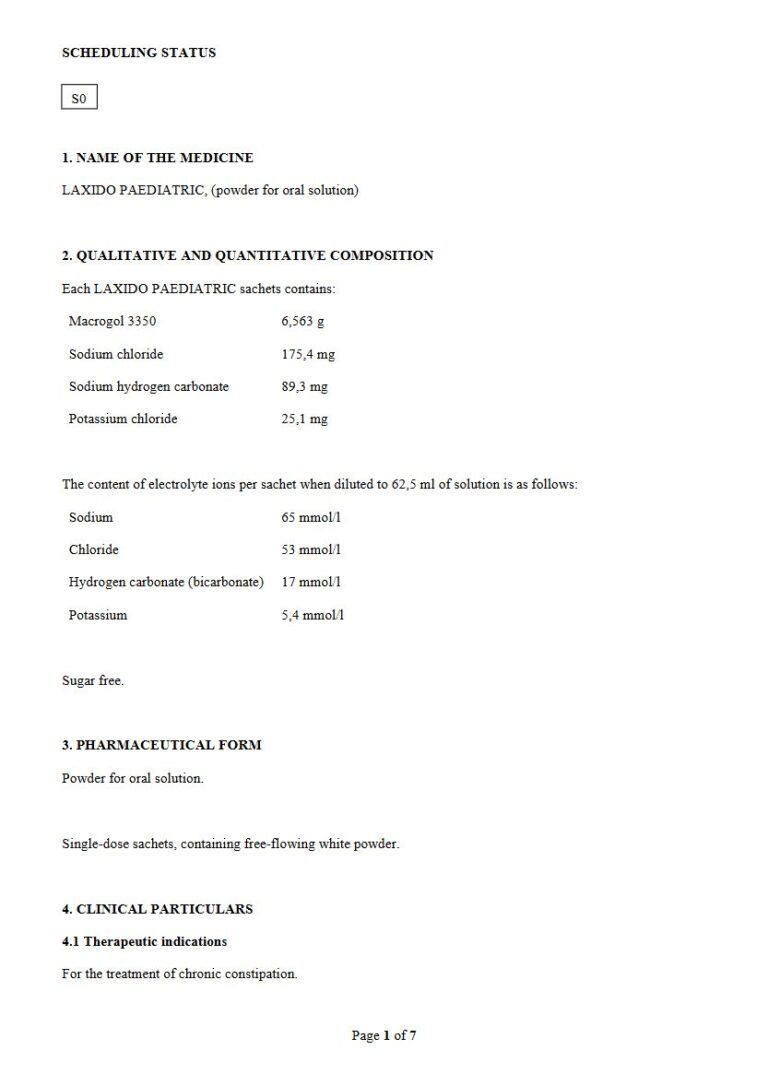
4.1 Therapeutic indications
For the treatment of chronic constipation.
4.2 Posology and method of administration
Posology
Chronic constipation: The usual starting dose is 1 sachet daily for children aged 2 u2013 6 years and 2 sachets a day in children aged 7 u2013 11 years. The dose should be adjusted up or down as required to produce regular soft stools. The maximum dose needed does not normally exceed 4 sachets a day.
LAXIDO PAEDIATRIC is not recommended for children below two years of age.
Special populations
Patients with impaired cardiovascular function: There is no clinical data for this group of patients.
Patients with renal insufficiency: There is no clinical data for this group of patients.
Method of administration
Each sachet should be dissolved in approximately 62,5 ml (quarter of a glass) of water, to make a clear or slightly hazy solution. The correct number of sachets may be reconstituted in advance and kept covered and refrigerated for up to 24 hours. For example, 4 sachets can be made up into 250 ml of water.
4.3 Contraindications
- Hypersensitivity to macrogol (PEG), sodium hydrogen carbonate, sodium chloride, or potassium chloride.
- Suspected intestinal perforation or obstruction due to a structural or functional disorder of the gut wall, ileus, and severe inflammatory conditions of the intestinal tract, such as Crohn's disease, ulcerative colitis and toxic megacolon.
4.4 Special warnings and precautions for use
LAXIDO PAEDIATRIC should not be used in the presence of abdominal pain, nausea and vomiting. LAXIDO PAEDIATRIC should not be used continuously. Frequent or prolonged use of laxatives may result in dependence and loss of normal bowel function.
If there is a sudden change in bowel habits that has persisted for a period greater than two weeks, a medical practitioner should be consulted. Rectal bleeding or failure to have a bowel movement after use of LAXIDO PAEDIATRIC may indicate a serious condition. LAXIDO PAEDIATRIC should be discontinued, and medical advice obtained.
The fluid content of LAXIDO PAEDIATRIC when re-constituted with water does not replace regular fluid intake and adequate fluid intake must be maintained.
If patients develop any symptoms indicating shifts of fluid/electrolytes (e.g., oedema, shortness of breath, increasing fatigue, dehydration and cardiac failure), LAXIDO PAEDIATRIC should be stopped immediately, electrolytes measured, and any abnormality should be treated appropriately.
The absorption of other medicines could transiently be reduced due to an increase in gastrointestinal transit rate induced by LAXIDO PAEDIATRIC (see section 4.5). LAXIDO PAEDIATRIC contains 93,4 mg of sodium per sachet, equivalent to approximately 4,6 % of the recommended maximum daily intake of sodium for an adult.
4.5 Interaction with other medicines and other forms of interaction
Macrogol raises the solubility of medicines that are soluble in alcohol and relatively insoluble in water. There is a possibility that the absorption of other medicines could be transiently reduced during use with LAXIDO PAEDIATRIC (see section 4.4). There have been reports of decreased efficacy with some concomitantly administered medicines, e.g., anti-epileptics.
4.6 Fertility, pregnancy and lactation
Pregnancy
Safety in pregnancy has not been established. There are limited amount of data from the use of the LAXIDO formulation in pregnant women. Clinically, no effects during pregnancy are anticipated since systemic exposure to macrogol 3350 is negligible.
Breastfeeding
No effects on the breastfed newborn/infant are anticipated since the systemic exposure of the breastfeeding woman to macrogol 3350 is negligible.
Fertility
There are no data on the effects of LAXIDO PAEDIATRIC on fertility in humans.
4.7 Effects on ability to drive and use machines
LAXIDO PAEDIATRIC has no influence on the ability to drive and use machines.
4.8 Undesirable effects
Reactions related to the gastrointestinal tract occur most commonly. These reactions may occur as a consequence of expansion of the contents of the gastrointestinal tract, and an increase in motility due to the pharmacologic effects of LAXIDO PAEDIATRIC. In the treatment of chronic constipation, diarrhoea or loose stools normally respond to a reduction in dose.
System Organ Class Frequency Adverse Event
Immune system disorders Less frequent Allergic reactions including anaphylactic reaction
Not known Dyspnoea and skin reaction (see below)
Skin and subcutaneous tissue disorders Not known Allergic skin reactions including angioedema, urticaria, pruritus, rash, erythema
Metabolism and nutrition disorders Not known Electrolyte disturbances, particularly hyperkalaemia and hypokalaemia
Nervous system disorders Not known Headache
Gastrointestinal disorders Frequent Abdominal pain, borborygmi, diarrhoea, vomiting, nausea and anorectal discomfort
Less frequent Abdominal distension, flatulence
Not known Dyspepsia and peri-anal inflammation
General disorders and administration site conditions Not known Peripheral oedema
Reporting of suspected adverse reactions
Reporting suspected adverse reactions after authorisation of the medicine is important. It allows continued monitoring of the benefit/risk balance of the medicine. Healthcare professionals are asked to report any suspected adverse reactions to SAHPRA via the u201c6.04 Adverse Drug Reaction Reporting Formu201d, found online under SAHPRAu2019s publications: https://www.sahpra.org.za/Publications/Index/8
4.9 Overdose
Severe abdominal pain or distension can be treated by nasogastric aspiration. Extensive fluid loss by diarrhoea or vomiting may require correction of electrolyte disturbances.
