
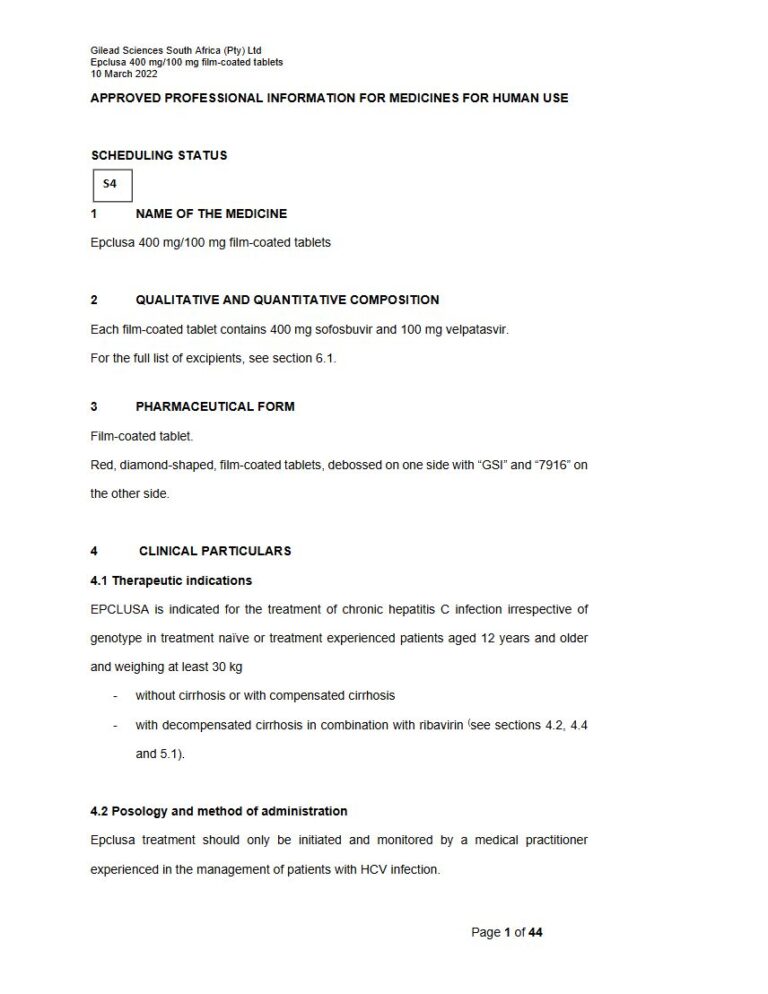
Epclusa 400 mg/100 mg FC tablet
PDF Leaflet Revision Date: 10 March 2022
Clinical Summary
Quick overview from the medicine insert
Indication
Treatment of chronic hepatitis C infection in patients aged 12 years and older.
Dosage (summary)
One tablet (400 mg sofosbuvir/100 mg velpatasvir) once daily.
Special Populations
- Renal impairment
- Hepatic impairment
Pregnancy & Breastfeeding
Contraindicated in pregnancy; unknown if excreted in breast milk.
Key Drug Interactions
- Amiodarone
- Rifampicin
- St. John's wort
Contraindications
- Hypersensitivity
- Pregnancy
- Concomitant use with strong P-gp/CYP inducers
Common side effects
- Headache
- Fatigue
- Nausea
Counselling Points
- Take with or without food
- Monitor for signs of bradycardia
- Do not double dose if missed
Serious warnings
- Severe bradycardia with amiodarone
- Hepatitis B reactivation risk
Important Disclaimer
The Epclusa 400 mg/100 mg FC tablet professional information leaflet below is the property of Gilead Sciences South Africa and is provided on Medinsert exactly as issued, with no.. alterations or editorial changes. We make every effort to keep content current by updating documents as soon as new versions become available. Medinsert serves as a trusted access point for healthcare professionals, but does not replace official sources or clinical judgement. For more details, please read our full disclaimer. read more>>
 Healthcare Professionals Only
This content is for registered healthcare professionals
Sign in or create a free account to read the full package insert.
Free for HPCSA-registered professionals. Powered by Medinsert.
Clinical Particulars
Section 4 of the official insert — extracted exactly as issued, no alterations
4.1 Therapeutic indications
EPCLUSA is indicated for the treatment of chronic hepatitis C infection irrespective of genotype in treatment nau00efve or treatment experienced patients aged 12 years and older and weighing at least 30 kg - without cirrhosis or with compensated cirrhosis - with decompensated cirrhosis in combination with ribavirin (see sections 4.2, 4.4 and 5.1).
4.2 Posology and method of administration
Epclusa treatment should only be initiated and monitored by a medical practitioner experienced in the management of patients with HCV infection.
The recommended dose of Epclusa in adults is one 400 mg/100 mg tablet, taken orally, once daily with or without food (see section 5.2).
The recommended dose of Epclusa in patients aged 12 to < 18 years and weighing at least 30 kg is one 400 mg/100 mg tablet, taken orally, once daily with or without food (see section 5.2).
Table 1: Recommended treatment and duration for adults regardless of HCV genotypes
Adult patient population Treatment and duration
- Patients without cirrhosis and patients with compensated cirrhosis: Epclusa for 12 weeks. No evidence that addition of ribavirin to Epclusa in patients with compensated cirrhosis will improve outcome.
- Patients with decompensated cirrhosis: Epclusa + ribavirin for 12 weeks. When used in combination with ribavirin, refer also to the PI of ribavirin.
The following dosing is recommended for adults where ribavirin is divided in two daily doses and given with food.
Table 2: Guidance for ribavirin dosing when administered with Epclusa to adults with decompensated cirrhosis
Adult patient Ribavirin dose
- Child-Pugh-Turcotte (CPT) Class B cirrhosis: 1,000 mg per day for patients < 75 kg and 1,200 mg for those weighing u2265 75 kg.
Safety and efficacy of Epclusa have not been established in patients with Child Pugh C decompensated cirrhosis. The safety and efficacy of Epclusa have not been established in CPT Class B or C post-transplant patients. For ribavirin dose modifications, refer to the ribavirin PI.
Patients should be instructed that if vomiting occurs within 3 hours of dosing an additional tablet should be taken. If vomiting occurs more than 3 hours after dosing, no further dose is needed. (see section 5.1).
If a dose is missed and it is within 18 hours of the normal time, patients should be instructed to take the tablet as soon as possible and then patients should take the next dose at the usual time. If it is after 18 hours then patients should be instructed to wait and take the next dose at the usual time. Patients should be instructed not to take a double dose.
Elderly: No dose adjustment is warranted for elderly patients. (see section 5.2).
Renal impairment: No dose adjustment of Epclusa is required for patients with renal impairment, including end stage renal disease (ESRD) requiring dialysis (see section 5.2).
Hepatic Impairment: No dose adjustment of EPCLUSA is required for patients with mild or moderate hepatic impairment (Child-Pugh (CPT) Class A or B) (see section 5.2). Safety and efficacy of EPCLUSA have been established in patients with Child-Pugh (CPT) Class B cirrhosis, but not in CPT Class C (see sections 4.4, 4.8 and 5.1).
Paediatric population: The safety and efficacy of Epclusa in children aged less than 12 years and weighing less than 30 kg have not yet been established.
Method of administration: For oral use. Patients should be instructed to swallow the tablet whole with or without food (see section 5.2). Due to the bitter taste, it is recommended that the film-coated tablet is not chewed or crushed.
4.3 Contraindications
Hypersensitivity to the active substances or to any of the excipients listed in section 6.1.
Pregnancy and lactation with or without the use of ribavirin.
Concomitant use with moderate to strong P-glycoprotein (P-gp) inducers and moderate to strong CYP inducers.
Concomitant use with medicines that are strong P-glycoprotein (P-gp) or strong cytochrome P450 (CYP) inducers (rifampicin, rifabutin, St. Johnu2019s wort [Hypericum perforatum], carbamazepine, phenobarbital and phenytoin) will significantly decrease sofosbuvir and/or velpatasvir plasma concentrations and could result in loss of efficacy of Epclusa (see section 4.5). Medicines that are moderate P-gp inducers or moderate CYP inducers include rifapentine, oxcarbazepine, modafinil and efavirenz may decrease sofosbuvir and/or velpatasvir concentrations that could result in loss of efficacy of Epclusa.
If Epclusa is used in combination with ribavirin the contraindications of ribavirin must be adhered to.
4.4 Special warnings and precautions for use
EPCLUSA should not be administered concomitantly with other medicines containing sofosbuvir.
Severe bradycardia and heart block: Severe and potentially life-threatening bradycardia and heart block have been observed when sofosbuvir-containing regimens such as Epclusa are used in combination with amiodarone with or without other medicines that lower heart rate. The mechanism is not established. Amiodarone should only be used in patients on Epclusa when other alternative anti-dysrhythmic treatments are not tolerated or are contraindicated. Should concomitant use of amiodarone be considered necessary, it is recommended that patients are closely monitored when initiating Epclusa. Patients who are identified as being at high risk of brady-dysrhythmia should be continuously monitored for 48 hours in an appropriate in-patient (hospital) setting after which outpatient or self-monitoring of heart rate should be done daily for at least the first two weeks of treatment. Due to the long half-life of amiodarone, appropriate monitoring should also be carried out for patients who have discontinued amiodarone within the past few months and are to be initiated on Epclusa. All patients receiving Epclusa in combination with amiodarone with or without other medicines that lower heart rate should also be warned of the symptoms of bradycardia and heart block and should be advised to seek medical advice urgently should they experience them.
Hepatitis B Virus Reactivation: Cases of hepatitis B virus (HBV) reactivation, some of them fatal, have been reported during or after treatment with direct acting antiviral medicines including Epclusa. HBV screening should be performed in all patients before initiation of treatment. Treatment with Epclusa should not be initiated in patients who screened positive for Hepatitis B virus infection. The safety and efficacy of Epclusa have not been established in HCV patients co-infected with Hepatitis B virus infection (HBV). HCV/HBV coinfected patients are at risk of HBV reactivation, and should therefore be monitored and managed according to current clinical guidelines.
Use with ribavirin: When Epclusa is used in combination with ribavirin refer also to the Professional information for ribavirin for patients with creatinine clearance < 50 ml/min (see section 5.2).
Use with certain HIV antiretroviral regimens: Epclusa has been shown to increase tenofovir exposure, especially when used together with an HIV regimen containing tenofovir disoproxil fumarate and a pharmacokinetic enhancer (ritonavir or cobicistat). The safety of tenofovir disoproxil fumarate in the setting of Epclusa and a pharmacokinetic enhancer has not been established. The potential risks and benefits associated with co-administration of Epclusa with the fixed-dose combination tablet containing elvitegravir/cobicistat/emtricitabine/tenofovir disoproxil fumarate or tenofovir disoproxil fumarate given in conjunction with a boosted HIV protease inhibitor (e.g. atazanavir or darunavir) should be considered, particularly in patients at increased risk of renal dysfunction. Patients receiving Epclusa concomitantly with elvitegravir/cobicistat/emtricitabine/tenofovir disoproxil fumarate or with tenofovir disoproxil fumarate and a boosted HIV protease inhibitor should be monitored for tenofovir-associated adverse reactions. Refer to the PIs of tenofovir disoproxil fumarate, emtricitabine/tenofovir disoproxil fumarate, or elvitegravir/cobicistat/emtricitabine/tenofovir disoproxil fumarate for recommendations on renal monitoring.
Use in diabetic patients: Hyperglycaemia and/or hypoglycaemia have been reported with Epclusa treatment. The medical practitioner should inform patients on the possibility of blood glucose changes during treatment with Epclusa before initiating treatment. Glucose levels of diabetic patients initiating Epclusa should be closely monitored, particularly within the first 3 months, and their diabetic medication modified when necessary. The physician in charge of the diabetic care of the patient should be informed when Epclusa is initiated.
CPT Class C cirrhosis: Safety and efficacy of Epclusa has not been assessed in patients with CPT Class C cirrhosis (see sections 4.8 and 5.1).
Liver transplant patients: The safety and efficacy of Epclusa in the treatment of HCV infection in patients who are post-liver transplant have not been assessed.
4.5 Interaction with other medicinal products and other forms of interaction
As Epclusa contains sofosbuvir and velpatasvir, any interactions that have been identified with these active substances individually may occur with Epclusa.
Potential for EPCLUSA to Affect Other Medicines: Velpatasvir is an inhibitor of drug transporter P-gp, breast cancer resistance protein (BCRP), (OATP)1B1 and OATP1B3. Coadministration of EPCLUSA with medicines that are substrates of these transporters may increase the exposure of such medicines. See Table 3 for examples of interactions with sensitive substrates of P-gp (digoxin), BCRP (rosuvastatin), and OATP (pravastatin).
Potential for other medicines to affect Epclusa: Sofosbuvir and velpatasvir are substrates of drug transporters P-gp and BCRP. Velpatasvir is also a substrate of drug transporter OATP1B. In vitro, slow metabolic turnover of velpatasvir by CYP2B6, CYP2C8, and CYP3A4 was observed. Medicines that are strong inducers of P-gp and/or strong inducers of CYP2B6, CYP2C8, or CYP3A4 (e.g. carbamazepine, phenobarbital and phenytoin rifampicin, rifabutin and St. Johnu2019s wort,) have been shown to decrease plasma concentrations of sofosbuvir and/or velpatasvir leading to reduced therapeutic effect of EPCLUSA. The use of such medicines with EPCLUSA is contraindicated (see section 4.3). Medicines that are moderate P-gp inducers or moderate CYP inducers (e.g. oxcarbazepine, modafinil or efavirenz) may decrease sofosbuvir or velpatasvir plasma concentration leading to reduced therapeutic effect of Epclusa. Co-administration with such medicines is not recommended with Epclusa (see section 4.4).
Coadministration with medicines that inhibit P-gp and/or BCRP may increase sofosbuvir and/or velpatasvir plasma concentrations. Medicines that inhibit OATP, CYP2B6, CYP2C8, or CYP3A4 may increase plasma concentration of velpatasvir. Clinically significant interactions with Epclusa mediated by P-gp, BCRP, OATP, or CYP450 inhibitors are not expected; EPCLUSA may be co-administered with P-gp, BCRP, OATP and CYP inhibitors.
Patients treated with vitamin K antagonists: As liver function may change during treatment with Epclusa, frequent monitoring of the International Normalised Ratio (INR) is required in patients on treatment with Vitamin K antagonists (e.g. Warfarin).
Impact of DAA therapy on drugs metabolized by the liver: The pharmacokinetics of drugs that are metabolized by the liver (e.g. immunosuppressive agents such as calcineurin inhibitors) may be impacted by changes in liver function during DAA therapy, related to clearance of HCV.
Interactions between Epclusa and other medicines: Table 3 provides a listing of established or potentially clinically significant medicine interactions (where 90 % confidence interval [CI] of the geometric least-squares mean [GLSM] ratio were within u201cu2194u201d, extended above u201cu2191u201d, or extended below u201cu2193u201d the predetermined interaction boundaries). The interactions described are based on studies conducted with either sofosbuvir/velpatasvir or velpatasvir and sofosbuvir as individual medicines, or are predicted medicine interactions that may occur with sofosbuvir/velpatasvir. The table is not all-inclusive.
4.6 Fertility, pregnancy and lactation
Pregnancy: Use of Epclusa is contraindicated in pregnancy as the possibility of teratogenicity in humans of the velpatasvir component cannot be excluded. Use of Epclusa combined with ribavirin is contraindicated in pregnancy as ribavirin is teratogenic (see PI of ribavirin). There are no or limited amount of data (less than 300 pregnancy outcomes) from the use of sofosbuvir, velpatasvir or Epclusa in pregnant women.
Sofosbuvir: Animal studies do not indicate direct or indirect harmful effects with respect to reproductive toxicity (see section 5.3). It has not been possible to fully estimate exposure margins achieved for sofosbuvir in the rat relative to the exposure in humans at the recommended clinical dose (see section 5.3).
Velpatasvir: Velpatasvir use in rabbits showed an increase in total visceral malformations in velpatasvir exposed animals at AUC exposures up to 0.7-fold the human exposed at clinical recommended doses. The human relevance of this finding is not known. Teratogenicity in humans cannot be excluded.
Breast-feeding: It is unknown whether sofosbuvir, metabolites of sofosbuvir or velpatasvir are excreted in human milk. Available pharmacokinetic data in animals have shown excretion of velpatasvir and metabolites of sofosbuvir in milk. A risk to the newborns/infants cannot be excluded. Therefore, Epclusa should not be used in women breastfeeding their babies. Women on treatment with Epclusa in combination with ribavirin, should not breastfeed their babies (See ribavirin PI).
Fertility: No human data on the effect of Epclusa on fertility are available. Animal studies do not indicate harmful effects of sofosbuvir or velpatasvir on fertility. If ribavirin is co-administered with Epclusa, consult the ribavirin PI for detailed recommendations regarding pregnancy, contraception, and breast-feeding.
4.7 Effects on ability to drive and use machines
Epclusa or Epclusa in combination with ribavirin, may influence the patientu2019s ability to drive and use machines. Patients should not drive and use machines until they know how they are affected by treatment with Epclusa or Epclusa combined with ribavirin.
4.8 Undesirable effects
a. Summary of the safety profile: The safety assessment of Epclusa was based on pooled Phase 3 clinical study data from patients with genotype 1, 2, 3, 4, 5 or 6 HCV infection (with or without compensated cirrhosis) including 1,035 patients who received Epclusa for 12 weeks. The proportion of patients who permanently discontinued treatment due to adverse events was 0.2 % and the proportion of patients who experienced any severe adverse events was 3.2 % for patients receiving Epclusa for 12 weeks.
b. Tabulated list of adverse events: In clinical trials, headache, fatigue and nausea were the most common (incidence u226510 %) treatment emergent adverse events reported in patients treated with 12 weeks of Epclusa. The adverse reactions are listed below by body system organ class and frequency. Frequencies are defined as follows: very common (u2265 1/10), common (u2265 1/100 to < 1/10), uncommon (u2265 1/1,000 to < 1/100), rare (u2265 1/10,000 to < 1/1,000) or very rare (< 1/10,000).
Frequency a Adverse drug reaction
Gastrointestinal disorders: Common Nausea, diarrhoea, constipation, dyspepsia, abdominal pain, vomiting, abdominal distension.
General Disorders and administration site conditions: Very common Fatigue; Common Asthenia.
Infections and infestations: Common Nasopharyngitis.
Metabolism and nutrition disorders: Common Decreased appetite.
Musculoskeletal and connective tissue disorders: Common Arthralgia, myalgia, muscle spasms.
Nervous System Disorder: Very common Headache; Common Dizziness, disturbance in attention.
Psychiatric disorders: Common Insomnia, irritability, sleep disorder, depressed mood.
Respiratory, thoracic and mediastinal disorders: Common Dyspnoea.
Skin and subcutaneous tissue disorders: Common Pruritus, rash.
a Frequencies are based on the frequencies of treatment-emergent adverse events considered related to the drug by the investigator.
Patients with decompensated cirrhosis: The safety profile of Epclusa has been evaluated in one open-label study in which patients with CPT Class B cirrhosis received Epclusa for 12 weeks (n = 90), Epclusa + RBV for 12 weeks (n = 87) or Epclusa for 24 weeks (n = 90). The adverse events observed were consistent with expected clinical sequelae of decompensated liver disease, or the known toxicity profile of ribavirin for patients receiving Epclusa in combination with ribavirin. Among the 87 patients who were treated with Epclusa + RBV for 12 weeks, decreases in haemoglobin to less than 10 g/dl and 8.5 g/dl during treatment were experienced by 23 % and 7 % patients, respectively. Ribavirin was discontinued in 15 % of patients treated with Epclusa + RBV for 12 weeks due to adverse events.
Patients with renal impairment: The safety profile of Epclusa has been evaluated in one open-label study (Study GS-US-342-4062) in which a total of 59 subjects with HCV and ESRD requiring dialysis received Epclusa for 12 weeks. The adverse events observed were consistent with expected clinical sequelae of ESRD.
Paediatric Population: The safety assessment of Epclusa in paediatric patients aged 12 years and older is based on data from a Phase 2, open-label clinical study (Study 1143) that enrolled 102 patients who were treated with sofosbuvir/velpatasvir for 12 weeks. The adverse reactions observed were consistent with those observed in clinical studies of Epclusa in adults.
Post-marketing experience: In addition to adverse reactions from clinical studies, the following adverse reactions were also identified during post approval use of Epclusa.
Adverse drug reaction: Skin and subcutaneous tissue disorders: Rash, Angioedema. Consult the ribavirin PI for side effects of ribavirin in patients on combination treatment with Epclusa and ribavirin.
c. Description of selected adverse reactions: Cardiac dysrhythmias: Cases of severe bradycardia and heart block have been observed when sofosbuvir-containing regimens, such as Epclusa, are used in combination with amiodarone and/or other medicines that lower heart rate (see sections 4.4 and 4.5).
Skin disorders: Frequency Not known: Stevens-Johnson syndrome.
Reporting of suspected adverse reactions: Reporting suspected adverse reactions after authorisation of Epclusa is important. It allows continued monitoring of the benefit/risk balance of Epclusa. Health care providers are asked to report any suspected adverse reactions to SAHPRA via the 6.04 Adverse Drug Reactions Reporting Form, found online under SAHPRAu2019s publications: https://www.sahpra.org.za/Publications/Index/8.
4.9 Overdose
In overdose, side effects can be precipitated and/or be of increased severity. No specific antidote is available for overdose with EPCLUSA. If overdose occurs the patient must be monitored for evidence of toxicity. Treatment of overdose with EPCLUSA consists of general symptomatic and supportive treatment measures including monitoring of vital signs as well as observation of the clinical status of the patient. Hemodialysis can efficiently remove the predominant circulating metabolite of sofosbuvir, GS-331007, with an extraction ratio of 53 %. Haemodialysis is unlikely to result in significant removal of velpatasvir since velpatasvir is highly bound to plasma protein.
