
Imigran Nasal 20 mg Spray
PDF Leaflet Revision Date: 05 August 2022
Clinical Summary
Quick overview from the medicine insert
Indication
Acute treatment of migraine attacks with or without aura.
Dosage (summary)
Adults: 20 mg; may repeat after 2 hours if needed, max 2 sprays in 24 hours.
Special Populations
- Elderly (over 65 years)
- Hepatic impairment
- Renal impairment
Pregnancy & Breastfeeding
Safety not established; excreted in breastmilk, avoid breastfeeding for 12 hours post-treatment.
Key Drug Interactions
- Contraindicated with MAOIs
- Caution with SSRIs/SNRIs
- Avoid ergotamine within 24 hours
Contraindications
- Hypersensitivity to sumatriptan
- Ischaemic heart disease
- Severe hepatic impairment
- History of CVA or TIA
Common side effects
- Dizziness
- Drowsiness
- Nausea
- Transient chest pain
Counselling Points
- Use at onset of migraine
- Avoid driving if drowsy
- Report any severe side effects
Serious warnings
- Risk of ischaemic heart disease
- Caution in controlled hypertension
- Serotonin syndrome risk
Important Disclaimer
The Imigran Nasal 20 mg Spray professional information leaflet below is the property of Glaxosmithkline South Africa and is provided on Medinsert exactly as issued, with no.. alterations or editorial changes. We make every effort to keep content current by updating documents as soon as new versions become available. Medinsert serves as a trusted access point for healthcare professionals, but does not replace official sources or clinical judgement. For more details, please read our full disclaimer. read more>>
 Healthcare Professionals Only
This content is for registered healthcare professionals
Sign in or create a free account to read the full package insert.
Free for HPCSA-registered professionals. Powered by Medinsert.
Clinical Particulars
Section 4 of the official insert — extracted exactly as issued, no alterations
4.1 Therapeutic indications
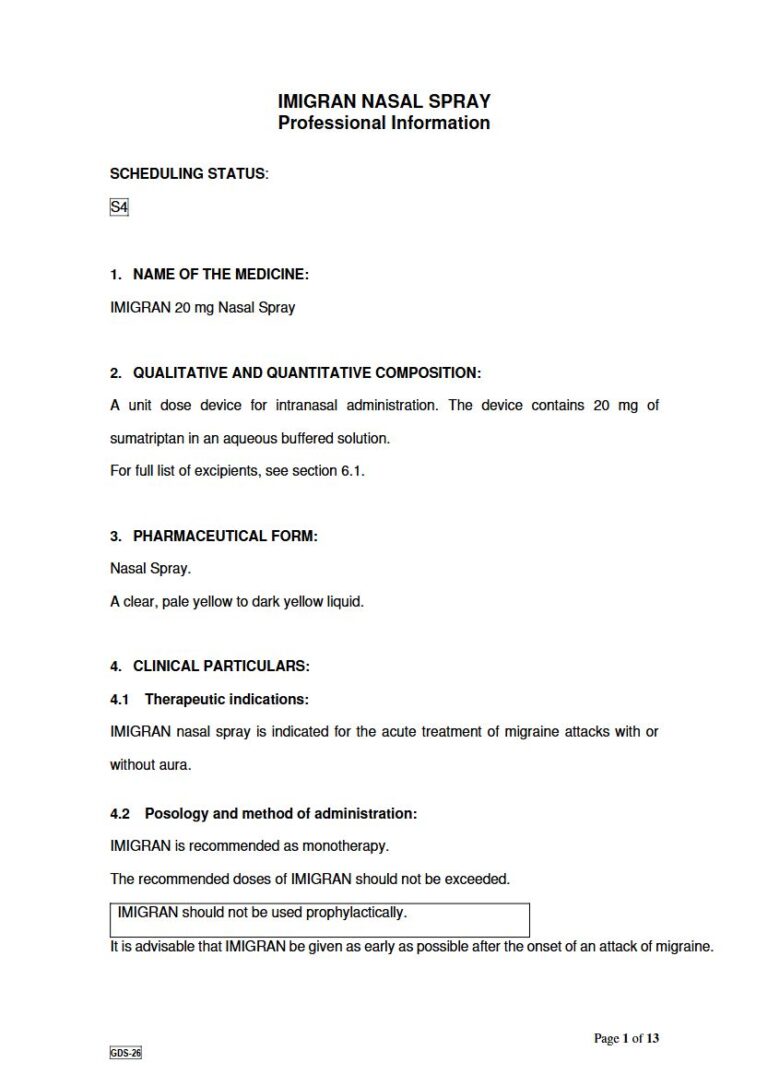
IMIGRAN nasal spray is indicated for the acute treatment of migraine attacks with or without aura.
4.2 Posology and method of administration
IMIGRAN is recommended as monotherapy. The recommended doses of IMIGRAN should not be exceeded. IMIGRAN should not be used prophylactically. It is advisable that IMIGRAN be given as early as possible after the onset of an attack of migraine.
Adults (18 years and over): The optimal dose of IMIGRAN nasal spray is 20 mg. If symptoms recur a second dose may be given in the next 24 hours provided that there is a minimum interval of 2 hours between the two doses. If a patient does not respond to the first dose of IMIGRAN, a second dose should not be taken for the same attack. IMIGRAN may be taken for subsequent attacks. If the patient has responded to the first dose, but the symptoms recur a second dose may be given in the next 24 hours, provided that there is a minimum interval of two hours between the two doses. No more than two IMIGRAN Nasal Sprays to be used in any 24-hour period.
Special populations: Elderly (over 65 years of age): There is no experience of the use of IMIGRAN Nasal Spray in patients over 65. Therefore, the use of IMIGRAN Nasal Spray is not recommended until further data are available. Hepatic impairment: IMIGRAN should be administered with caution to patients with mild to moderate hepatic impairment (Child Pugh grade A or B; see section 5.2). IMIGRAN is contraindicated in patients with severe hepatic impairment (Child Pugh Grade C) (see section 4.3). Renal impairment: IMIGRAN should be administered with caution to patients with renal impairment (see section 5.2).
Paediatric population: IMIGRAN 20 mg Nasal Spray is not recommended in children aged 17 years and below.
4.3 Contraindications
Hypersensitivity to sumatriptan or to any of the excipients listed in section 6.1. IMIGRAN should not be given to patients who have had previous myocardial infarction or have ischaemic heart disease (IHD), Prinzmetalu2019s angina/coronary vasospasm, peripheral vascular disease or patients who have symptoms or signs consistent with ischaemic heart disease. IMIGRAN should not be administered to patients with a history of cerebrovascular accident (CVA) or transient ischaemic attack (TIA). IMIGRAN should not be administered to patients with severe hepatic impairment (Child Pugh Grade C). The concomitant use of ergotamine or derivatives of ergotamine (including methysergide) and IMIGRAN is contraindicated. Concurrent administration of monoamine oxidase inhibitors or use within two weeks of discontinuation of MAOI therapy is contraindicated.
4.4 Special warnings and precautions for use
IMIGRAN should only be used where there is a clear diagnosis of migraine. IMIGRAN is not indicated for use in the management of hemiplegic, basilar or ophthalmoplegic migraine. Before treating with IMIGRAN, care should be taken to exclude potentially serious neurological conditions (e.g. CVA, TIA), if the patient presents with atypical symptoms or if they have received an appropriate diagnosis for IMIGRAN use. Administration of IMIGRAN can be associated with transient symptoms, including chest pain and tightness, which may be intense and involve the throat. Where such symptoms are thought to indicate ischaemic heart disease appropriate evaluation should be carried out.
IMIGRAN should not be given to patients in whom unrecognised cardiac disease is likely without a prior evaluation for underlying cardiovascular disease. Such patients include postmenopausal women, males over 40 and patients with risk factors for coronary artery disease. However, these evaluations may not identify every patient who has cardiac disease and, serious cardiac events have occurred in patients without underlying cardiovascular disease. IMIGRAN should be administered with caution in patients with controlled hypertension since transient increases in blood pressure and peripheral vascular resistance have been observed in a small proportion of patients. There have been rare post-marketing reports describing patients with serotonin syndrome (including altered mental status, autonomic instability and neuromuscular abnormalities) following the use of a selective serotonin reuptake inhibitor (SSRI) and IMIGRAN. Serotonin syndrome has been reported following concomitant treatment with triptans and serotonin noradrenaline reuptake inhibitors (SNRIs). If concomitant treatment with IMIGRAN and an SSRI/SNRI is clinically warranted, appropriate observation of the patient is advised (see section 4.5). The concomitant administration of any triptan/5-HT1 agonist with IMIGRAN is not recommended. IMIGRAN should also be administered with caution to patients with conditions which may alter the absorption, metabolism, or excretion of medicines, such as impaired hepatic (Child Pugh grade A or B; see section 5.2) or renal function. IMIGRAN should be used with caution in patients with a history of seizures or other risk factors which lower the seizure threshold. Overuse of acute migraine treatments has been associated with the exacerbation of headache (medication overuse headache, MOH) in susceptible patients. Withdrawal of the treatment may be necessary. Patients with known hypersensitivity to sulphonamides may exhibit an allergic reaction following administration of IMIGRAN. Reactions may range from cutaneous hypersensitivity to anaphylaxis. Evidence of cross sensitivity is limited; however, caution should be exercised before using IMIGRAN in these patients.
4.5 Interactions with other medicines and other forms of interactions
Prolonged vasospastic reactions have been reported with ergotamine. As these effects may be additive, 24 hours should elapse before IMIGRAN can be administered following an ergotamine preparation. Conversely, ergotamine containing preparations should not be taken until 6 hours have elapsed following IMIGRAN administration. There is no evidence of interactions with propranolol, flunarizine, pizotifen or alcohol. An interaction may occur between IMIGRAN and MAOIs and concomitant administration is contraindicated. There may be a risk of serotonergic syndrome also if sumatriptan is used concomitantly with lithium. An interaction may occur between IMIGRAN and SSRIs. There have been post-marketing reports describing patients with serotonin syndrome (including altered mental status, autonomic instability and neuromuscular abnormalities) following the use of SSRIs and IMIGRAN. Serotonin syndrome has also been reported following concomitant treatment with triptans and SNRIs (see section 4.4). IMIGRAN should be used with caution in patients on SSRIs or SNRIs. Co-administration of IMIGRAN with other medicines that enhance the effect of serotonergic neurotransmission such as amphetamines, fentanyl and its analogues, pethidine, and tramadol should be undertaken with caution and avoided whenever possible due to the potential for pharmacodynamic interaction.
4.6 Fertility, pregnancy and lactation
Safety in pregnancy and lactation has not been established. It has been demonstrated that following subcutaneous administration IMIGRAN is excreted into breastmilk. Infant exposure can be minimised by avoiding breastfeeding for 12 hours after treatment.
4.7 Effects on ability to drive and use machines
Drowsiness may occur as a result of migraine or its treatment with IMIGRAN. Caution is recommended in patients performing skilled tasks, e.g. driving or operating machinery. Patients experiencing drowsiness should avoid driving and use of machines.
4.8 Undesirable effects
Adverse events are listed below by system organ class and frequency. Frequencies are defined as: very common (> 1/10), common (> 1/100, 1/1 000, 1/10 000, < 1/1 000) and very rare (< 1/10 000), including isolated reports. It should be noted that the background rate in comparator groups was not taken into account. Post-marketing data refer to reporting rate rather than true frequency.
Clinical Trial Data: Nervous System Disorders: Common: dizziness, drowsiness, sensory disturbance including paraesthesia and hypoaesthesia. Vascular disorders: Common: transient increases in blood pressure arising soon after treatment. Flushing. Gastrointestinal disorders: Common: nausea and vomiting occurred in some patients but the relationship to sumatriptan is not clear.
Musculoskeletal and Connective Tissue Disorders: The following symptom is usually transient and may be intense and can affect any part of the body including the chest and throat: Common: sensations of heaviness. Respiratory, thoracic and mediastinal disorders: Common: dyspnoea. Following administration of IMIGRAN nasal spray mild, transient irritation or burning sensation in the nose or throat or epistaxis have been reported. A characteristic taste has been reported. IMIGRAN nasal spray should not be used in upper airway obstruction.
General Disorders and Administration Site Conditions: The following symptoms are usually transient and may be intense and can affect any part of the body including the chest and throat: Common: pain, sensations of heat or cold, pressure or tightness. The following symptoms are mostly mild to moderate in intensity and transient: Common: feelings of weakness, fatigue. Investigations: Very rare: minor disturbances in liver function tests have occasionally been observed.
Post-Marketing Data: Immune System Disorders: hypersensitivity reactions ranging from cutaneous hypersensitivity to rare cases of anaphylaxis. Nervous System Disorders: seizures, although some have occurred in patients with either a history of seizures or concurrent conditions predisposing to seizures there are also reports in patients where no such predisposing factors are apparent. Tremor, dystonia, nystagmus, scotoma. Eye disorders: flickering, diplopia, reduced vision. Loss of vision (usually transient). However, visual disorders may also occur during a migraine attack itself.
Cardiac disorders: bradycardia, tachycardia, palpitations, cardiac dysrhythmias, transient ischaemic ECG changes, coronary artery vasospasm, angina, myocardial infarction (see sections 4.3 and 4.4). Vascular disorders: hypotension, Raynaudu2019s phenomenon. Gastrointestinal disorders: ischaemic colitis.
Reporting of side effects: Reporting suspected adverse reactions after authorisation of the medicine is important. It allows continued monitoring of the benefit/risk balance of the medicine. Healthcare providers are asked to report any suspected adverse reactions to SAHPRA via the u201c6.04 Adverse Drug Reactions Reporting Formu201d, found online under SAHPRAu2019s publications: https://www.sahpra.org.za/Publications/Index/8.
4.9 Overdose
Single doses up to 40 mg intranasally, were not associated with side effects other than those mentioned. There is no experience of doses greater than these. In clinical studies volunteers have received 20 mg of IMIGRAN by the intranasal route three times a day for a period of 4 days without significant adverse effects. If overdosage with IMIGRAN occurs, the patient should be monitored for at least ten hours and standard supportive treatment applied as required. It is unknown what effect haemodialysis or peritoneal dialysis has on the plasma concentration of sumatriptan.
