
Adco Telmisartan Tablets
Clinical Summary
Quick overview from the medicine insert
Indication
Management of hypertension and reduction of cardiovascular risk in patients unable to take ACE inhibitors.
Dosage (summary)
Initial dose is 40 mg once daily; may be increased to 80 mg once daily based on blood pressure response.
Onset of Action / Duration
Antihypertensive effect typically observed within 3 to 6 hours, with peak effect at 4 to 6 weeks.
Special Populations
- Elderly patients may require dose adjustment.
- Patients with renal impairment should be monitored for renal function.
- Patients with hepatic impairment should use with caution.
Pregnancy & Breastfeeding
Not recommended during pregnancy; contraindicated in the second and third trimesters. Caution advised during lactation.
Key Drug Interactions
- Potassium-sparing diuretics may increase the risk of hyperkalemia.
- Non-steroidal anti-inflammatory drugs (NSAIDs) may reduce the antihypertensive effect.
- Other antihypertensive agents may have additive effects.
Contraindications
- Hypersensitivity to telmisartan or any component of the formulation.
- Pregnancy (especially in the second and third trimesters).
- Severe hepatic impairment.
Common side effects
- Dizziness
- Fatigue
- Headache
- Nausea
- Hyperkalemia
Counselling Points
- Take the medication at the same time each day.
- Monitor blood pressure regularly.
- Report any signs of allergic reactions or severe side effects.
- Maintain adequate hydration.
Serious warnings
- Use with caution in patients with renal artery stenosis.
- Monitor for signs of hypotension, especially after initiation or dose increase.
- Discontinue if pregnancy is detected.
Important Disclaimer
The Adco Telmisartan Tablets professional information leaflet below is the property of Adcock Ingram and is provided on Medinsert exactly as issued, with no.. alterations or editorial changes. We make every effort to keep content current by updating documents as soon as new versions become available. Medinsert serves as a trusted access point for healthcare professionals, but does not replace official sources or clinical judgement. For more details, please read our full disclaimer. read more>>
 Healthcare Professionals Only
This content is for registered healthcare professionals
Sign in or create a free account to read the full package insert.
Free for HPCSA-registered professionals. Powered by Medinsert.
Clinical Particulars
Section 4 of the official insert — extracted exactly as issued, no alterations
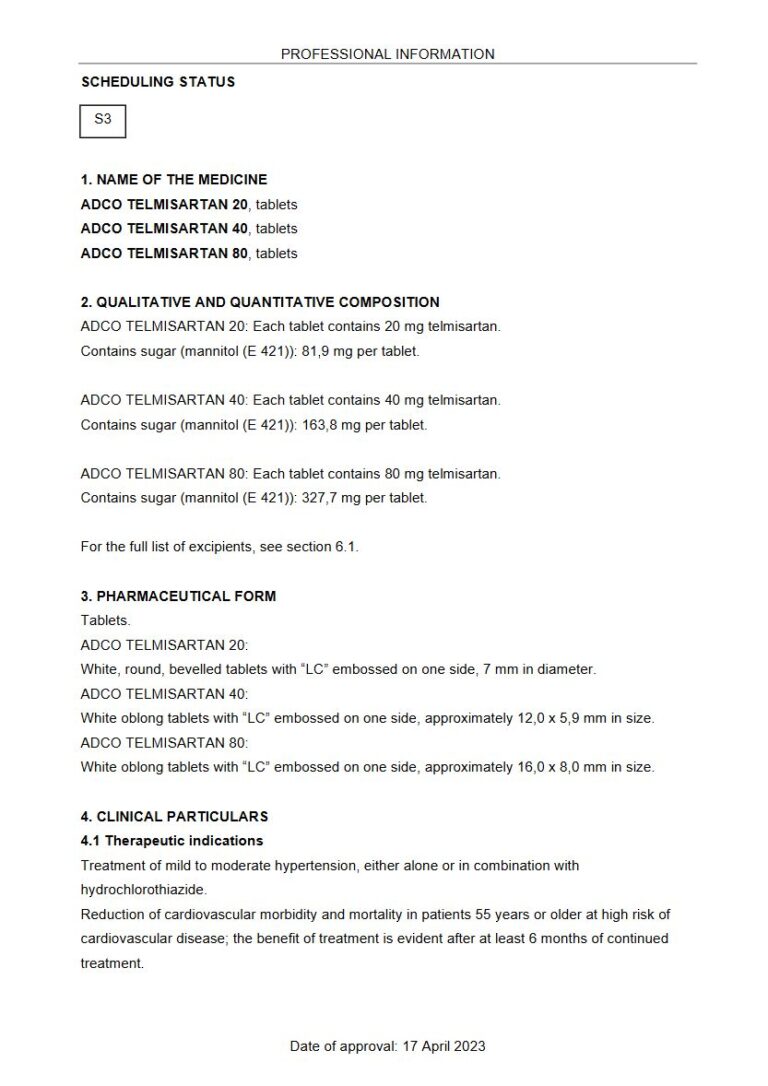
4.1 Therapeutic indications
Treatment of mild to moderate hypertension, either alone or in combination with hydrochlorothiazide. Reduction of cardiovascular morbidity and mortality in patients 55 years or older at high risk of cardiovascular disease; the benefit of treatment is evident after at least 6 months of continued treatment.
4.2 Posology and method of administration
Adults
Treatment of essential hypertension
The usually effective dose is 40 mg once daily. Some patients may already benefit at a daily dose of 20 mg. In cases where the target blood pressure is not achieved, the dose of ADCO TELMISARTAN can be increased to a maximum of 80 mg once daily. Alternatively, ADCO TELMISARTAN may be used in combination with thiazide-type diuretics such as hydrochlorothiazide 12,5 mg which has been shown to have an additive blood pressure lowering effect with ADCO TELMISARTAN. When considering raising the dose, it must be borne in mind that the maximum antihypertensive effect is generally attained four to eight weeks after the start of treatment.
Reduction of cardiovascular morbidity and mortality
The recommended dose is 80 mg once daily. It is not known whether doses lower than 80 mg of ADCO TELMISARTAN are effective in reducing cardiovascular morbidity and mortality. When initiating ADCO TELMISARTAN therapy for the reduction of cardiovascular morbidity and mortality, monitoring of blood pressure is recommended and, if appropriate, adjustment of medications that lower blood pressure may be necessary. The benefit of treatment is evident only after 6 months of continued treatment.
Special populations
Renal impairment
No dosage adjustment is required for patients with mild to moderate renal impairment. Limited experience is available in patients with severe renal impairment or haemodialysis (see section 4.3).
Hepatic impairment
In patients with mild to moderate hepatic impairment the dosage should not exceed 40 mg once daily.
Elderly
No dosing adjustment is necessary for elderly patients.
Paediatric population
Children and adolescents up to 18 years of age
ADCO TELMISARTAN is not recommended for use in children below 18 years due to a lack of data on safety and efficacy.
4.3 Contraindications
- Hypersensitivity to telmisartan or any of the inactive ingredients of ADCO TELMISARTAN (see section 2 and 6.1).
- A history of angioedema related to previous therapy with angiotensin converting enzyme (ACE) inhibitors or angiotensin receptor blockers (ARBs): These patients must never again be given these medicines.
- Hereditary or idiopathic angioedema.
- Hypertrophic obstructive cardiomyopathy (HOCM).
- Severe renal function impairment (creatinine clearance less than 30 ml/min).
- Bilateral renal artery stenosis.
- Renal artery stenosis in patients with a single kidney.
- Aortic stenosis.
- Biliary obstructive disorders.
- Severe hepatic impairment.
- Concomitant therapy with potassium sparing diuretics such as spironolactone, triamterene, amiloride (see section 4.5).
- Porphyria.
- Lithium therapy: Concomitant administration with ADCO TELMISARTAN may lead to toxic blood concentrations of lithium (see section 4.5).
- Pregnancy and lactation (see section 4.6).
- The concomitant use of ADCO TELMISARTAN with renin inhibitors, such as aliskiren-containing products is contraindicated (see section 4.4 and 4.5).
- Concomitant use of fluoroquinolones with ACE inhibitors/Angiotensin receptor blockers is contraindicated in patients with moderate to severe renal impairment (Creatinine Clearance u2264 30ml/min) and in elderly patients.
4.4 Special warnings and precautions for use
ADCO TELMISARTAN should not be initiated during pregnancy. Should a woman become pregnant while receiving ADCO TELMISARTAN, the treatment should be stopped promptly and switched to a different class of antihypertensive medicine. (see section 4.3 and 4.6).
Renovascular hypertension
There is an increased risk of severe hypotension and renal insufficiency when patients with bilateral renal artery stenosis or stenosis of the artery to a single functioning kidney are treated with medicines that affect the renin-angiotensin-aldosterone system, such as ADCO TELMISARTAN (see section 4.3).
Renal impairment and kidney transplantation
When ADCO TELMISARTAN is used in patients with impaired renal function, periodic monitoring of potassium and creatinine serum levels is recommended. There is no experience regarding the administration of ADCO TELMISARTAN in patients with recent kidney transplantation.
Intravascular hypovolaemia
Symptomatic hypotension, especially after the first dose of ADCO TELMISARTAN, may occur in patients who are volume and/or sodium depleted by vigorous diuretic therapy, dietary salt restriction, diarrhoea, or vomiting. Such conditions, particularly volume and/or sodium depletion, should be corrected before the administration of ADCO TELMISARTAN.
Dual blockade of the renin-angiotensin-aldosterone system (RAAS)
There is evidence that the concomitant use of ACE inhibitors, angiotensin II receptor blockers (ARBs) or aliskiren may increase the risk of hypotension, hyperkalaemia and decreases renal function (including acute renal failure). Dual blockade of RAAS through the combined use of ADCO TELMISARTAN and aliskiren is therefore contraindicated (see section 4.3). ADCO TELMISARTAN should not be used concomitantly with renin inhibitors, such as aliskiren (see section 4.3).
4.5 Interaction with other medicines and other forms of interaction
Dual blockade of the RAAS with ARBs, ACE inhibitors, or renin inhibitors, such as aliskiren
Clinical trial data has shown that dual blockade of the renin-angiotensin-aldosterone-system (RAAS) through the combined use of ACE inhibitors, angiotensin II receptor blockers (as contained in ADCO TELMISARTAN) or renin inhibitors, such as aliskiren is associated with a higher frequency of adverse events such as hypotension, hyperkalaemia and decreased renal function (see section 4.3 and 4.4).
Other antihypertensive medicines
The blood pressure lowering effect of other antihypertensive medicines can be increased by concomitant use of ADCO TELMISARTAN. Baclofen and amifostine may potentiate the hypotensive effects of ADCO TELMISARTAN. Furthermore, orthostatic hypotension may be aggravated by alcohol, barbiturates, narcotics or antidepressants.
Digoxin
For digoxin, a 20 % increase in median plasma digoxin trough concentration has been observed. Monitoring of plasma digoxin levels should be considered.
Lithium
Reversible increases in serum lithium concentrations and toxicity have been reported during concomitant administration of lithium with angiotensin converting enzyme inhibitors and with angiotensin II antagonists, including telmisartan, as in ADCO TELMISARTAN (see section 4.3).
Potassium-sparing diuretics or potassium supplements
Angiotensin II receptor antagonists such as ADCO TELMISARTAN attenuate diuretic-induced potassium loss. Potassium-sparing diuretics, such as spironolactone, eplerenone, triamterene or amiloride, potassium supplements or potassium-containing salt substitutes may lead to a significant increase in serum potassium (see section 4.3 and 4.4).
Nonsteroidal anti-inflammatory drugs (NSAIDs)
Concomitant treatment with NSAIDs (including aspirin at anti-inflammatory dosage regimens, COX-2 inhibitors and non-selective NSAIDs) may increase the risk for acute renal impairment in patients who are dehydrated. Patients taking NSAIDs concomitantly with ADCO TELMISARTAN should be adequately hydrated and renal function should be monitored. A reduced effect of antihypertensive medicines like ADCO TELMISARTAN by inhibition of vasodilating prostaglandins has been reported during combined treatment with NSAIDs.
Diuretic medicines (thiazide or loop diuretics)
Prior treatment with high dose diuretics such as furosemide (loop diuretic) and hydrochlorothiazide (thiazide diuretic) may result in volume depletion and in a risk of hypotension when initiating treatment with ADCO TELMISARTAN.
Corticosteroids (systemic route)
Concomitant use may cause a reduction of the antihypertensive effect.
Fluoroquinolones and ACE inhibitors/Angiotensin receptor blockers
Concomitant use of fluoroquinolones and ACE inhibitors/Angiotensin receptor blockers may precipitate acute kidney injury. The mechanism of the possible interaction between the different classes of medicines, over and above different mechanisms of kidney damage, is unknown (see section 4.3).
Hyperkalaemia
As with other medicinal products acting on RAAS, telmisartan, as in ADCO TELMISARTAN, may provoke hyperkalaemia (see section 4.4). The risk may increase in case of treatment combination with other medicinal products that may also provoke hyperkalaemia (salt substitutes containing potassium, ACE inhibitors, angiotensin II receptor antagonists, NSAIDs (including selective COX-2 inhibitors), heparin, immunosuppressives (cyclosporin or tacrolimus), and trimethoprim). The occurrence of hyperkalaemia depends on associated risk factors. The risk is increased in case of the abovementioned treatment combinations. The risk is particularly high when combined with salt substitutes containing potassium. A combination with ACE inhibitors or NSAIDs, for example, presents a lesser risk provided that precautions for use are strictly followed. Combination treatment with potassium-sparing diuretics is contraindicated (see section 4.3).
General
Concomitant use of ADCO TELMISARTAN did not result in a clinically significant interaction with warfarin, hydrochlorothiazide, glibenclamide, paracetamol, ibuprofen, simvastatin or amlodipine.
4.6 Fertility, pregnancy and lactation
Pregnancy and lactation
ADCO TELMISARTAN is contraindicated during pregnancy and lactation (safety in pregnancy and lactation has not been established). See section 4.3 and 4.4. When pregnancy is planned or confirmed ADCO TELMISARTAN should be discontinued. Medicines affecting the renin-angiotensin system, such as ADCO TELMISARTAN, can cause embryonal toxicity, foetal and neonatal morbidity and mortality when administered to pregnant women. Women of childbearing age should use adequate contraception. Since it is not known whether telmisartan is excreted in human milk, ADCO TELMISARTAN is contraindicated during breastfeeding (see section 4.3 and 4.4).
Fertility
No effects of telmisartan, as in ADCO TELMISARTAN, on male and female fertility were observed in reported studies.
4.7 Effects on ability to drive and use machines
No studies on the effect on the ability to drive and use machines have been performed. However, when driving vehicles or operating machinery it must be borne in mind that dizziness or drowsiness may occasionally occur when taking ADCO TELMISARTAN.
4.8 Undesirable effects
Tabulated list of adverse reactions
SYSTEM ORGAN CLASS FREQUENCY ADVERSE REACTIONS
Infections and infestations Less frequent Urinary tract infections (including cystitis), upper respiratory tract infections including pharyngitis and sinusitis, sepsis (including fatal outcome)
Blood and lymphatic system disorders Less frequent Anaemia, thrombocytopenia, eosinophilia
Immune system disorders Less frequent Hypersensitivity, angioedema (with fatal outcome), anaphylactic reaction
Metabolism and nutrition disorders Less frequent Hyperkalaemia, hypoglycaemia (in diabetic patients)
Psychiatric disorders Less frequent Anxiety, depression, insomnia
Nervous system disorders Less frequent Syncope/fainting, somnolence
Eye disorders Less frequent Abnormal vision
Ear and labyrinth disorders Less frequent Vertigo
Cardiac disorders Less frequent Bradycardia, tachycardia
Vascular disorders Less frequent Hypotension, orthostatic hypotension
Respiratory, thoracic and mediastinal disorders Less frequent Dyspnoea, cough, interstitial lung disease
Gastrointestinal disorders Less frequent Abdominal pain, diarrhoea, dyspepsia, flatulence, vomiting, dry mouth, stomach upset, dysgeusia
Hepato-biliary disorders Less frequent Abnormal hepatic function, liver disorder
Skin and subcutaneous tissue disorders Less frequent Hyperhidrosis, erythema, pruritus, eczema, rash, drug eruption, toxic skin eruption, urticaria
Musculoskeletal and connective tissue disorders Less frequent Arthralgia, myalgia, back pain (e.g. sciatica), muscle cramps, pain in extremity, tendon pain (tendinitis-like symptoms)
Renal and urinary disorders Less frequent Renal impairment, including acute renal failure
General disorders and administration site conditions Less frequent Chest pain, influenza-like illness, asthenia
Investigations Less frequent Haemoglobin decreased, blood uric acid increased, blood creatinine increased, hepatic enzymes increased, blood creatine phosphokinase increased
Description of selected adverse reactions
Sepsis
An increased incidence of sepsis has been reported with telmisartan, as in ADCO TELMISARTAN, compared with placebo.
Hypotension
This adverse reaction was reported as common in patients with controlled blood pressure who were treated with telmisartan, as in ADCO TELMISARTAN, for the reduction of cardiovascular morbidity on top of standard care.
Abnormal hepatic function/liver disorder
Most cases of abnormal hepatic function/liver disorder occurred in Japanese patients. Japanese patients are more likely to experience these adverse reactions.
Interstitial lung disease
Cases of interstitial lung disease have been reported in temporal association with the intake of telmisartan, as in ADCO TELMISARTAN. However, a causal relationship has not been established.
Reporting of suspected adverse reactions
Reporting suspected adverse reactions after authorisation of the medicine is important. It allows continued monitoring of the benefit/risk balance of the medicine. Health care providers are asked to report any suspected adverse reactions to SAHPRA via the u201c6.04 Adverse Drug Reactions Reporting Formu201d, found online under SAHPRAu2019s publications: https://www.sahpra.org.za/Publications/Index/8
4.9 Overdose
Symptoms
The most prominent manifestations of telmisartan, as in ADCO TELMISARTAN, overdose were hypotension and tachycardia; bradycardia also occurred.
Treatment
Telmisartan, as in ADCO TELMISARTAN, is not removed by haemodialysis. The patient should be closely monitored, and the treatment should be symptomatic and supportive. Activated charcoal may be useful in the treatment of overdosage. Serum electrolytes and creatinine should be monitored frequently. If symptomatic hypotension occurs, the patient should be placed in a supine position, with salt and volume replacement given quickly.
