
Ranega 23 mg FC tablets
PDF Leaflet Revision Date: 21 November 2024
Clinical Summary
Quick overview from the medicine insert
Indication
Treatment of HIV-1 infection in adults aged 18 years and older.
Dosage (summary)
One tablet orally once daily, without regard to food.
Special Populations
- Renal impairment
- Hepatic impairment
Pregnancy & Breastfeeding
Contraindicated in pregnancy and lactation; potential risk of neural tube defects.
Key Drug Interactions
- Rifampicin decreases dolutegravir levels
- Trimethoprim increases lamivudine levels
Contraindications
- Hypersensitivity to components
- Uncontrolled renal failure
- Pregnancy
- Moderate and severe hepatic impairment
Common side effects
- Depression
- Nausea
- Fatigue
- Headache
- Rash
Counselling Points
- Monitor for signs of depression
- Avoid breastfeeding
- Use effective contraception in women of childbearing age
Serious warnings
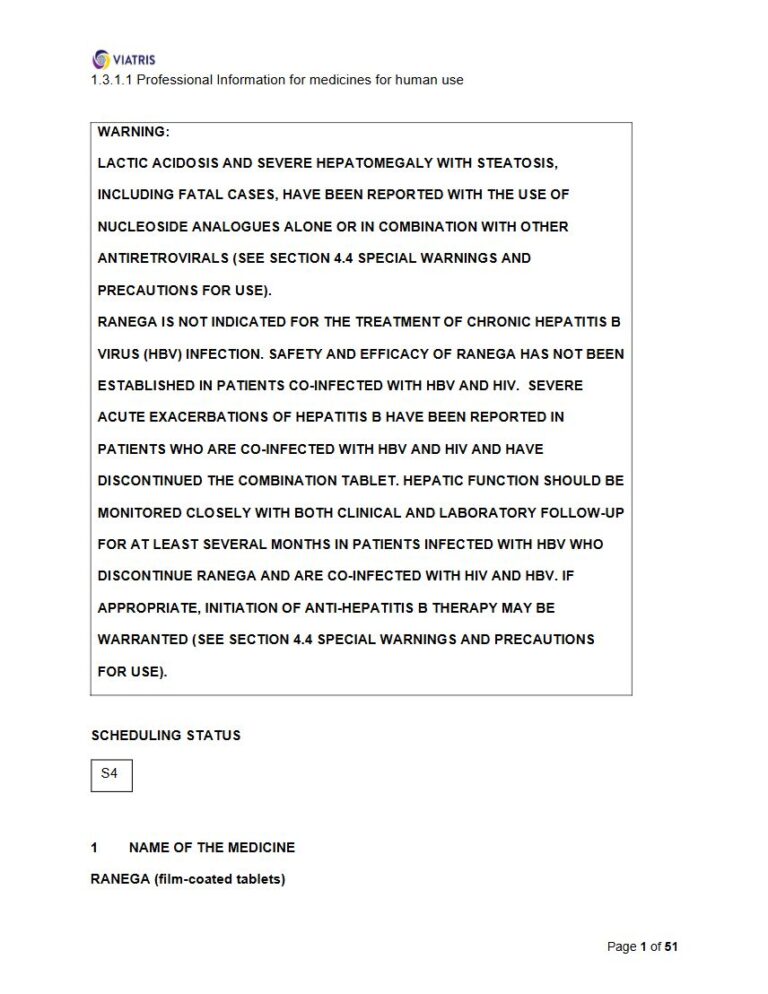
- Lactic acidosis
- Severe hepatomegaly
- Immune reconstitution inflammatory syndrome
Important Disclaimer
The Ranega 23 mg FC tablets professional information leaflet below is the property of Viatris Healthcare and is provided on Medinsert exactly as issued, with no.. alterations or editorial changes. We make every effort to keep content current by updating documents as soon as new versions become available. Medinsert serves as a trusted access point for healthcare professionals, but does not replace official sources or clinical judgement. For more details, please read our full disclaimer. read more>>
 Healthcare Professionals Only
This content is for registered healthcare professionals
Sign in or create a free account to read the full package insert.
Free for HPCSA-registered professionals. Powered by Medinsert.
Clinical Particulars
Section 4 of the official insert — extracted exactly as issued, no alterations
4.1 Therapeutic indications
RANEGA is indicated for the treatment of HIV-1 infection in adults aged 18 years and older.
4.2 Posology and method of administration
Posology Therapy should be initiated by a doctor experienced in the management of HIV infection.
Adults: The dose of RANEGA is one tablet taken orally, once daily, without regard to food.
Special Populations
Paediatrics: RANEGA is not recommended for use in patients younger than 18 years of age.
Dose adjustment for renal impairment: Significantly increased exposure occurred when tenofovir, as in RANEGA, was administered to patients with moderate to severe renal impairment (see section 4.3 Contraindications). The pharmacokinetics of tenofovir, as in RANEGA, have not been evaluated in non-haemodialysis patients with creatinine clearance < 50 ml/min); therefore, no dosing recommendations is available for these patients. RANEGA is not suitable for use in patients with renal impairment with creatinine clearance less than 50 ml/min. Rifampicin decreases the blood levels of dolutegravir. A supplementary dose of dolutegravir should be given to patients taking RANEGA.
4.3 Contraindications
- RANEGA tablets are contraindicated in patients with known hypersensitivity to lamivudine, tenofovir or dolutegravir or to any of the components of the tablets.
- Uncontrolled renal failure (see section 4.4 Special warnings and precautions for use).
- Pregnancy and lactation (see section 4.6 Fertility, pregnancy and lactation).
- Women of child-bearing age not using highly effective contraception.
- Concomitant use with adefovir dipivoxil.
- Co-administration with dofetilide and pilsicainide.
- Co-administration with didanosine.
- Patients younger than 18 years of age.
- Moderate and severe hepatic impairment.
4.4 Special warnings and precautions for use
Safety and efficacy of the individual active ingredients in various antiretroviral combination regimens with similar dosages as contained in RANEGA have been established in clinical studies for the treatment of HIV patients. However, safety and efficacy of the fixed drug combination as in RANEGA for the treatment of HIV have not been established in clinical studies.
Depression (including suicidal ideation): RANEGA can cause depression and suicidal ideation behaviour, particularly in patients with a pre-existing history of depression or psychiatric illness. Patients should inform their doctor if they notice any symptoms of depression during treatment. The complete package inserts of the other medicines used in combination should be consulted before initiation of therapy.
Metabolic abnormalities: Combination antiretroviral therapy, including RANEGA has been associated with metabolic abnormalities such as hypertriglyceridaemia, hypercholesterolaemia, insulin resistance, hyperglycaemia and hyperlactataemia.
...
Patients receiving RANEGA may continue to develop opportunistic infections and other complications of HIV infection, and therefore should remain under close clinical observation by doctors experienced in the treatment of patients with HIV associated diseases.
The risk of HIV transmission to others: Patients must be advised that treatment with antiretroviral RANEGA, have not been proven to prevent the risk of transmission of HIV to others through sexual contact or blood contamination. Appropriate precautions must continue to be used.
Lactic acidosis/severe hepatomegaly with steatosis: Lactic acidosis, usually associated with hepatic steatosis, including fatal cases, has been reported with the use of nucleoside analogues, such as in RANEGA. Early symptoms (symptomatic hyperlactataemia) include benign digestive symptoms (nausea, vomiting and abdominal pain), non-specific malaise, loss of appetite, weight loss, respiratory symptoms (rapid and/or deep breathing) or neurological symptoms (including motor weakness). Lactic acidosis has a high mortality and may be associated with pancreatitis, liver failure or renal failure. Lactic acidosis generally occurs after a few or several months of treatment. Treatment with nucleoside analogues should be discontinued in the setting of symptomatic hyperlactataemia and metabolic/lactic acidosis, progressive hepatomegaly, or rapidly elevating aminotransferase levels.
4.5 Interactions with other medicines
The likelihood of interactions is low due to the limited metabolism as plasma protein binding and almost complete renal clearance. Zidovudine plasma levels are not significantly altered when co-administered with Lamivudine. Zidovudine has no effect on the pharmacokinetics of lamivudine. Lamivudine may inhibit the intracellular phosphorylation of zalcitabine when the two medicinal products are used concurrently. Lamivudine is therefore not recommended to be used in combination with zalcitabine.
Administration of trimethoprim, a constituent of co-trimoxazole causes an increase in lamivudine plasma levels. However, unless the patient has renal impairment, no dosage adjustment of lamivudine is necessary. Lamivudine has no effect on the pharmacokinetics of co-trimoxazole.
The possibility of interactions with other medicines administered concurrently should be considered, particularly when the main route is renal. No medicine interaction studies have been conducted using RANEGA. As RANEGA contains tenofovir disoproxil fumarate and lamivudine, any interactions that have been identified with these individual medicines may occur with RANEGA.
4.6 Fertility, pregnancy and lactation
Women of childbearing potential / Contraception in males and females RANEGA should not be prescribed in women who plan to become pregnant. Woman of child-bearing age should not use RANEGA unless they are reliably using highly effective contraception. Treatment with RANEGA should not be initiated without a medically supervised negative pregnancy test. This test should be repeated at frequent intervals during treatment with RANEGA; and especially in the event that pregnancy is suspected.
Pregnancy: RANEGA is contraindicated in pregnancy and lactation. Tenofovir, dolutegravir and lamivudine were shown to cross the placenta in reproductive toxicity studies in animals. Late onset neurological disorders, including seizures, have been observed in children who have been exposed to nucleoside analogues such as tenofovir and lamivudine.
...
Breastfeeding: Mothers breastfeeding their infants should not use RANEGA. HIV infected women should not breastfeed their infants in order to avoid transmission of HIV or follow appropriate guidelines. Dolutegravir is excreted in human breast milk, and there is significant exposure to the neonate/infants due to slow elimination; the half-life of dolutegravir in the newborn was 33 hr compared to 14 hr in the adults.
4.7 Effects on ability to drive and use machines
RANEGA may affect the ability to drive and use machines. Patients should ensure that they do not engage in driving or using machines until they know how RANEGA affects them.
4.8 Undesirable effects
RANEGA can have side effects. Psychiatric disorders: Less frequent: depression. The following side effects have been reported during therapy for HIV disease with RANEGA tablets alone and in combination with other antiretrovirals.
...
General disorders and administration site conditions Frequent: Fatigue, malaise, fever.
4.9 Overdose
Tenofovir disoproxil fumarate: If overdose occurs the patient must be monitored for evidence of toxicity and palliative supportive treatment be applied as necessary. Tenofovir can be removed by haemodialysis; the median haemodialysis clearance of tenofovir is 134 ml/min. The elimination of tenofovir by peritoneal dialysis has not been studied.
Lamivudine: Limited data are available on the consequences of ingestion of acute overdoses in humans. If overdosage occurs the patient should be monitored, and palliative supportive treatment applied as required.
Dolutegravir: Management should be as clinically indicated or as recommended by the national poisons centre, where available. There is no specific treatment for an overdose of RANEGA. If overdose occurs, the patient should be treated supportively with appropriate monitoring as necessary.
