
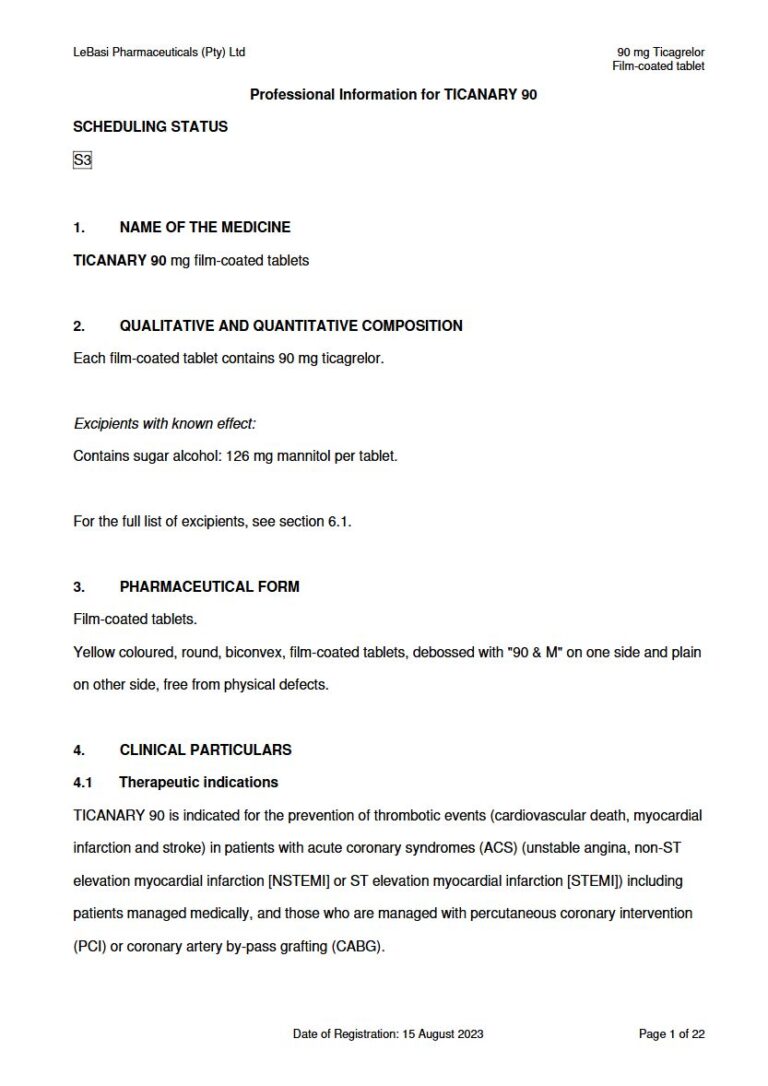
Ticanary 90 90 mg Tablet
PDF Leaflet Revision Date: 15 August 2023
Clinical Summary
Quick overview from the medicine insert
Indication
Prevention of thrombotic events in acute coronary syndromes.
Dosage (summary)
180 mg loading dose, then 90 mg twice daily.
Onset of Action / Duration
Onset: 30 mins, Duration: 6-8 hours
Special Populations
- Elderly
- Renal impairment
- Hepatic impairment
Pregnancy & Breastfeeding
Not recommended during pregnancy or breastfeeding.
Key Drug Interactions
- Strong CYP3A4 inhibitors
- CYP3A4 inducers
- Morphine
Contraindications
- Hypersensitivity
- Active bleeding
- Severe hepatic impairment
Common side effects
- Bleeding
- Dyspnoea
- Dizziness
Counselling Points
- Take with aspirin unless contraindicated
- Avoid missed doses
- Inform healthcare providers before surgery
Serious warnings
- Increased bleeding risk
- Caution in surgery
- TTP reported
Important Disclaimer
The Ticanary 90 90 mg Tablet professional information leaflet below is the property of Lebasi Pharmaceuticals and is provided on Medinsert exactly as issued, with no.. alterations or editorial changes. We make every effort to keep content current by updating documents as soon as new versions become available. Medinsert serves as a trusted access point for healthcare professionals, but does not replace official sources or clinical judgement. For more details, please read our full disclaimer. read more>>
 Healthcare Professionals Only
This content is for registered healthcare professionals
Sign in or create a free account to read the full package insert.
Free for HPCSA-registered professionals. Powered by Medinsert.
Clinical Particulars
Section 4 of the official insert — extracted exactly as issued, no alterations
4.1 Therapeutic indications
TICANARY 90 is indicated for the prevention of thrombotic events (cardiovascular death, myocardial infarction and stroke) in patients with acute coronary syndromes (ACS) (unstable angina, non-ST elevation myocardial infarction [NSTEMI] or ST elevation myocardial infarction [STEMI]) including patients managed medically, and those who are managed with percutaneous coronary intervention (PCI) or coronary artery by-pass grafting (CABG).
4.2 Posology and method of administration
Posology
TICANARY 90 treatment should be initiated with a single 180 mg loading dose (2 tablets of 90 mg) and then continued at 90 mg twice daily. Patients taking TICANARY 90 should also use aspirin daily unless specifically contraindicated. Following an initial dose of aspirin, TICANARY 90 should be used with a maintenance dose of aspirin of 75 u2013 150 mg daily (see sections 4.4 and 5.1). Medical practitioners who desire to switch patients from clopidogrel to TICANARY 90 should administer the first 90 mg dose of TICANARY 90 24 hours following the last dose of clopidogrel. There is no data on switching patients from other ADP receptor inhibitors to TICANARY 90. Treatment is recommended for at least 12 months unless discontinuation of TICANARY 90 is clinically indicated. In patients with acute coronary syndromes (ACS), premature discontinuation with any antiplatelet therapy, including TICANARY 90, could result in an increased risk of cardiovascular death, or myocardial infarction due to the patient's underlying disease (see section 4.4).
Special populations
Elderly patients
No dose adjustment is required.
Patients with renal impairment
No dose adjustment is necessary for patients with renal impairment (see section 5.2). No information is available concerning treatment of patients on renal dialysis.
Patients with hepatic impairment
Although the elimination of TICANARY 90 was statistically significantly delayed in patients with mild hepatic impairment (Child Pugh A), no dose adjustment is necessary in these patients. TICANARY 90 has not been studied in patients with moderate or severe hepatic impairment (see sections 4.3, 4.4 and 5.2).
Paediatric patients
Safety and efficacy in children below the age of 18 have not been established.
Method of administration
Oral use. TICANARY 90 can be taken with or without food. Lapses in therapy should be avoided. A patient who misses a dose of TICANARY 90 should take one 90 mg tablet (their next dose) at its scheduled time.
4.3 Contraindications
- Hypersensitivity to ticagrelor or to any of the excipients of TICANARY 90 listed in section 6.1.
- Active pathological bleeding.
- History of intracranial haemorrhage (see section 4.8).
- Severe hepatic impairment (see sections 4.2, 4.4 and 5.2).
- Strong CYP3A4 inhibitors (e.g. ketoconazole, clarithromycin, itraconazole, nefazodone, ritonavir and atazanavir), as co-administration may lead to a substantial increase in exposure to ticagrelor (see section 4.5).
- Inherited bleeding disorders.
- CYP3A4 inducers (such as rifampicin, phenytoin, carbamazepine and phenobarbital).
4.4 Special warnings and precautions for use
Bleeding risk
The use of TICANARY 90 in patients at known increased risk for bleeding should be balanced against the benefit in terms of prevention of atherothrombotic events (see sections 4.8 and 5.1). If clinically indicated, TICANARY 90 should be used with caution in the following patient groups:
- Patients with a propensity to bleed (e.g. due to recent trauma, recent surgery, coagulation disorders, active or recent gastrointestinal bleeding). The use of TICANARY 90 is contraindicated in patients with active pathological bleeding, in those with a history of intracranial haemorrhage, and in patients with severe hepatic impairment (see section 4.3).
- Patients with concomitant administration of medicines that may increase the risk of bleeding (e.g. non-steroidal anti-inflammatory drugs (NSAIDs), oral anticoagulants and/or fibrinolytics) within 24 hours of TICANARY 90 dosing.
- The safe co-administration of TICANARY 90 with warfarin has not been established.
Platelet transfusion did not reverse the antiplatelet effect of ticagrelor, as contained in TICANARY 90, in healthy volunteers and is unlikely to be of clinical benefit in patients with bleeding. Since co-administration of ticagrelor with desmopressin did not decrease template bleeding time, desmopressin is unlikely to be effective in managing clinical bleeding events (see section 4.5).
CABG-related bleeding:
In a phase 3 study, 12 % underwent coronary artery bypass graft (CABG) surgery. Major fatal/Life-threatening bleeding occurred in approximately 42 % of patients and fatal CABG bleeding has occurred in 6 patients. Antifibrinolytic therapy (aminocaproic acid or tranexamic acid) and/or recombinant factor VIIa therapy may increase haemostasis. TICANARY 90 may be resumed after the cause of bleeding has been identified and controlled.
Surgery
If a patient requires surgery, healthcare professionals should consider each patient's clinical profile as well as the benefits and risks of continued antiplatelet therapy when determining when discontinuation of TICANARY 90 treatment should occur. In a clinical study, mean inhibition of platelet aggregation (IPA) for ticagrelor at 24-, 48-, 72- and 120-hours post-dose was 58,4 %, 32,8 %, 19,5 % and 9,7 % respectively. Patients should be advised to inform healthcare professionals and dentists that they are taking TICANARY 90 before any surgery is scheduled and before any new medicine is taken. If a patient is to undergo elective surgery and antiplatelet effect is not desired, TICANARY 90 should be discontinued 5 days prior to surgery (see section 5.1). There are no data available regarding major regional block techniques and neuraxial blocks. Caution is advised in patients with increased risk of bleeding such as those undergoing spinal anaesthesia, epidural anaesthesia and lumbar puncture. Neurological monitoring for neuroaxial haematoma is recommended consistent with standard of care, during peri-operative and post-operative care.
Patients with prior ischemic stroke
ACS patients with prior ischaemic stroke can be treated with TICANARY 90 for up to 12 months. Treatment beyond one year is not recommended in these patients.
Hepatic impairment
Use of TICANARY 90 is contraindicated in patients with severe hepatic impairment (see sections 4.2 and 4.3). There is limited experience with TICANARY 90 in patients with moderate hepatic impairment, therefore, caution is advised in these patients (see sections 4.2 and 5.2).
Patients at risk for bradycardic events
Holter ECG monitoring has shown an increased frequency of mostly asymptomatic ventricular pauses during treatment with ticagrelor compared with clopidogrel. Patients with an increased risk of bradycardic events (e.g. patients without a pacemaker who have sick sinus syndrome, 2nd or 3rd degree AV block or bradycardic-related syncope) have been excluded from the main studies evaluating the safety and efficacy of ticagrelor. Therefore, due to the limited clinical experience, TICANARY 90 should be used with caution in these patients (see section 5.1). In addition, caution should be exercised when administering TICANARY 90 concomitantly with medicines known to induce bradycardia.
Dyspnoea
Dyspnoea was reported in patients treated with TICANARY 90. Dyspnoea is usually mild to moderate in intensity and often resolves without need for treatment discontinuation. Patients with asthma/chronic obstructive pulmonary disease (COPD) may have an increased absolute risk of experiencing dyspnoea with TICANARY 90. TICANARY 90 should be used with caution in patients with history of asthma and/or COPD. The mechanism has not been elucidated. If a patient reports new, prolonged or worsened dyspnoea this should be investigated fully and if not tolerated, treatment with TICANARY 90 should be stopped.
Creatine elevations
Creatinine levels may increase during treatment with TICANARY 90. The mechanism has not been elucidated. Renal function should be checked according to routine medical practice. In patients with ACS, it is recommended that renal function is also checked one month after initiating the treatment with TICANARY 90, paying special attention to patients u2265 75 years, patients with moderate/severe renal impairment and those receiving concomitant treatment with an angiotensin receptor blocker (ARB).
Uric acid increase
Hyperuricaemia may occur during treatment with TICANARY 90. Caution is advised in patients with history of hyperuricaemia or gouty arthritis. As a precautionary measure, the use of TICANARY 90 in patients with uric acid nephropathy is discouraged.
Thrombotic thrombocytopenic purpura (TTP)
Thrombotic thrombocytopenic purpura (TTP) has been reported with the use of ticagrelor, as contained in TICANARY 90. It is characterised by thrombocytopenia and microangiopathic haemolytic anaemia associated with either neurological findings, renal dysfunction or fever. TTP is a potentially fatal condition requiring prompt treatment including plasmapheresis.
Interference with platelet function tests to diagnose heparin induced thrombocytopenia (HIT)
In the heparin induced platelet activation (HIPA) test used to diagnose HIT, anti-platelet factor 4/heparin antibodies in patient serum activate platelets of healthy donors in the presence of heparin. False negative results in a platelet function test (to include but may not be limited to the HIPA test) for HIT have been reported in patients administered ticagrelor. This is related to inhibition of the P2Y 12 - receptor on the healthy donor platelets in the test by ticagrelor in the patient's sera/plasma. Information on concomitant treatment with TICANARY 90 is required for interpretation of HIT platelet function tests. In patients who have developed HIT, the benefit-risk of continued treatment with TICANARY 90 should be assessed, taking both the prothrombotic state of HIT and the increased risk of bleeding with concomitant anticoagulant and TICANARY 90 treatment into consideration.
Other
Co-administration of TICANARY 90 and high maintenance dose aspirin (> 300 mg) is not recommended (see section 5.1). Premature discontinuation with any antiplatelet therapy, including TICANARY 90, could result in an increased risk of cardiovascular (CV) death, MI or stroke due to the patient's underlying disease. Therefore, premature discontinuation of treatment should be avoided.
4.5 Interactions with other medicines
Ticagrelor, as contained in TICANARY 90, is primarily a CYP3A4 substrate and a mild inhibitor of CYP3A4. Ticagrelor is also a P-glycoprotein (P-gp) substrate and a weak P-gp inhibitor and may increase the exposure of P-gp substrates.
Effects of medicines and other products on TICANARY 90
- CYP3A4 inhibitors
u2022 Strong CYP3A4 inhibitors u2013 Co-administration of ketoconazole with ticagrelor increased the ticagrelor C max and AUC equal to 2,4-fold and 7,3-fold, respectively. The C max and AUC of the active metabolite were reduced by 89 % and 56 %, respectively. Other strong inhibitors of CYP3A4 (clarithromycin, itraconazole, nefazodone, ritonavir, and atazanavir) would be expected to have similar effects and therefore concomitant use of strong CYP3A4 inhibitors with TICANARY 90 is contraindicated (see section 4.3). - u2022 Moderate CYP3A4 inhibitors u2013 Co-administration of diltiazem with ticagrelor increased the ticagrelor C max by 69 % and AUC to 2,7-fold and decreased the active metabolite C max by 38 % and AUC was unchanged. There was no effect of ticagrelor on diltiazem plasma levels. Other moderate CYP3A4 inhibitors (e.g. amprenavir, aprepitant, erythromycin, fluconazole and verapamil) would be expected to have a similar effect and can as well be co-administered with TICANARY 90.
- u2022 A 2-fold increase of ticagrelor exposure was observed after daily consumption of large quantities of grapefruit juice (3 x 200 mL). This magnitude of increased exposure is not expected to be clinically relevant to most patients.
CYP3A inducers
Co-administration of rifampicin with ticagrelor decreased ticagrelor C max and AUC by 73 % and 86 %, respectively. The C max of the active metabolite was unchanged and the AUC was decreased by 46 %, respectively. Other CYP3A inducers (e.g. dexamethasone, phenytoin, carbamazepine and phenobarbital) would be expected to decrease the exposure to ticagrelor as well. Co-administration of TICANARY 90 with potent CYP3A inducers may decrease exposure and efficacy of TICANARY 90 (see section 4.3).
Ciclosporin (P-gp and CYP3A inhibitor)
Co-administration of ciclosporin (600 mg) with ticagrelor increased ticagrelor C max and AUC equal to 2,3-fold and 2,8-fold, respectively. The AUC of the active metabolite was increased by 32 % and C max was decreased by 15 % in the presence of ciclosporin. No data are available on concomitant use of ticagrelor with other active substances that also are potent P-gp inhibitors and moderate CYP3A4 inhibitors (e.g. verapamil, quinidine) that also may increase ticagrelor exposure. If the association cannot be avoided, their concomitant use should be made with caution.
Others
Clinical pharmacology interaction studies showed that co-administration of ticagrelor with heparin, enoxaparin and aspirin or desmopressin did not have any effect on the pharmacokinetics of ticagrelor or the active metabolite or on ADP-induced platelet aggregation compared with ticagrelor alone. If clinically indicated, medicines that alter haemostasis should be used with caution in combination with TICANARY 90. A delayed and decreased exposure to oral P2Y 12 inhibitors, including ticagrelor and its active metabolite, has been observed in patients with ACS treated with morphine (35 % reduction in ticagrelor exposure). This interaction may be related to reduced gastrointestinal motility and apply to other opioids. The clinical relevance is unknown, but data indicate the potential for reduced TICANARY 90 efficacy in patients co-administered TICANARY 90 and morphine. In patients with ACS, in whom morphine cannot be withheld and fast P2Y 12 inhibition is deemed crucial, the use of a parenteral P2Y 12 inhibitor may be considered.
4.6 Fertility, pregnancy and lactation
Women of childbearing potential
Women of childbearing potential should use appropriate contraceptive measures to avoid pregnancy during TICANARY 90 therapy.
Pregnancy
There are no or limited amount of data from the use of TICANARY 90 in pregnant women. Studies in animals have shown reproductive toxicity. TICANARY 90 is not recommended during pregnancy.
Breastfeeding
Available pharmacodynamic/toxicological data in animals have shown excretion of ticagrelor and its active metabolites in milk. A risk to newborns and infants cannot be excluded. The use of TICANARY 90 during breastfeeding is not recommended.
Fertility
TICANARY 90 had no effect on male or female fertility in animals.
4.7 Effects on ability to drive and use machines
TICANARY 90 can cause side effects, such as dizziness and confusion and can affect the ability to drive a vehicle and use machines. Caution is advised when driving a vehicle or operating machinery until the effects of TICANARY 90 are known.
4.8 Undesirable effects
Summary of the safety profile
The most commonly reported adverse reactions in patients treated with TICANARY 90 were bleeding and dyspnoea.
Table 1: Adverse reactions by frequency and system organ class (SOC)
| System organ class | Frequent | Less frequent | Frequency unknown |
|---|---|---|---|
| Neoplasms benign and malignant (including cysts and polyps) | Tumour bleedings a | ||
| Blood and the lymphatic system disorders | Blood disorder bleedings b | Thrombotic thrombocytopenic purpura j | |
| Immune system disorders | Hypersensitivity including angioedema j | ||
| Metabolism and nutrition disorders | Hyperuricaemiad, gout/gouty arthritis | ||
| Psychiatric disorders | Confusion | ||
| Nervous system disorders | Dizziness, syncope, headache | Intracranial haemorrhage, paraesthesia | |
| Eye disorders | Eye haemorrhage e | ||
| Ear and labyrinth disorders | Vertigo | Ear haemorrhage | |
| Vascular disorders | Hypotension | ||
| Respiratory, thoracic and mediastinal disorders | Dyspnoea, epistaxis, | haemoptysis | |
| Gastrointestinal disorders | Abdominal pain, gastrointestinal haemorrhage g , diarrhoea, nausea, vomiting, dyspepsia, constipation | Retroperitoneal haemorrhage | |
| Skin and subcutaneous tissue disorders | Subcutaneous or dermal bleeding h , rash, pruritus | ||
| Musculoskeletal and connective tissue disorders | Haemarthrosis, muscular bleedings | ||
| Renal and urinary disorders | Urinary tract bleeding f | ||
| Reproductive system and breast disorders | Reproductive system bleedings i | ||
| Investigations | Increased blood creatinine d | ||
| Injury, poisoning and procedural complications | Post procedural haemorrhage, traumatic bleedings c |
a e.g. bleeding from bladder cancer, gastric cancer, colon cancer
b e.g. increased tendency to bruise, spontaneous haematoma, haemorrhagic diathesis
c e.g. contusion, traumatic haematoma, traumatic haemorrhage
d Frequencies derived from lab observations (Uric acid increases to > upper limit of normal from baseline below or within reference range. Creatinine increases of > 50 % from baseline.) and not crude adverse event report frequency.
e e.g. conjunctival, retinal, intraocular bleeding
f e.g. haematuria, cystitis haemorrhagic
g e.g. gingival bleeding, rectal haemorrhage, gastric ulcer haemorrhage
h e.g. ecchymosis, skin haemorrhage, petechiae
i e.g. vaginal haemorrhage, haematospermia, postmenopausal haemorrhage
j Identified in post-marketing experience
4.9 Overdose
TICANARY 90 is well tolerated in single doses up to 900 mg. Gastrointestinal toxicity was dose-limiting in a single ascending dose study. Other clinically meaningful adverse reactions which may occur with overdose include dyspnoea and ventricular pauses (see section 4.8). In the event of an overdose, the above potential adverse reactions could occur and ECG monitoring should be considered. There is currently no known antidote to reverse the effects of TICANARY 90, and TICANARY 90 is not dialysable (see section 5.2). Treatment of overdose should follow local standard medical practice. The expected effect of excessive TICANARY 90 dosing is prolonged duration of bleeding risk associated with platelet inhibition. Platelet transfusion is unlikely to be of clinical benefit in patients with bleeding (see section 4.4). If bleeding occurs other appropriate supportive measures should be taken.
