
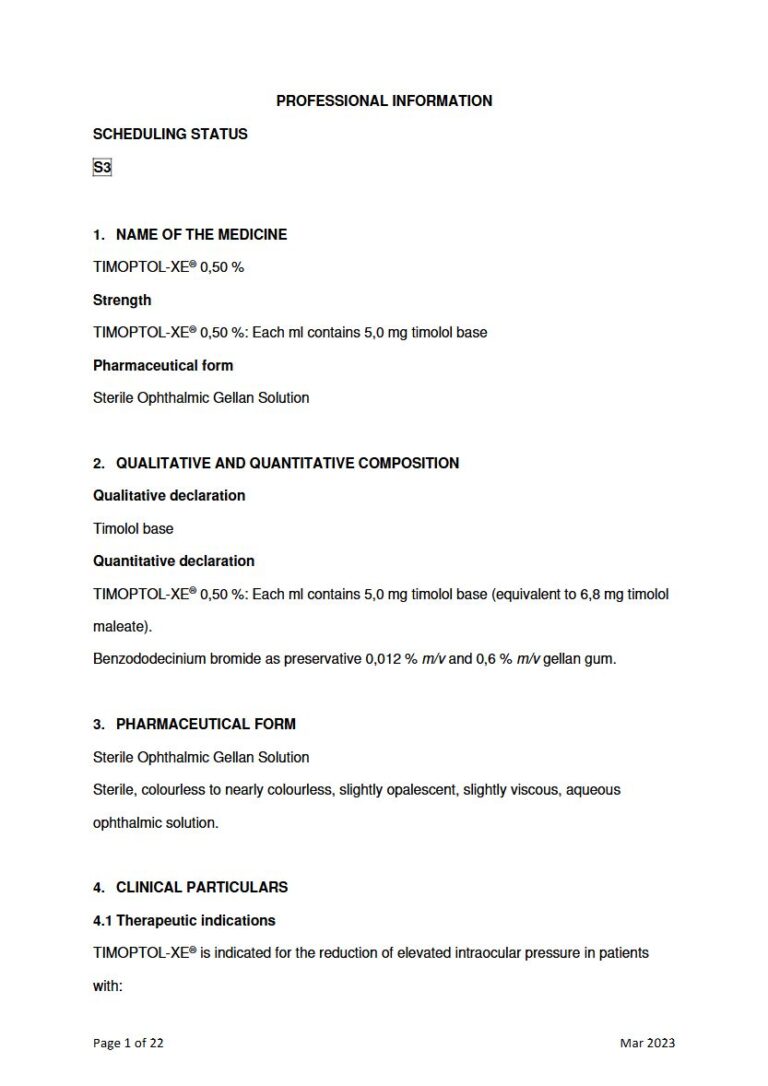
Timoptol-Xea 0,50 % 5,0 mg Sterile Ophthalmic Gellan Solution
PDF Leaflet Revision Date: 03 April 2023
Clinical Summary
Quick overview from the medicine insert
Indication
Reduction of elevated intraocular pressure in glaucoma and ocular hypertension.
Dosage (summary)
One drop in affected eye(s) once daily.
Onset of Action / Duration
Onset: 20 mins, Duration: 24 hours
Special Populations
- Elderly
- Renal impairment
- Hepatic impairment
Pregnancy & Breastfeeding
Not recommended in pregnancy; contraindicated in breastfeeding.
Key Drug Interactions
- Calcium channel blockers
- Oral beta-blockers
- Antiarrhythmics
Contraindications
- Hypersensitivity
- Asthma
- Bradycardia
- Heart block
- Cardiac failure
Common side effects
- Blurred vision
- Burning
- Stinging
- Dry eyes
Counselling Points
- Avoid driving until vision is clear
- Monitor for respiratory symptoms
- Do not use with contact lenses
Serious warnings
- Cardiac complications
- Respiratory issues
- Hypoglycemia masking
Important Disclaimer
The Timoptol-Xea 0,50 % 5,0 mg Sterile Ophthalmic Gellan Solution professional information leaflet below is the property of Mundipharma and is provided on Medinsert exactly as issued, with no.. alterations or editorial changes. We make every effort to keep content current by updating documents as soon as new versions become available. Medinsert serves as a trusted access point for healthcare professionals, but does not replace official sources or clinical judgement. For more details, please read our full disclaimer. read more>>
 Healthcare Professionals Only
This content is for registered healthcare professionals
Sign in or create a free account to read the full package insert.
Free for HPCSA-registered professionals. Powered by Medinsert.
Clinical Particulars
Section 4 of the official insert — extracted exactly as issued, no alterations
4.1 Therapeutic indications
TIMOPTOL-XE u00ae is indicated for the reduction of elevated intraocular pressure in patients with:
- ocular hypertension
- chronic open-angle glaucoma
- aphakia and glaucoma
- secondary glaucoma (some cases)
- narrow angles and a history of spontaneous or iatrogenically induced narrow-angle closure in the opposite eye in whom reduction of intraocular pressure is necessary (see section 4.4)
4.2 Posology and method of administration
Posology
The dose is one drop of 0,5 % TIMOPTOL-XE u00ae in the affected eye(s) once a day. If needed, concomitant therapy with other agents for lowering intraocular pressure may be given with TIMOPTOL-XE u00ae. The use of two topical beta-adrenergic blockers is not recommended (see section 4.4). If one dose is missed, treatment should continue with the next dose as planned. Other topically applied medications should be administered no less than 10 minutes before TIMOPTOL-XE u00ae.
How to Transfer Patients from Other Therapy
When a patient is transferred from TIMOPTOL u00ae to TIMOPTOL-XE u00ae, TIMOPTOL u00ae should be discontinued after proper dosing on one day, and treatment with TIMOPTOL-XE u00ae started on the following day. When changing patients from miotics to TIMOPTOL-XE u00ae, refraction may be necessary after the effects of the miotic have passed.
Paediatric population
Safety and efficacy of TIMOPTOL-XE u00ae has not been established in children.
Method of administration
Invert the closed container and shake once before each use. It is not necessary to shake the container more than once. When using nasolacrimal occlusion or closing the eyelids for 2 minutes, the systemic absorption may be reduced. This may result in an increase in local activity.
4.3 Contraindications
TIMOPTOL-XE u00ae is contraindicated in patients with:
- Hypersensitivity to the active substance or to any of the excipients listed in section 6.1
- Reactive airway disease, including bronchial asthma or a history of bronchial asthma, or chronic obstructive pulmonary disease
- Sinus bradycardia, heart block, including sino-atrial block, sick sinus syndrome sino-atrial block, second or third degree atrioventricular block, not controlled with pace-maker, overt cardiac failure, uncontrolled cardiac failure, cardiogenic shock
- Concomitant use with calcium-channel antagonists in patients with impaired cardiac function
- Advanced peripheral arterial insufficiency
- Raynaudu2019s syndrome
Timoptol-XE u00ae should not be used in patients wearing contact lenses as it has not been studied in these patients.
4.4 Special warnings and precautions for use
TIMOPTOL-XE u00ae is absorbed systemically and the same types of cardiovascular, pulmonary and other adverse reactions found with systemic administration of beta-adrenergic blocking agents may occur with topical administration. Incidence of systemic ADRs after topical ophthalmic administration is lower than for systemic administration. To reduce the systemic absorption, see section 4.2. Prolonged use may be followed with a decreased response.
Cardiac disorders
In patients with cardiovascular diseases (e.g. coronary heart disease, Prinzmetal's angina and cardiac failure) and hypotension therapy with beta-blockers should be critically assessed and the therapy with other active substances should be considered. Patients with cardiovascular diseases should be watched for signs of deterioration of these diseases and of adverse reactions. Cardiac complications, including death in association with cardiac failure, have been reported following administration of beta-adrenergic blocking agents. Cardiac failure should be adequately controlled before beginning therapy with TIMOPTOL-XE u00ae. In patients with a history of cardiac disease, signs of cardiac failure should be sought and pulse rates should be monitored. Due to its negative effect on conduction time, TIMOPTOL-XE u00ae should not be given to patients with first degree heart block.
Respiratory disorders
Respiratory complications, including death due to bronchospasm in patients with asthma have been reported following administration of beta-adrenergic blocking agents. These are potential complications of therapy with TIMOPTOL-XE u00ae.
Vascular disorders
Patients with peripheral arterial insufficiency or circulatory disturbance/disorders (e.g. severe forms of Raynaudu2019s disease or Raynaudu2019s syndrome) should be treated with caution (see section 4.3).
Hypoglycaemia/diabetes
TIMOPTOL-XE u00ae should be administered with caution in patients subject to spontaneous hypoglycaemia or to diabetic patients (especially those with labile diabetes) who are receiving insulin or oral hypoglycaemic agents. TIMOPTOL-XE u00ae may mask the signs and symptoms of acute hypoglycaemia and the bodyu2019s response to hypoglycaemia.
Masking of hyperthyroidism
TIMOPTOL-XE u00ae may mask certain clinical signs of hyperthyroidism (e.g. tachycardia). Patients suspected of developing hyperthyroidism should be managed carefully to avoid abrupt withdrawal of beta-adrenergic blocking agents, such as TIMOPTOL-XE u00ae, which might precipitate a thyroid storm (see section 4.3).
Corneal diseases
Ophthalmic beta-blockers may induce dryness of eyes. Patients with corneal diseases should be treated with caution.
Other beta-blocking agents
Patients who are already receiving an oral beta-adrenergic blocking medicine(s) and who are given TIMOPTOL-XE u00ae should be observed for a potential additive effect either on the intraocular pressure or on the known systemic effects of beta blockade. The use of TIMOPTOL-XE u00ae plus another topical beta-adrenergic blocking medicine is not recommended (see section 4.5).
There have been reports of skin rashes and/or dry eyes associated with the use of beta-adrenoreceptor blocking medicines. The reported incidence is small and in most cases the symptoms have cleared when treatment was withdrawn. Discontinuation of the medicine should be considered if any such reaction is not otherwise explicable. Cessation of therapy involving beta-blockade should be gradual.
In patients with angle-closure glaucoma, the immediate objective of treatment is to re-open the angle. This requires constricting the pupil with a miotic. Timolol maleate has little or no effect on the pupil. Should TIMOPTOL-XE u00ae be used to reduce elevated intraocular pressure in angle-closure glaucoma, it should be used together with a miotic and not on its own.
Choroidal detachment
Choroidal detachment has been reported with administration of aqueous suppressant therapy such as TIMOPTOL-XE u00ae after surgical and other filtration procedures. TIMOPTOL-XE u00ae has not been studied in patients wearing contact lenses (see section 4.3).
The dispenser of TIMOPTOL-XE u00ae contains benzododecinium bromide as a preservative. In a clinical study, the time required to eliminate 50 % of the gellan solution from the eye was up to 30 minutes.
Surgical anaesthesia
Beta-blocking ophthalmological preparations may block systemic beta-agonist effects e.g. of epinephrine (adrenaline). The anaesthesiologist should be informed when the patient is receiving timolol.
The most frequent medicine related side effects are transient blurred vision, which may last from 30 seconds to 5 minutes and in rare cases up to 30 minutes or longer, following instillation. Blurred vision and potential visual disturbances may impair the ability to perform hazardous tasks such as operating machinery or driving a motor vehicle. Ensure that vision is clear before driving a motor vehicle or operating machinery.
Patients should be advised that if they develop an intercurrent ocular condition (e.g. trauma, ocular surgery or infection), they should immediately seek their physicianu2019s advice concerning the continued use of the present multidose container (see section 4.2). There have been reports of bacterial keratitis associated with the use of multiple dose containers of topical ophthalmic products. These containers had been inadvertently contaminated by patients who, in most cases, had a concurrent corneal disease or a disruption of the ocular epithelial surface.
Anaphylactic Reactions
While using TIMOPTOL-XE u00ae, patients with a history of atopy or a history of severe anaphylactic reaction to a variety of allergens may be more reactive to repeated challenge with such allergens, whether accidental, diagnostic or therapeutic. Such patients may be unresponsive to the usual doses of epinephrine (adrenaline) used to treat anaphylactic reactions.
Paediatric population
Safety and efficacy of TIMOPTOL-XE u00ae has not been established in children.
4.5 Interaction with other medicines and other forms of interaction
No specific medicine interaction studies have been performed with timolol. There is a potential for additive effects resulting in hypotension and/or marked bradycardia when ophthalmic beta-blockers solution is administered concomitantly with oral calcium channel blockers, beta-adrenergic blocking agents, antiarrhythmics (including amiodarone), digitalis glycosides, rauwolfia alkaloids, parasympathomimetics, guanethidine. Mydriasis resulting from concomitant therapy with epinephrine (adrenaline) has been reported. The potential for mydriasis exists from concomitant therapy with TIMOPTOL-XE u00ae and epinephrine (adrenaline). Close observation of the patient is recommended when TIMOPTOL-XE u00ae is administered to patients receiving catecholamine-depleting medication such as rauwolfia derivatives or antidysrhythmics and parasympathomimetics, because of the possible additive effects and the production of hypotension and/or marked bradycardia, which may produce vertigo, syncope, or postural hypotension. Hypotension, atrioventricular (AV) conduction disturbances and left ventricular failure may occur in patients receiving TIMOPTOL-XE u00ae when an oral calcium-channel blocker is added to the treatment regimen (see section 4.3). The nature of any cardiovascular adverse effect tends to depend on the type of calcium-channel blocker used. Dihydropyridine derivatives, such as nifedipine, may lead to hypotension, whereas verapamil or diltiazem have a greater propensity to lead to AV conduction disturbances or left ventricular failure when used with a beta-blocker. The concomitant use of TIMOPTOL-XE u00ae and digoxin with a calcium antagonist (for example diltiazem or verapamil) may have additive effects in prolonging AV conduction time. Oral calcium-channel antagonists may be used in combination with beta-adrenergic blocking agents when heart function is normal, but should be avoided in patients with impaired cardiac function. Intravenous calcium-channel blockers should be used with caution in patients receiving TIMOPTOL-XE u00ae. Oral beta-adrenergic blockers may exacerbate the rebound hypertension which can follow the withdrawal of clonidine. Therefore, if clonidine and TIMOPTOL-XE u00ae are co-administered, TIMOPTOL-XE u00ae should be withdrawn several days before the gradual withdrawal of clonidine. If replacing clonidine by beta blocker therapy, the introduction of beta-adrenergic blocking agent should be delayed for several days after clonidine administration has stopped. Potentiated systemic beta-blockade (e.g. decreased heart rate, depression) has been reported during combined treatment with CYP2D6 inhibitors (e.g. quinidine, SSRIs including fluoxetine and paroxetine) and TIMOPTOL-XE u00ae.
4.6 Fertility, pregnancy and lactation
Pregnancy
There are no adequate data for the use of timolol in pregnant women. TIMOPTOL-XE u00ae should not be used during pregnancy. To reduce the systemic absorption, see section 4.2. Epidemiological studies have not revealed malformative effects but show a risk for intra uterine growth retardation when beta-blockers are administered by the oral route. In addition, signs and symptoms of beta-blockade (e.g. bradycardia, hypotension, respiratory distress and hypoglycaemia) have been observed in the neonate when beta-blockers have been administered until delivery. If TIMOPTOL-XE u00ae is administered until delivery, the neonate should be carefully monitored during the first days of life.
Breastfeeding
Timolol is secreted in human milk. Women on TIMOPTOL-XE u00ae should not breastfeed their infants. A decision for breastfeeding mothers, either to stop taking TIMOPTOL-XE u00ae or stop nursing, should be based on the importance of the medicine to the mother.
4.7 Effects on ability to drive and use machines
Transient blurred vision following instillation may occur, generally lasting from 30 seconds to 5 minutes, and in rare cases, up to 30 minutes or longer. Blurred vision and potential visual disturbances, refractive changes, diplopia, ptosis, frequent episodes of mild and transient blurred vision and fatigue may impair the ability to perform hazardous tasks such as operating machinery or driving a motor vehicle.
4.8 Undesirable effects
Like other topically applied ophthalmic medicines, timolol is absorbed into the systemic circulation. This may cause similar undesirable effects as seen with systemic beta-blocking agents. Incidence of systemic ADRs after topical ophthalmic administration is lower than for systemic administration. The most frequent medicine-related complaint in clinical studies was transient blurred vision (6,0 %), lasting from 30 seconds to 5 minutes following instillation. Diminished responsiveness to TIMOPTOL-XE u00ae after prolonged therapy has been reported. The following adverse reactions have been reported with ocular administration of TIMOPTOL-XE u00ae. Additional adverse reactions have been reported in clinical experiences with systemic timolol, and may be considered potential effects of ophthalmic timolol. Also listed are adverse reactions seen within the class of ophthalmic beta-blockers and may potentially occur with TIMOPTOL-XE u00ae.
Very Common ( u2265 1/10)
Common ( u2265 1/100 to <1/10)
Uncommon ( u2265 1/1 000 to <1/100)
Rare (u2265 1/10 000 to <1/1 000)
Not known
Blood and lymphatic system disorders
Systemic non-thrombocytopenic purpura
Immune system disorders
Ocular systemic lupus erythematosus, signs and symptoms of allergic reactions including anaphylaxis, angioedema, urticaria, localised and generalised rash pruritis
Systemic anaphylactic reaction
Metabolism and nutrition disorders
Ocular hypoglycaemia
Systemic hyperglycaemia, masking of the signs and symptoms of acute hypoglycaemia (see section 4.4)
Psychiatric disorders
Ocular depression insomnia, nightmares, memory loss hallucination
Systemic impaired concentration, increased dreaming nightmares, and other psychiatric disturbances (e.g. anxiety and nervousness)
Nervous system disorders
Ocular headache syncope, dizziness cerebrovascular accident, cerebral ischaemia, increase in signs and symptoms of myasthenia gravis, paraesthesia
Systemic vertigo, local weakness
Eye disorders
Ocular transient blurred vision (lasting from 30 seconds to 5 minutes following instillation) burning and stinging, conjunctival injection, discharge, foreign body sensation, and itching. Signs and symptoms of ocular irritation (e.g. burning, stinging, itching, tearing, redness) conjunctivitis, blepharitis, keratitis, decreased corneal sensitivity, and dry eyes visual disturbances, including refractive changes (due to withdrawal of miotic therapy in some cases) diplopia, ptosis, choroidal detachment following filtration surgery or other filtration procedures (see section 4.4) corneal erosion
Ear and labyrinth disorders
Ocular tinnitus
Cardiac disorders
Ocular bradycardia dysrhythmia, heart block, congestive heart failure, palpitation, cardiac arrest, oedema, chest pain
atrial fibrillation, atrioventricular block, cardiac failure
Systemic AV block (2nd- or 3rd- degree), sino-atrial block, pulmonary oedema, worsening of peripheral arterial insufficiency (including Raynaudu2019s phenomenon, intermittent claudication), worsening of angina pectoris, vasodilation
Vascular disorders
Ocular hypotension, claudication, Raynaudu2019s phenomenon, cold hands and feet
Respiratory, thoracic, and mediastinal disorders
Ocular dyspnoea bronchospasm (predominantly in patients with pre-existing bronchospastic disease such as asthma or COPD), respiratory failure, cough
Systemic rales
Gastrointestinal disorders
Ocular nausea, dyspepsia
diarrhoea, dry mouth dysgeusia, abdominal pain, vomiting
Systemic abdominal pain, vomiting
Skin and subcutaneous tissue disorders
Ocular alopecia, psoriasiform rash or exacerbation of psoriasis skin rash
Systemic sweating, exfoliative dermatitis
Musculoskeletal and connective tissue disorders
Ocular myalgia
Systemic arthralgia, myalgia, extremity pain
Reproductive system and breast disorders
Ocular Peyronieu2019s disease, decreased libido sexual dysfunction such as impotence
Systemic micturition difficulties, impotence
General disorders and administration site conditions
Ocular asthenia, fatigue
Systemic extremity pain, decreased exercise tolerance, local weakness
Investigations
Systemic increases in blood urea, serum potassium, serum uric acid and triglycerides and decreases in haemoglobin, haematocrit and HDL-cholesterol
Post-marketing Experience
The following adverse effects have been reported but a causal relationship to therapy with TIMOPTOL-XE u00ae has not been established.
4.9 Overdose
Overdosage with TIMOPTOL-XE u00ae has resulted in systemic effects similar to those seen with systemic beta-adrenergic blockers e.g. dizziness, headache, shortness of breath, bradycardia, bronchospasm, and cardiac arrest (also see section 4.8).
The following specific therapeutic measures should be considered:
- Symptomatic bradycardia: Administer atropine sulphate intravenously in a dosage of 0,25 to 2 mg to induce vagal blockade. If bradycardia persists, intravenous isoproterenol hydrochloride should be cautiously administered. In refractory cases the use of a transvenous cardiac pacemaker may be considered.
- Heart block (second or third degree): Treatment is symptomatic and supportive.
- Hypotension: Use sympathomimetic pressor medication therapy, such as dopamine, dobutamine or levarterenol. In refractory cases the use of glucagon hydrochloride has been reported to be useful.
- Acute cardiac failure: Conventional therapy with digoxin, diuretics and oxygen should be instituted immediately. In refractory cases the use of intravenous aminophylline is suggested. This may be followed if necessary by glucagon hydrochloride, which has been reported to be useful.
- Bronchospasm: Additional therapy with aminophylline may be considered. Timolol does not dialyse readily.
