
Tiotropium Adco 16 micrograms Hard capsule for inhalation
PDF Leaflet Revision Date: 05 May 2022
Clinical Summary
Quick overview from the medicine insert
Indication
Long-term maintenance treatment of chronic obstructive pulmonary disease (COPD).
Dosage (summary)
Inhale one capsule once daily using the Zephir Inhaler.
Onset of Action / Duration
Onset: Few days, Duration: >24 hours
Special Populations
- Elderly patients
- Renal impairment
- Hepatic impairment
Pregnancy & Breastfeeding
Use during pregnancy is not recommended; unknown if excreted in breast milk.
Key Drug Interactions
- Concomitant use with other anticholinergics not recommended
- No significant interactions with LABA or ICS
Contraindications
- Hypersensitivity to tiotropium or excipients
- Children under 18 years
Common side effects
- Dry mouth
- Dizziness
- Blurred vision
- Headache
Counselling Points
- Instruct on proper inhaler use
- Avoid eye contact with powder
- Do not exceed once daily dosing
Serious warnings
- Not for acute bronchospasm
- Caution in narrow-angle glaucoma
- Risk of inhalation-induced bronchospasm
Important Disclaimer
The Tiotropium Adco 16 micrograms Hard capsule for inhalation professional information leaflet below is the property of Adcock Ingram and is provided on Medinsert exactly as issued, with no.. alterations or editorial changes. We make every effort to keep content current by updating documents as soon as new versions become available. Medinsert serves as a trusted access point for healthcare professionals, but does not replace official sources or clinical judgement. For more details, please read our full disclaimer. read more>>
 Healthcare Professionals Only
This content is for registered healthcare professionals
Sign in or create a free account to read the full package insert.
Free for HPCSA-registered professionals. Powered by Medinsert.
Clinical Particulars
Section 4 of the official insert — extracted exactly as issued, no alterations
4.1 Therapeutic indications
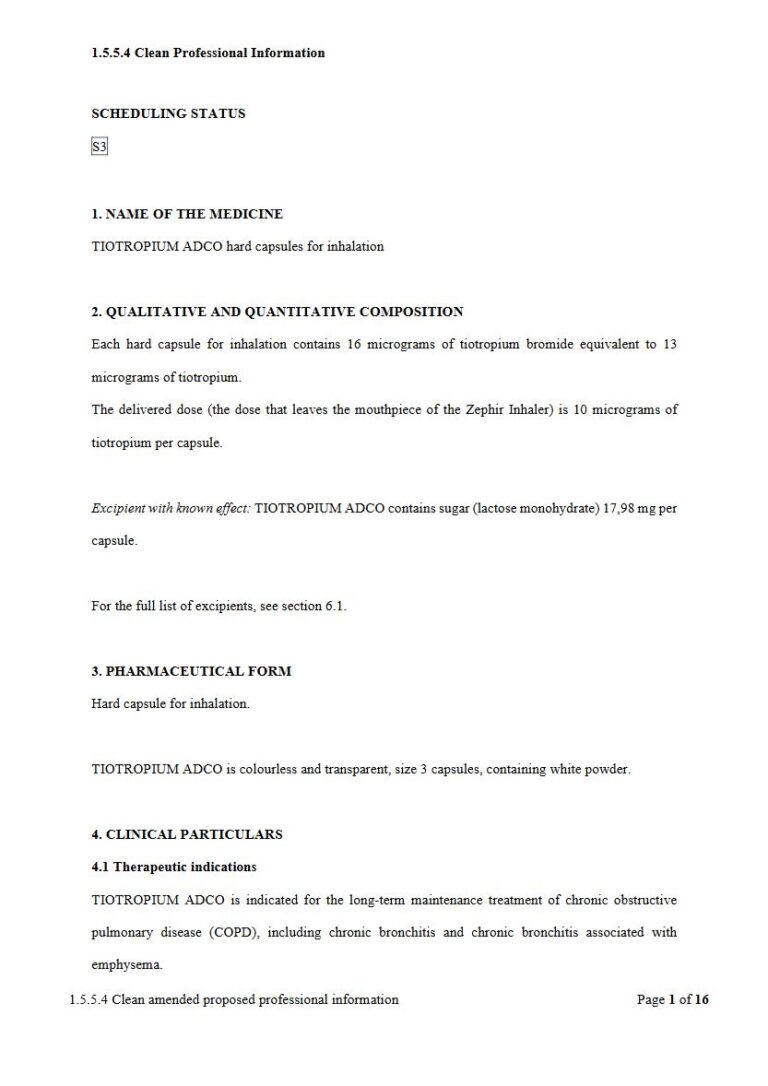
TIOTROPIUM ADCO is indicated for the long-term maintenance treatment of chronic obstructive pulmonary disease (COPD), including chronic bronchitis and chronic bronchitis associated with emphysema.
4.2 Posology and method of administration
Posology
Recommended dosage: Inhale the contents of one capsule once daily, at the same time each day, using the Zephir Inhaler device. TIOTROPIUM ADCO capsules must not be swallowed. Optimum efficacy can only be expected within a few days of usage.
Special Populations:
Elderly patients can use the recommended dose of TIOTROPIUM ADCO capsules for inhalation. Renally impaired patients can use tiotropium at the recommended dose. However, TIOTROPIUM ADCO use should be monitored closely in patients with moderate to severe renal impairment (see sections 4.4 and 5.2). Hepatically impaired patients can use TIOTROPIUM ADCO at the recommended dose (see section 5.2).
Paediatric population
The safety and efficacy in children have not been established. No data are available.
Method of administration
To ensure proper administration of the TIOTROPIUM ADCO the patient should be trained how to use the inhaler by the medical practitioner or by other healthcare professionals. The Zephir Inhaler is especially designed for TIOTROPIUM ADCO. The Zephir Inhaler must not be used it to take any other medication. Zephir Inhaler can be used for up to one year to take TIOTROPIUM ADCO.
4.3 Contraindications
Hypersensitivity to tiotropium bromide or to atropine or its derivatives, e.g. ipratropium or oxitropium or to any excipient of TIOTROPIUM ADCO listed in section 6.1. Contraindicated in children below 18 years as safety and efficacy have not been demonstrated.
4.4 Special warnings and precautions for use
Tiotropium bromide as contained in TIOTROPIUM ADCO, as a once daily maintenance bronchodilator, should not be used for the initial treatment of acute episodes of bronchospasm, i.e. rescue therapy. Immediate hypersensitivity reactions may occur after administration of TIOTROPIUM ADCO inhalation powder. Consistent with its anticholinergic activity, TIOTROPIUM ADCO should be used with caution in patients with narrow-angle glaucoma, prostatic hyperplasia or bladder-neck obstruction. (see section 4.8). Inhaled TIOTROPIUM ADCO may cause inhalation-induced bronchospasm.
TIOTROPIUM ADCO should be used with caution in patients with recent myocardial infarction < 6 months; any unstable or life-threatening cardiac dysrhythmia or cardiac dysrhythmia requiring intervention or a change in medicine therapy in the past year; hospitalisation of heart failure (NYHA Class III or IV) within the past year. These patients were excluded from the clinical trials and these conditions may be affected by the anticholinergic mechanism of action. As plasma concentration increases with decreased renal function in patients with moderate to severe renal impairment (creatinine clearance u2264 50 ml/min), the use of TIOTROPIUM ADCO should be monitored closely in these patients. There is no long-term experience in patients with severe renal impairment (see section 5.2). Patients should be cautioned to avoid getting the medicine powder into their eyes. They should be advised that this may result in precipitation or worsening of narrow-angle glaucoma, eye pain or discomfort, temporary blurring of vision, visual halos or coloured images in association with red eyes from conjunctival congestion and corneal oedema. Should any combination of these eye symptoms develop, patients should stop using TIOTROPIUM ADCO and consult a specialist immediately. Dry mouth, which has been observed with anti-cholinergic treatment, may in the long term be associated with dental caries. TIOTROPIUM ADCO should not be used more frequently than once daily (see section 4.9). TIOTROPIUM ADCO contains lactose monohydrate. Patients with rare hereditary problems of galactose intolerance, total lactase deficiency or glucose-galactose malabsorption should not take TIOTROPIUM ADCO.
4.5 Interaction with other medicines and other forms of interaction
Although no formal medicine interaction studies have been performed, TIOTROPIUM ADCO inhalation powder has been used concomitantly with other medicines without clinical evidence of medicine interactions. These include sympathomimetic bronchodilators, methylxanthines, oral and inhaled steroids, commonly used in the treatment of COPD. Use of long-acting u03b22 agonists (LABA) or inhaled corticosteroids (ICS) was not found to alter the exposure to tiotropium. The co-administration of TIOTROPIUM ADCO with other anticholinergic-containing medicines has not been studied and is therefore not recommended.
4.6 Fertility, pregnancy and lactation
Pregnancy
There is a very limited amount of data from the use of tiotropium in pregnant women. Animal studies do not indicate direct or indirect harmful effects with respect to reproductive toxicity at clinically relevant doses (see 5.3). As a precautionary measure, it is preferable to avoid the use of TIOTROPIUM ADCO during pregnancy.
Breastfeeding
It is unknown whether TIOTROPIUM ADCO is excreted in human breast milk. Despite studies in rodents which have demonstrated that excretion of tiotropium bromide in breast milk occurs only in small amounts, use of TIOTROPIUM ADCO is not recommended during breast-feeding. Tiotropium bromide as contained in TIOTROPIUM ADCO is a long-acting compound. A decision on whether to continue/discontinue breast-feeding or to continue/discontinue therapy with TIOTROPIUM ADCO should be made taking into account the benefit of breast-feeding to the child and the benefit of TIOTROPIUM ADCO therapy to the woman.
Fertility
Clinical data on fertility are not available for TIOTROPIUM ADCO. An animal study performed with tiotropium showed no indication of any adverse effect on fertility (see section 5.3).
4.7 Effects on ability to drive and use machines
No studies on the effects on the ability to drive and use machines have been performed. The occurrence of dizziness, blurred vision, or headache may influence the ability to drive and use machinery.
4.8 Undesirable effects
a. Summary of the safety profile
Many of the listed undesirable effects can be assigned to the anticholinergic properties of TIOTROPIUM ADCO.
b. Tabulated list of adverse reactions
The frequencies assigned to the undesirable effects listed below are based on crude incidence rates of adverse drug reactions (i.e. events attributed to tiotropium) observed in placebo controlled clinical trials with treatment periods ranging from four weeks to four years.
System Organ Class (MedDRA) Frequency Adverse reaction
Metabolism and nutrition disorders Frequency unknown Dehydration
Nervous system disorders Less frequent Dizziness, headache, taste disorders, insomnia
Eye disorders Less frequent Blurred vision, glaucoma, increased intraocular pressure
Cardiac disorders Less frequent Atrial fibrillation, supraventricular tachycardia, tachycardia, palpitations
Respiratory, thoracic and mediastinal disorders Less frequent Pharyngitis, dysphonia, cough, bronchospasm, epistaxis, laryngitis, sinusitis
Gastrointestinal disorders Frequent Dry mouth Less frequent Gastro-oesophageal reflux disease, constipation, oropharyngeal candidiasis, intestinal obstruction, including ileus paralytic, gingivitis, glossitis, dysphagia, stomatitis, nausea Frequency unknown Dental caries, mouth ulceration, pharyngolaryngeal pain, hoarseness, throat irritation
Skin and subcutaneous tissue disorders Less frequent Rash, urticaria, pruritus, hypersensitivity (including immediate reactions), angioedema Frequency unknown Anaphylactic reaction, skin infection, skin ulcer, dry skin, pruritis
Musculoskeletal and connective tissue disorders Frequency unknown Joint swelling
Renal and urinary disorders Less frequent Dysuria, urinary retention, urinary tract infection
Description of selected adverse reactions
The most commonly observed undesirable effects were anticholinergic undesirable side effects such as dry mouth. Serious undesirable effects consistent with anticholinergic effects include glaucoma, constipation and intestinal obstruction including ileus paralytic as well as urinary retention.
Other special population An increase in anticholinergic effects may occur with increasing age.
Reporting of suspected adverse reactions Reporting suspected adverse reactions after authorisation of the medicine is important. It allows continued monitoring of the benefit/risk balance of the medicine. Healthcare providers are asked to report any suspected adverse reactions to SAHPRA via the u201c6.04 Adverse Drug Reaction Reporting Formu201d, found online under SAHPRAu2019s publications: https://www.sahpra.org.za/Publications/Index/8.
4.9 Overdose
High doses of tiotropium bromide may lead to anticholinergic signs and symptoms. Acute intoxication by inadvertent oral ingestion of TIOTROPIUM ADCO capsules is unlikely due to low oral bioavailability. Treatment is symptomatic and supportive.
